Ingredients and steps on one page. Print it, or choose “Save as PDF” in the print dialog.
Sekai Gohan
Daliang Stir-Fried Milk: Shunde Milk Curds with Prawns and Chives
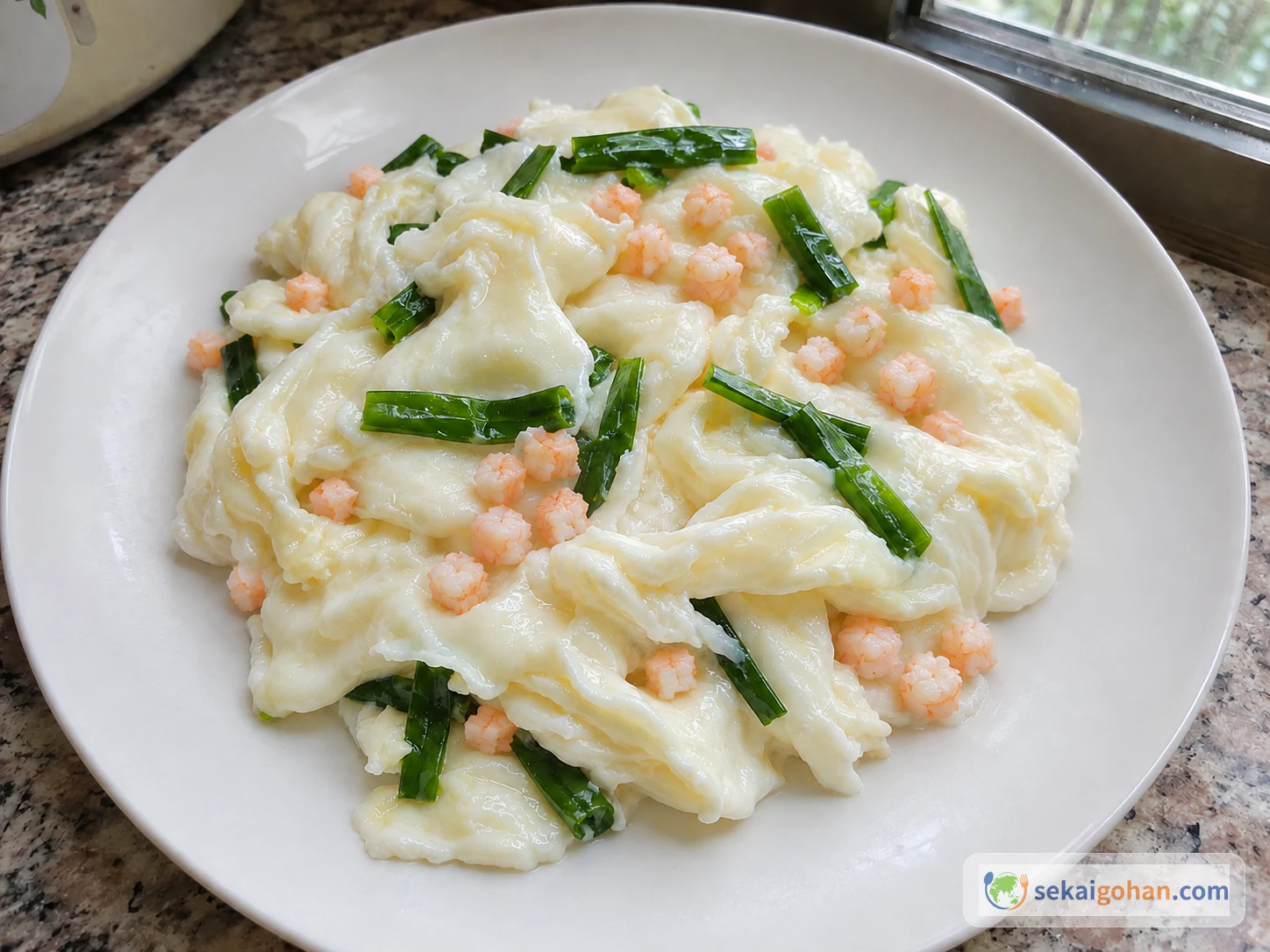
Ingredients
| Ingredient | Amount | Role |
|---|---|---|
| Whole milk (全脂鮮奶), cold | 1⅔ cups (400 ml), divided: scant ½ cup (100 ml) and 1¼ cups (300 ml) | The body of the curd. Its fat and solids are what set |
| Egg whites (蛋白) | from 4 eggs | The second setting agent. Holds the curd together as it heats |
| Peeled raw prawns (去殼生蝦), thawed if frozen | 6½ oz (180 g) | Sweetness, bite and pink color. No seasoning or marinade |
| Cornstarch (粟粉) | scant 1 oz (25 g) | The first setting agent. Thickens the milk so it sets softly |
| Chinese chives (韭菜) | 1¼ oz (35 g) | A green, oniony lift against the white curd |
| Salt | ½ tsp | Seasons the milk mixture |
| Ground white pepper | ¼ tsp | Gentle warmth that keeps the dish white |
| Neutral cooking oil | 2 tbsp, divided: 1 tbsp + 1 tbsp | One spoon for the prawns, one for the milk |
Steps
1Dry and dice the prawns
Lay the thawed raw prawns on kitchen paper and pat them dry on all sides. On the cutting board you keep for raw food, cut them into small pieces of the same size, so every piece cooks at the same pace. Keep this board and knife apart from anything that will touch cooked food, and wash your hands when you finish. The prawns are ready when they sit in a small, evenly cut pile with dry surfaces and no water pooling on the board.
2Wash and cut the chives
Rinse the chives under running water, then shake them well and let them drain. Line up the leaves and cut them into short, even lengths. Keep the full 1¼ oz (35 g) together, because all of it goes back into the pan at the end. You are done when you have a loose pile of bright green, dry pieces with no yellow leaves among them.
3Dissolve the cornstarch in cold milk
Pour scant ½ cup (100 ml) of the cold milk into a small bowl and keep the other 1¼ cups (300 ml) aside. Add all the cornstarch and whisk until every speck has disappeared. The starch always goes into milk first, never straight into the egg whites, or it clumps. The slurry is ready when it is smooth and opaque white, and no grit is left on the bottom when you tilt the bowl.
4Mix in the rest of the milk and the egg whites
Add the remaining 1¼ cups (300 ml) of milk, the egg whites, the salt and the white pepper to the slurry, using a larger bowl if needed. Stir slowly with the whisk to combine without beating air into it. Air bubbles leave holes in the curd. Do not taste this raw egg mixture. Stop when the liquid is thin, still and evenly milky, with only a few small bubbles on the surface and no foam.
5Strain the mixture
Set a fine-mesh sieve over a clean bowl and pour the whole mixture through it. The mesh catches any undissolved starch, stringy bits of egg white and bubbles. Place the bowl next to the stove so it is ready when the pan is. The liquid in the bowl should look smooth and flat, with only a few specks and bubbles left behind on the mesh.
6Heat the pan and the first spoon of oil
Set the non-stick pan over medium heat and let it warm through. Add 1 tbsp of the oil and tilt the pan so a thin film covers the whole base. Keep the heat at medium and do not let the oil smoke. The pan is ready when a thin film of oil covers the base and no smoke rises.
7Cook the prawns through
Add all the prawns and stir-fry for 2 to 3 minutes, until they turn opaque and pink. Push a clean probe thermometer into the thickest piece and check that it reads 167°F (75°C) and holds there for at least 30 seconds. If it falls short, keep stir-frying and measure again. Move the prawns to the clean plate for cooked food. They are done when no grey translucency is left in the center and the reading has held.
8Wipe the pan and switch to low heat
Take the pan off the heat. If water from the prawns has gathered in it, fold a sheet of kitchen paper, grip it with long tongs and wipe the pan dry. Pour the second 1 tbsp of oil around the inside edge of the pan, never into the center. Return the pan to the stove and turn the heat to low. The pan is ready when the oil lies warm and loose around the rim, the flame is small and nothing is smoking.
Turn the heat down before the milk goes inOver high heat the curd turns grainy and water seeps out of it. Turn the heat to low before you pour. Keep the flame small for the rest of the cooking.
9Pour in the milk and push the edges inward
Give the strained mixture one more stir, since the starch settles to the bottom. Pour all of it into the pan. Let it sit on low heat until the rim starts to set. Then slide the silicone spatula under a set edge and push it toward the center, always in the same direction. Never scrape back and forth. You are on track when the rim is matte and thicker, the center is still fluid, and only gentle steam rises with no hard bubbling.
10Fold the curds into soft sheets
Keep pushing in one direction, and as the set curd piles up, fold it gently over itself. This builds broad, tender layers, while chopping or stirring would break it into small bits. Keep folding on low heat until no runny egg white is left in the pan. The curds are done when they are glossy, soft and in wide sheets, and nothing flows when you tilt the pan.
One direction, every timeMoving the spatula one way keeps the set layers whole and stacks them into sheets. Scraping back and forth tears them and lets liquid escape. Push, fold, and push again the same way.
11Fold in the prawns and chives and plate at once
Return all the prawns and all the chives to the pan. On low heat, fold them through gently until the chives soften and no runny white remains anywhere. Probe the thickest piece of curd and a prawn, and make sure each reads 167°F (75°C) for 30 seconds. Slide everything onto the warmed plate straight away, because the curds tighten as they cool. It is ready when the chives are bright green and just wilted and the curd is soft, white and dry at the edges.