Ingredients and steps on one page. Print it, or choose “Save as PDF” in the print dialog.
Sekai Gohan
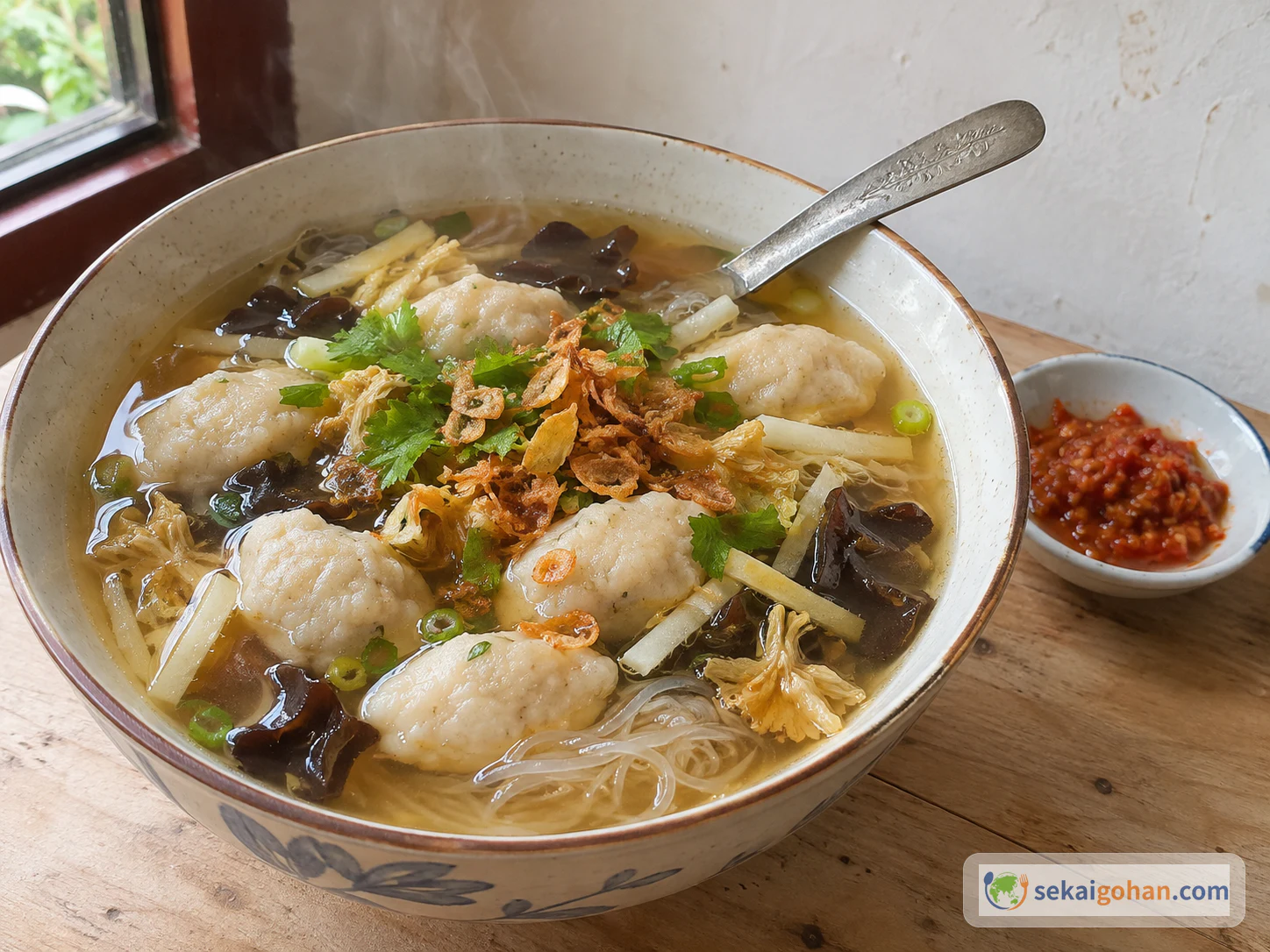
Tekwan: Palembang Fish Balls in Clear Shrimp Broth
Ingredients
| Ingredient | Amount | Role |
|---|---|---|
| Tenggiri or Spanish mackerel fillet (ikan tenggiri), skinned and boned | 9 oz (250 g) | The body and savor of the fish balls |
| Egg white (putih telur) | 1 | Binds the paste and keeps the balls light |
| Salt, for the fish balls (garam) | 1 tsp | Draws out stickiness in the paste and seasons it |
| Sugar, for the fish balls (gula pasir) | 1 tsp | Rounds off the sharp edge of the fish |
| Sago starch (tepung sagu) | 3½ oz (100 g) | The springy bite of the balls |
| All-purpose flour (tepung terigu) | 2 tbsp | Helps the balls hold their shape |
| Ice water (air es) | scant ½ cup (100 ml) | Keeps the paste cold while it is worked |
| Shrimp, peeled weight (udang kupas); keep the shells and heads | 3½ oz (100 g) | Flesh for the broth; shells and heads for the stock |
| Water, for the shrimp stock (kaldu udang) | 6¼ cups (1.5 L) | Becomes the shrimp stock |
| Oil | 2 tbsp | For frying the garlic and shrimp |
| Garlic (bawang putih) | 4 cloves | The aromatic center of the broth |
| Dried shrimp (ebi) | 1 tbsp | Salt and a deep shellfish note |
| Ground pepper (merica bubuk) | 1 tsp | Gives the broth an edge |
| Sugar, for the soup | 2 tsp | Softens the salt |
| Stock powder (kaldu bubuk) | 1 tbsp | Adds savory depth |
| Salt, for the soup | 2 tbsp | Seasons the broth; add 1 tbsp first, then taste |
| Wood ear mushrooms (jamur kuping), dried | 4 | Crisp, snappy bite |
| Dried tuberose flowers (bunga sedap malam) | 20 | A soft floral scent; optional |
| Jicama (bengkuang), cut into thin matchsticks | 5 oz (150 g) | Juicy crunch |
| Glass noodles (suun) | 1¾ oz (50 g) | Bed at the bottom of each bowl |
| Fried shallots (bawang merah goreng) | 5 tbsp | Toasty crunch on top |
| Celery, chopped (seledri) | 2 tbsp | Green, fresh smell |
| Spring onion, sliced (daun bawang) | 5 tbsp | Bite and color |
| Bird's-eye chili sambal (sambal rawit) | to taste | Heat at the table |
Steps
1Make a cold fish paste
Cut the skinned, boned fish into ¾-inch (2 cm) cubes and pat them dry with paper towels. Put them in the food processor with the salt and sugar for the balls, the egg white and half the ice water. Run the processor for 30 seconds, stop, and repeat for about 2 minutes in total. If the paste feels warm and slack, chill the processor bowl in the refrigerator for 10 minutes. It is ready when it is pale, glossy and sticky enough to cling to your finger.
2Work in the starch
Move the paste to a mixing bowl. Add the sago starch and flour in two additions, folding with a rubber spatula. Add the rest of the ice water a little at a time to adjust the softness. Stop as soon as no dry powder remains, because working it longer packs the balls hard and dense. The dough is right when a spoonful dropped back into the bowl holds a mound and a fingertip pressed in springs back slowly.
3Shape small ovals
Wet your hands and set a plate beside you, lightly wetted. Scoop about 2 teaspoons of dough, squeeze it gently and smooth it into a thumb-sized oval. Line the ovals up on the plate as you go. Larger balls are slow to cook through, and smaller ones shrink in the soup. Each one should be smooth with no cracks and keep its shape when you tilt the plate.
4Poach the balls
Bring a large pot of water, enough to cover the balls, to a boil. Drop the balls in. If hard boiling knocks them apart, turn off the heat while you add them and turn it back on once they are all in. When they float, keep them boiling for 1 to 2 more minutes. They are done when a ball springs back under a fingertip and one cut open is white all the way through. Lift them out with a slotted spoon and discard the water, which holds the fishy smell.
Floating is not the finish lineA ball floats when the dough lightens, before the center is necessarily cooked. Give it the extra minutes after it floats, and check that the center reaches 167°F (75°C) for 1 minute.
5Make the shrimp stock
Put the shrimp shells and heads in a deep frying pan and cook them, stirring, until they turn orange. Pour in the water and keep it at a gentle simmer so the stock stays clear. If you have only a few shells, top the water back up to the full 6¼ cups (1.5 L). Strain through a fine-mesh strainer into a heatproof bowl. You want a pale orange stock that stops just short of cloudy. A harsh, bitter taste means it simmered too long.
6Build the broth
Chop the garlic, the peeled shrimp and the soaked dried shrimp. Heat the oil in the soup pot and fry the garlic over low heat until fragrant. Add the shrimp and dried shrimp and fry until the shrimp turn pink. Pour in the stock and season with the soup sugar, pepper, stock powder and 1 tbsp of the salt, then taste and add the rest of the salt only as needed. Hold it at a gentle simmer and skim off any scum. It should taste of salt first, then the sweetness of shrimp.
Salt in two stagesThe full 2 tbsp of salt is a lot for this much broth, and the dried shrimp and stock powder bring salt of their own. Salting halfway, then tasting, is how you keep the broth clean and sweet with shrimp.
7Add the vegetables, then the balls
Drain the wood ear and tear any large pieces. Drain the tuberose flowers and tie each into a knot. Add both to the broth with the jicama and simmer until the vegetables soften. Slip in the poached balls last and heat them for 2 to 3 minutes. The soup is ready when the jicama turns translucent but still crunches and the wood ear is plump.
8Assemble the bowls
Soak the glass noodles in boiling water until soft, drain them well and divide them among the bowls. Add the balls and vegetables, then ladle in the hot broth. Scatter the fried shallots, celery and spring onion just before eating so they stay crisp and bright, and put the sambal on the table. The bowl is right when the noodles turn clear as they drink the broth. Keeping the noodles out of the pot also stops them from swelling in any leftovers.