Ingredients and steps on one page. Print it, or choose “Save as PDF” in the print dialog.
Sekai Gohan
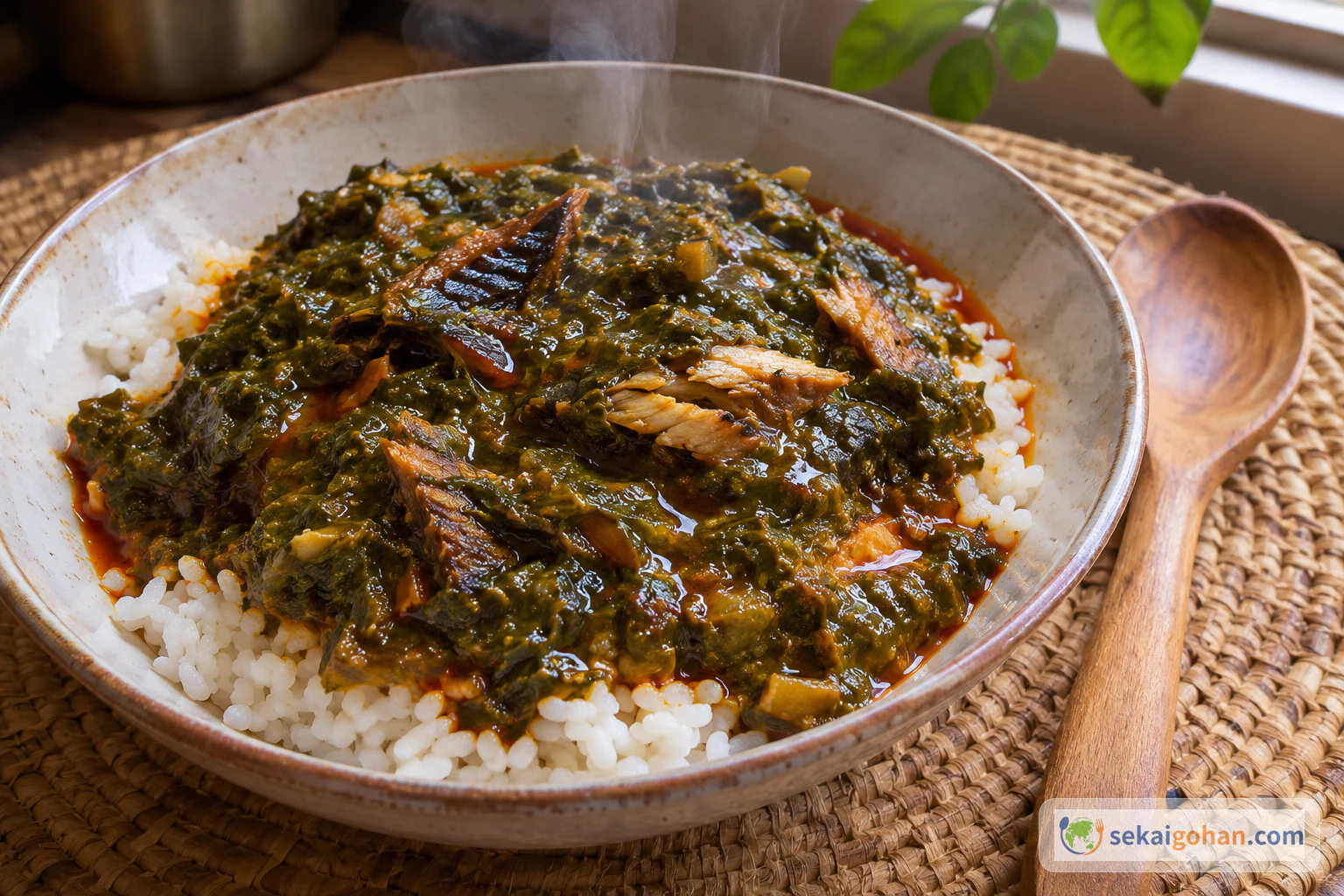
Plasas: Gambian Sweet Potato Leaf Stew with Palm Oil
Ingredients
| Ingredient | Amount | Role |
|---|---|---|
| Sweet potato leaves (potato leaves) | as needed | The body of the stew; chopped and washed |
| Meat (beef works well) | as needed | Steamed first; gives the pot its savory base |
| Water | a little | For steaming the meat |
| Peanut powder, unsweetened | as needed | Thickens and binds the leaves and liquid |
| Bitter tomato (jahatu) | as needed | Bitter accent |
| Hot pepper | to taste | Heat; part goes into the pot, part into the pounded paste |
| Locust beans | a little | Fermented depth in the pounded paste |
| Spring onion | as needed | Fresh aroma in the pounded paste |
| Smoked stingray fish | as needed | Smoke and savory depth while the pot reduces |
| Smoked fish | as needed | Smoke and saltiness at the finish |
| Red palm oil | as needed | Color and the signature aroma |
| Seasoning cube | to taste | Salt and stock flavor at the finish |
| Salt | to taste | Final seasoning |
| Cooked white rice | as needed | To serve |
Steps
1Wash and steam the meat
Cut the meat into bite-size pieces and wash it under cold running water. Put it in the heavy pot with a little water, cover, and set it over gentle heat. Let it steam in its own juices and that small amount of water. It is ready for the leaves when steam escapes steadily from under the lid and the outside of the meat has turned from red to grey-brown.
2Chop and wash the leaves
While the meat steams, cut the sweet potato leaves finely on a board. Put them in a large bowl of cold water, swish them with your hands, and lift them out into a colander. Repeat with fresh water until no grit settles at the bottom of the bowl. They are ready when the last rinse water stays clear and the leaves look bright and clean.
3Add the leaves to the steaming meat
Lift the lid and tip the chopped leaves straight onto the meat while the pot is still steaming. Keep the meat and its liquid in the pot. Turn the leaves over with a wooden spoon so the ones at the top reach the heat. Move on when the heap has collapsed into the pot and the leaves have turned a deeper, darker green.
4Add peanut powder, bitter tomato and hot pepper
Loosen the peanut powder with a ladle of liquid from the pot in a small bowl. Stir it into the leaves with the bitter tomato and part of the hot pepper. Keep the pot cooking and stir from the bottom now and then so the peanut does not catch. The sauce is on its way when the clear green liquid turns cloudy and pale and begins to cling to the spoon.
Loosen the peanut firstDry peanut powder dropped straight into the pot forms lumps that stay floury inside. Stirring it smooth with a little hot liquid from the pot first lets it melt evenly into the leaves.
5Pound the pepper paste
While the pot cooks, put the remaining hot pepper, the locust beans and the spring onion in a mortar. Pound until everything breaks down and gathers into one coarse paste. A blender does the same job; pulse it rather than running it smooth. The paste is ready when it is green-brown, slightly wet, and smells sharp and fermented.
6Add the smoked stingray
Rinse the smoked stingray under running water and break it into pieces. Add it to the pot and stir it through the leaves. Let the pot keep cooking so the liquid reduces around the fish. Move on when the smell of smoke rises with the steam and the stew looks glossy rather than watery.
7Stir in the paste when the water has gone
Keep cooking until the water in the pot has evaporated. Scrape the pounded paste into the pot and stir it through evenly. Let it cook for a few minutes. It is right when the raw bite of the spring onion has softened in the aroma and a spoon drawn across the bottom leaves a line that slowly closes.
Wait for the water to goThe paste goes in only after the liquid has cooked away. Added to a watery pot, its sharp, fermented flavor is diluted and the sauce stays thin.
8Finish with palm oil, smoked fish and seasoning
Pour in the red palm oil, then add the smoked fish, broken into flakes, and the seasoning cube. Stir once and taste before adding any salt, then season with salt to taste. It is done when an orange-red sheen spreads across the surface and the oil no longer looks separate from the leaves; spoon it over hot white rice.
Salt goes last for a reasonSmoked fish, smoked stingray and the seasoning cube all bring salt. Tasting after they are in, and before the salt, keeps the pot from tipping over.