Ingredients and steps on one page. Print it, or choose “Save as PDF” in the print dialog.
Sekai Gohan
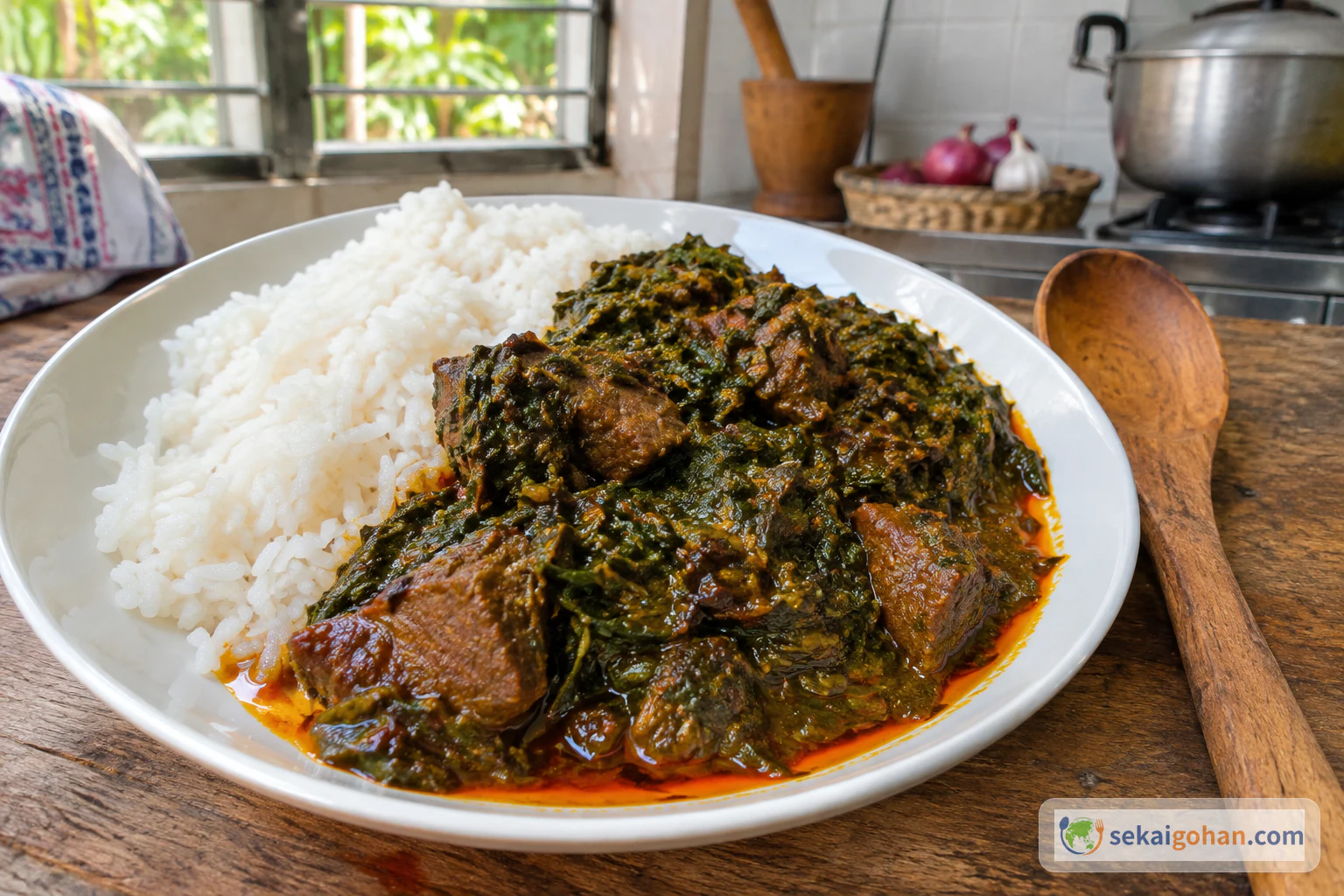
Bawin Sauce: Western Ivorian Cassava Leaves in Palm-Nut Juice
Ingredients
| Ingredient | Amount | Role |
|---|---|---|
| Fresh or frozen cassava leaves (feuilles de manioc) | 1.1 lb (500 g) | The body and the green flavor of the sauce |
| Baking soda | 1 tsp | Goes into the water for boiling the leaves |
| Fresh palm nuts (noix de palme), or palm-nut juice concentrate | 2.2 lb (1 kg) | Their juice is the base of the sauce |
| Beef, goat or chicken | 1.1 lb (500 g) | The meat in the sauce |
| Onions | 2 medium | Sweetness and aroma |
| Garlic | 4 cloves | Aroma |
| Ginger | a 1¼-inch (3 cm) piece | Warmth and aroma |
| Oil | 2 tbsp | For browning the meat and aromatics |
| Bouillon cube | 1 | Savory depth |
| Bay leaves | 2 | Aroma during the simmer |
| Black pepper | 1 tsp | Seasoning at the end |
| Salt | to taste | Seasoning |
| Water | up to 2½ cups (600 ml) | Loosens the sauce during the simmer |
| White rice | as needed, for serving | Served alongside |
Steps
1Strip and wash the cassava leaves
Pull the thick stems off the cassava leaves and cut out the heavy central veins. Wash the leaves in several changes of cold water, lifting them out each time so any grit stays behind. Shake them dry. Stop when only the soft green blades remain in a loose pile.
2Pound the leaves to a paste
Put the leaves in the mortar in batches and pound them for 20 to 30 minutes, scraping the sides down now and then. Pounding breaks the fibers so the leaves can melt into the sauce later. If you have no mortar, chop the leaves very finely with a knife or pulse them in a blender. The leaves are ready when they form a coarse, damp green paste with no whole pieces of leaf left.
Pounding decides the textureBawin should eat as a creamy sauce, not as strands of greens. A little more time with the pestle now gives a smoother pot later.
3Boil the leaves in baking-soda water and squeeze them
Bring a large pot of water to a boil and stir in 1 tsp baking soda. Add the pounded leaves, stir to break up clumps, and boil for 10 minutes. Drain in a colander and discard the water. Once the leaves are cool enough to handle, squeeze them out a handful at a time. Stop when you have a dense green mass that no longer drips.
4Make the palm-nut juice
Boil the fresh palm nuts for 30 to 40 minutes. Drain them and crush them to free the pulp from the nuts. Then press everything through a fine sieve into a bowl and discard the fibers and nuts. If you are using concentrate, loosen it with hot water instead. You want a thick, bright orange juice.
5Brown the meat
Cut the meat into chunks and season it with a little salt. Heat 2 tbsp oil in the heavy pot until it shimmers. Brown the meat in batches so the pieces sear instead of steaming, then lift them onto a plate. Move on when every side is golden-brown and the fat in the pot smells toasty.
Hot oilLay the meat into the oil away from you and pat the pieces dry first. Wet meat spatters.
6Cook the onion, garlic and ginger, then return the meat
Chop the onions and add them to the same pot. Stir them through the fat and scrape up the browned bits, and cook until they are soft and translucent. Add the minced garlic and ginger and stir until they smell fragrant, without letting them brown. Return the meat and its juices to the pot. The onions should smell sweet and the raw sharpness of the garlic should be gone.
7Simmer the meat in the palm-nut juice
Pour in the palm-nut juice, add the bay leaves and crumble in the bouillon cube. Add the water a little at a time, up to 2½ cups (600 ml), keeping the sauce loose. Bring it to a boil, then lower the heat to a steady simmer and cook for 30 minutes, stirring along the bottom now and then.
8Add the leaves and simmer until creamy
Stir in the squeezed leaves, breaking up the clumps so they spread through the juice. Simmer for another 30 to 40 minutes, stirring from the bottom every so often, and add a splash of water if it starts to stick. Do not cut this time short. Stop when the leaves are completely tender and the sauce is thick and creamy, with no separate streaks of green and orange.
Stir along the bottomOnce the leaves go in, the sauce thickens and settles. Drag the spoon across the whole base of the pot each time you stir. A scorched layer at the bottom will flavor the entire pot.
9Season and serve hot with rice
Fish out the bay leaves. Stir in 1 tsp black pepper, then add salt a little at a time, tasting as you go, because the bouillon has already salted the pot. Spoon the sauce hot beside white rice. It is ready when it is creamy and falls slowly from the spoon.