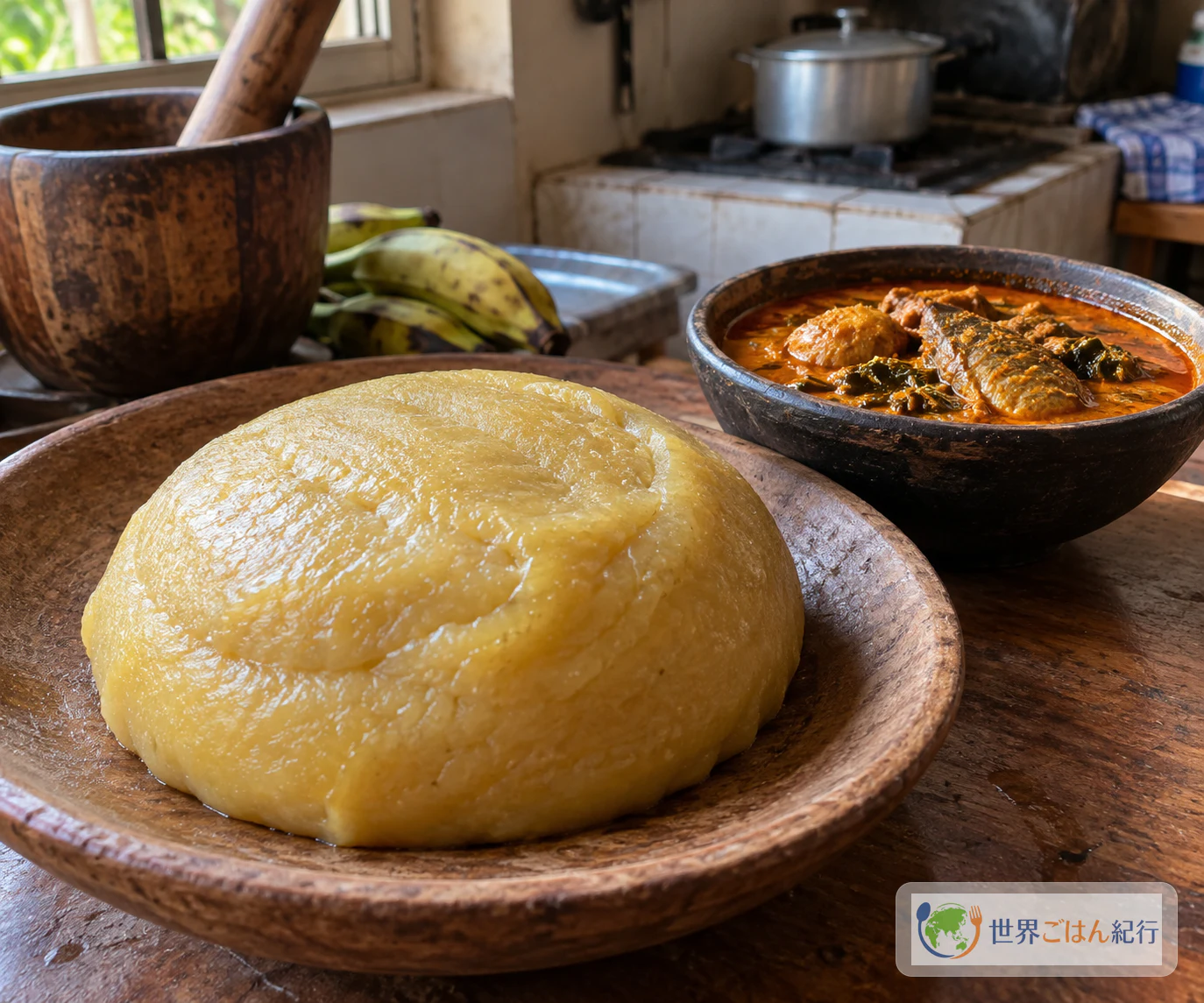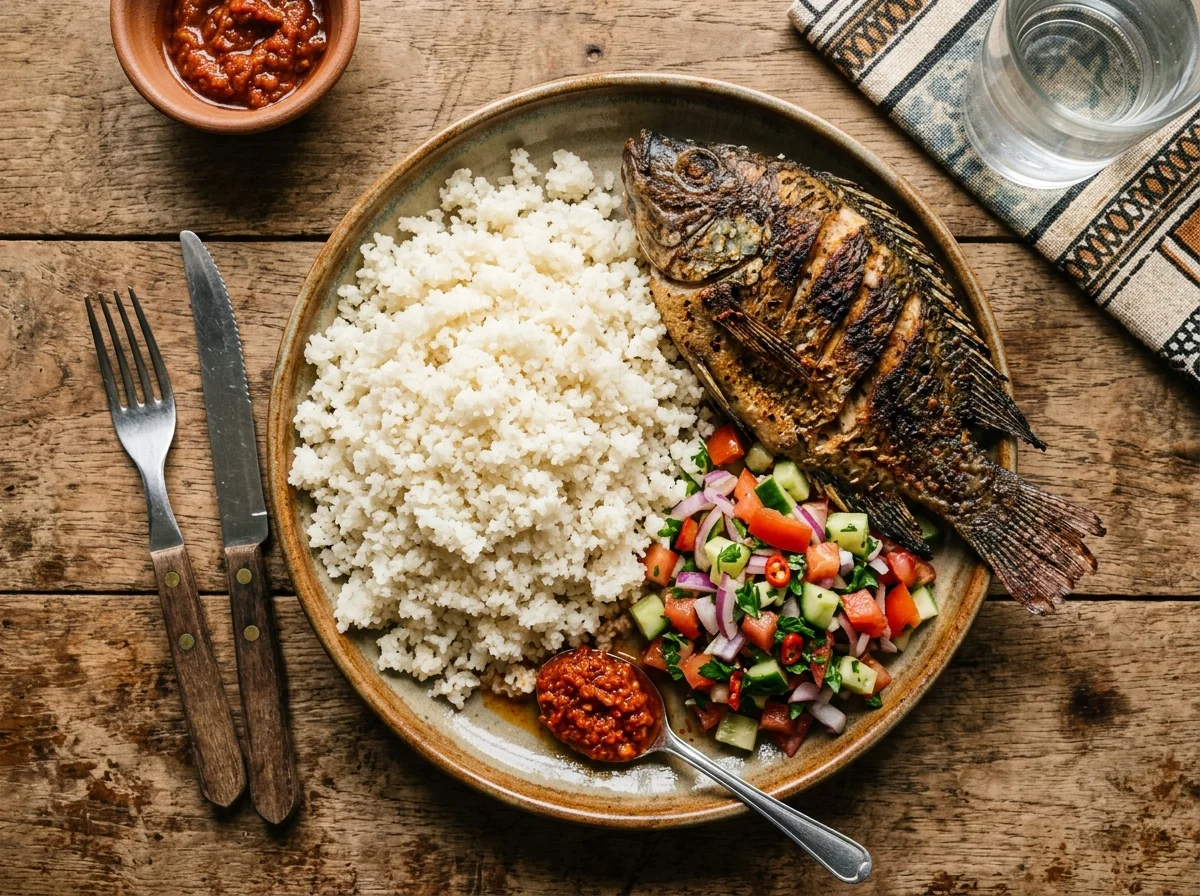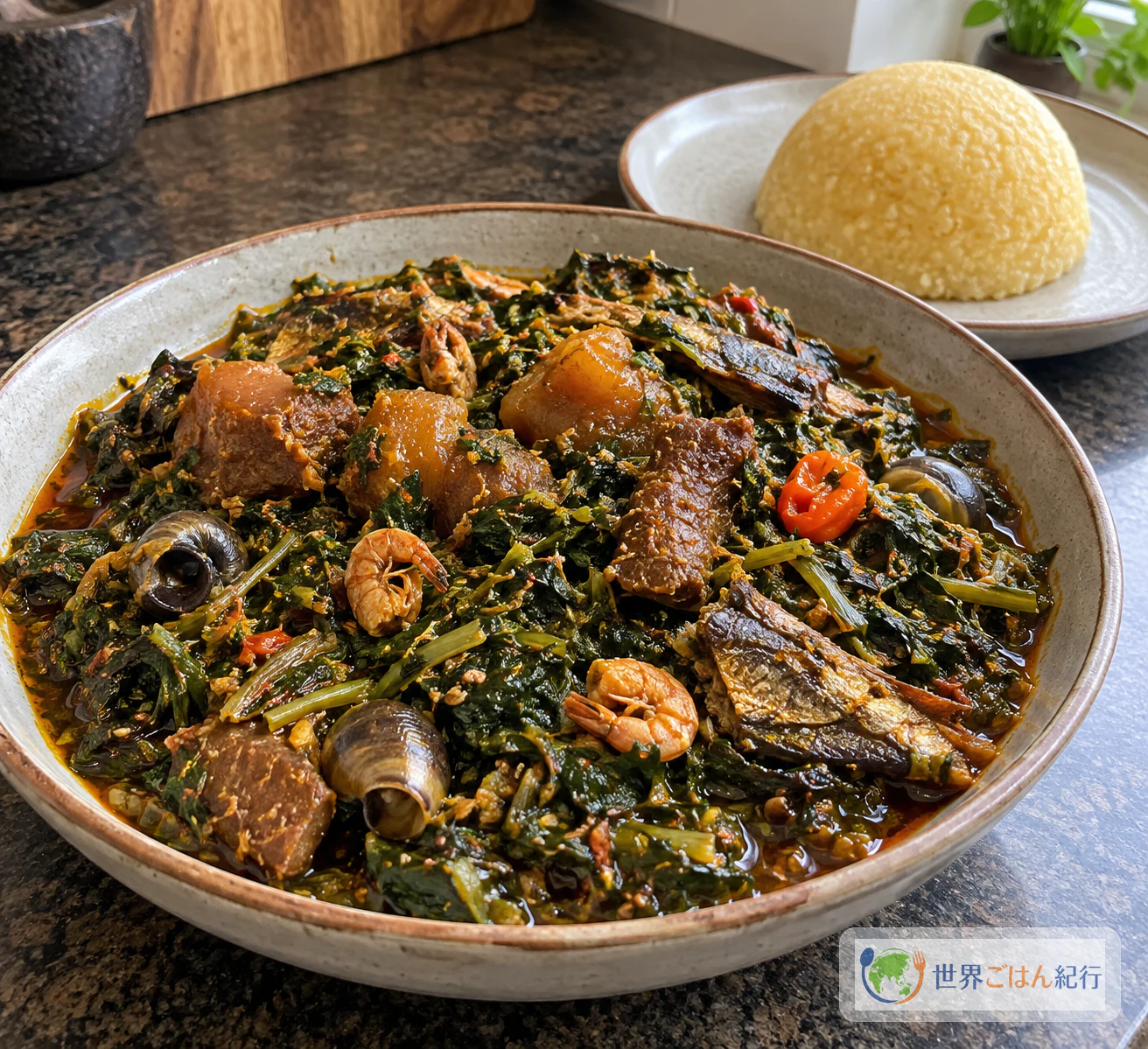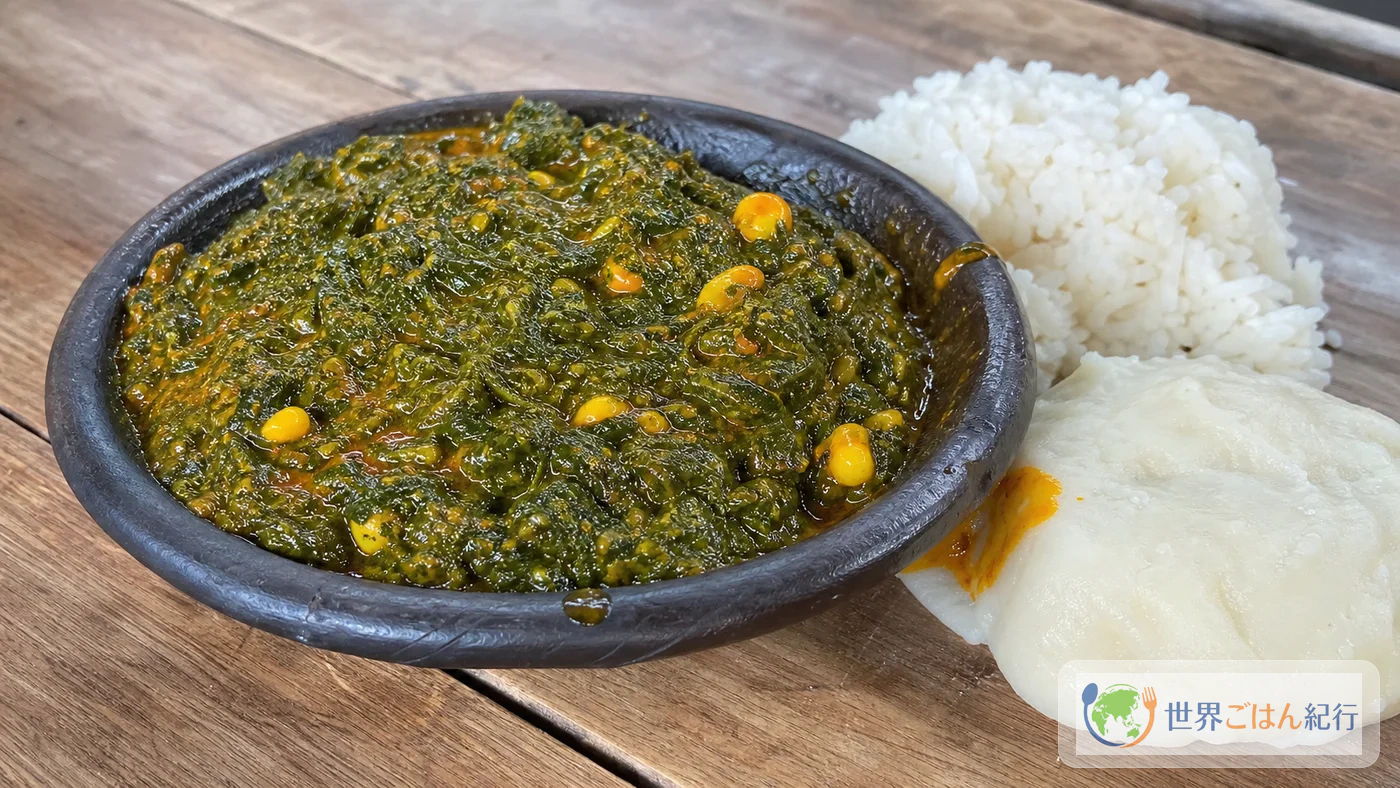
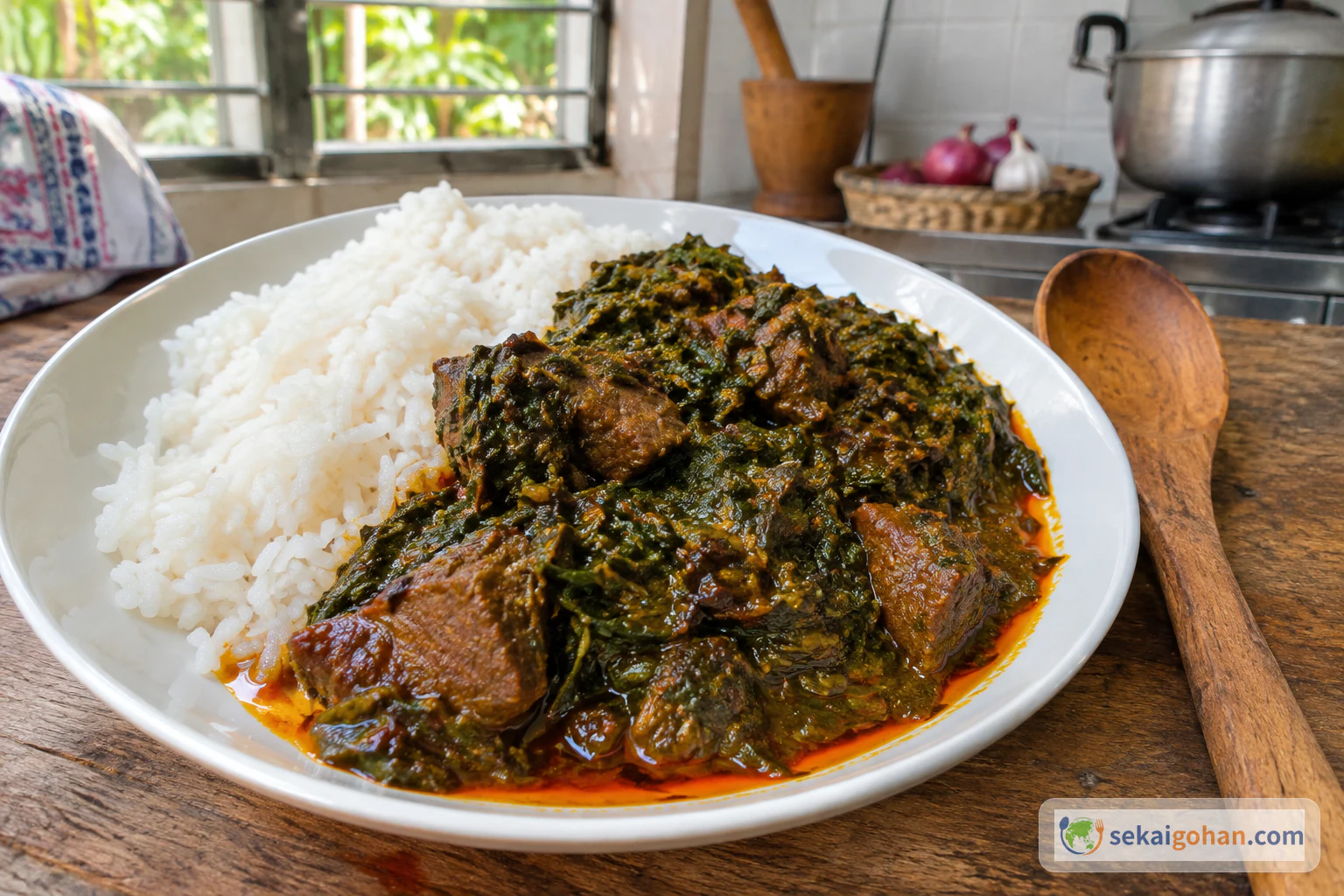
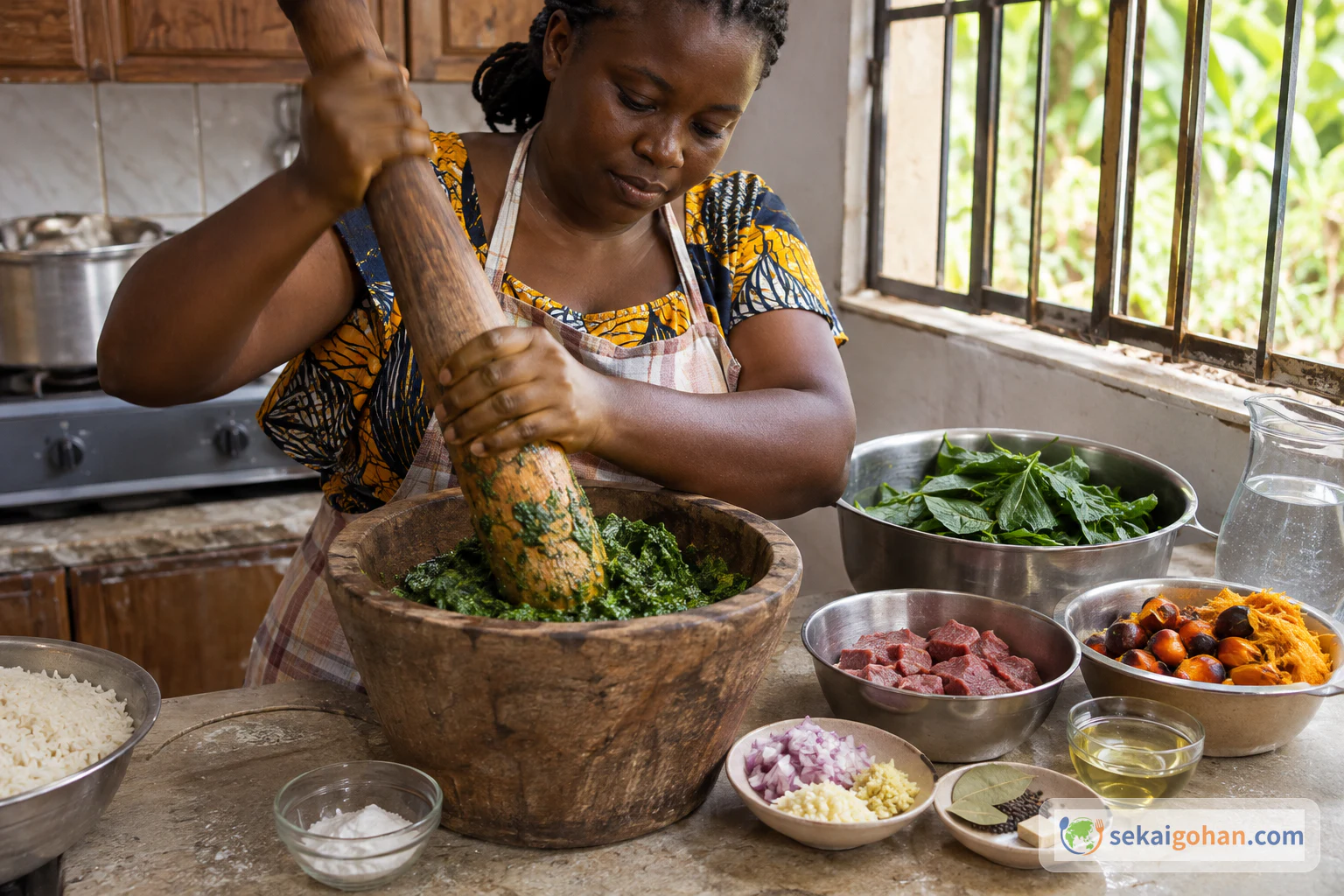
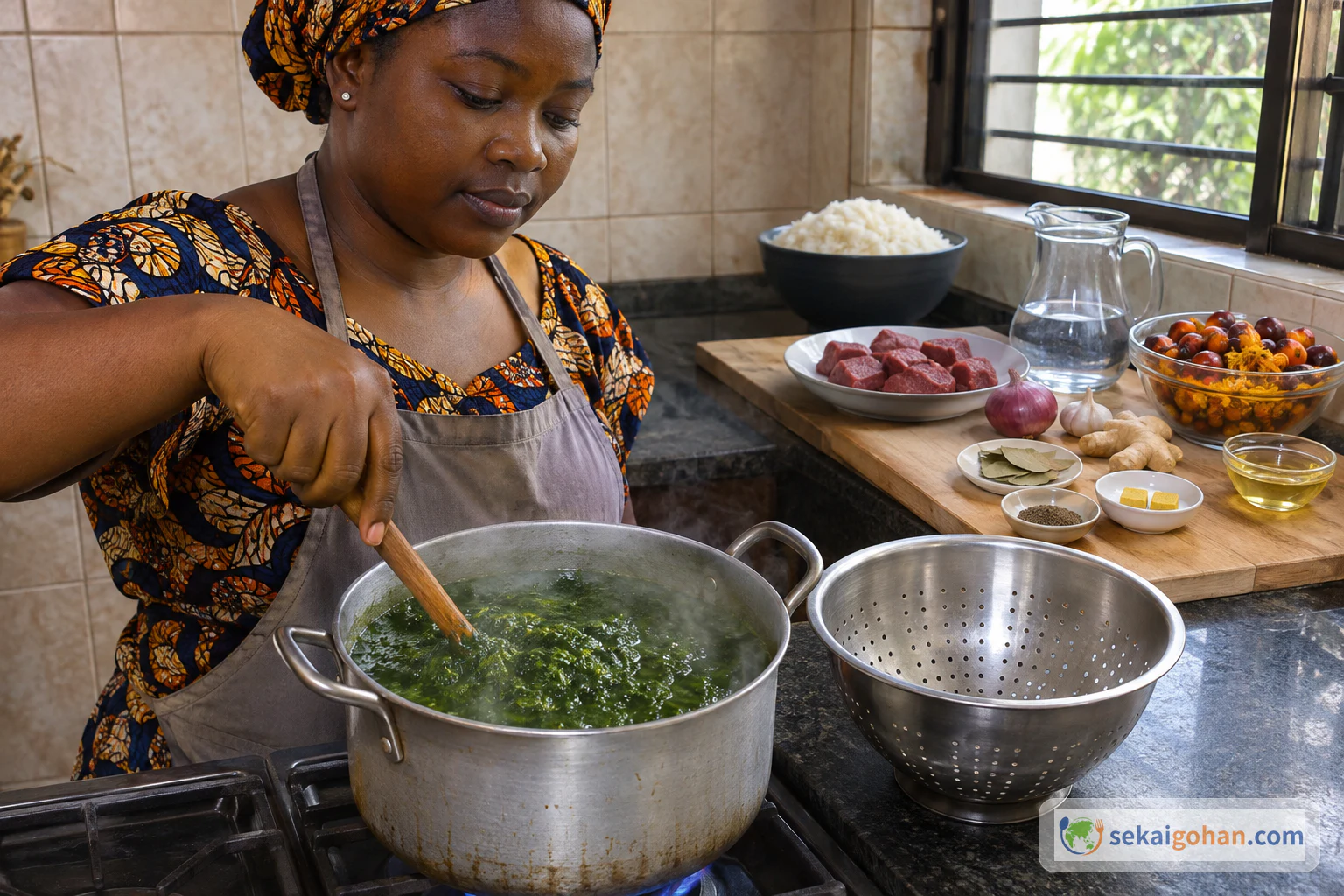
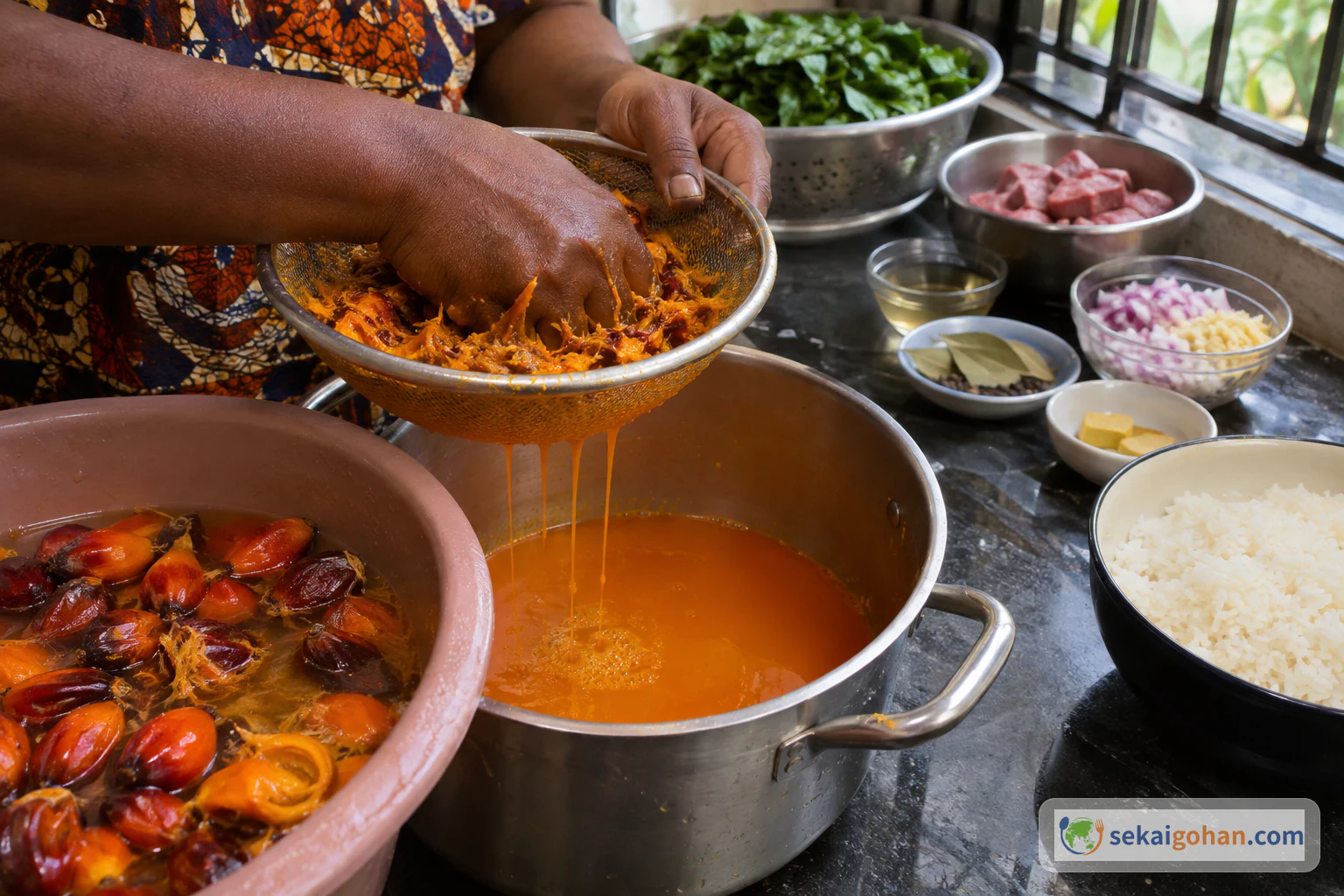
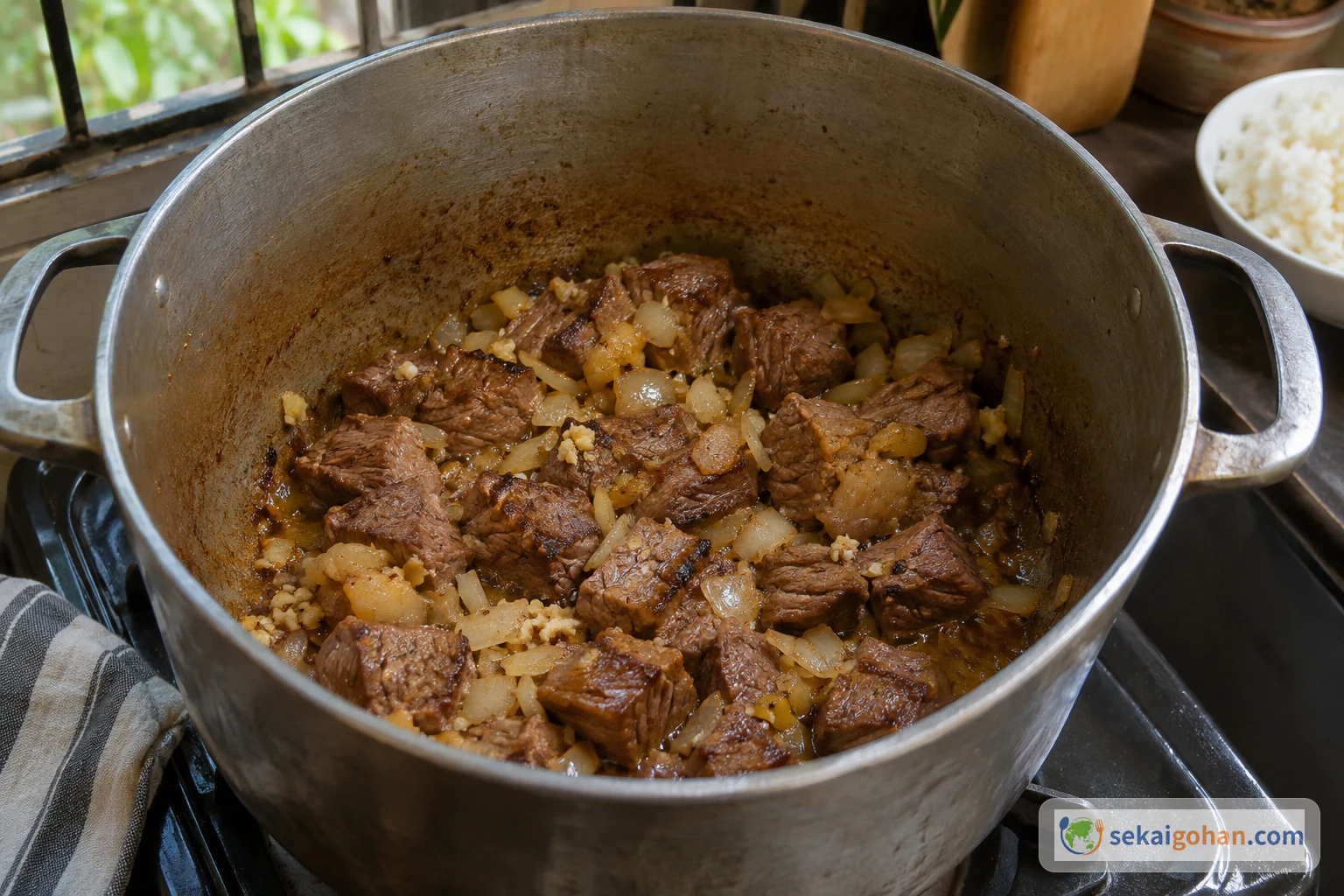
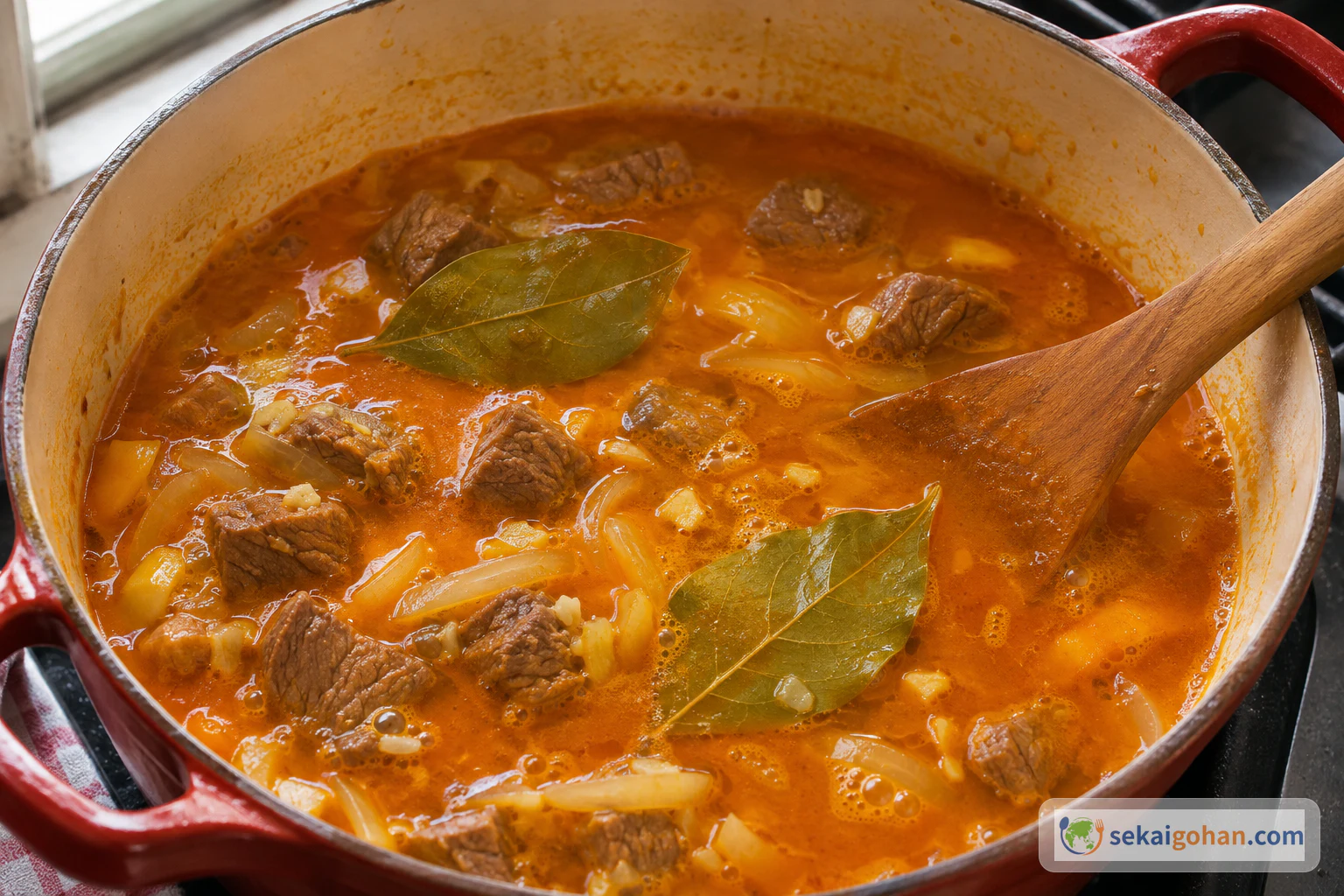
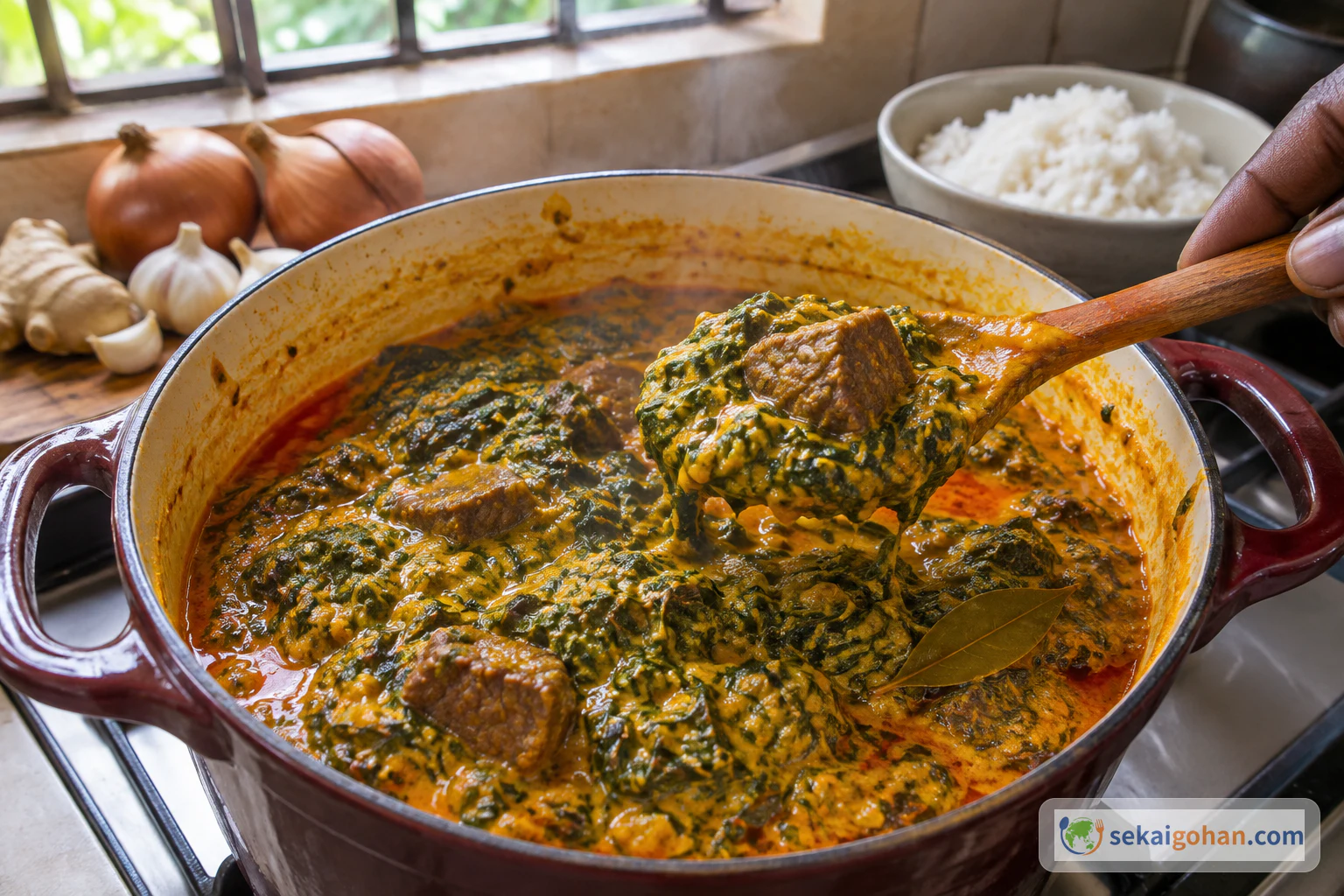
The pounded leaves go into the pot as a dense, damp green mass. Then they slowly dissolve into the orange palm-nut juice until the colors merge and the sauce turns thick and creamy around the chunks of browned meat. Bawin sauce is the cassava-leaf sauce of western Côte d'Ivoire. It is spooned hot beside white rice. The flavor is deep and green, with the round, fruity richness of fresh palm nuts and the savory weight of meat simmered for an hour or more.
The Guéré Leaf Sauce of the Far West
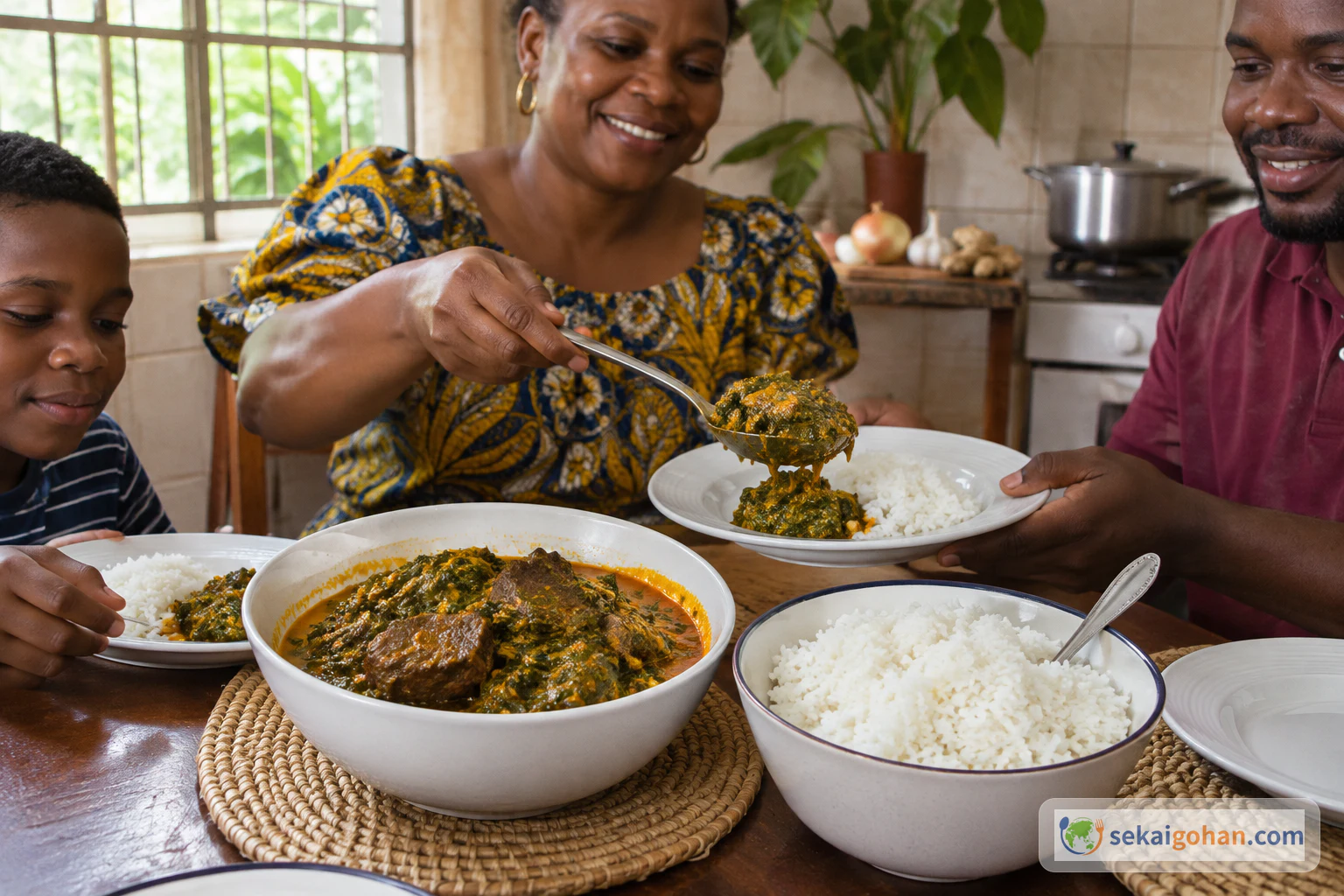
Bawin belongs to the Guéré people of western Côte d'Ivoire, in the Cavally region. It is named as a dish of the west within the Ivorian kitchen. There it is eaten as a leaf sauce with rice: a mound of plain white grains on one side and a generous ladle of dark green sauce on the other, each mouthful taking a little of both. Some households also serve it with maize couscous.
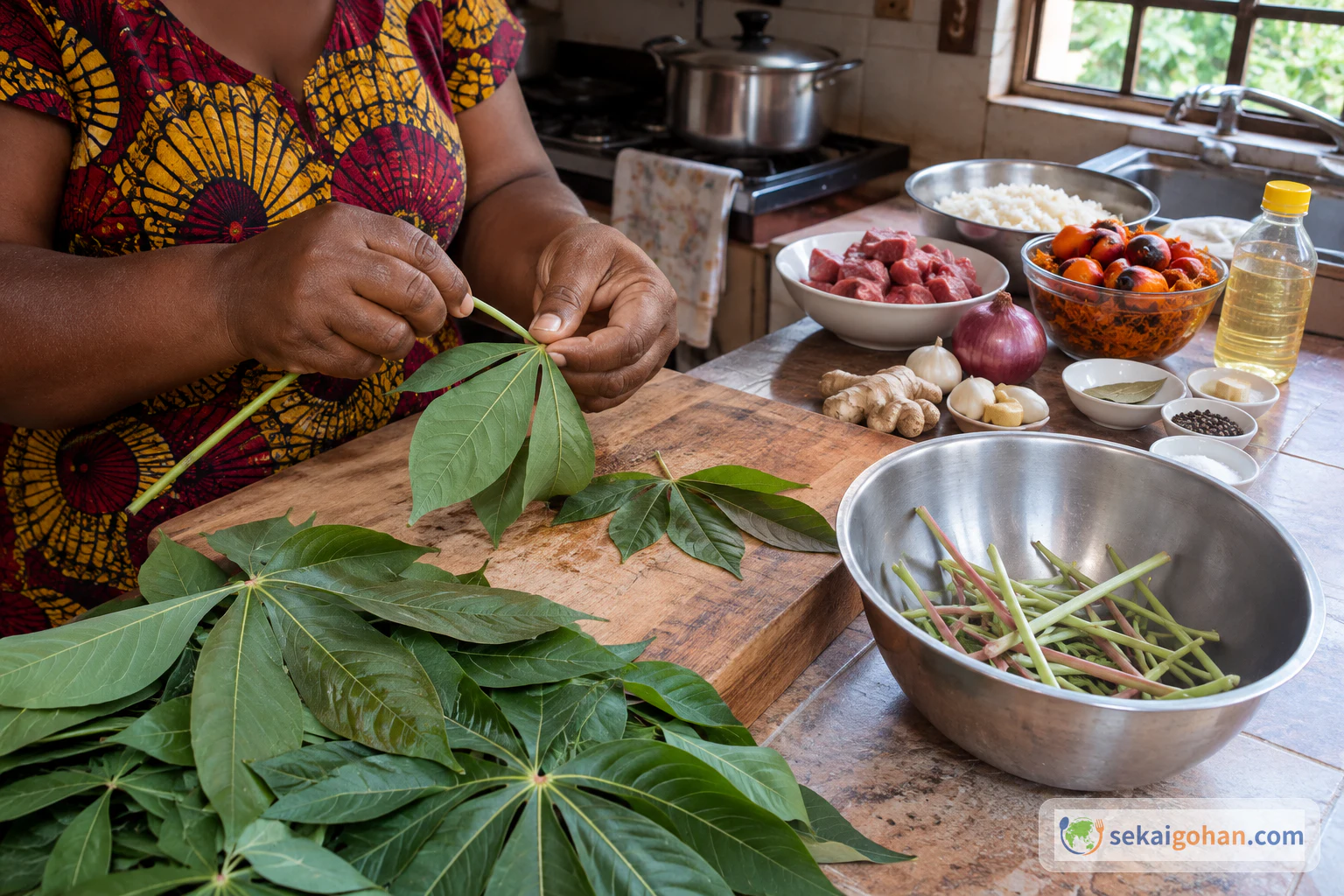
The usual base is cassava leaves pounded to a paste and simmered in the juice pressed from palm nuts, with meat, onion, garlic and stock. Beyond that, households differ. Dried or smoked fish often goes in for a deeper, smokier taste, and chili is common. Some cooks thicken the sauce with peanut paste instead of palm juice. Others make a richer pot with smoked beef, smoked fish and crab. Bawin is also cooked and sometimes labeled as a Cameroonian dish. The name is Guéré, and the dish is usually traced to the west of Côte d'Ivoire, but exactly where it began is not settled.
Sierra Leone has its own cassava leaf stew, made with red palm oil, peanuts and smoked fish. Bawin builds its sauce on the juice of the fruit itself, so the green of the leaves stays in front and the sauce comes out creamy.
In the Guéré language, ba means cassava and win means leaf, so "bawin" is simply "cassava leaves." You will see it written bawin, bawoin or baouin, and in French as sauce bawin.
Ingredients (serves 4)
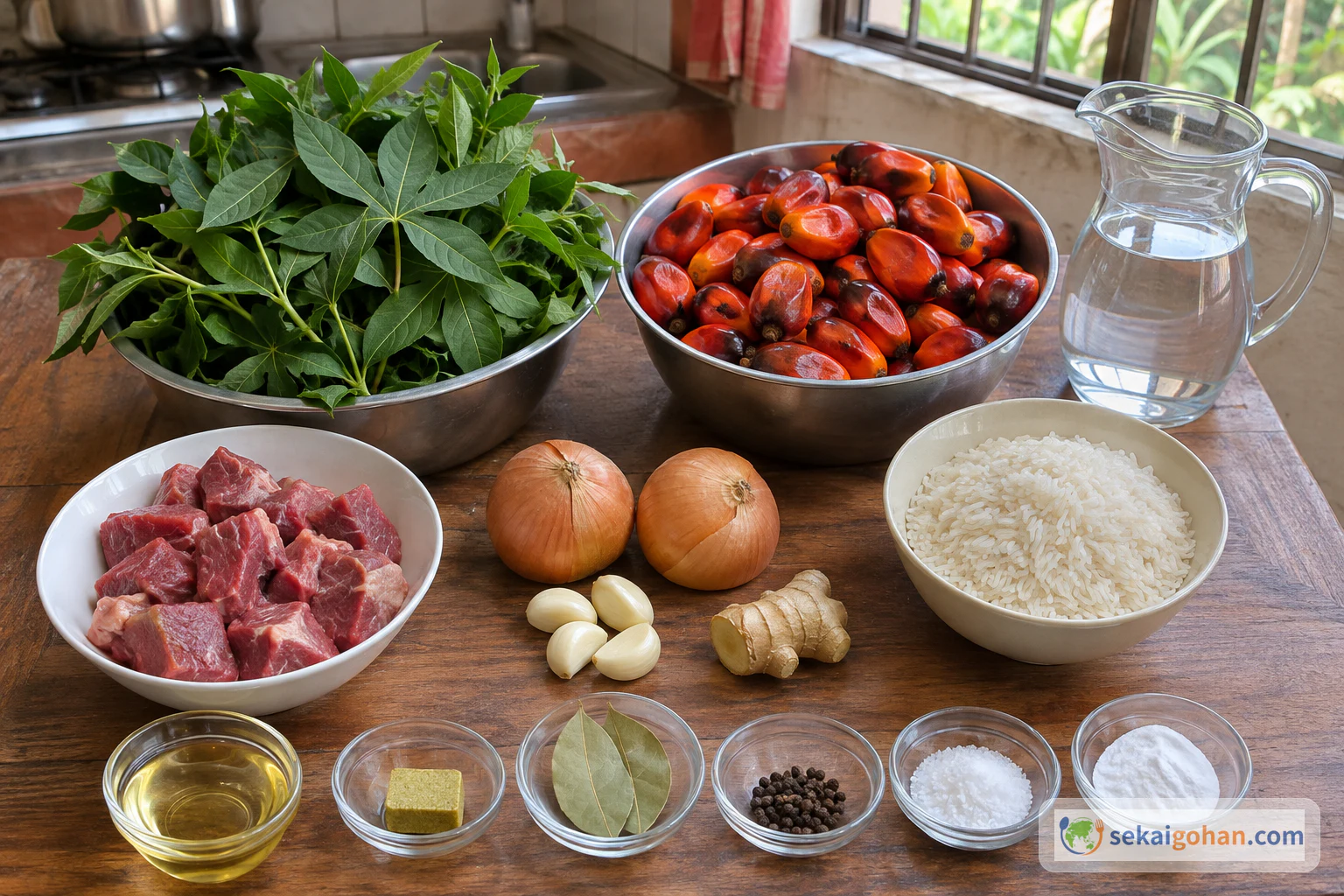
Bouillon cubes often contain wheat, soy, celery or milk. Check the label. If you make the peanut version described under variations, the sauce contains peanuts. The smoked-fish and crab versions contain fish and shellfish.
Equipment
- Large mortar and pestle, a blender, or a sharp knife and board
- Large pot for boiling the leaves
- Colander
- Fine sieve and a bowl, for the palm-nut juice
- Heavy pot for the sauce
- Wooden spoon
Buying Cassava Leaves and Palm Nuts Outside West Africa
Fresh cassava leaves are hard to find outside the tropics. Frozen cassava leaves from African or international grocers are the practical buy. Whatever state they come in, they still get the boil in baking-soda water and the full simmer. Fresh palm nuts are rarer still, so most cooks abroad use canned palm-nut concentrate (sold as canned palm fruit or palm sauce). How rich and thick the sauce turns out depends on how concentrated the can is, so loosen it with hot water until it pours like a thick juice.
For the meat, beef is the easiest choice. Goat gives a gamier, deeper sauce, and chicken gives a lighter one. Serve plain, unperfumed white rice. Long-grain rice keeps the grains separate under the sauce, while short-grain rice is stickier and changes how each mouthful eats.
| Keep this for the dish to taste like bawin | You can let this go |
|---|---|
| Cassava leaves, pounded and simmered | Which meat you use |
| Palm-nut juice as the base (fresh or canned) | Fresh nuts, if canned concentrate is all you can find |
| A long simmer after the leaves go in | The type of white rice |
Spinach, kale and other greens make a pleasant green stew, but it is a different dish. Track down the cassava leaves first. If you can't get them, make something else tonight.
Method
Prepare the leaves first, because they take the longest hands-on work. Strip, pound and boil them, then squeeze them dry and set them aside. While they wait, make the palm-nut juice and brown the meat. The last hour is mostly hands-off simmering, with a stir now and then so the thick sauce doesn't catch on the bottom.
Cassava leaves contain cyanogenic glycosides. Pounding and long cooking reduce them, but even boiled leaves keep some. Never eat the leaves raw. Always pound or finely chop them, boil them, and throw away the boiling water. Give the sauce its full simmering time, and eat it as a sauce in ordinary portions with rice rather than in large amounts every day.
When It Goes Wrong
| What you see | Why | What to do |
|---|---|---|
| The sauce sticks or smells scorched | The heat is too high, or the bottom wasn't stirred after the leaves went in | Move the sauce to a clean pot without scraping up the burnt layer, add a splash of water and simmer gently |
| The leaves stay fibrous | They weren't pounded enough, or the simmer was cut short | Keep simmering, stirring often, until the leaves are completely tender |
| The sauce stays thin and watery | Too much water, or the leaves weren't squeezed dry | Simmer uncovered and stir until it thickens to a creamy sauce |
| Canned concentrate makes the sauce heavy and cloying | The can is very concentrated | Loosen it with hot water before it goes into the pot, and add more water during the simmer |
| The sauce tastes flat | It needs salt | Add salt a pinch at a time at the end and taste after each addition |
Serving, Variations and Storage
At the table
Bawin is a main dish. Serve it with a bowl of plain white rice and let everyone spoon sauce over their own portion, or serve it with maize couscous. The sauce is rich enough that rice is all it needs.
Variations
- Peanut paste instead of palm juice. Dissolve peanut paste into the pot, simmer for 30 minutes, then add the leaves and cook until thick. The sauce turns nutty and heavier, and it loses the fruity color of palm.
- Smoked meat, smoked fish and crab. Cook these in plenty of palm-nut juice and add the leaves in several batches. The sauce becomes deeply smoky and richer.
- Dried or smoked fish with the meat. A piece added to the pot gives a savory, smoky background without changing the base. Add it to taste.
- Chicken or goat instead of beef. Chicken makes a lighter sauce. Goat makes it gamier.
Storage and reheating
Bawin is just as good reheated the next day. Let leftovers cool, then refrigerate them promptly in a covered container. To serve, reheat the sauce in a pot until it is bubbling hot all the way through, stirring from the bottom and adding a splash of water if it has thickened.
Frequently asked questions
Is bawin sauce Cameroonian or Ivorian?
It is cooked in both countries, and some recipes call it Cameroonian. The name comes from the Guéré language of western Côte d'Ivoire, and the dish is usually traced there. Where it was first made is not settled.
Can I use spinach if I can't find cassava leaves?
You can cook a good green stew with spinach in palm-nut juice, but it will taste and eat like a different dish. Spinach is soft and mild and collapses quickly, while cassava leaves give bawin its deep green flavor and creamy body after the long simmer. Look for frozen cassava leaves at an African or international grocer.
Is a blender as good as a mortar?
A blender or very fine chopping breaks the leaves down well enough to make the sauce. Pounding crushes the fibers rather than cutting them, which gives the smoothest result. Either way, the leaves still get the 10-minute boil and the full simmer.