Ingredients and steps on one page. Print it, or choose “Save as PDF” in the print dialog.
Sekai Gohan
Paomo: Xi'an Lamb Soup with Torn Flatbread
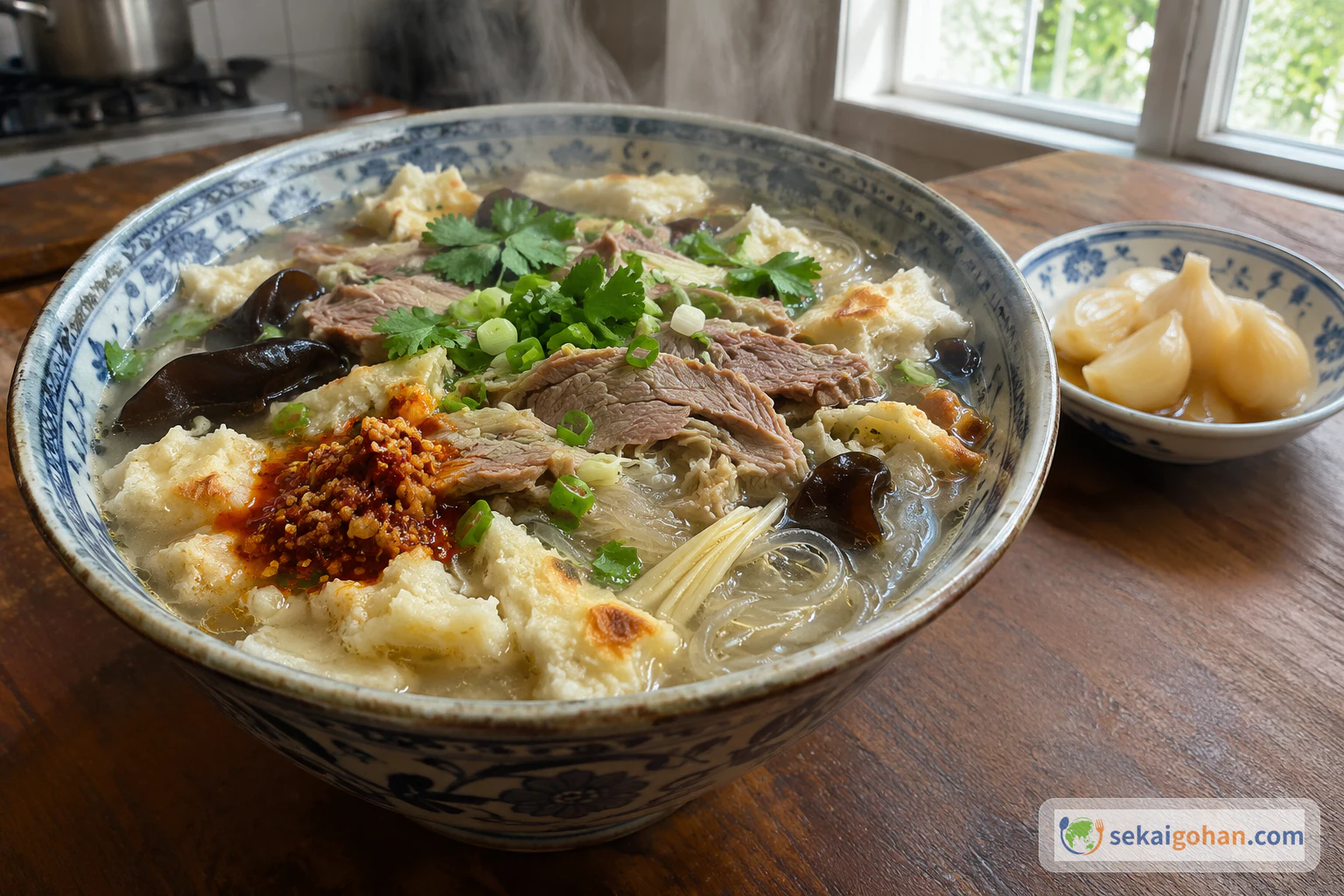
Ingredients
| Ingredient | Amount | Role |
|---|---|---|
| All-purpose flour, for the main dough | 1 lb (450 g) | Body of the flatbread |
| Food-grade alkali (食用碱, shijian) | a little | Changes the flavor and color of the bread |
| Water, for dissolving the alkali | 8½ oz (240 g) | Brings the main dough together |
| Instant yeast | 0.05 oz (1.5 g) | Leavens the small starter dough |
| Water, for the yeast dough | scant 1 oz (25 g) | Dissolves the yeast |
| All-purpose flour, for the yeast dough | about 1½ oz (45 g) | Starter dough |
| Lamb bones | 2 lb (900 g) | Depth and body of the broth |
| Lamb leg, in one piece | 1½ lb (680 g) | Sliced meat for the bowl |
| Water, for the broth | 3¼–4¼ quarts (3–4 L) | Stock |
| Fennel seeds (小茴香, xiaohuixiang) | 1 tbsp | Spice bag, sweet anise note |
| Sichuan peppercorns (花椒, huajiao) | 1 tbsp | Spice bag, numbing fragrance |
| Bay leaves | 3 | Spice bag |
| Dried red chilies | 2 | Spice bag, gentle warmth |
| Fresh ginger | 6 slices | Spice bag, cuts the lamb's gaminess |
| Scallions, for the spice bag | a handful | Aromatic for the stock |
| Dried black wood ear (黑木耳) | as needed | Crunch in the bowl |
| Dried daylily buds (黄花菜, huanghuacai) | as needed | Earthy, slightly sweet strands |
| Mung bean glass noodles | as needed | Slippery bite |
| Scallions, finely sliced | as needed | Fresh garnish |
| Cilantro, finely sliced | as needed | Fresh garnish |
| Garlic chili paste | to taste | Heat on top |
| Sweet pickled garlic (糖蒜, tangsuan) | as needed | Sweet-sour bite on the side |
| Salt | to taste | Seasons each bowl |
Steps
1Make the main dough and let it rest
Dissolve the food-grade alkali in 8½ oz (240 g) of water. Pour it into 1 lb (450 g) of all-purpose flour and bring it together. Knead by hand for 8 to 10 minutes, or with the dough hook on low for 10 to 12 minutes. Cover with plastic wrap and rest for 1 hour. It's ready when the surface looks smooth and the dough holds together in one ball.
2Ferment the yeast dough
Dissolve 1.5 g of instant yeast in about 1 oz (25 g) of water in a small bowl. Stir in about 1½ oz (45 g) of flour until no dry flour is left. Cover and leave it somewhere warm for 1 hour. It's ready when it has risen and you can see bubbles on the surface.
3Knead the two doughs together
Put the rested main dough and the yeast dough together. Knead with the dough hook on low for 10 minutes, or by hand for 6 to 8 minutes. At first the two doughs slide against each other. Keep going until they turn into one even mass. It's ready when the dough is smooth, firm and no longer sticks to your hands.
4Divide into eight and rest
Cut the dough into 8 equal pieces. Roll each one into a ball by cupping it under your palm and tucking the edges underneath. Cover loosely with a damp towel and rest for 10 minutes. Move on when the surface of each ball has relaxed and turned smooth again.
5Roll thin and griddle until dry through
Roll each ball into a thin round 5 to 6 inches (13 to 15 cm) across. Heat a dry skillet over low to medium heat and cook the rounds one at a time, 2 to 3 minutes a side. Give them longer if the center still feels doughy. Cook until both sides have browned spots and the middle is dry, with no raw, tacky feel when you press it. Stack the finished breads under a damp towel to cool.
The bread is done on the griddleCook the bread all the way through in this step. It only spends a few minutes in the broth later, and that isn't enough to cook raw dough. A bread that is dry right through also tears cleanly into small pieces instead of smearing into paste.
6Soak the bones and lamb overnight in the refrigerator
Put the lamb bones and the lamb leg in a deep container and cover them with cold water. Cover the container and set it on the lowest shelf of the refrigerator overnight, where no juices can drip onto other food. The next morning, pour off the soaking water and rinse the bones and meat under running water. Clean the sink afterward. They're ready when the rinse water runs clearer and no blood is left on the surface.
Handling raw lambKeep the knife, cutting board and containers you use for raw lamb separate from cooked food and from vegetables eaten raw, like the scallion and cilantro garnish. Wash your hands after touching raw meat and before you handle anything else. Store raw meat in the refrigerator so its juices can't reach other ingredients.
7Boil the bones, skim, then add the spices and lamb
Put the bones in the stockpot with 3¼ to 4¼ quarts (3 to 4 L) of fresh water and bring to a boil. Skim off the gray foam as it rises until the surface stays fairly clean. Fill the spice bag with the fennel seeds, Sichuan peppercorns, bay leaves, dried chilies, ginger and the handful of scallions. Add the bag and the lamb leg, then simmer over medium-low heat for 1 hour. It's ready when a chopstick pushed into the thickest part of the meat slides in with no resistance.
8Lift out the lamb to chill and keep the bones going
Lift the lamb onto a clean plate, not the one that held it raw. Let the steam come off it, then cover it and put it in the refrigerator. Leave the bones in the pot and simmer for another hour. The meat is ready to slice once it's cold and firm all the way through.
9Strain the broth
Lift out the bones and pour the broth through a fine-mesh sieve into a clean pot or bowl. Throw away the spice bag along with whatever the sieve catches. Let the broth sit for a moment and look at the surface. It's right when the broth is fairly clear and a layer of fat floats on top. If you're making it ahead, see storage below.
10Slice the lamb and soak the dried goods
Slice the chilled lamb thinly against the grain on a board and knife that never touched raw meat. Soak the wood ear, daylily buds and glass noodles in water for 1 hour. Tear the larger wood ear pieces to about 1 inch (2.5 cm) and cut the noodles into 4 to 5 inch (10 to 13 cm) lengths. They're ready when the wood ear and daylily are soft and plump and the noodles bend without snapping.
11Tear the bread to soybean size
Take one and a half breads per bowl to start. Hold a bread in both hands, pull it into strips, then pinch and tear the strips into smaller and smaller bits. Shake the pile now and then so the loose crumbs settle and the bigger pieces show. The size is right when every piece is about as big as a soybean.
Take your time tearingTearing is the slow part, and it decides the bowl. Even, soybean-sized pieces soak evenly in the few minutes of simmering and still chew. Big pieces stay dry inside. If you knead them or crumble them to dust, they melt into porridge.
12Simmer, season and finish each bowl
Bring 2 cups (480 ml) of broth per bowl to a boil in a small pot. Add the torn bread, wood ear, daylily buds, glass noodles and sliced lamb. Simmer for a few minutes, then taste and add salt. Pour everything into the bowl and top with scallion, cilantro and garlic chili paste, with sweet pickled garlic on the side. It's ready when the broth is at a full boil and the lamb is steaming hot all the way through.