Ingredients and steps on one page. Print it, or choose “Save as PDF” in the print dialog.
Sekai Gohan
Wandouhuang: Set Yellow Split Pea Cake from Beijing
Ingredients
| Ingredient | Amount | Role |
|---|---|---|
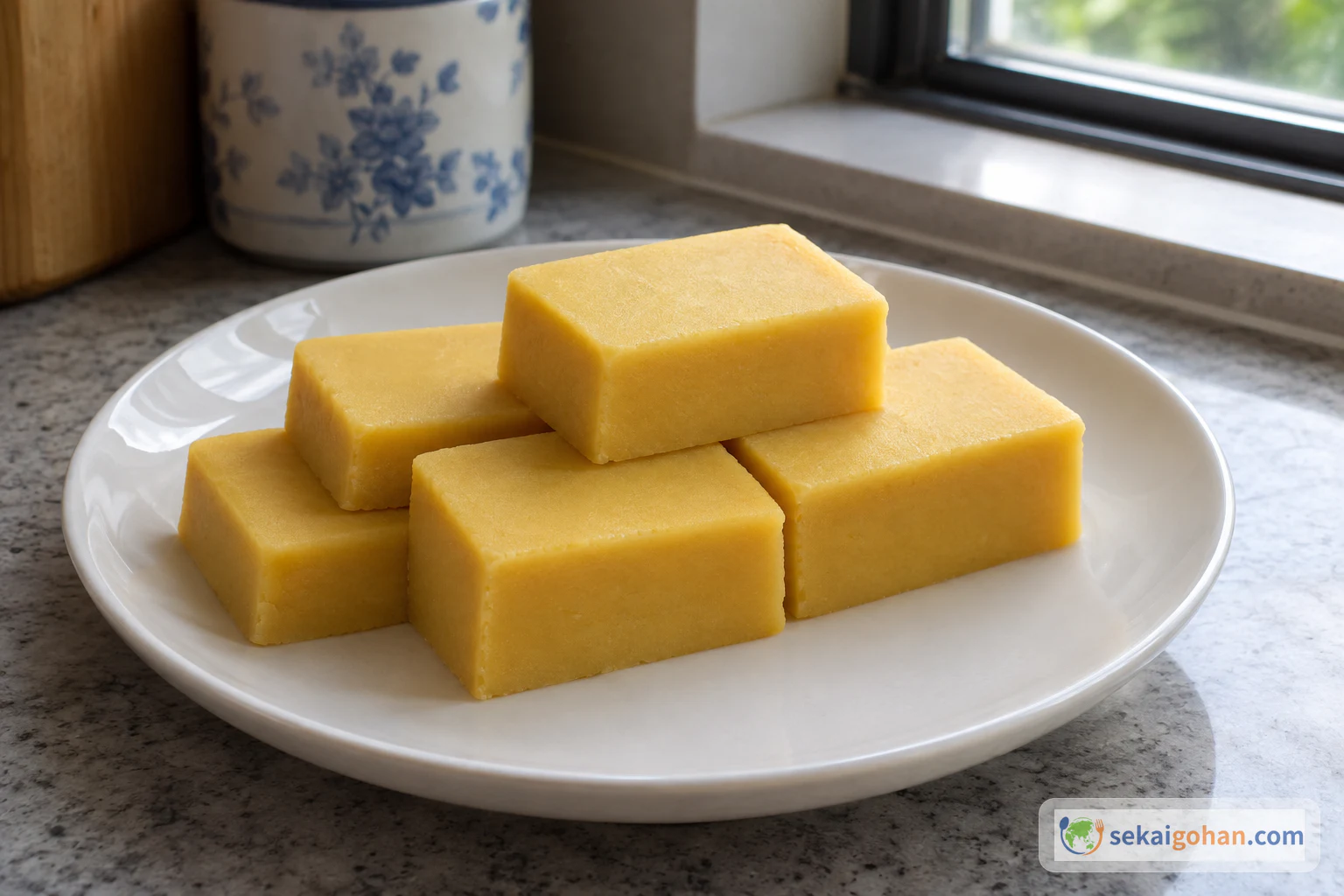
| Dried peeled yellow split peas (脱皮干豌豆) | 9 oz (250 g) | The body of the cake; their starch sets it |
| Cold water for soaking | As needed, enough to cover the peas well | Softens the peas before cooking; discarded |
| Water for cooking | 2½ cups (600 ml) | Cooks the peas until they collapse |
| Cold water for blending | A little, as needed | Loosens the purée if it is too stiff to blend |
| Caster sugar | 2 oz (60 g) | Light sweetness and a glossy, firmer paste |
Steps
1Rinse and soak the peas
Put the split peas in a fine strainer and rinse them under cold running water, rubbing them lightly with your hand. Tip them into a large bowl and cover them generously with cold water. Leave them to soak overnight, or for at least 4 hours. Drain and discard the soaking water. The peas are ready when they have swollen and look fuller than when they went in.
2Cook the peas until they collapse
Put the drained peas in a saucepan with 2½ cups (600 ml) of fresh water and bring it to a boil. Skim off the pale foam that rises, then lower the heat and simmer, topping up with a little water if the level drops below the peas. Cook the dried peas thoroughly; they must be fully soft before they go any further. They are done when a pea crushes easily between your fingers with no firm centre.
Judge by the pea, not the clockCooking time swings widely, from about half an hour to two hours, depending on the peas and the pot. Start checking early, and keep going until every pea you test mashes to paste.
3Blend into a smooth purée
Let the peas cool slightly, then blend them with the liquid left in the pot until completely smooth. If the purée is too stiff for the blades to turn, add cold water a little at a time. For the fine palace texture, press the purée through a fine-mesh sieve with a spatula. The purée is ready when it is thick, golden and silky, with no visible bits of pea.
4Cook the paste with sugar to the ribbon stage
Scrape the purée into a non-stick saucepan, add the sugar and set it over medium heat. Stir constantly, scraping the bottom and corners, as the paste thickens and starts to pull away from the pan; turn the heat down if it catches. Lift the spatula to test it. The paste is ready when it falls in a thick ribbon that sits on the surface and sinks back slowly.
The ribbon decides the setThis stage is what makes the cake firm. If the paste still runs off the spatula in a smooth stream, keep stirring; there is no gelatin or agar to rescue it later.
Hot pasteThick paste spits as it bubbles and clings to skin. Use a long-handled spatula, keep your hand and forearm away from the pan, and stir steadily so it does not erupt.
5Fill the tin and cover the surface
Pour the hot paste straight into the 8-inch (20 cm) square tin; it does not need greasing. Spread it into the corners and smooth the top flat with the spatula. Press cling film directly onto the surface, touching the paste everywhere, with no air pockets. The tin is ready when the top is level and sealed under the film.
Film on the paste, not over the tinFilm pressed onto the surface stops it drying and cracking as it cools, the same job the damp blue cloth did on the temple-fair barrows.
6Chill, turn out and cut
Let the tin cool to room temperature, then refrigerate it for at least 4 hours, ideally overnight. Peel off the film and turn the cake out onto a cutting board. Cut it into neat rectangles with a long knife, wiping the blade between cuts. The cake is set when it turns out in one firm block and the cut faces stay clean and smooth.