Ingredients and steps on one page. Print it, or choose “Save as PDF” in the print dialog.
Sekai Gohan
Sachima: Chinese Fried Egg-Dough Strips Bound with Maltose Syrup
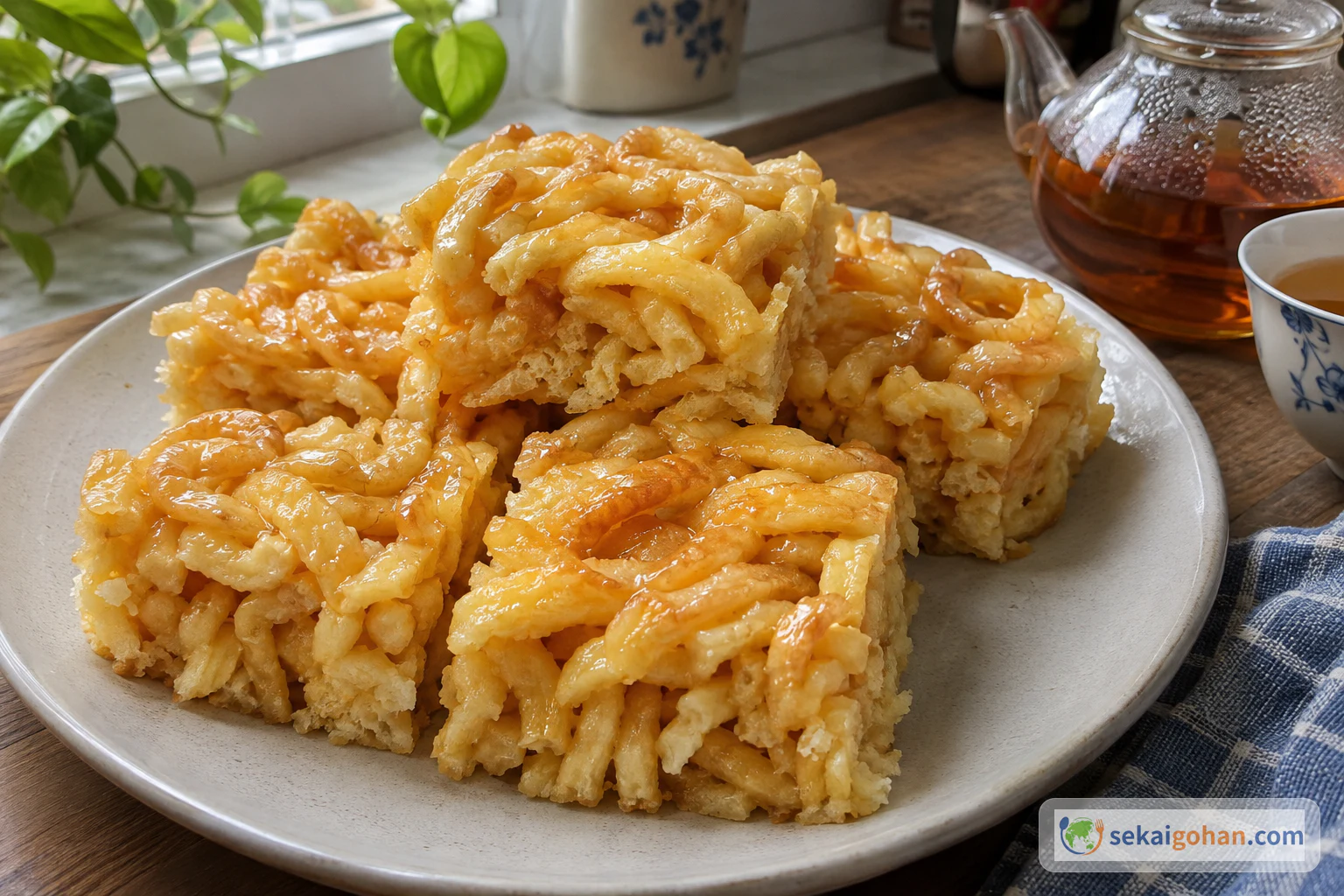
Ingredients
| Ingredient | Amount | Role |
|---|---|---|
| All-purpose or bread flour | 7 oz (200 g) | The structure of the strips |
| Eggs, large | 2 | Flavor, color and the only liquid in the dough |
| Egg yolk | 1 | Richness and a tender, airy bite |
| Salt | ⅛ tsp | Sharpens the egg flavor |
| Baking powder | ½ tsp | Puffs the strips in the oil |
| Cornstarch | ¼ cup (60 ml) | Dusting, so the cut strips stay apart |
| Neutral oil (such as sunflower) | As needed, at least 3¼ inches (8 cm) deep | Frying |
| White sugar (syrup) | 4½ oz (130 g) | Sweetness and the set of the block |
| Maltose (麦芽糖, syrup) | 2 oz (60 g) | Gloss, chew and stickiness that holds |
| Water (syrup) | 1½ oz (40 g) | Dissolves the sugars |
Steps
1Knead the egg dough and let it rest
Combine the flour, baking powder and salt in a bowl. Add the 2 eggs and the yolk and work everything together with your hands, then knead on the counter until the dough is smooth. The eggs are the only liquid, so keep kneading past the shaggy stage rather than reaching for water. Cover the dough and leave it for at least 30 minutes, ideally 1 hour. It is ready when it has turned into a smooth, pale yellow ball.
2Roll out a large thin sheet
Do not knead the dough again after the rest; take it straight to the rolling pin. Roll it into a large, thin rectangle about 12 inches (30 cm) across. Dust both sides and the counter with cornstarch as you go. The sheet is right when it is evenly thin.
Straight from rest to rolling pinKneading after the rest tightens the dough again, and it fights back on the rolling pin. Shape it once, rest it, then only roll.
3Cut the dough into fine short strips
Cut the sheet into long ribbons with the large knife, then cut across them to make fine, short matchsticks. Toss the cut pieces with more cornstarch and spread them loosely on the counter. Keep everything dry; wet hands or a wet board make the strips clump. The pile is ready when it falls apart into single strands when you lift a handful.
4Heat the oil and fry one test strip
Pour the oil into the deep pot to a depth of at least 3¼ inches (8 cm) and set it over heat. Set the large bowl and the spider strainer next to the stove. Drop in a single strip. The oil is ready when the strip floats within 3 seconds; if it lingers on the bottom, wait and test again.
Hot oilKeep the strips, your hands and every tool dry before anything goes near the oil. Add the strips in small batches so the oil does not foam up. Keep a lid beside the pot and a way to put out an oil fire within reach, and never leave the pot unattended.
Trust the float testThe test strip tells you more than a dial on the stove. When it bobs up almost at once and sizzles steadily, the next batches will puff evenly and stay pale.
5Fry the strips in small batches
Shake loose cornstarch off a handful of strips and scatter them into the oil. Stir them apart and fry for 12 to 15 seconds, until they have puffed and turned a pale, light gold. Lift them out with the spider, let the oil drain back for a moment, and tip them into the large bowl. Repeat with the rest, testing again if a batch is slow to float. The bowl is ready when every strip is crisp-light and evenly pale.
6Cook the syrup to temperature
Put the sugar, maltose and water in the small saucepan over medium heat. Do not stir; let the sugars melt and bubble on their own. Cook until the syrup reaches about 240°F (115°C), and no higher than about 250°F (120°C). The temperature moves quickly, so lift the pan off the heat each time you read the thermometer. Stop when it reads in that range off the heat.
The thermometer decidesWatching the syrup pull into threads helps, but it only backs up the thermometer. Read the temperature off the heat every time and go by the number.
7Coat the strips with syrup
Pour the hot syrup over the strips in 2 or 3 additions, folding with the spatula after each one. Work fast and keep the coat thin; you are binding the strands, not drowning them. Stop adding syrup once everything clings, even if some is left in the pan. The strips are coated when they glisten all over and come together in loose clumps that pull fine threads as you fold.
Hot syrupSyrup at 240°F (115°C) sticks to skin and burns. Do not touch it or the coated strips with bare hands; use the spatula for every move.
8Press into the pan and cool
Tip the coated strips into the parchment-lined pan. Spread them to the corners and press the top lightly with the flat of the spatula until it is level. Press just enough to close the gaps, keeping air between the strands. Leave the block until it has cooled completely. It is ready when it feels firm and cool all the way through, with no warmth under the surface.
9Cut into squares
Lift the block out by the parchment and set it on a cutting board. Cut it into 9 squares with the large knife. The squares are right when the cut faces show a tight tangle of strips held in glossy syrup and the pieces hold their shape in your hand.