Ingredients and steps on one page. Print it, or choose “Save as PDF” in the print dialog.
Sekai Gohan
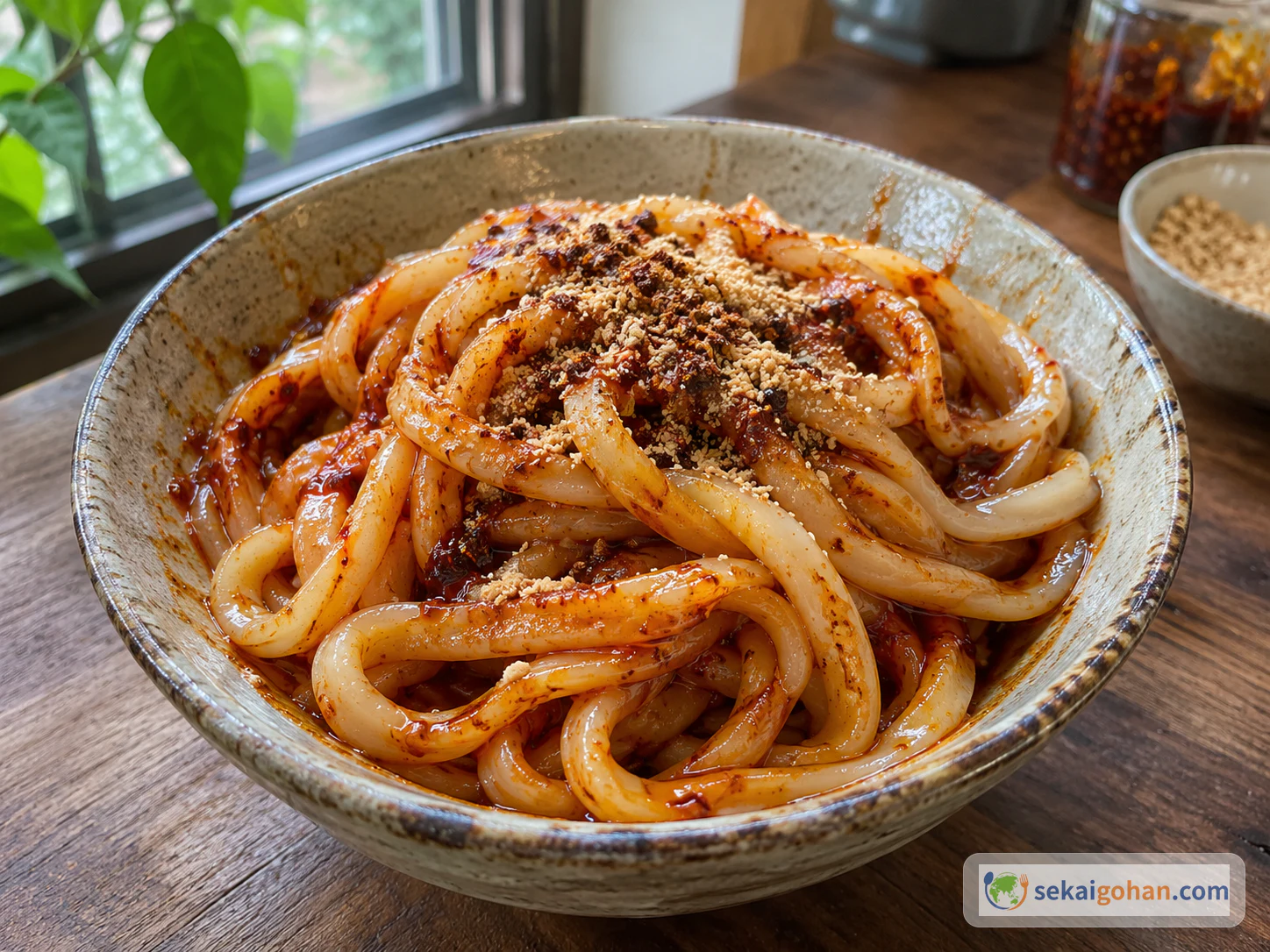
Tianshui Noodles: Chengdu Thick Noodles in Sweet Spiced Soy
Ingredients
| Ingredient | Amount | Role |
|---|---|---|
| All-purpose flour (noodles) | 9 oz (250 g) | The noodle itself |
| Water (noodles) | 4–4½ oz (115–125 g) | Makes a stiff dough; add according to how the flour absorbs it |
| Salt (noodles) | ⅙ tsp | Tightens the gluten and seasons lightly |
| Flour for dusting | as needed | Keeps strips separate while cutting and stretching |
| Chinese light soy sauce (生抽, sheng chou) | ½ cup (150 g) | Base of the sweet spiced soy |
| Brown sugar (红糖, hong tang) | ¼ cup (40 g) | The sweetness and the red-brown color |
| Water (sweet soy) | 4 tbsp (40 g) | Loosens the soy for simmering |
| Fennel seeds (小茴香) | ¼ tsp | Sweet, warm aroma |
| Mature ginger, skin on (老姜) | 2 slices | Aromatic base |
| Star anise (八角) | 1 | Sweet-savory backbone |
| Clove (丁香) | 1 | Concentrated aroma at the core |
| Chinese black cardamom (草果, cao guo) | 1 | Smoky depth |
| Bay leaves (香叶) | 2 | Rounds out the spice outline |
| Cassia bark (桂皮) | 1 small stick | Warm sweetness |
| Sweet spiced soy (made above) | 1 tbsp per bowl | Sweetness, salt and gloss |
| Sichuan chili oil (辣椒油), store-bought | 1 tbsp per bowl | Color, heat and aroma |
| Chinese sesame paste (芝麻酱) | 1 tbsp per bowl, thinned with a little warm water | Body and richness; binds the chili oil to the noodle |
| Roasted soybean powder (熟黄豆粉) | ½ tsp per bowl | Toasty aroma; helps the sauce thicken |
| Grated garlic, with its juice (蒜泥) | ½ tsp per bowl | Sharp, fresh bite |
| Ground Sichuan pepper (花椒粉) | a pinch per bowl | The numbing tingle |
| Mushroom seasoning (香菇粉) | a pinch per bowl | Savory lift |
Steps
1Simmer the sweet spiced soy
Put the light soy sauce, brown sugar, water, fennel seeds, ginger, star anise, clove, black cardamom, bay leaves and cassia into a small saucepan. Set it over the lowest heat and let it barely bubble, stirring now and then; a hard boil scorches the sugar. Keep going until the sugar has fully dissolved and the liquid has thickened slightly. Pour it through a fine-mesh strainer, discard the spices, and let it cool to room temperature. It is ready when it coats the back of a spoon in a thin, glossy, red-brown film.
2Knead a stiff dough and rest it
Mix the flour and salt in a bowl. Add the water a little at a time, working it in until the flour comes together into one firm mass; use the lower amount first and add the rest only if dry flour remains. Turn it out and knead until smooth. Wrap it and leave it to rest for 30 minutes. The dough is right when it is smooth, dense and barely tacky to the touch.
3Roll out and cut into strips
Dust the board and roll the rested dough into a long sheet about ⅛ inch (3 mm) thick. Dust the surface with flour. Cut it with a knife into strips ½ inch (13 mm) wide. Pull the strips slightly apart so they do not stick to each other. The strips should separate cleanly, each one with crisp, square edges.
4Stretch each strip to pencil thickness
Dust each strip with flour. Take one at a time by both ends and stretch it gently until it is about as thick as a pencil. Lay each finished noodle on the board so it does not overlap the others. Put on the water for boiling while you work through the strips. Each noodle should be round-to-square in section, evenly thick along its length, and lightly dusted.
Cut first, then stretchCutting the strips before stretching is what gives these noodles their even thickness and squarish shape. Dust every strip on its own; a strip that sticks to its neighbor tears when you pull it.
5Boil the noodles
Bring a large pot of water to a full boil. Lower the noodles in and stir once so they do not stick to the bottom. Boil for 4–5 minutes. Lift one out and bite through it; it is done when the center is cooked through and no raw, pale core remains.
6Rinse in cold water and drain
Tip the noodles into a colander. Run cold water over them briefly to stop the cooking and set their spring. Shake the colander and let them drain well. The noodles are ready when they feel cool and firm, bounce when you press one, and no water pools at the bottom of the colander.
7Build the sauce in each bowl
In each bowl, put 1 tbsp sweet spiced soy, 1 tbsp chili oil and 1 tbsp sesame paste thinned with a little warm water, and stir them together. Add the roasted soybean powder, freshly grated garlic with its juice, a pinch of ground Sichuan pepper and a pinch of mushroom seasoning. Stir again. The sauce is ready when the dark soy, red oil and beige sesame paste have come together into a loose, streaky glaze at the bottom of the bowl.
One bowl at a timeDress each bowl separately instead of mixing one large batch. Built in the bowl, the sweet soy and the chili oil each keep their own place, and the sweet-then-hot order stays clear when you eat.
8Toss the noodles with the sauce and eat
Divide the drained noodles between the bowls. Toss them thoroughly with chopsticks, lifting from the bottom so the sauce reaches every strand. Eat them right away, slightly cool. They are ready when every noodle is glossy and red-brown all over, with no pale patches left.