Ingredients and steps on one page. Print it, or choose “Save as PDF” in the print dialog.
Sekai Gohan
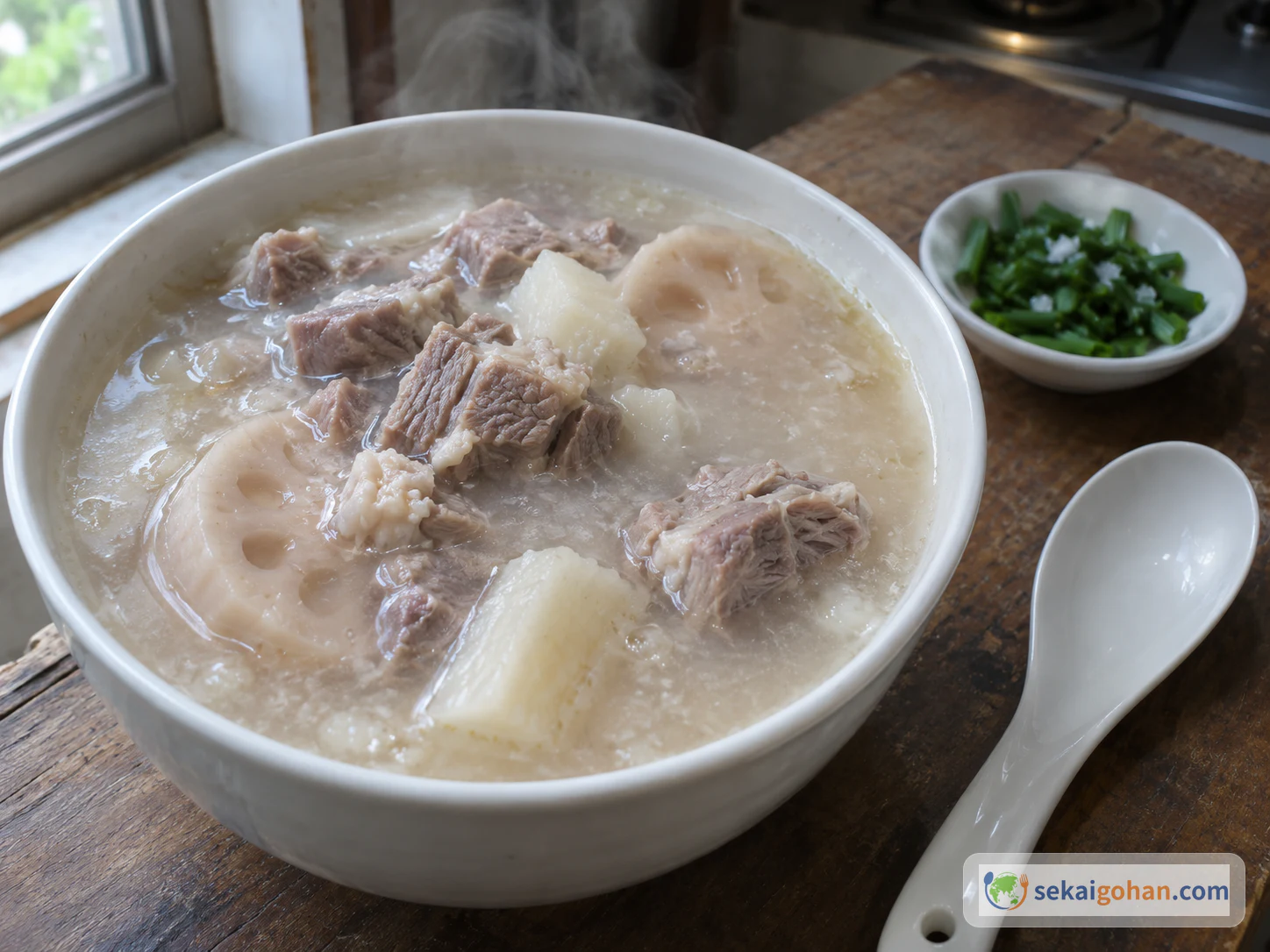
Tounao: Taiyuan's Thick Lamb and Yam Breakfast Soup
Ingredients
| Ingredient | Amount | Role |
|---|---|---|
| Lamb leg, boneless block (羊后腿肉) | 10½ oz (300 g) | The meat, and most of the savoriness and fat |
| Lotus root (莲藕) | ½ root | A crisp bite that holds through the simmer |
| Chinese yam (山药), or nagaimo | ½ yam | Gentle sweetness and some body for the thickening |
| Plain wheat flour (面粉) | 1¾ oz (50 g) | Toasted, it becomes the white thickening |
| Shaoxing wine or other Chinese yellow rice wine (黄酒) | 2 tbsp | Aroma, depth and some of the salt |
| Sake lees, in place of Chinese wine lees (酒糟) | 1 tbsp | The fermented, boozy-sweet signature |
| Sweet fermented rice (酒酿), or rice-koji amazake | 1 tbsp | Sweetness and a second fermented note |
| Star anise (八角) | 1 pod, cracked | Backbone of the aroma |
| Sichuan peppercorns (花椒) | ½ tsp, whole | Fragrance and a light tingle |
| Fresh ginger (生姜) | 3 thin slices | Softens the mutton smell |
| Negi, Japanese long onion (葱段) | 1, cut into lengths (green part) | Works with the ginger |
| Astragalus root, dried slices (黄芪) | 0.2 oz (5 g) | The medicinal note; mild in flavor |
| Salt | to taste | Final seasoning |
| Salted garlic chives (腌韭菜) | as needed | The "guide" served with each bowl |
| Water for the pot | 3⅓ cups (800 ml) | The broth |
| Water for the slurry | scant ½ cup (100 ml) | Turns the toasted flour into a pourable slurry |
Steps
1Blanch the lamb
Cut the lamb into small chunks of ¾–1¼ inch (2–3 cm) and rinse them in cold water. Put them in a pot, cover with water and bring to a boil over high heat. When the meat changes color and a thick grey foam floods the surface, turn off the heat. Lift out the lamb and rinse it under running water until no scum clings to the pieces.
2Cut the yam and lotus root, and loosen the lees
Peel the Chinese yam and roll-cut it into irregular chunks, turning it a quarter after each cut. Don't make the pieces perfectly even. Some will soften and break down in the pot, and that helps the thickening. Peel the lotus root and cut it into small pieces a scant ¼ inch (4–5 mm) thick. Stir the sake lees with a little hot water into a smooth paste with no dry lumps.
3Toast the flour
Set the heavy pot over low heat, dry, with no oil, and add the flour. Stir constantly so nothing catches on the bottom. Stop when it is evenly pale yellow and smells toasty. If you stop too early it tastes of raw flour, and if you go too far it turns bitter. Tip the flour straight into a dry bowl to cool, so the hot pot doesn't keep cooking it.
4Sieve the flour and mix the slurry
When the flour is completely cool, sieve it into a large bowl to break up the clumps that formed during toasting. Add the slurry water a little at a time, stirring with chopsticks after each pour. Toasted flour takes up water more easily than raw flour, so it comes together quickly. Keep going until the slurry is smooth and pourable and the chopsticks come out free of lumps.
5Simmer the lamb with the aromatics
Put the 3⅓ cups (800 ml) water in the heavy pot with the blanched lamb, star anise, Sichuan peppercorns, ginger, negi and astragalus. Bring it to a boil over high heat. A second, lighter foam rises as it comes up. Skim it off with a small spoon until the surface is clear and the kitchen smells of anise and ginger.
6Add the wine and vegetables, then the lees
Pour in the Shaoxing wine, add the yam and lotus root, and simmer over medium heat until everything is cooked. The lamb must be cooked through to the center. A chopstick should slide in easily, and a piece cut open should show no raw center. Watch the color of the broth. When it turns milky white, stir in the loosened lees and the fermented rice and bring it back to a boil.
The white broth is your signalLees added to a clear, thin broth smell raw and sharp. Wait until the broth has clouded, then let the pot come back to a full boil after the lees go in. That boil softens the fermented edge.
7Thicken with the slurry
Stir the slurry once more, then pour it into the pot in a thin, steady stream while you whisk. Bring it back to a boil over medium heat. Keep stirring slowly the whole time so the soup and flour cook into one body and do not separate. Test the thickness: spoon a little into a bowl and swirl it. When it coats the inside of the bowl in a thin layer, it is right.
Read the bowl, not the potThe soup looks thinner in a hot pot than it will be in the bowl. If it slides off the bowl without leaving a coat, it needs more flour. If it clings in a heavy layer, it is too thick, so loosen it with hot water a little at a time.
8Season and serve
Taste before you add any salt, because the wine and lees have already brought some. Add salt a pinch at a time, stirring and tasting between pinches. Ladle the soup into deep bowls. It should fall from the ladle in a thick, glossy ribbon. Finish each bowl with a spoonful of chopped salted chives, or set them on the side.