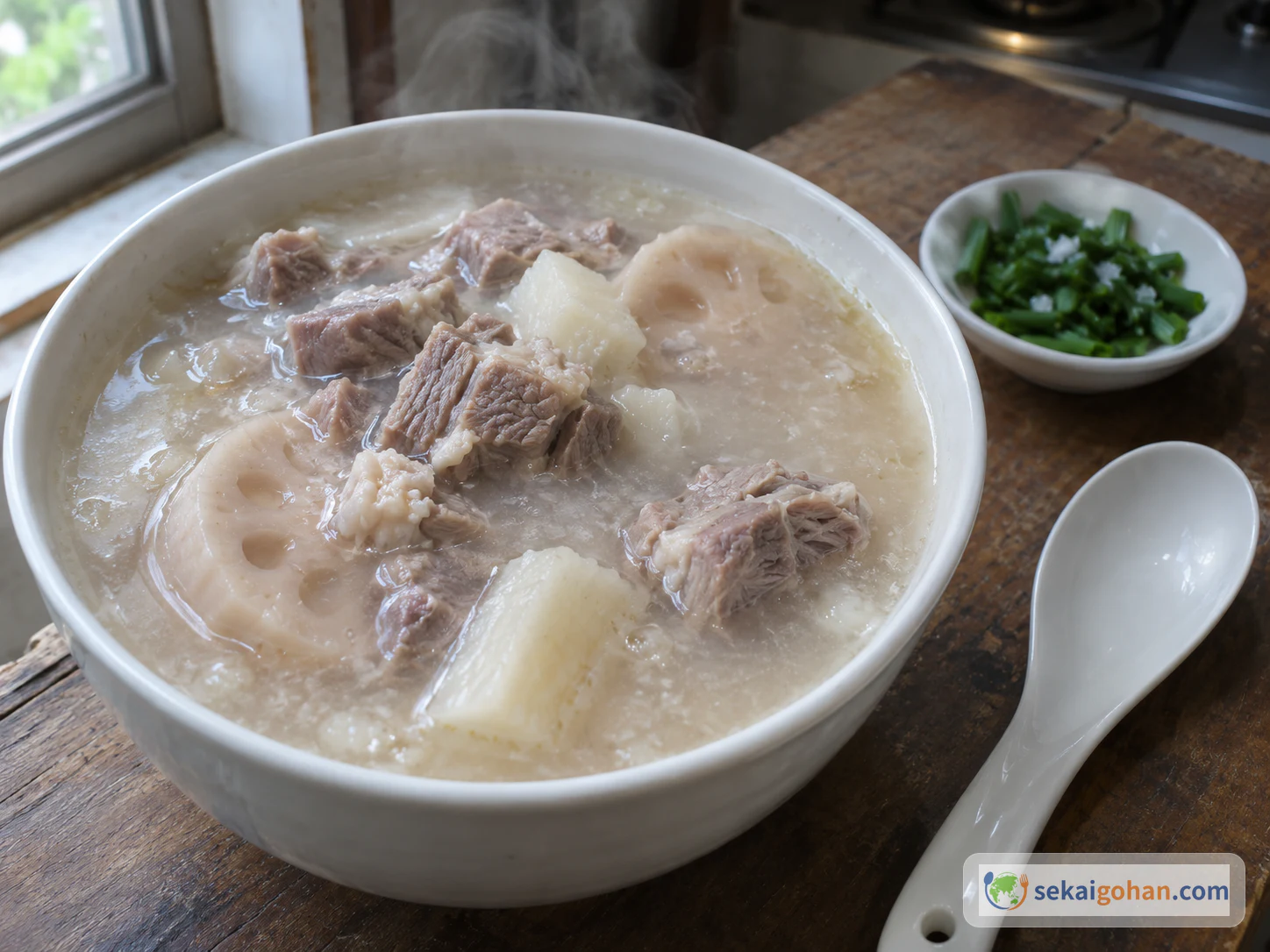
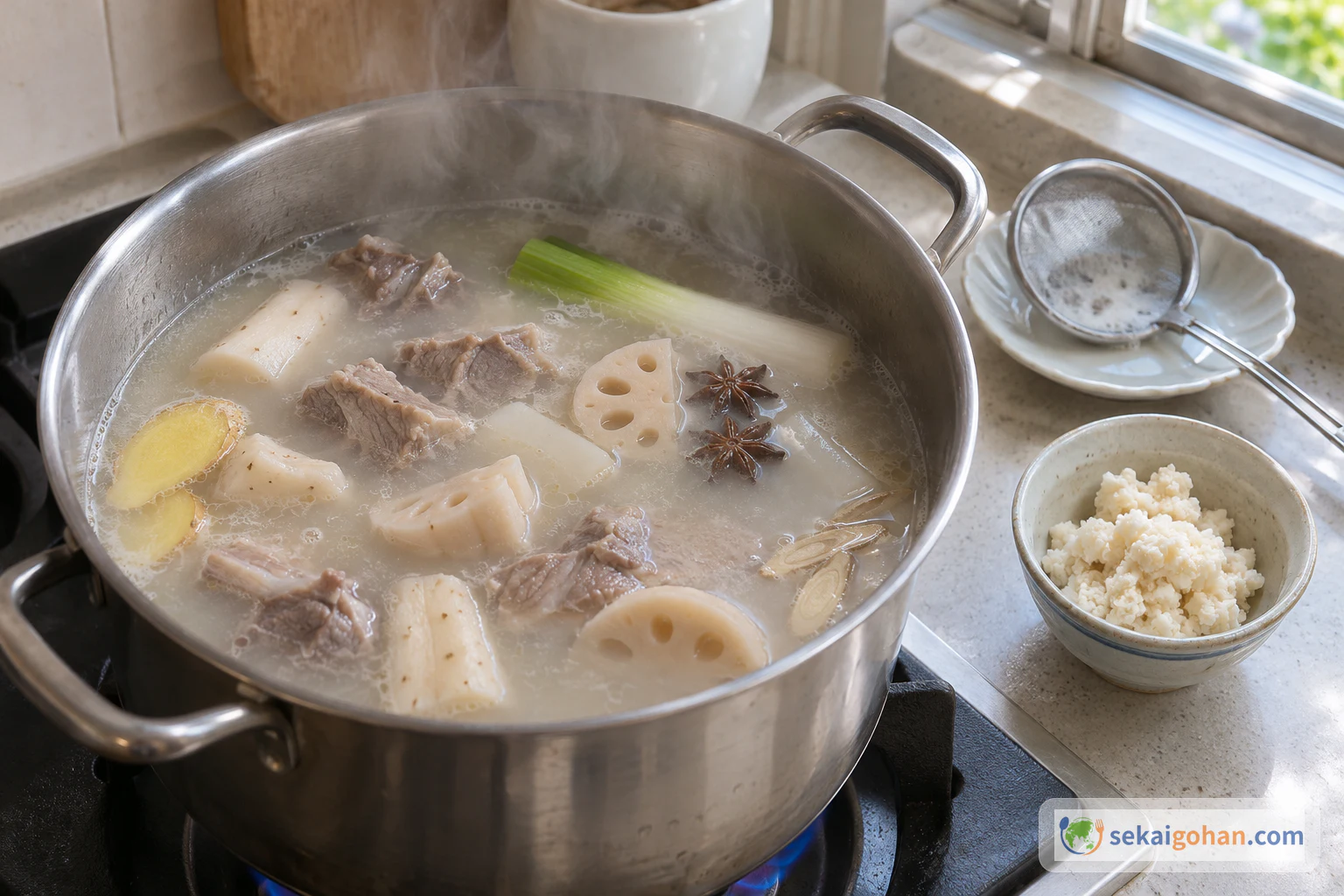
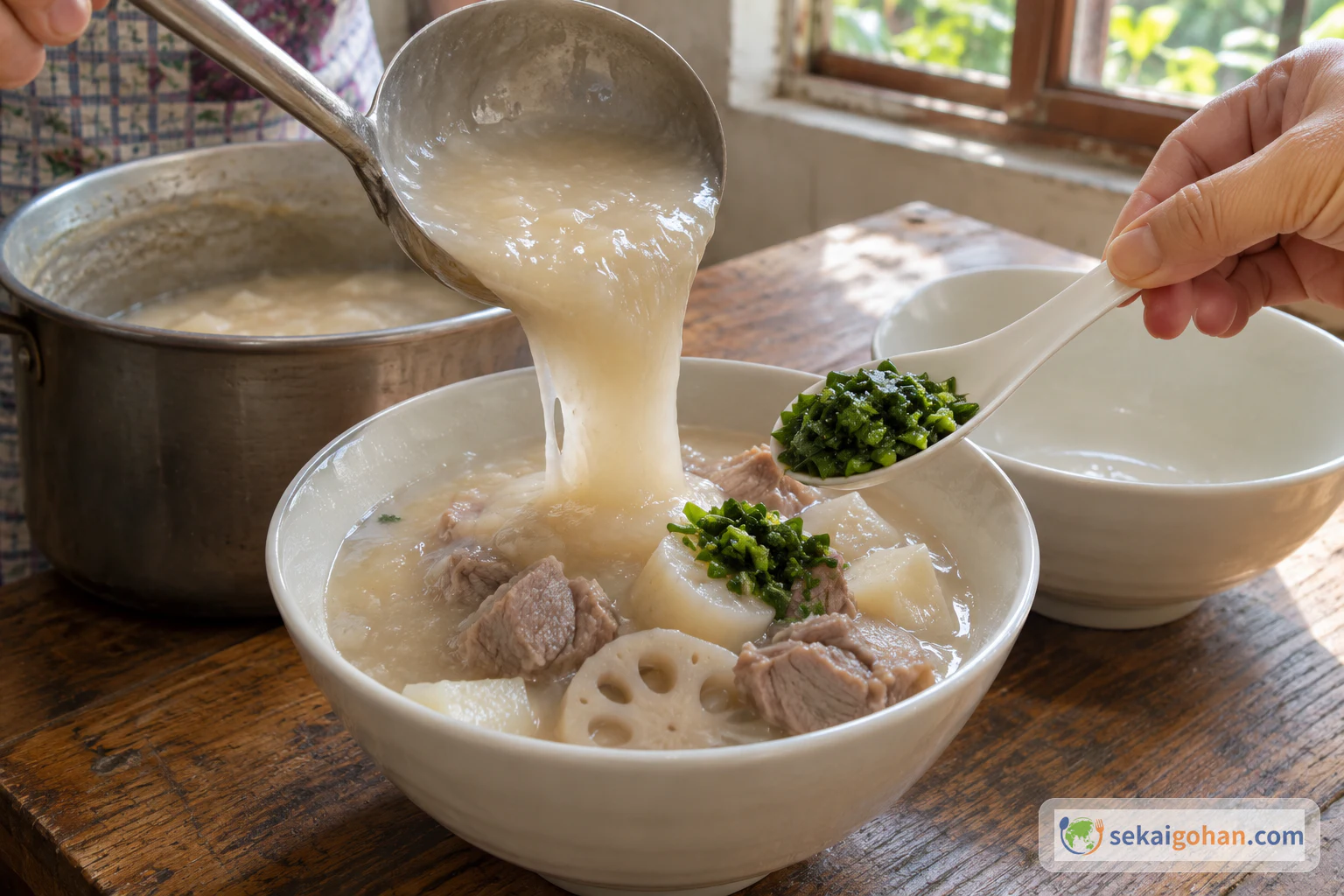
On a winter morning in Taiyuan the ladle rises from the pot with something closer to porridge than soup. It is pale and glossy, and thick enough to hold its shape as it falls into the bowl. Cubes of lamb, pieces of lotus root and soft Chinese yam sit in it, and a little dish of chopped salted chives waits beside the bowl. The first breath is mutton and fermented rice lees, warm and a little boozy.
The name reads as "brains" in Chinese, but the bowl holds no brains at all. It holds lamb, toasted wheat flour, lotus root, yam, yellow rice wine, wine lees and dried astragalus root. It tastes savory and deep, soft in the mouth with a faint sweetness at the center, and it is the breakfast of Taiyuan, the capital of Shanxi province in northern China.
A dawn bowl that belongs to Taiyuan
Tounao is a Taiyuan dish. Even Yuci and Xinzhou, the nearest towns, do not serve it this way, so it reads more truly as the city's morning bowl than as Shanxi food in general. It grew up in Hui Muslim (qingzhen) kitchens, and pork and lard have no place in it. The season runs from Bailu, the "white dew" of early September, to Lichun, the start of spring the following February. It is eaten early, ideally before full light. In 2008 it was entered on China's national list of intangible cultural heritage as the medicinal "eight-treasure soup" of Taiyuan, under traditional medicine.
Inside the city it is well loved. Restaurants that specialise in Sichuan or Hunan cooking have put tounao on their menus too. Not everyone is won over on the first bowl, though. People who find it hard going describe the mutton smell as too strong, the lees as too heavy and the soup as paste that sticks in the throat. A Taiyuan saying answers them: the first bowl feels like your first taste of foreign liquor, the second bowl lets you catch the fragrance, and by the third you taste how good it is.
头脑 (tóunǎo) is the everyday Chinese word for "head" or "brain". One explanation traces the name to doulao, old words for twice-brewed wine still thick with its lees, which drifted in sound until they became "tounao". The dish also goes by bazhen tang, "eight-treasure soup", and sometimes Fu Shan tounao. Qinghe Yuan, the best-known shop, hangs it on its sign beside yang zage, a lamb offal soup that is a separate dish.
Eight treasures, counted two ways
The eight treasures are not counted the same way everywhere. One list gives astragalus, prepared flour, lotus root, lamb, Chinese yam, yellow wine, wine lees and lamb-tail fat, and serves salted chives alongside as the yinzi. In Chinese food-medicine the yinzi is the "guide" that leads the rest. Another list leaves out the tail fat and counts galangal and the salted chives among the eight. Both lists are long-standing, and neither one is the only correct version. A home pot made without tail fat or galangal holds fewer than eight treasures, so it is a near version of the shop bowl rather than the full one.
In traditional food-medicine terms the bowl is warming. Lamb is "hot" and restoring, lotus root "clears heat", yam supports digestion and astragalus "builds strength". That language explains why tounao became a breakfast for cold mornings and for older people. It is lore, and it is told here as lore.
Fu Shan, and an older bowl of wine
The story Taiyuan tells points to Fu Shan (Fu Qingzhu, 1606 or 1607 to 1684). He was a scholar, calligrapher, painter and physician from Yangqu, today part of Taiyuan, and the author of a well-known work on women's medicine. His mother, Lady Chen, suffered with her stomach every winter. Fu Shan made her the eight-treasure soup as a winter breakfast, and the story says she got through the cold months well and lived to 84.
He is then said to have taught the recipe to a lamb offal shop on Nancang Lane, run by a Hui family from Gansu. He named the shop Qinghe Yuan and the dish tounao, and he wrote "zage tounao" for its sign. The characters Qing and Yuan are read as a quiet lament: both are names of conquering dynasties, set down by a man loyal to the fallen Ming. Customers came before dawn carrying lanterns, which carried the meaning "the sky is not yet bright, but people long for light".
Where tounao began is not settled. A Ming-dynasty notebook by Zhu Guozhen describes "tounao wine". In winter, guests were served a big bowl of meat and assorted morsels with hot wine poured over it, and from the winter solstice to Lichun the court gave it to the palace guards and generals. In chapter 51 of the Ming novel Water Margin, the character Li Xiao'er goes off "to catch a bowl of tounao". The Qinghe Yuan plaque is also dated 1632, twelve years before Qing troops came through the pass, and that sits awkwardly with the anti-Qing reading of the name. Fu Shan may well have refined an older dish rather than invented a new one.
Lanterns before dawn at Qinghe Yuan
Going out early for a bowl was called gan tounao, "chasing tounao". Shops hung paper lanterns at the door before light. Once the streets had proper lamps the lanterns disappeared, and the phrase stayed. Qinghe Yuan is a China Time-honored Brand and has served tounao for more than 300 years. It moved from Nancang Lane to Qiaotou Street and then to Tongluowan. Hongbinlou and Qingjuyuan are among the other places that serve it. An old Taiyuan rhyme lists the city's best things: Renyili's dumplings, Ninghuafu's vinegar, Laoshuku's sweet dumplings, Liuweizhai's braised meat, and zage and tounao at Qinghe Yuan.
In January 2020 a bowl at the Tongluowan shop cost 22 yuan. The shop sold 800 to 1,000 bowls a day and about 1,500 on its busiest mornings. Diners over 70 paid 25 yuan instead of 35 for the bowl with shaomai.
Behind the counter: how the shops make it
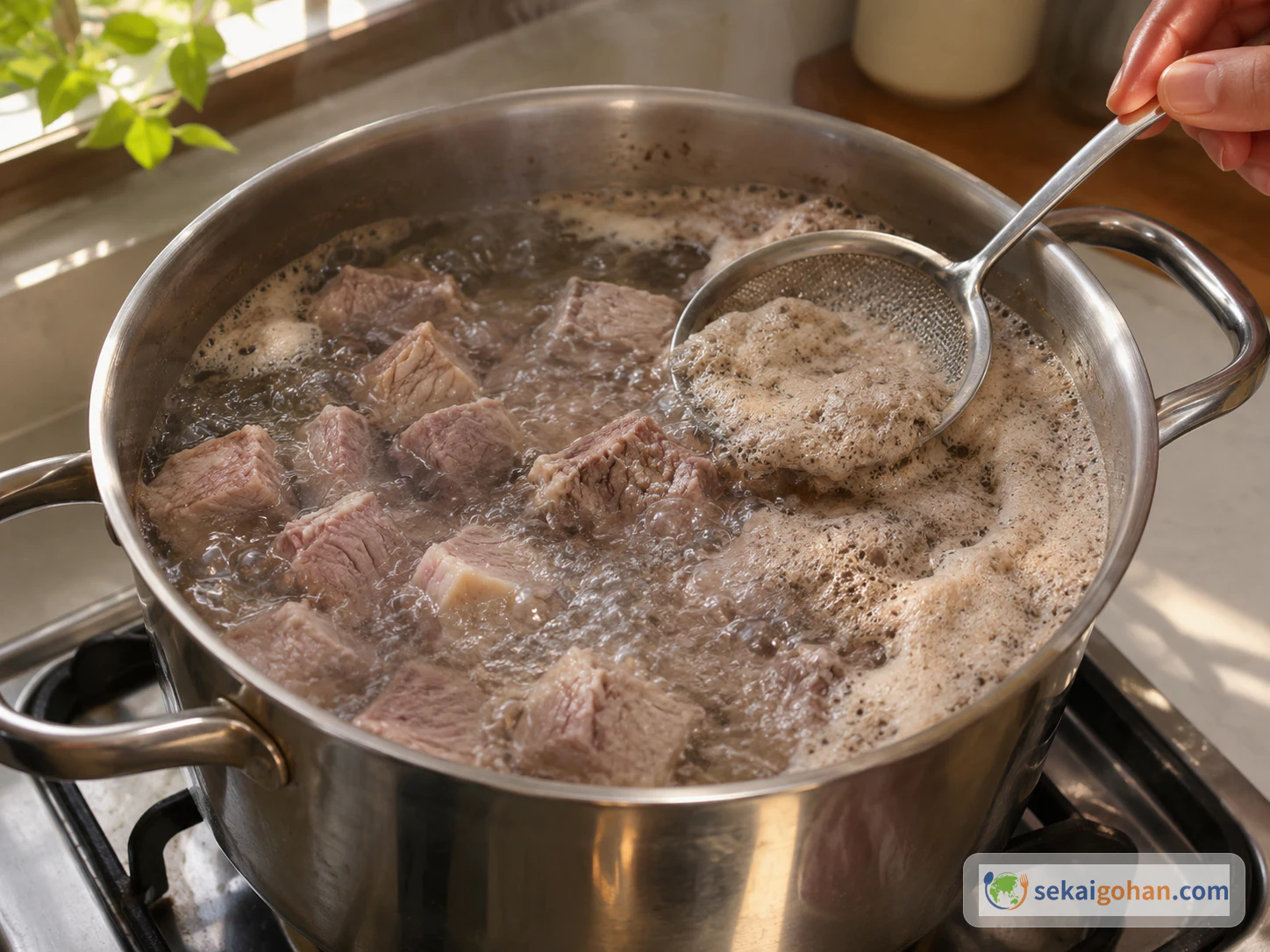
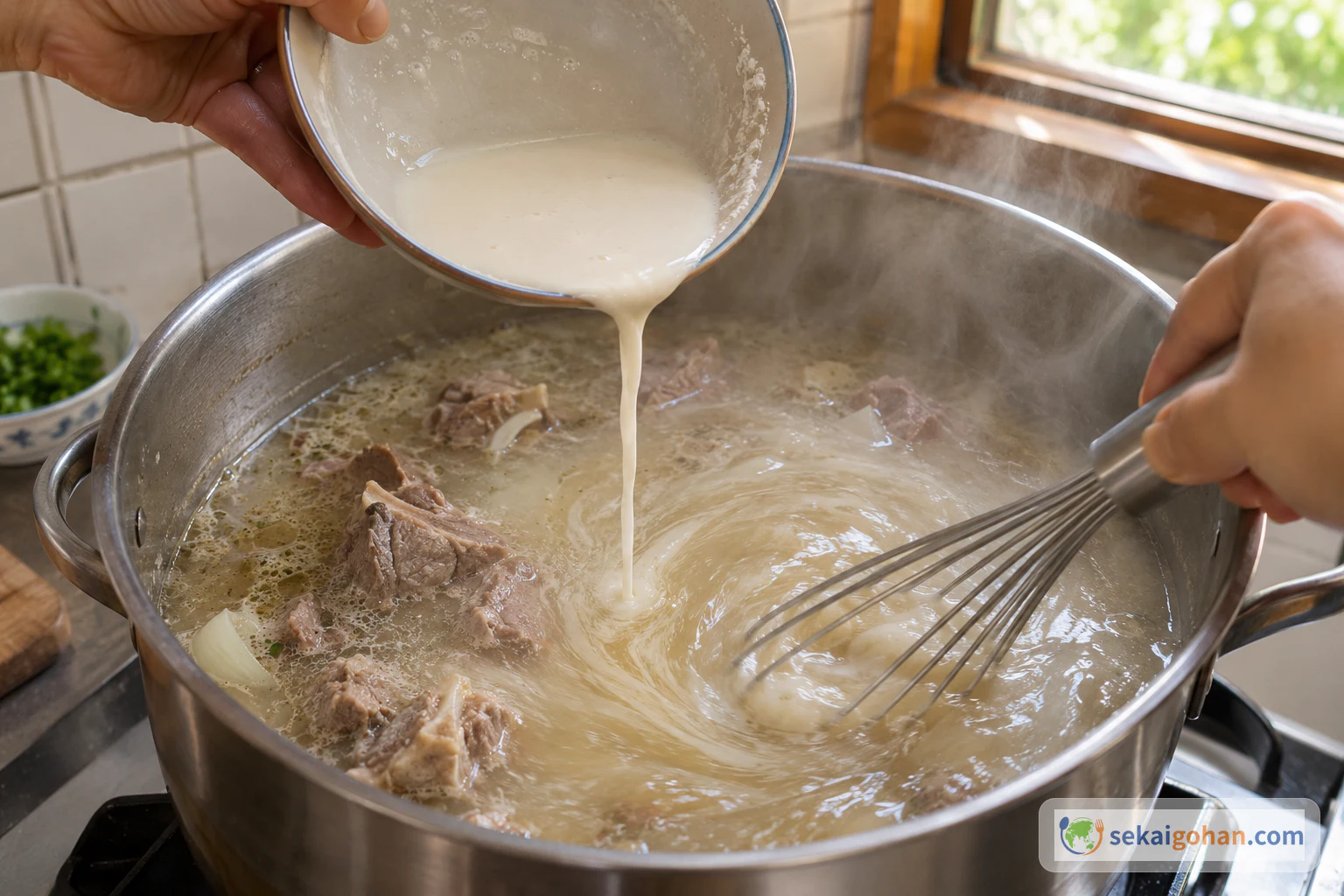
The shop method is slower than the home method. Shops steam the flour for three hours or more until it turns translucent, then cool it and sieve it fine. The lamb is cooked the day before, and the yam and lotus root are steamed ahead. The wine lees are strained twice, through a coarse sieve and then a fine one. The liquid is boiled and skimmed, and the stock is built on whole-lamb broth and tail fat. Flour slurry goes in a little at a time while the pot is stirred, and yellow wine is added at the very end before the heat comes down.
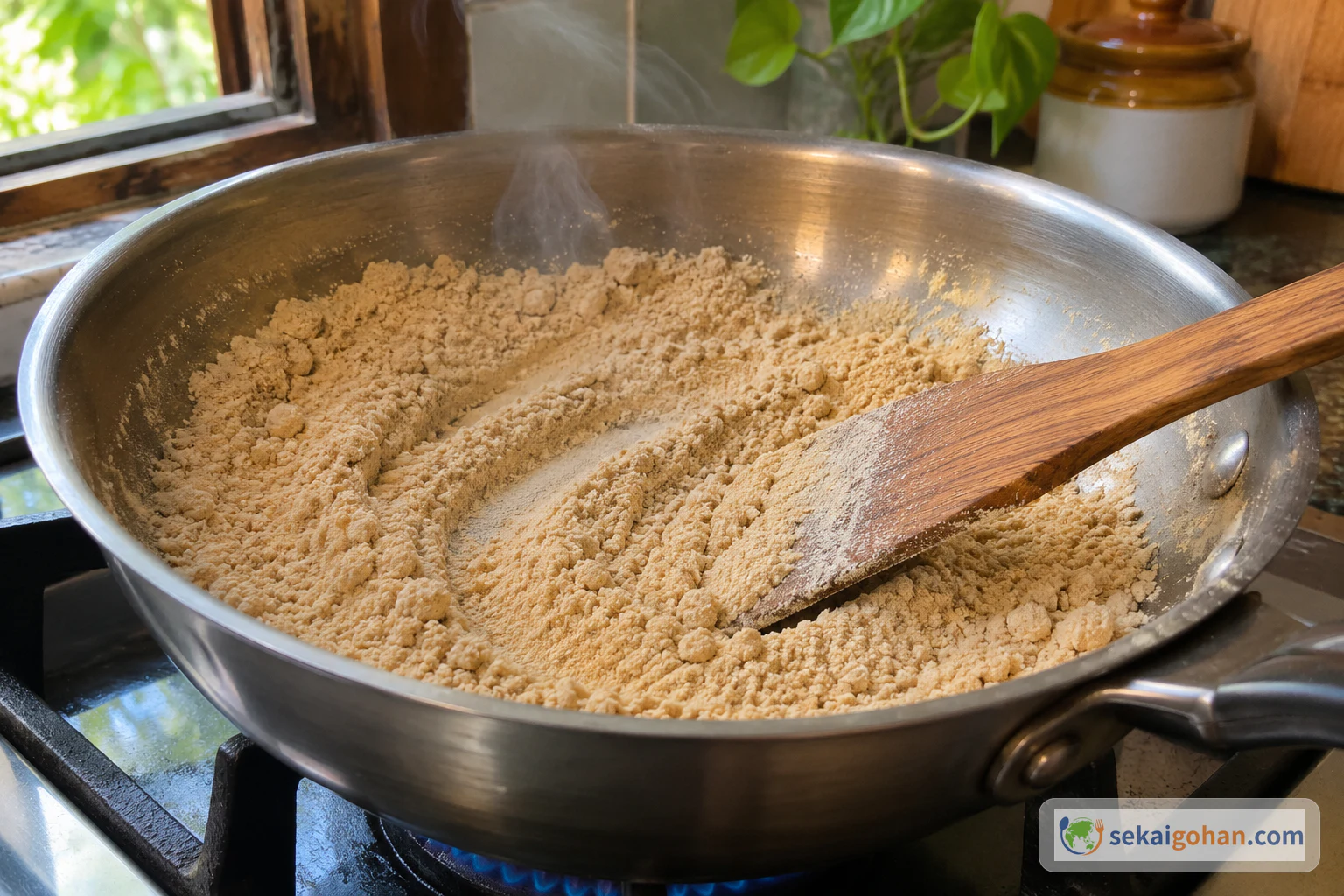
At home the flour is toasted dry and the lees go into the pot as they are. The two methods run in a different order, so cook one or the other from start to finish and keep them separate.
The home recipe below is one version put together for a home kitchen, and Sekai Gohan has not cooked it in a test kitchen. The amounts of star anise, Sichuan peppercorns, ginger, negi, astragalus and water are our suggested starting points, so adjust by taste and by the thickness test in the steps.
Ingredients
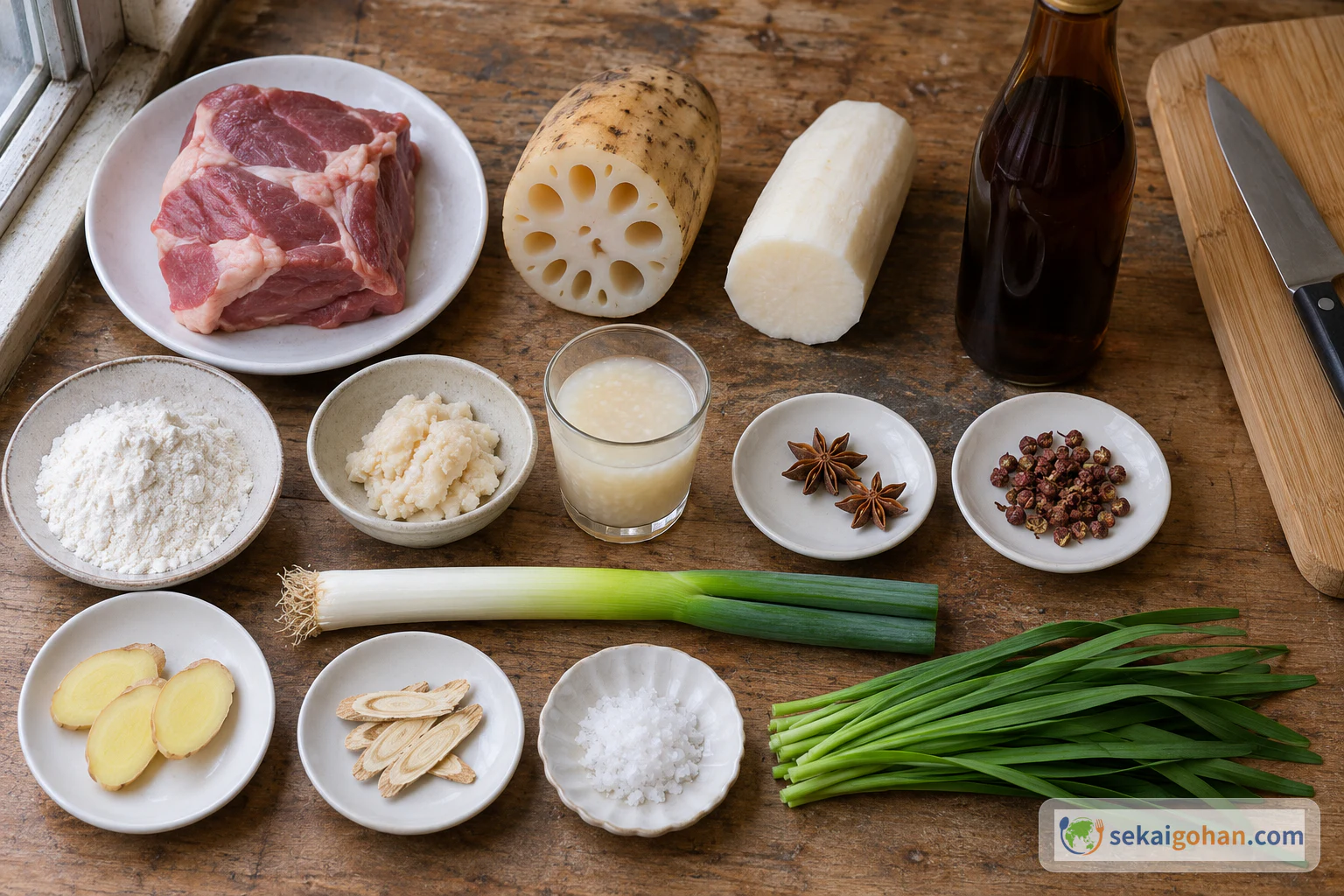
The pale color matters to this dish. Season with salt only, never soy sauce of any kind, and thicken with toasted wheat flour, never cornstarch or potato starch. Starch gives a slippery, clear gloss. Toasted flour gives the soft, opaque body tounao should have.
Contains wheat (flour), lamb and garlic chives (allium family). Shaoxing wine, sake lees and amazake are fermented rice products. Check the labels of the brands you buy.
Equipment
- A heavy pot, 2½–3 quarts (2.5–3 L), enamel or stainless steel, for toasting the flour and simmering
- A second pot for blanching the lamb
- A fine-mesh sieve for the toasted flour
- A wire whisk or wooden spatula for the thickening
- Chopsticks for mixing the slurry
- A small spoon or fine skimmer for the foam
- Measuring spoons
- A large bowl and a dry bowl for cooling the flour
Choosing and substituting
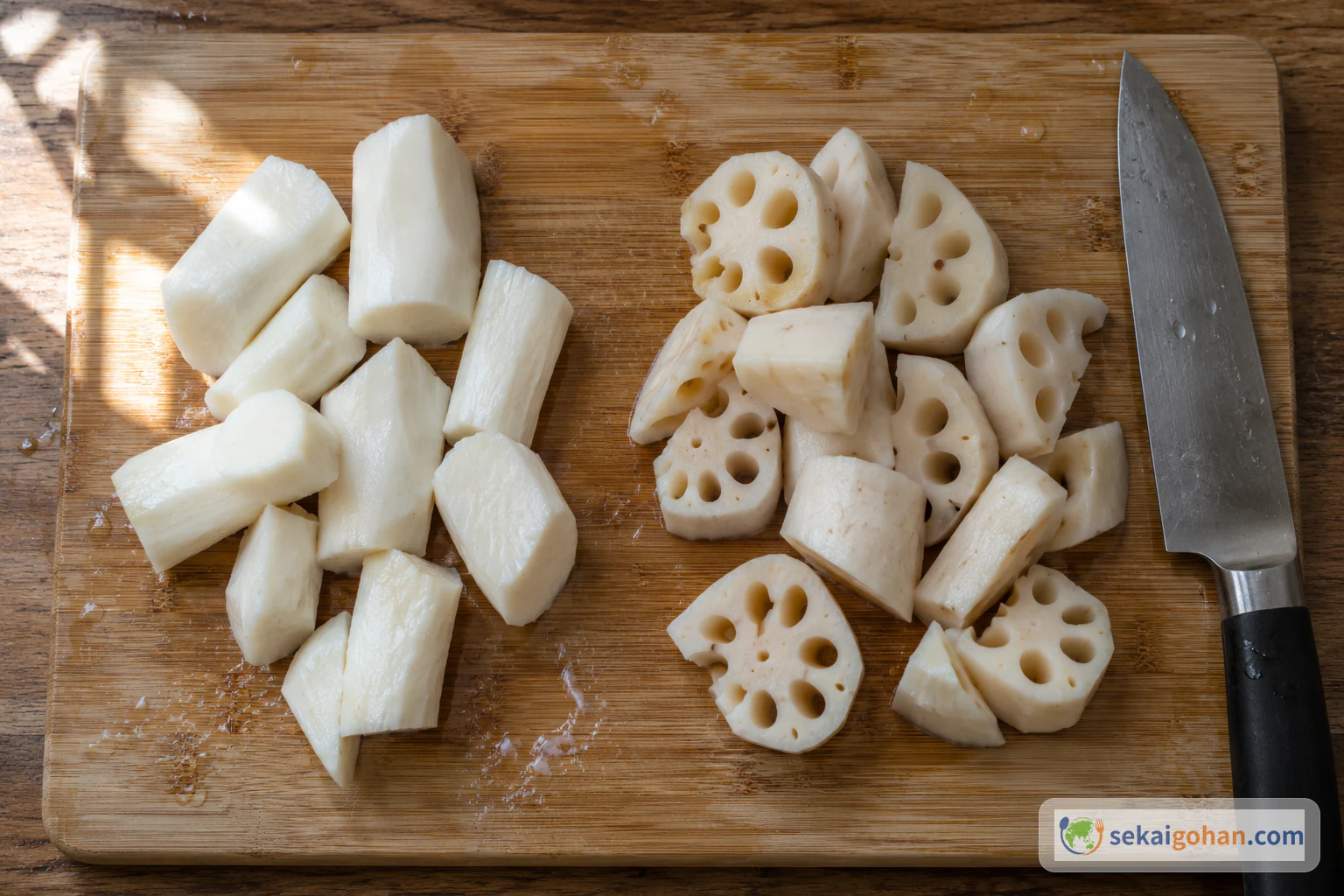
Buy lamb leg as a block, not sliced or diced. Mutton smells stronger, and shoulder cooks differently from leg. Chinese yam (shanyao) is sticky and holds its shape in the pot. Nagaimo or yamato-imo from a Japanese or Asian grocer works the same way, and the stickiness adds to the thickening. Jinenjo is a different plant, so leave it on the shelf. Choose lotus root with thick segments and peel it before cutting. Cake flour or all-purpose flour will do.
The fermented layers need the most care. Shaoxing wine or another Chinese brewed rice wine is the right bottle. Japanese sake changes both the aroma and the saltiness. Sake lees can stand in for Chinese yellow-wine lees, but they differ in salt, acidity and graininess, so the bowl comes out close to the Taiyuan taste and a little different. Rice-koji amazake is sweeter than Chinese fermented rice and has a different wine note. Astragalus is sold as thin, dry, pale slices in kampo pharmacies and shops that stock Chinese herbs.
| Keep for the Taiyuan taste | Fine to let go abroad |
|---|---|
| Toasted wheat flour as the only thickener | Lamb-tail fat (not in the home pot) |
| Two fermented layers: rice wine and lees | Galangal (not in the home pot) |
| Some mutton aroma left after blanching | Maohe bread (toast will do) |
| Salt as the only seasoning | Astragalus, if you accept a near version |
Astragalus (huangqi) is the dried root of Astragalus membranaceus or A. mongholicus, grown in Shanxi among other places. It is sold as an herbal drug, not as an everyday food. If you are pregnant or breastfeeding, take medication, or have a chronic illness, ask a doctor or pharmacist before eating it. Phrases like "restores energy" and "warms the stomach" come from traditional lore and do not describe a proven effect. For children, leave the astragalus out and add one extra slice of ginger.
Shaoxing wine contains alcohol, and simmering does not drive all of it off. For children, during pregnancy and before driving, leave the wine out and season with salt. Use bought sake lees and amazake. Do not brew rice wine or make lees at home for this dish. Buy salted or lightly pickled chives where you can. If you salt your own, make a small amount, keep it in the refrigerator and use it within a few days. Throw it out if it smells off, turns slimy or bubbles with gas.
Method
Blanch the lamb first, and while it boils, cut the vegetables and loosen the lees. Toast the flour and turn it into slurry before the main simmer starts, so it is cool and smooth when you need it. The simmer is the hands-off stretch. Thickening needs you at the stove with a whisk until the bowls are filled.
When it goes wrong
| What you see | Why | What to do |
|---|---|---|
| Stiff, like paste | The slurry went in all at once, or the soup cooked down too far | Loosen with hot water a little at a time. Do not add more flour |
| Flour and broth separate, or lumps form | Not enough stirring, or the heat was too low | Keep the heat on and keep stirring. If it has split, loosen with a little hot water and bring back to a boil |
| Thin, doesn't coat the bowl | Too little flour for the amount of liquid | Toast a spoonful more flour, cool it, make a little more slurry and whisk it in |
| Tastes of raw flour | The flour was toasted too lightly | Cook a little longer after thickening. Next time toast until pale yellow |
| Mutton smell is too strong | The blanching was rushed | Skim again, and add another slice of ginger and a few more Sichuan peppercorns |
| Lees smell too loud | Too much lees, or not boiled after adding | Make sure the pot comes to a full boil. Use less next time |
| Tastes flat | Not enough salt | Add salt a pinch at a time. Soy sauce darkens the soup, so keep it out |
At the table, variations and leftovers
The Taiyuan set
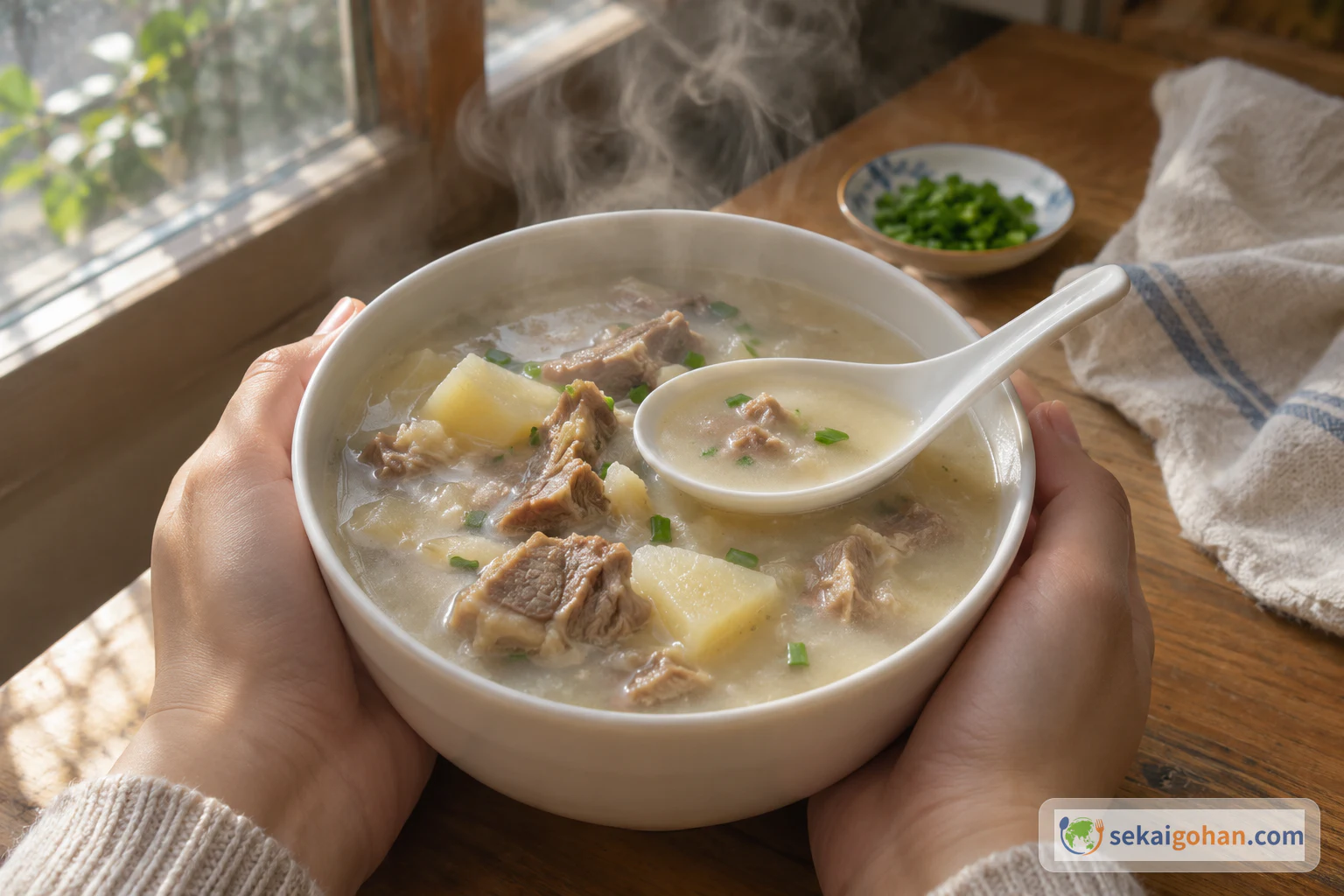
In Taiyuan the bowl comes with company. The classic order is one pot of warm yellow wine, two liang of shaomai and three maohe with your tounao. Shaomai (also written shaomei) are open-topped steamed dumplings filled with lamb and scallion. Maohe are round breads made from unleavened flour mixed with pepper-salt. Two hollow shells are pressed together and baked in an oven, and the result looks like a hat box. Break them into the soup, where they soak up the liquid and stay chewy. People in Taiyuan describe the rhythm as a mouthful of soup, a mouthful of meat, a mouthful of shaomai, a sip of wine, and a few strands of salted chives. The warm wine is optional, and the bowl is complete without it.
Tounao is very thick, and it has long been a breakfast for older people. For anyone who has trouble swallowing, make it thinner with a little hot water and serve a smaller portion.
Variations
- Closer to Taiyuan richness. Add a little lamb fat, about ⅓ oz (10 g), with the lamb in step 5. The soup becomes richer and heavier, moving toward the tail-fat bowls of the shops.
- Toast for dunking. With no maohe, break toasted bread into the bowl. It softens faster and lacks the chewy pull of the oven-baked bread, but it carries the soup the same way.
- Lighter chives. Instead of fully salted chives, toss chopped chives with a little salt and keep them in the refrigerator as a quick pickle. The aroma is gentler and the fermentation risk drops.
Leftovers
The soup sets firm as it cools. Cool it, then refrigerate it promptly in a covered container and eat it the next day. To reheat, put it in a pot with a little hot water and warm it over medium-low heat. Stir from the bottom until it is loose again and steaming hot all the way through.
Frequently asked questions
Can I use mutton or lamb shoulder instead of leg?
Leg is the cut to use. Mutton brings a much stronger aroma, which pushes the bowl further toward the smell some first-timers struggle with. Shoulder cooks differently in the pot. Whatever you buy, get a block and cut it yourself.
Can I make it without alcohol?
Yes. Leave out the Shaoxing wine and season with salt. The bowl loses one of its fermented layers and tastes simpler, so taste carefully at the end and adjust the salt.
Can I use Japanese sake instead of Shaoxing wine?
You can. The aroma changes and the saltiness changes too. Shaoxing wine carries part of the seasoning, so with sake you may need a little more salt at the end. Add it in pinches.
Is this the same as Shanghai tounao or doufunao?
No. Shanghai has a dish with the same name, and it is sweet. It is made with fried dried glutinous rice cake, eggs, chicken, ham, pork, rock sugar and sweet fermented rice juice, which makes it entirely different from the Taiyuan lamb soup. Doufunao, "tofu brain", is soft set tofu with a sauce poured over it. Only the "brain" in the name connects the three.