Ingredients and steps on one page. Print it, or choose “Save as PDF” in the print dialog.
Sekai Gohan
Zhimaqiu (Jin Deui): Cantonese Fried Sesame Balls with Red Bean Paste
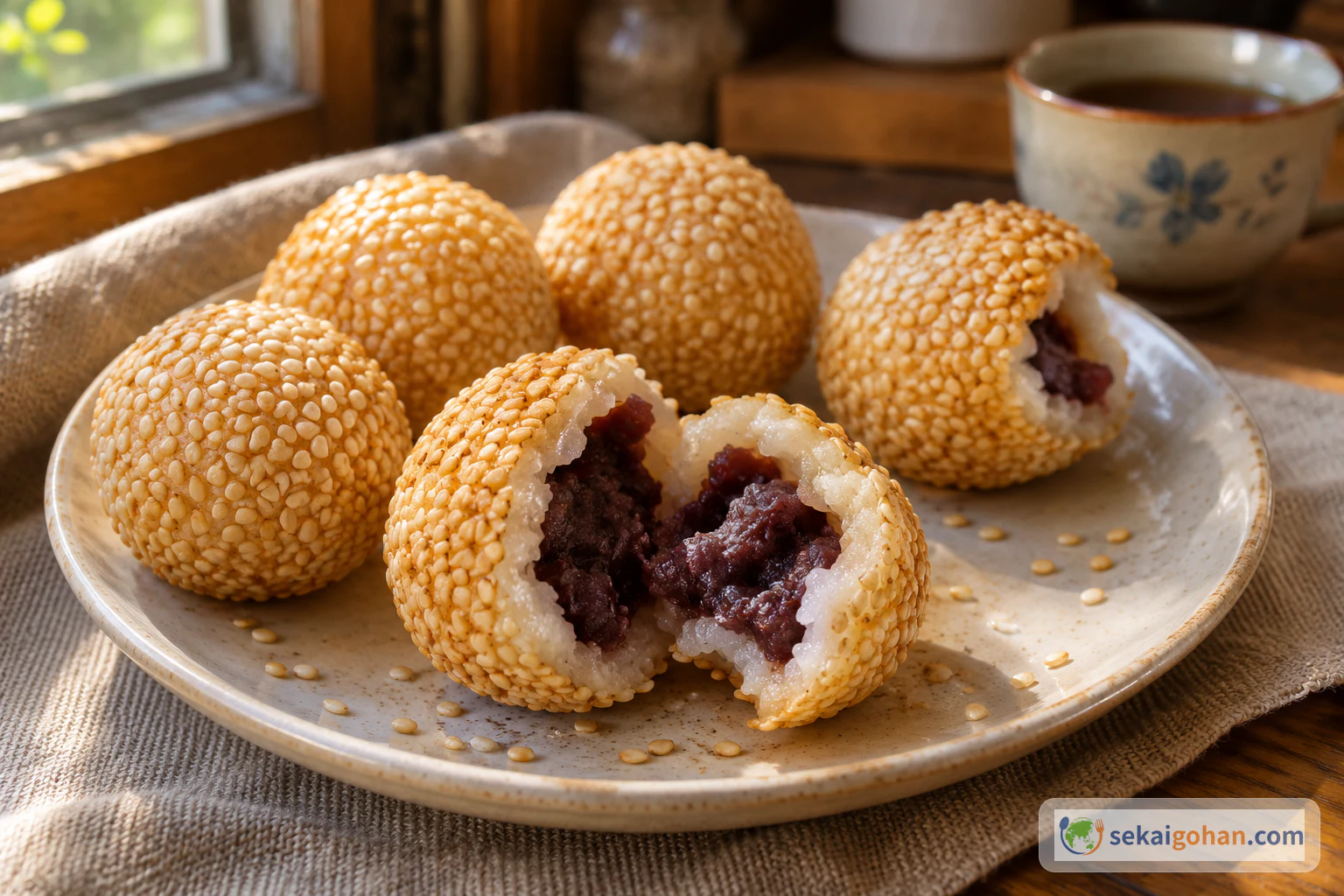
Ingredients
| Ingredient | Amount | Role |
|---|---|---|
| Water-milled glutinous rice flour (糯米粉), for the dough | ¾ cup (90 g), then ⅓ cup (40 g), plus up to ½ oz (15 g) more if needed | The body of the dough; scalded starch gives it the stretch to puff |
| Water, for the dough | ½ cup + 1 tbsp (128 g) | Brought to a boil with the sugar to scald the flour |
| Granulated sugar | ¼ cup (50 g) | Sweetness, moisture and the pale golden color |
| Neutral oil, for the dough | 1¼ tsp (5 g) | Makes the dough smooth and slows drying |
| Red bean paste (紅豆沙) or lotus seed paste (蓮蓉), smooth or chunky | ½ cup (150 g) | The sweet center |
| Water-milled glutinous rice flour, for the slurry | 1½ tbsp (11 g) | Thin glue that holds the sesame |
| Water, for the slurry | ¼ cup (57 g) | Thins the slurry |
| Raw white sesame seeds | ½ cup (71 g) | The crisp, nutty coat |
| Neutral oil, for frying | 6 to 8 cups, enough for 2 inches (5 cm) in the pot | Carries gentle, steady heat |
Steps
1Scald the flour with hot syrup
Weigh ¾ cup (90 g) glutinous rice flour into a heatproof bowl. In a small saucepan, bring ½ cup + 1 tbsp (128 g) water to a boil, add ¼ cup (50 g) sugar and stir until it dissolves completely. Take the pan off the heat and wait 10 seconds. Pour the syrup onto the flour in a thin stream, stirring the whole time with chopsticks. It is ready when it has become a thick, wet paste with no white dry flour left and it feels heavy on the chopsticks.
2Knead in the rest of the flour and the oil, then rest
Add the remaining ⅓ cup (40 g) flour and mix with a spatula until even and no longer sticky to the touch. If it still clings, add more flour 1 tbsp at a time, up to ½ oz (15 g). Add 1¼ tsp (5 g) oil and knead in the bowl or on the counter until the dough is smooth and feels like soft modeling clay. Wrap it tightly and leave it at room temperature for 30 minutes, without unwrapping. It is rested when the surface is glossy, springs back slowly when pressed, and shows no cracks.
3Portion and chill the filling
While the dough rests, divide ½ cup (150 g) bean paste into 16 pieces of about ⅓ oz (9 g) each. Roll each one smooth between your palms and line them up on a small tray. Cover with plastic wrap and refrigerate. Firm filling keeps its shape when you close the dough around it; soft filling spreads, thins the wrapper and breaks through. The balls are ready when they hold their shape under a light press of a finger.
4Divide the dough
Unwrap the dough and roll it into a rope about 10 inches (25 cm) long. Cut it into 16 pieces of about ⅔ oz (18 g) each. Cover the pieces with plastic wrap as you cut them, because exposed dough dries fast and tears when you wrap. If a piece starts to feel dry, mist it very lightly with water. The pieces are right when they are soft, smooth and pliable, with no cracking at the cut edges.
5Wrap the filling and seal
Press one piece of dough in your palm into a disc 1½ to 2 inches (3.8 to 5 cm) across. Cup your hand so the edges rise and the disc becomes a shallow well, then set a ball of filling in the middle. Gather the edges up and pinch them together, then roll the ball gently between your hands or on the counter without squashing the filling. Repeat with the rest, keeping finished balls covered. Each one is done when the seam is fully closed with no paste showing, because any gap opens up in the oil.
6Dip in the slurry
Stir 1½ tbsp (11 g) flour into ¼ cup (57 g) water to make a thin, milky slurry. Dip one ball at a time, rolling it so the whole surface is coated. Lift it out and let the excess drip back into the bowl; a dripping-wet ball makes the oil spit. Each ball is ready when it is evenly wet and shiny, with no drops falling from it.
7Coat with sesame and press it in
Put ½ cup (71 g) raw sesame seeds in a bowl. Roll each wet ball in the seeds until it is covered all over, then cup it between both palms and roll gently, pressing the seeds into the dough. This pressing is what keeps the coat on during the long fry. Leave the coated balls uncovered on a tray. They are ready when the seeds cover the ball with no bare patches and none fall into your palms.
8Fry low until the balls float and swell
Pour oil into a heavy pot to a depth of 2 inches (5 cm) and heat it to 250°F (121°C), checking with a thermometer. Slide in 6 to 8 balls, no more than fit without touching, and stir gently so they do not stick to the bottom. Fry for 4 to 6 minutes, stirring now and then. This stage is done when the balls lift off the bottom, float and swell to a size larger, while they are still pale.
9Keep frying until pale gold and firm
Fry for another 8 to 10 minutes, pressing the balls under the oil now and then with the back of the slotted spoon. Hold the oil near 250°F (121°C) and never let it go above 300°F (149°C). This second stretch dries and firms the shell so it holds up as it cools. Stop when the sesame is lightly colored and the dough is pale golden and firm when pressed; frying longer makes the seeds bitter. Lift the balls onto the rack to drain, bring the oil back to 250°F (121°C), and fry the second batch the same way.