Ingredients and steps on one page. Print it, or choose “Save as PDF” in the print dialog.
Sekai Gohan
Tanmen: Kanto Salt Broth Noodles with Stir-Fried Vegetables
Ingredients
| Ingredient | Amount | Role |
|---|---|---|
| Thinly sliced pork offcuts (buta komagire) | 5 oz (150 g) | The meat and the savoury base of the broth |
| Sake (sake) | 2 tsp | Seasons the pork and takes away its raw smell |
| Salt, for the pork (shio) | a little | Seasons the pork before cooking |
| Ground pepper, for the pork (koshō) | a little | Seasons the pork before cooking |
| Cabbage (kyabetsu) | ¼ head (about 5 oz / 150 g) | The main vegetable; sweetness and bite |
| Carrot (ninjin) | ¼ | Colour and sweetness |
| Bean sprouts (moyashi) | 3½ oz (100 g) | Volume and crunch; washed and well drained |
| Toasted sesame oil, for frying (goma abura) | 1 tbsp | Frying fat and aroma |
| Toasted sesame oil, to finish (goma abura) | 1 tsp | Raw aroma over the finished bowl |
| Water | 2½ cups (600 ml) | The soup |
| Chicken stock powder (torigara sūpu no moto) | 1 tbsp | The backbone of the broth |
| White pepper (howaito peppā) | a little | A soft, clean back note in the soup |
| Salt, for the soup (shio) | to taste | Final seasoning |
| Fresh Chinese noodles (chūka men, nama) | 2 portions | The noodles |
| Coarsely ground black pepper (arabiki kuro koshō) | to taste | The sharp top note at the table |
Steps
1Season the pork and cut the vegetables
Put the pork in a bowl and rub in the sake, a little salt and a little pepper with your hands. Cut the cabbage into rough bite-size pieces and the carrot into thin matchsticks. Wash the bean sprouts and drain them well. The pork is ready when its surface looks moist and no liquid is pooling in the bowl.
2Fry the pork in sesame oil
Heat 1 tbsp sesame oil in the frying pan over medium heat until it shimmers. Add the pork and spread it out so the slices touch the pan. Stir only now and then so it picks up a little colour. Move on when the edges have turned white and about half the pink is gone.
3Stir-fry the cabbage, carrot and bean sprouts
Add the cabbage and carrot to the pork and stir-fry for about 2 minutes. Add the bean sprouts and toss them through quickly. Keep the heat at medium, high enough that the vegetables fry rather than weep, low enough that nothing scorches. Stop when the cabbage edges look translucent and the carrot is just starting to bend, with no dark browning.
The sprouts decide the brothBean sprouts are mostly water. Drain them well and give them only a quick toss before the broth goes in; fried too long, they wilt and their water thins the soup.
4Add the broth and simmer
Pour in the water, the chicken stock powder and a little white pepper. When it comes to a boil, skim off the grey foam that gathers at the edges. Simmer over medium heat for about 3 minutes, until the vegetables have settled into the broth. The soup is ready for seasoning when it has turned faintly cloudy and the vegetables have sunk and moved as one.
5Season with salt and check the pork
Taste the broth before adding any salt, since stock powders differ a lot in saltiness. Add salt in small pinches, stirring and tasting after each one. Lift out a piece of pork and cut it open. Stop salting when the broth tastes bright and savoury rather than flat, and the pork is cooked through to the centre.
Cook the pork throughThe pork must reach 167°F (75°C) at its centre for at least 1 minute. Without a thermometer, cut a piece open: the juices run clear and the centre has turned whitish. Pork is never eaten raw.
6Boil and drain the noodles
Drop the noodles into the separate pot of boiling water and cook them to the time on the pack. Drain them in the strainer and shake hard so no water clings. Divide them between two bowls, warmed with hot water if you have a minute. They are right when they look glossy and no water collects in the bottom of the bowl.
7Pour, drizzle and pepper
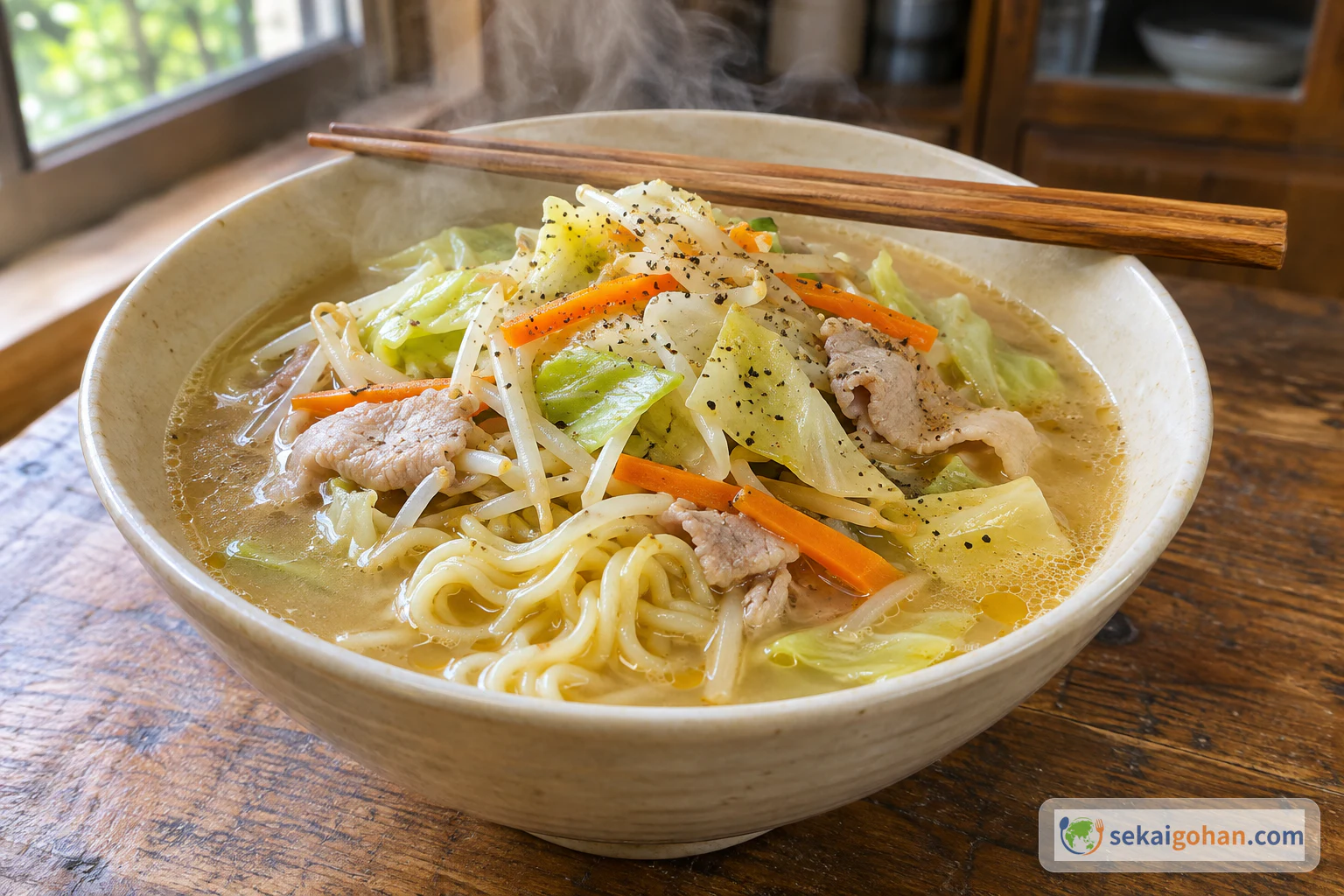
Pour the soup and vegetables over the noodles, filling each bowl to about four-fifths. Drizzle 1 tsp sesame oil over the two bowls. Grind coarse black pepper on top just before you eat. The bowl is done when the oil shows as a faint sheen across the surface and the pepper smell rises with the steam.
Two oils, two jobsThe tablespoon of sesame oil in the pan is for frying; the teaspoon at the end is never heated, so it keeps the full toasted smell. Leave out the finishing oil and the bowl loses the aroma that marks it as a diner tanmen.