Ingredients and steps on one page. Print it, or choose “Save as PDF” in the print dialog.
Sekai Gohan
Temaki: Japanese Hand-Rolled Sushi in Nori Cones
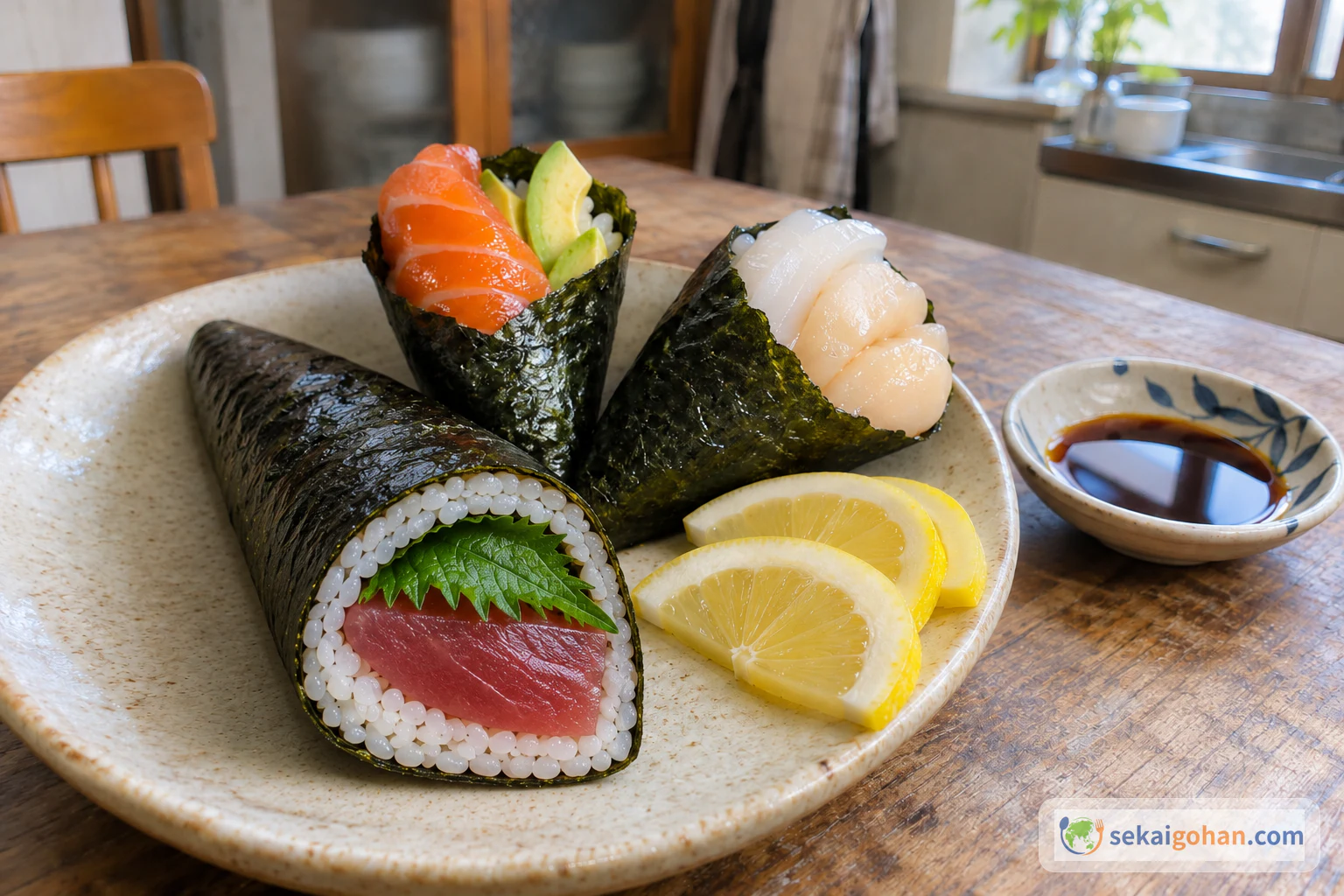
Ingredients
| Ingredient | Amount | Role |
|---|---|---|
| Japanese short-grain rice (kome) | 1½ cups (2 gō) | The body of the sushi rice |
| Water | 1½ cups (2 gō) | For cooking the rice |
| Kombu (dried kelp) | one 2-inch (5 cm) piece | Quiet savoury depth in the rice |
| Rice vinegar (komezu) | 4 tbsp | The sourness of the sushi rice |
| Sugar | 2 tbsp | Sweetness and gloss |
| Salt | 1 tsp | The backbone of the seasoning |
| Tuna, sashimi grade (maguro) | 3 oz (80 g) | The lean red filling |
| Salmon, sashimi grade | 3 oz (80 g) | Rich, fatty sweetness |
| Squid, sashimi grade (ika) | 1½ oz (40 g) | Chew and sweetness |
| Scallops, sashimi grade (hotate) | 1½ oz (40 g) | Soft sweetness |
| Sweet shrimp (amaebi) | 4 | Sweetness and colour |
| Salmon roe (ikura) | as needed | Salty pops of colour |
| Avocado | ¼ | Creamy richness |
| Okra | 2 pods | Slippery texture and a green note |
| Radish sprouts (kaiware) | ⅓ small pack | Peppery bite |
| Onion, thinly sliced | a little | Sharpness and sweetness |
| Lemon, sliced into rounds | as needed | Brightness |
| Green shiso leaves (aojiso, also called ōba) | as needed | Fresh herbal aroma |
| Leaf lettuce | as needed | Crunch and a soft wrapper |
| Toasted nori (yakinori) | 8 full sheets, cut into 16 halves | The wrapper |
| Soy sauce | to taste | Dipping |
Steps
1Rinse the rice and mix the vinegar blend
Wash the rice in cold water, swirling it with your hand and pouring off the cloudy water until it runs nearly clear. Tip it into a sieve and leave it to drain for 30 minutes to 1 hour. Meanwhile, stir the rice vinegar, sugar and salt together in a small bowl. Salt dissolves slowly in vinegar, so do this well ahead. The rice is ready when a grain crushes easily between your fingers, and the blend is ready when no grains of salt remain at the bottom of the bowl.
2Cook the rice with kombu
Put the drained rice in the rice cooker with the water and the piece of kombu, and start it. When it finishes, open the lid and lift out the kombu. The rice should be fluffy, steaming and firm, with each grain standing up rather than collapsing into the others.
3Season and fan the rice
Turn the hot rice into a wide bowl, tray or sushi tub and pour the vinegar blend evenly over it. Leave it for 1 minute. Then cut through the rice with the paddle in slicing strokes, turn it over once, spread it flat and fan it. Stop mixing once the vinegar is in, because constant stirring makes the rice sticky. It is done when the steam has gone, the grains are glossy and separate, and a hand held just above the rice feels only a faint warmth. Cover it with a damp cloth until you roll.
4Cut the nori in half
Lay a full sheet of nori on a dry board and cut it straight across the middle with kitchen scissors. You get two long, narrow half sheets. Stack them as you go and keep the stack together until the table is set. When you finish, there are 16 neat half sheets with clean, straight edges.
5Cut the seafood
Use the board you keep only for raw seafood. Press each piece lightly with paper towel to take off surface moisture, and look it over as you cut. Cut the tuna and salmon so that each roll gets 2–3 pieces, and cut the squid and scallops into thin strips. Leave the tails on the sweet shrimp. The pieces should lie inside a half sheet with a little room to spare: big enough to taste, small enough for the nori to close.
Small pieces close the rollFish cut too large keeps the nori from closing, and fish cut too fine loses its texture. Cut the tuna and salmon so that each roll gets 2–3 pieces, and the rice and filling will both stay inside.
6Boil the okra and prepare the garnishes
Boil the okra pods in a small saucepan of water until tender, then slice them into thin rounds and drain them in a strainer. Slice the onion thinly. If it tastes too sharp, soak the slices in water for a while, then drain. The okra is ready when the rounds are bright green with a clear star shape in the middle and no water pooling around them.
7Set out the platter
Cut the avocado quarter into 8–10 slices now, just before serving. Arrange the seafood, avocado and okra on a large platter in separate groups, with the radish sprouts, onion, lemon rounds, shiso leaves and lettuce beside them. Put the salmon roe in a small bowl of its own so it does not roll around. Bring the rice, the stack of nori and small dishes of soy sauce to the table. The platter is ready when every filling sits in its own clear group and everyone can reach it.
8Roll the cone
Hold a half sheet with the long side across. From the middle of the sheet toward the left, place a small amount of rice and press it into a triangle. Lay the filling over the rice at a slant, pointing toward the upper left. Lift the bottom-left corner of the nori and roll it up toward the upper right, wrapping the rice and filling into a cone. The roll is right when the nori is unbroken, the rice stays inside, and about ½ inch (1 cm) of nori is left at the end of the wrap.
Less rice than you thinkToo much rice is the most common reason a hand roll will not close. Keep the triangle small and thin. The filling should be the bulk of each bite, and the nori should wrap easily around it.
9Dip and eat
Dip the filling end of the cone lightly in soy sauce. A little wasabi goes well with it, but it is optional. Eat each roll the moment it is rolled, then reach for the next sheet and a new combination. A good roll holds its cone shape in your hand from the first bite to the last.