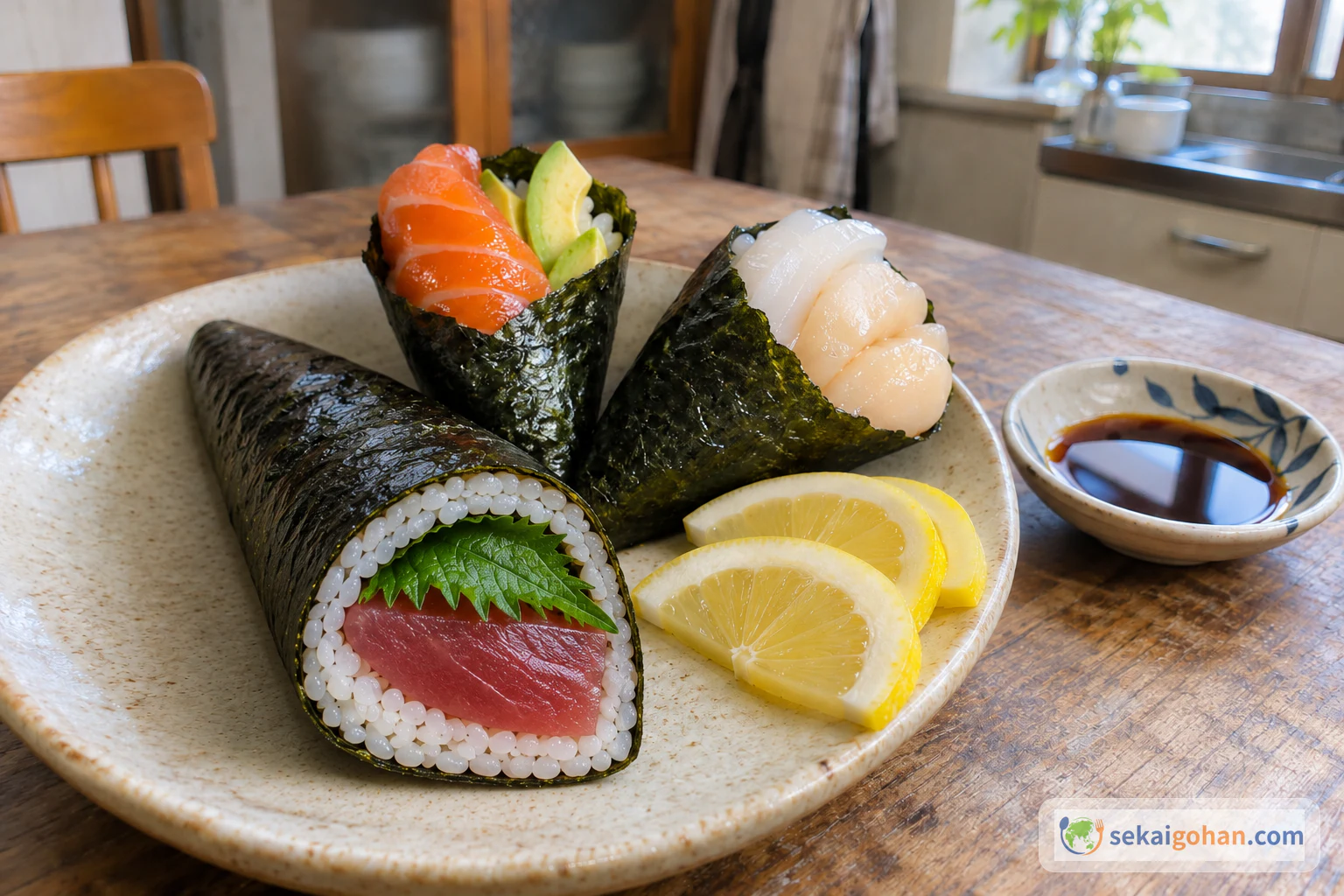
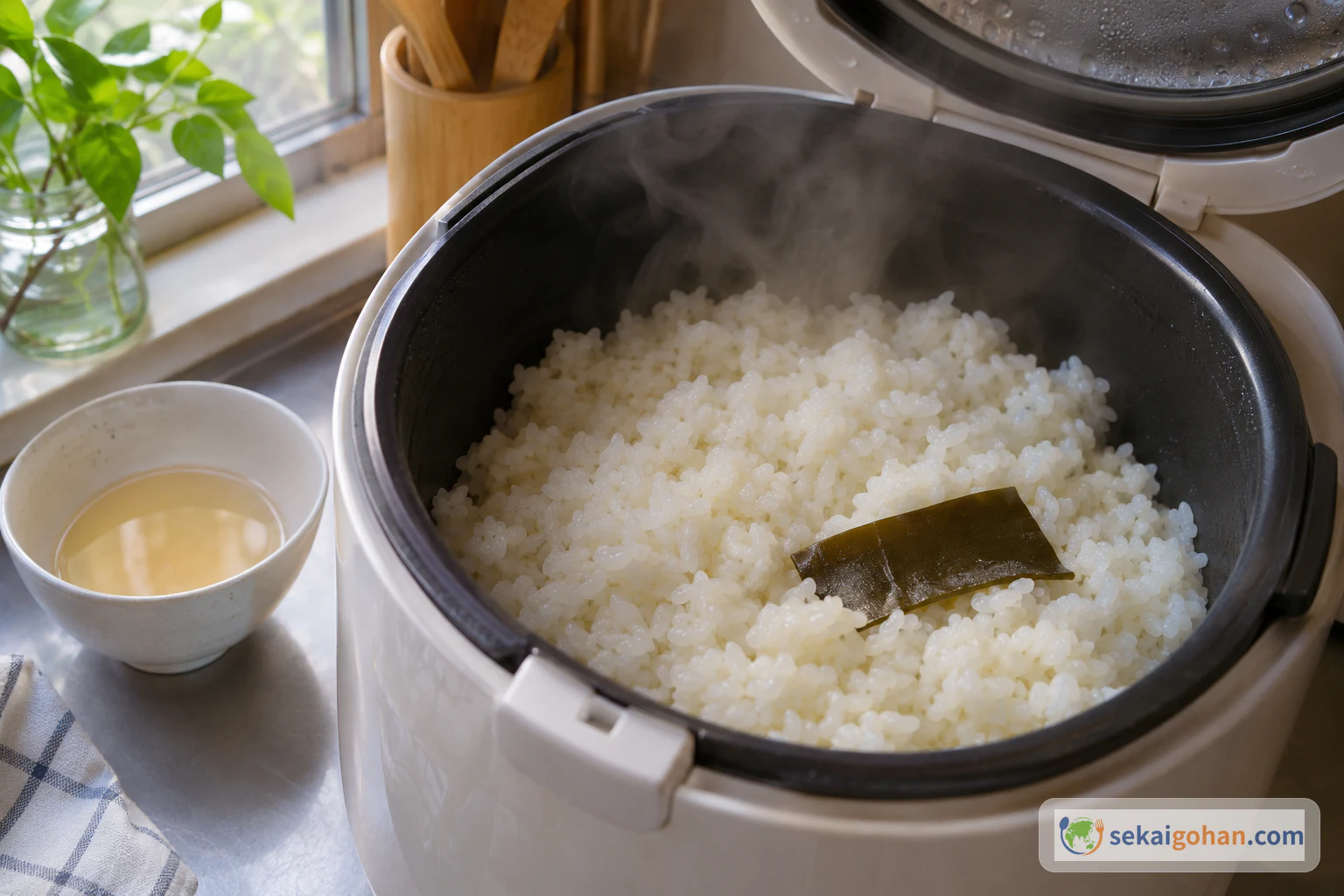
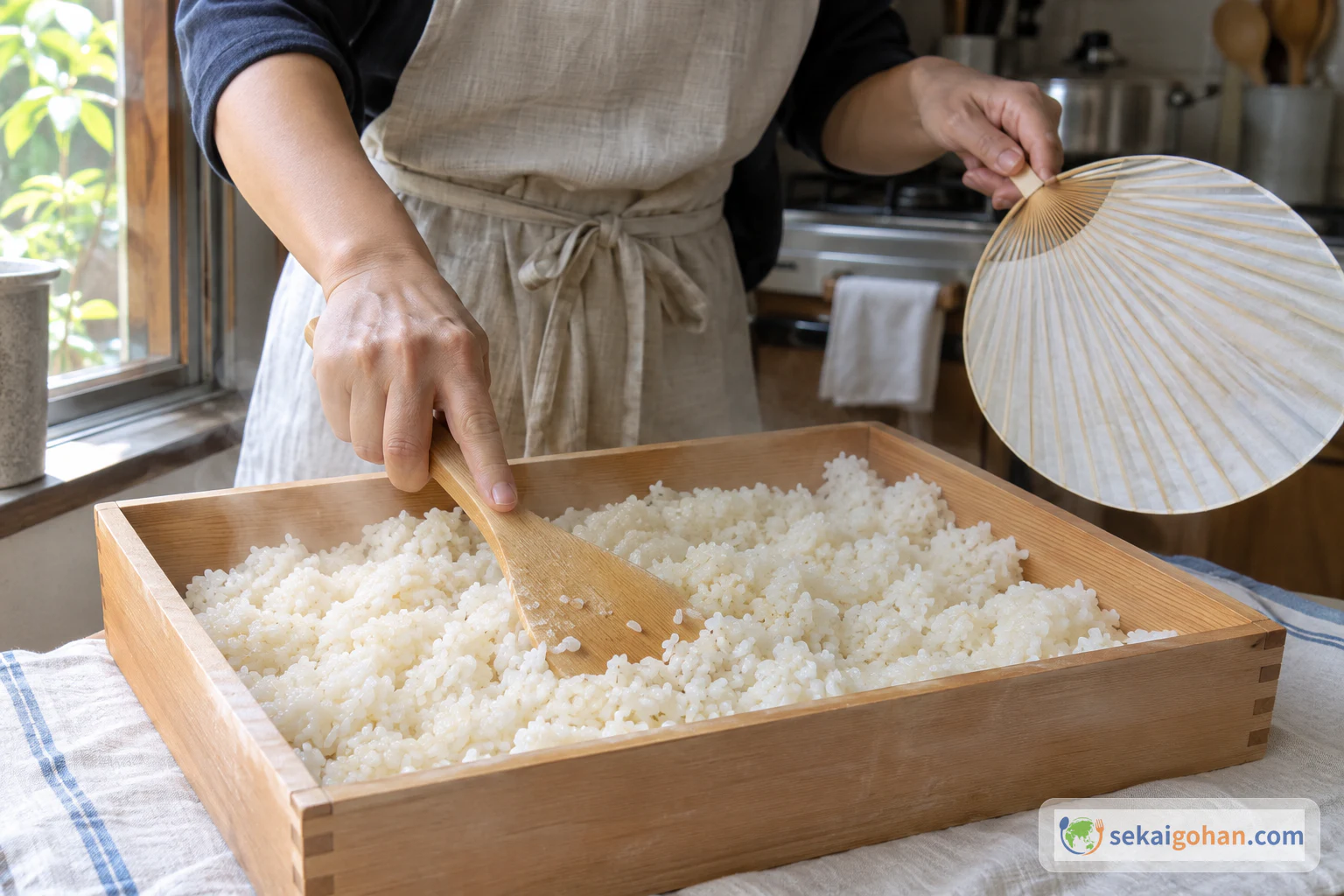
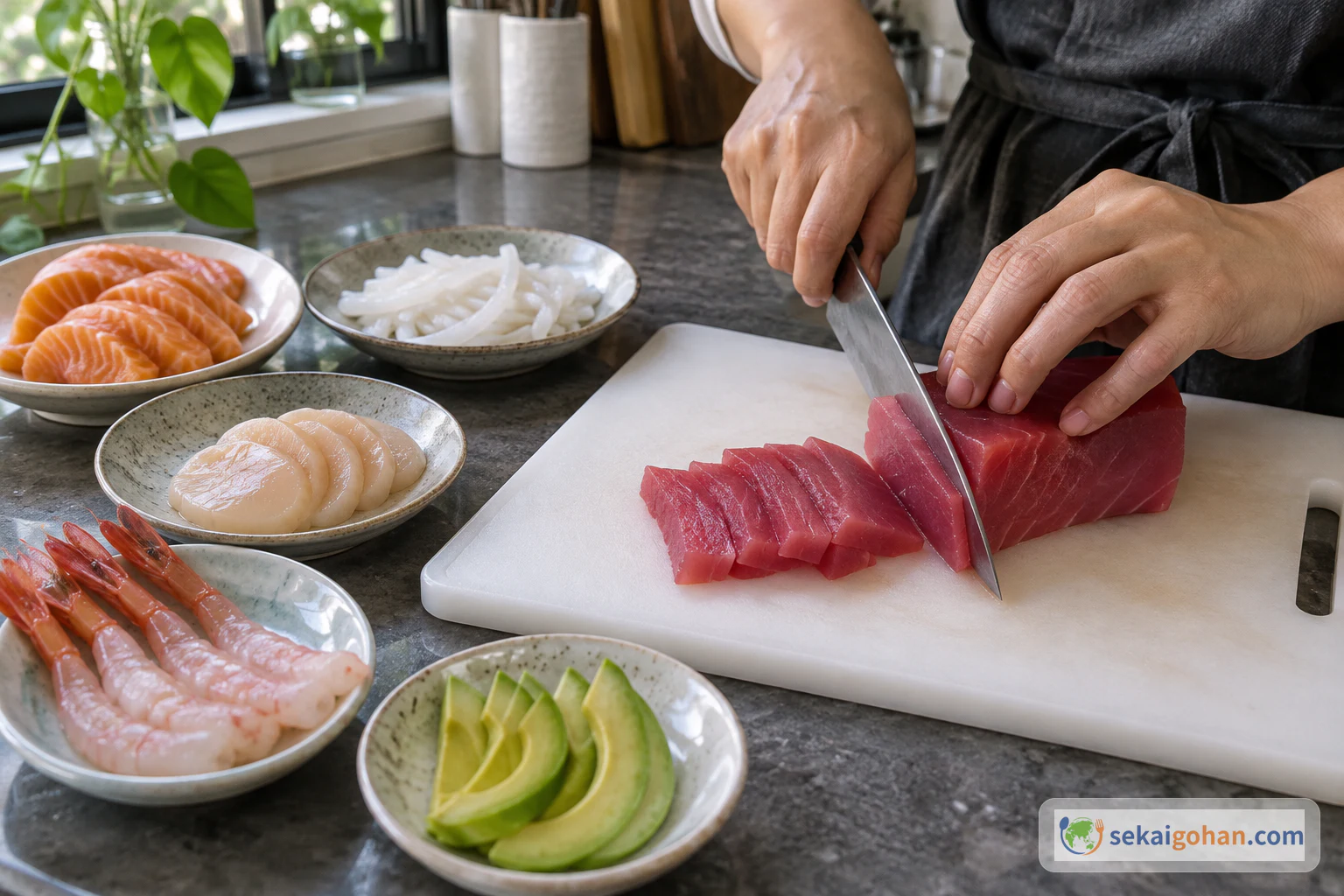
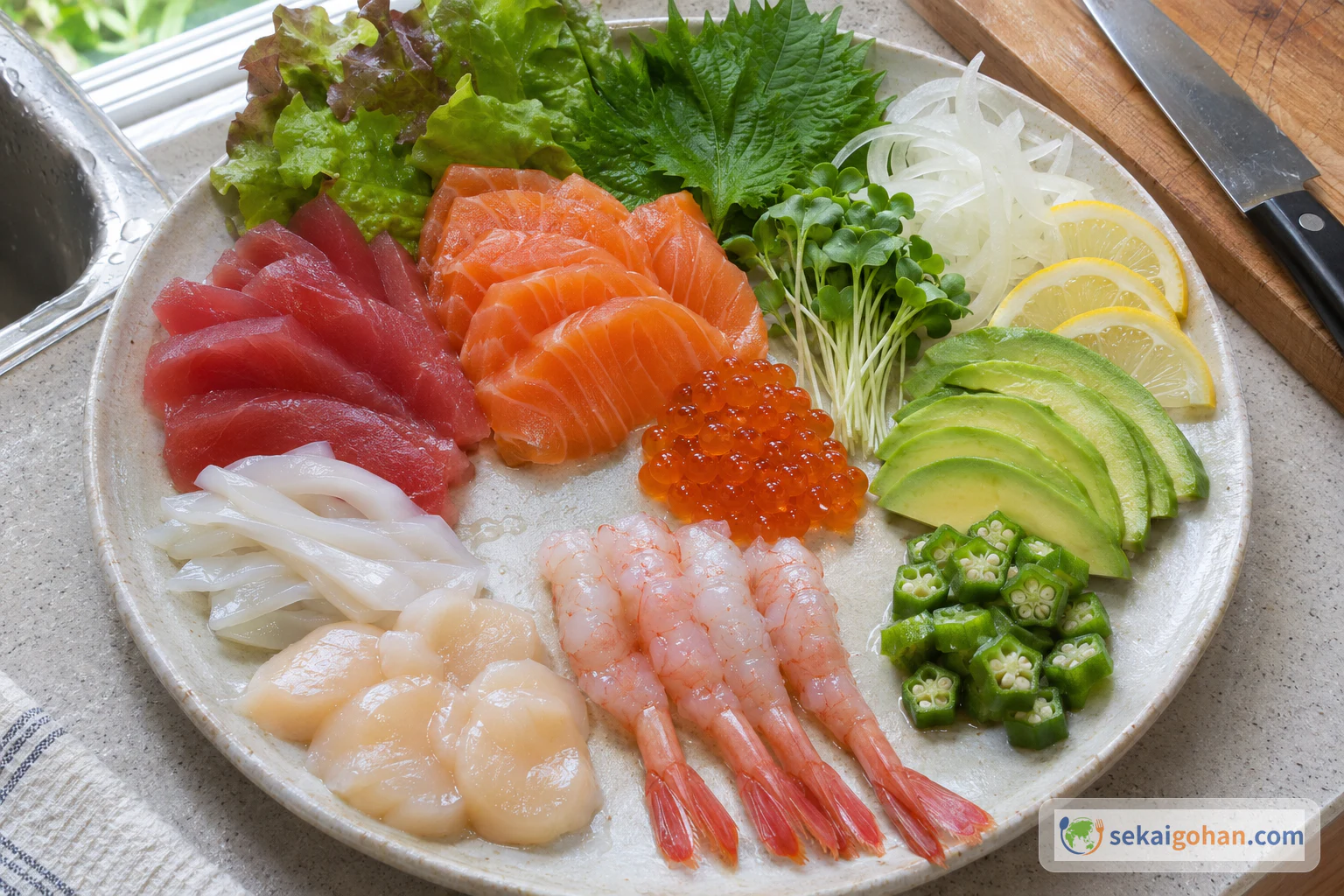
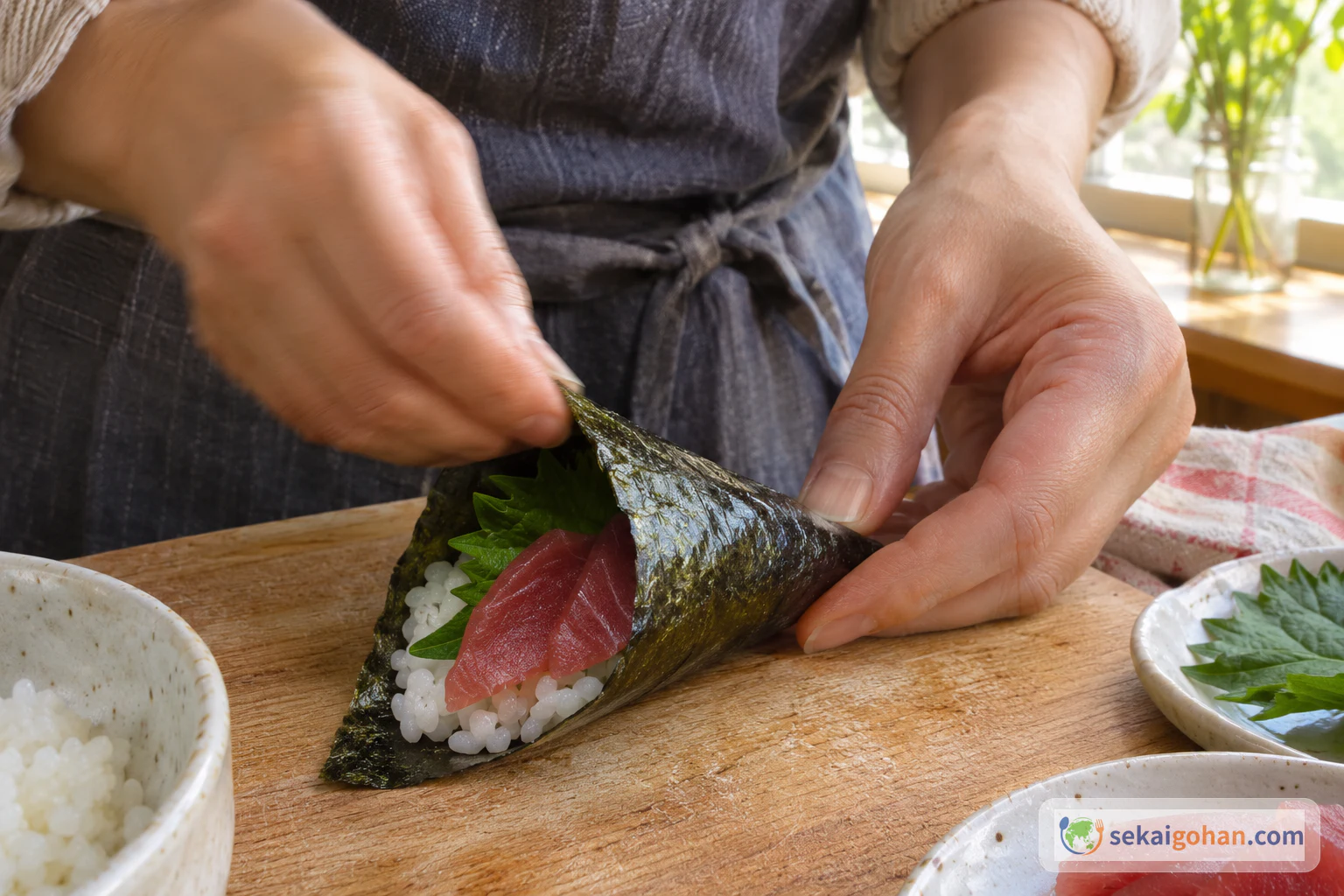
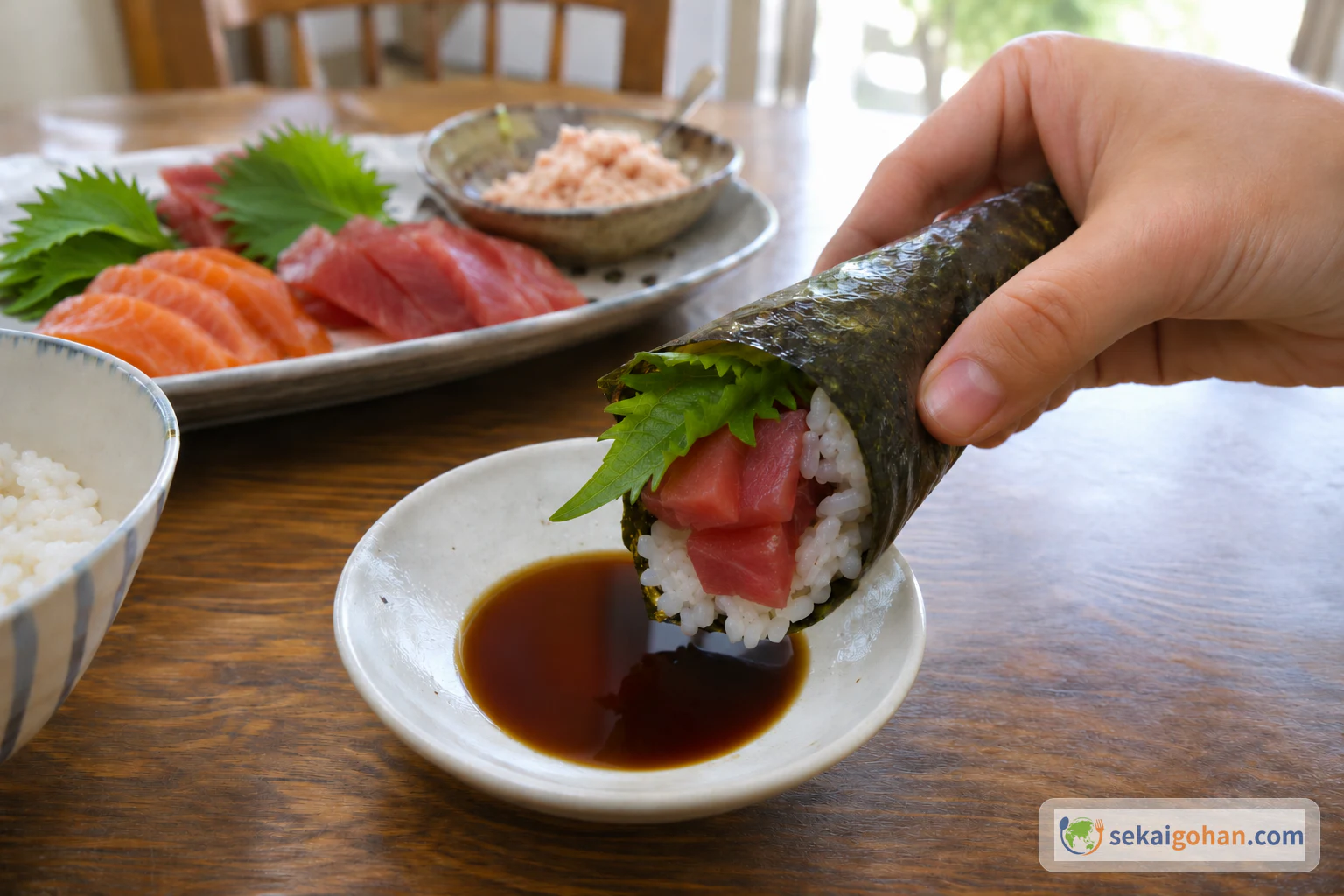
The rice cooker opens with a cloud of steam. Vinegar goes over the hot rice, the sharp smell rises for a moment, and then someone starts fanning while the paddle cuts through the grains. On the table, a platter of tuna, salmon, squid and shiso waits beside a stack of nori. Everyone takes a sheet, adds a little rice and whatever they like, rolls it into a cone and eats it on the spot. That is temaki, Japanese hand-rolled sushi. The rice is lightly sweet and sour, the fish is cool and soft, and the nori crackles on the first bite.
Sushi You Roll Yourself, at Home
In Japan, temaki is the sushi of the home table. A sushi chef does the work for nigiri before anything is shaped. Fish is simmered, steamed, boiled, marinated in soy sauce, pressed in kombu or washed in vinegar. At home, all of that falls away. The cook makes the rice, cuts the fillings and sets everything out, and each person builds their own roll. Fillings change from shop to shop and family to family, so the right way to set the table is many kinds in small amounts.
The day it gets made is usually a weekend, a birthday, or an evening when people gather. Children like it because they get to roll their own. The nori industry has made the third Saturday of every month Temaki Sushi Day, a day for families to sit down and eat together and for children to learn about food.
From rice-filled nigiri to filling-first rolls
Sushi began as preserved food. In the Heian period, salted fish was packed in rice and left to ferment. The Edo period brought faster styles: quick sushi, pressed sushi and finally nigiri, which became a hit as street-stall food in Edo, today's Tokyo. Three shops of that time are still remembered by name: Kenuki-zushi, Yohei-zushi and Matsu-ga-zushi. Edo nigiri carried about three times as much rice as today's. It was a snack meant to fill you up with rice. Traditional Edo-mae sushi rice takes no sugar at all. The home blend in this recipe is sweeter.
Today the filling is the focus. Sushi is everyday food, sold at conveyor-belt restaurants, department-store food halls, supermarkets and convenience stores, and temaki is now one of the most popular ways to eat it. Rolled sushi is usually dated to between 1750 and 1776 and is thought to have become common by 1783. Its roots lie in bō-zushi, a fermented sushi pressed into a log. Edo tended to favour thin rolls, while the Kansai region tended to prefer thick ones. In the Edo period, rolls were bought, not made at home. Making sushi in a home kitchen is usually placed around the Taishō era. When families first started rolling their own cones at the table is not settled.
The sheet that makes the roll
Nori has a longer written history than sushi rice. Its oldest mention is generally placed in the Taihō Code of 701. The Yōrō Code of 757 lists murasaki-nori as a tribute item, and the Engishiki of 927 records it as a tax good, served in soups at official banquets and seasonal festivals. In the Edo period, cultivation began in Tokyo Bay around Shinagawa and Ōmori to supply Tokugawa Ieyasu. By the middle of the period, square sheets pressed on bamboo screens had appeared, and production grew. Toasting nori is credited to Tanaka Magozaemon of the Miuraya shop in Ōmori, who sold it in glass jars in 1844. The name yaki-nori (toasted nori) settled in the middle of the Meiji era. In 1949 the British researcher Drew discovered the filament stage in nori's life cycle, and cultivation took a great leap forward.
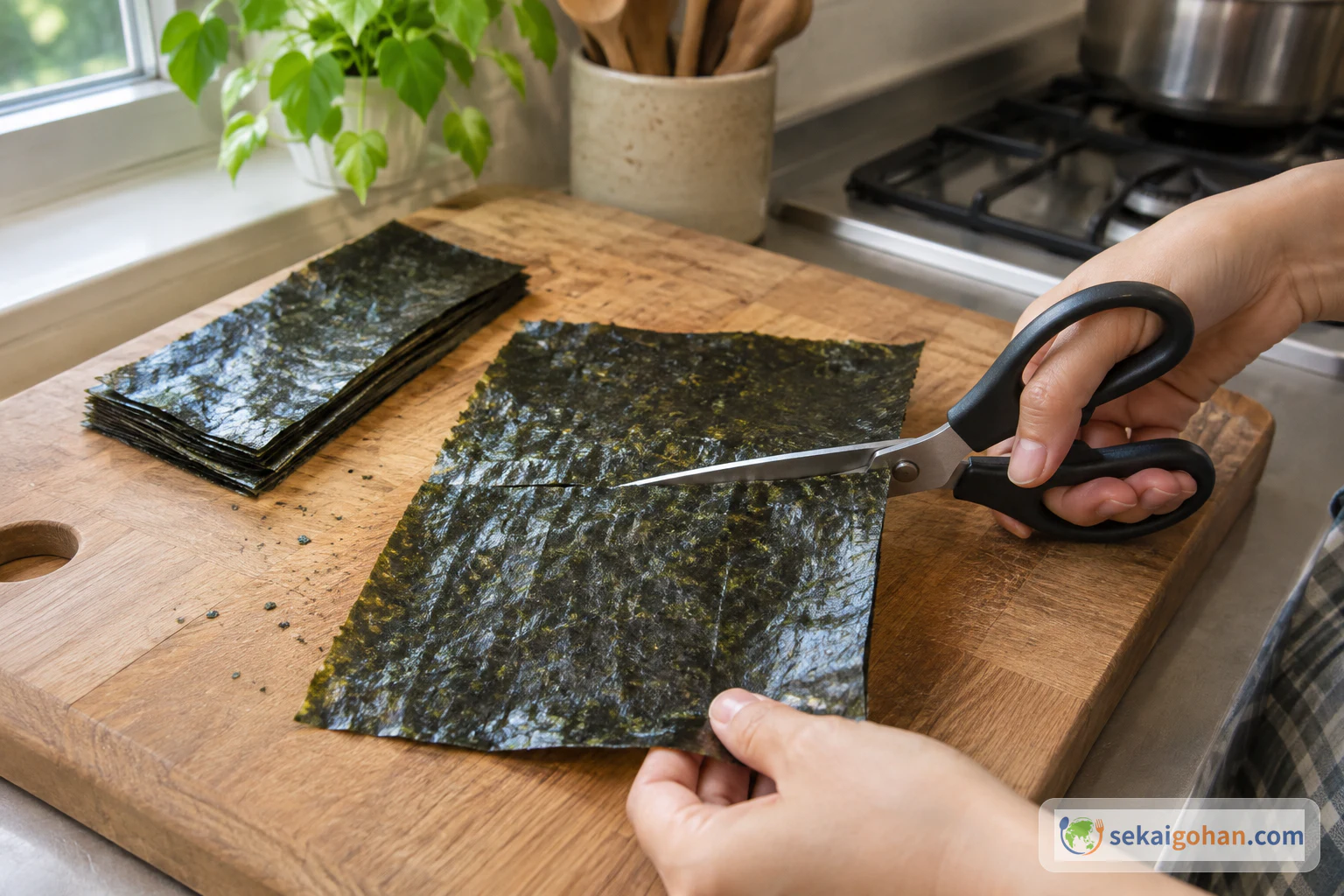
A full sheet of nori measures 8¼ × 7½ inches (21 × 19 cm). This size became the national standard after the Second World War, once fully automatic drying machines spread. Cut in half, it becomes a long, narrow hansetsu (half sheet), and that shape is commonly used for hand rolls.
Korean kimbap is also rice rolled in nori. The difference is in the rice. Kimbap rice is seasoned with sesame oil and salt instead of vinegar. More Japanese dishes are collected on the Japan country page.
Ingredients (serves 4)
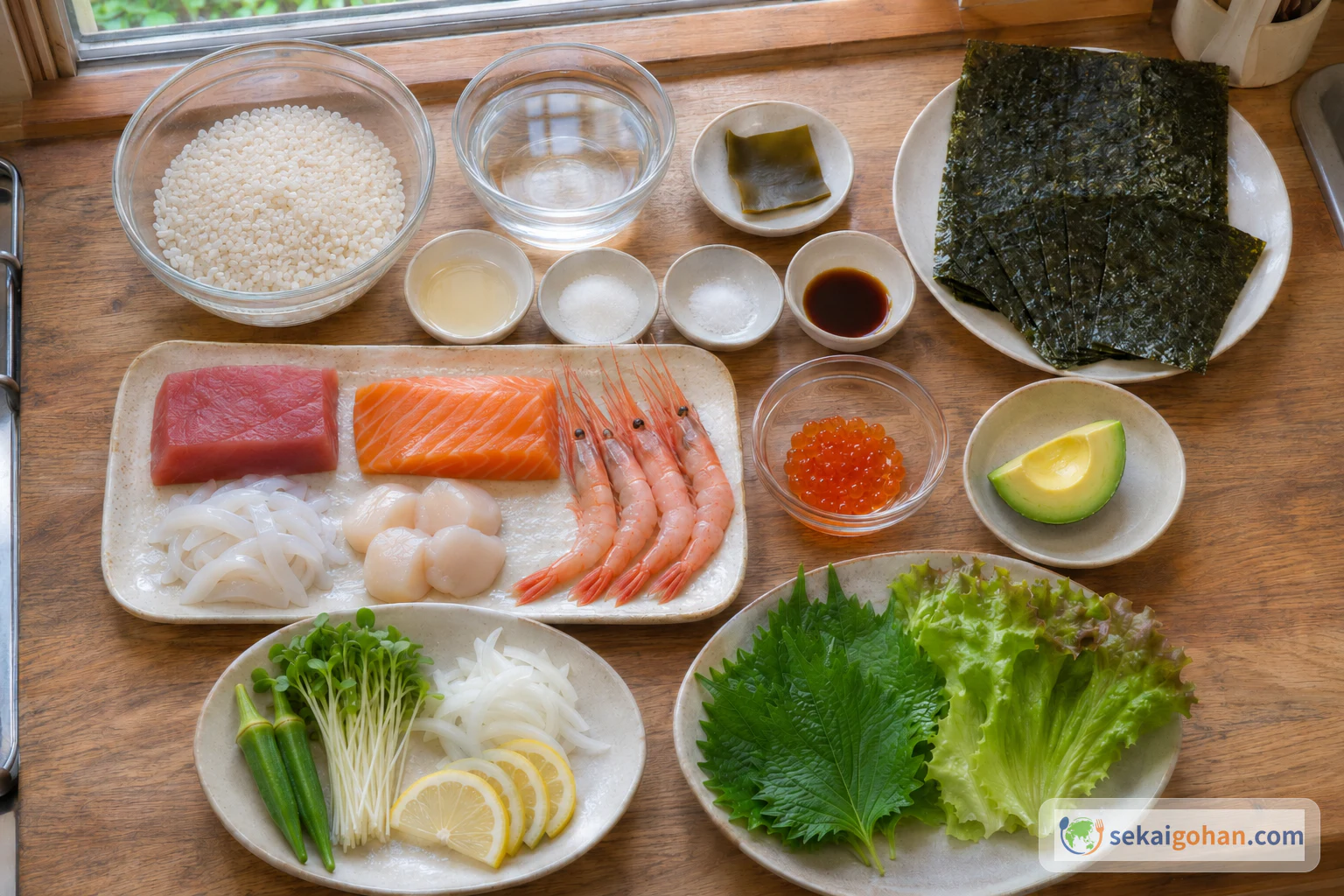
As a rough guide, sixteen half sheets give each person about four rolls; this is an estimate, not a tested count. Keep the fish to the amounts in the table. The portions are small on purpose, and the pleasure is in mixing many kinds.
This meal contains shrimp (crustacean), scallops and squid (mollusc), salmon and salmon roe (fish and fish roe), wheat and soy (in soy sauce) and seaweed (nori and kombu). Avocado can also affect people with fruit allergies.
Equipment
- Rice cooker
- Fine-mesh sieve
- Wide bowl or flat tray, or a wooden sushi tub (hangiri), which draws off extra moisture and keeps the rice from drying out
- Wooden rice paddle (shamoji)
- Hand fan (uchiwa) or a stiff piece of card
- Clean damp cloth
- Cutting boards, with one kept only for raw seafood
- Sharp kitchen knife
- Kitchen scissors
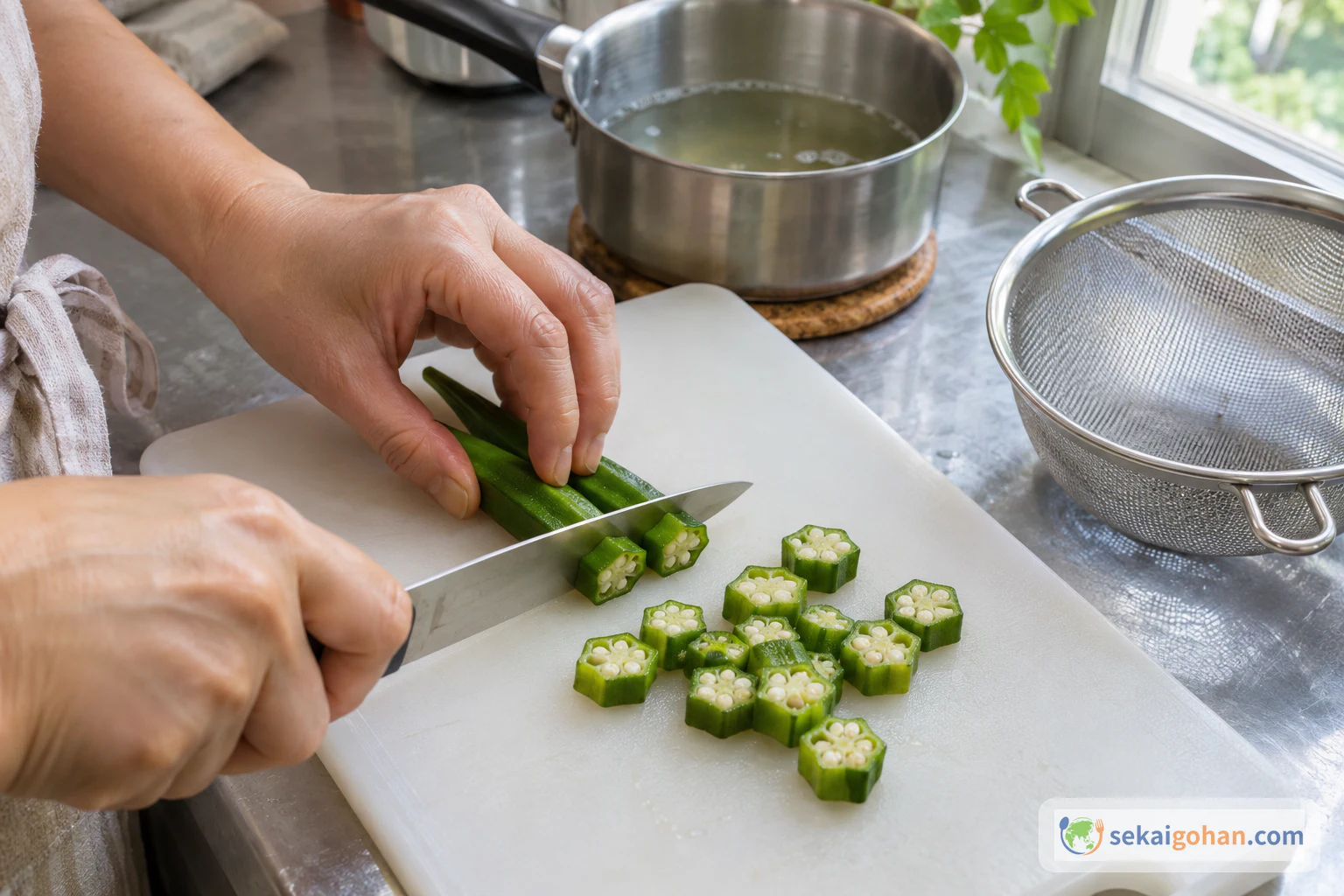
- Small saucepan and a strainer
- Paper towels
- Large platter, small bowls and small dishes for soy sauce
Buying and Swapping
The fish decides this meal. Buy seafood labelled for eating raw (sashimi grade) from a trusted fishmonger or a Japanese or Asian grocer. Nori, kombu, rice vinegar and short-grain rice are sold at the same grocers and online. Half sheets of nori already cut for hand rolls are also sold, and they save you the cutting.
Raw fish can carry anisakis, a parasitic worm. The larvae are white threads ¾–1¼ inch (2–3 cm) long and less than 1/16 inch (0.5–1 mm) wide. They are found in mackerel, horse mackerel, saury, bonito, sardine, salmon, flounder, tuna, squid and other seafood. After a fish dies, the larvae can move from its gut into the flesh, and some are already in the flesh while the fish is alive. Vinegar, salt, soy sauce and wasabi do not kill them. What protects you is fresh fish, never eating the guts raw, and looking over each piece and removing any larvae you see. Freezing at -4°F (-20°C) for 24 hours or more kills them, and so does heating to 158°F (70°C) or above, or 140°F (60°C) for 1 minute. If you plan to freeze fish at home, check the temperature shown on your freezer.
Buy fish and shellfish sold for eating raw, from a trusted fishmonger or grocer. Keep it cold until the moment it goes on the table, and eat it the same day. Use a clean board and knife for the raw seafood and keep them apart from other food. People who are pregnant, elderly, very young or have weakened immunity should skip the raw fillings and roll the cooked ones below.
For the sushi rice, use rice vinegar. Mixing in a little red vinegar (akazu) gives a more serious sushi-shop flavour. Grain vinegar works in a pinch, but its sourness comes out sharper. Leave out the kombu and the savoury depth gets thinner. With less sugar the rice tastes tighter, and with more it tastes sweeter. For a shortcut, season 1 lb 7 oz (640 g) of freshly cooked rice with 4 tbsp of ready-made sushi vinegar with kombu dashi, or 6 tbsp of a sweeter all-purpose seasoned vinegar. Choose one of the two, and use it in place of the homemade blend, never mixed with it.
| Instead of | Use | What changes |
|---|---|---|
| Tuna | Sashimi-grade bonito or sea bream | Bonito brings more aroma, sea bream is milder |
| Salmon | Sashimi-grade trout | Richer or lighter depending on the fat |
| Squid | Spear squid or Japanese flying squid | Flying squid is firmer |
| Raw scallops | Boiled scallops | The silky raw texture gives way to a more fibrous bite |
| Sweet shrimp | Boiled shrimp | The sticky raw sweetness is lost |
| Salmon roe | Flying fish roe (tobiko) or trout roe | Different grain size and saltiness |
| Radish sprouts | Mizuna | Different heat |
| Leaf lettuce | Red leaf or green leaf lettuce | Thicker leaves roll a little differently |
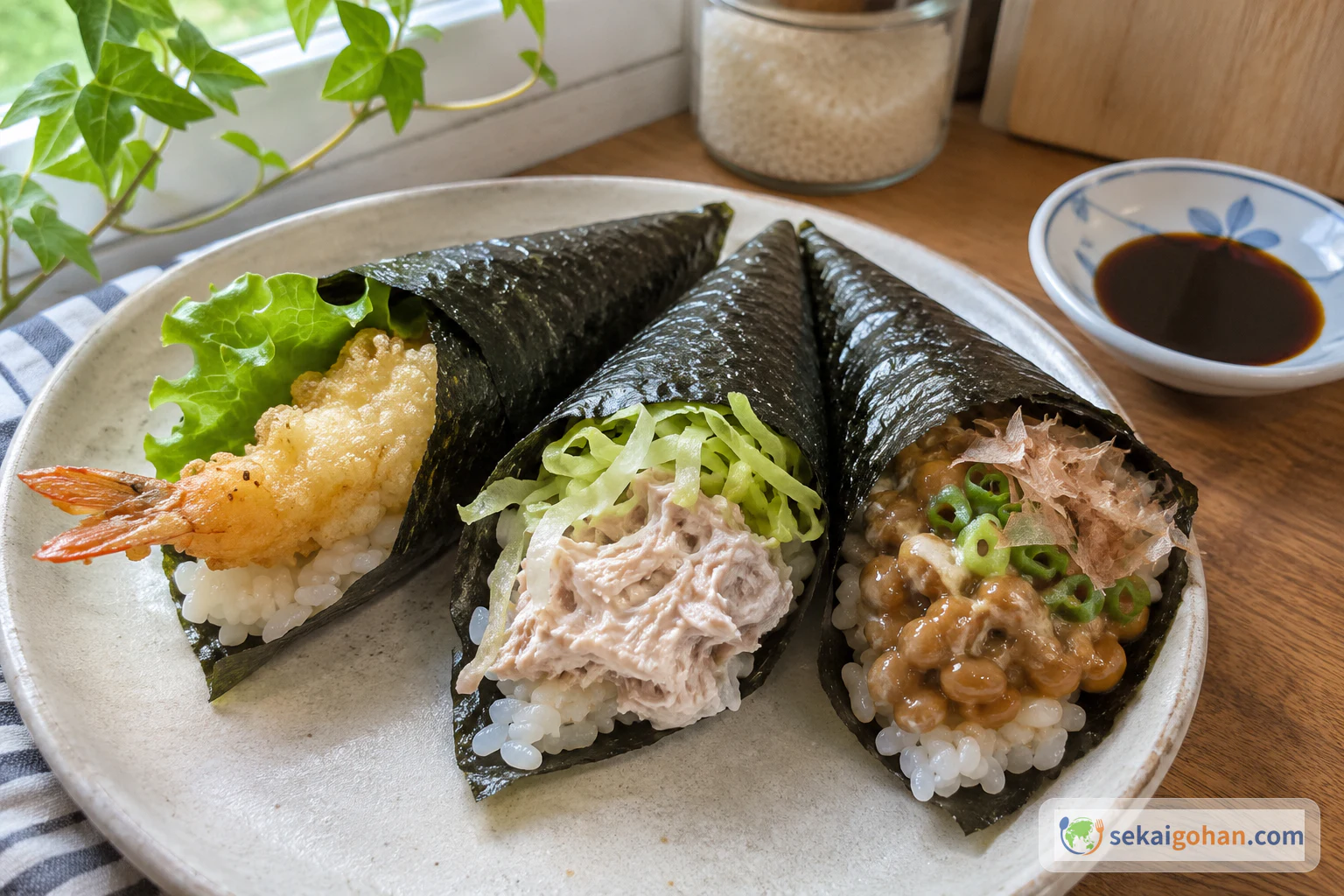
For a table with no raw fish, roll shrimp tempura with lettuce, canned tuna mixed with mayonnaise, natto with scallion and bonito flakes, tonkatsu, or roast beef. These fillings sit alongside the raw platter or replace it entirely.
Method: Rice First, Then Cut and Set Out
Start with the rice. It needs time to drain and time to cook, and it must cool to body temperature before anyone rolls. While the rice cooks, cut the nori, then the seafood, the okra and the garnishes, and set the platter. Cut the fish and avocado last, just before everyone sits down, and keep the fish cold until then.
When It Goes Wrong
| What you see | Why | What to do |
|---|---|---|
| The nori tears or the end will not close | Too much rice or filling | Use a smaller triangle of rice and fewer pieces, and leave about ½ inch (1 cm) of nori for the end of the wrap |
| The rice is sticky and pasty | It was stirred too long or not cooled enough | Cut through it in slicing strokes, spread it flat and fan it. Stop stirring once the vinegar is in |
| The rice tastes flat | The salt never dissolved in the blend | Mix the vinegar, sugar and salt first, until no grains remain |
| The roll is lopsided | The filling and the roll went in different directions | Lay the filling at a slant toward the upper left and roll from the bottom-left corner to the upper right |
| The fish smells fishy | It was cut too early or is wet on the surface | Cut it just before serving and press it dry with paper towel |
| The avocado turns brown | It was cut too early | Slice it right before the platter goes to the table |
Variations and Leftover Rice
Fillings to try
Fillings are where everyone at the table makes temaki their own. Tuna with shiso and cucumber is the classic combination. Buy a cucumber and cut it into sticks, and its crunch and freshness balance the soft fish. Onion with salmon and lettuce uses ingredients already on the platter: the bite of the onion cuts the richness of the salmon. Natto with scallion and bonito flakes needs no fish at all and is sticky, savoury and smoky. Tuna mayo with lettuce and radish sprouts is the roll children reach for first. Rice simmered with dashi in place of sushi rice also works, with a milder flavour and no sourness.
Leftover sushi rice
Rolled temaki is eaten as soon as it is made. Leftover sushi rice keeps, but the vinegar aroma fades with time. Wrap it tightly in plastic wrap and leave it in a cool place overnight. The refrigerator spoils both its texture and its flavour. In hot weather, or if you will not eat it by the next day, freeze it instead. When the rice has hardened, warm it in the microwave until it is just body temperature and it softens again.
Frequently asked questions
Can I use frozen rice or packaged cooked rice?
Yes. Both turn soft more easily than freshly cooked rice, so add the vinegar blend gradually, tasting as you go until the flavour is right.
Can I roll with full sheets of nori?
A full sheet is too large for the small amount of filling in a hand roll. The long end lifts away and the cone will not stay closed. The half sheet is the size that holds a cone neatly in one hand.
What should I watch for after eating raw fish?
Anisakis symptoms appear between 1 hour and several days after eating. In the stomach, severe pain in the upper abdomen, nausea and vomiting come within 12 hours. In the intestine, lower abdominal pain comes after more than ten hours. Anyone with severe abdominal pain should see a doctor promptly. There is no medicine that kills the larvae: in the stomach they are removed with an endoscope, and in the intestine the symptoms are treated, sometimes with surgery. Anisakis can also trigger allergic reactions such as hives or anaphylaxis.