Ingredients and steps on one page. Print it, or choose “Save as PDF” in the print dialog.
Sekai Gohan
Chicken Katsu: Japanese Panko-Fried Chicken Breast Cutlets
Ingredients
| Ingredient | Amount | Role |
|---|---|---|
| Chicken breasts, small (tori mune-niku) | 2, 14 oz (400 g) total | The cutlet. Skin removed, thick part scored |
| Salt | ⅓ tsp | Seasons both sides before coating |
| Pepper | a little | Seasons with the salt |
| Flour (komugiko) | as needed | A thin first layer that makes the egg stick |
| Egg, beaten | ½ egg | Base of the egg wash |
| Water | 1 tsp | Thins the egg wash |
| Fresh panko (nama panko) | ¾–⅞ oz (20–25 g) | The coarse, light outer crust |
| Cabbage (kyabetsu) | 1 large leaf, 2½ oz (70 g) | Shredded raw, served alongside |
| Tonkatsu sauce | to taste | Poured over the cutlet at the table |
| Japanese mustard paste (neri karashi) | to taste | Sharp heat beside the sauce |
| Frying oil | enough for 1 inch (2.5 cm) in the pan | For frying |
Steps
1Skin, score and season the chicken
Take the chicken out of the refrigerator 30 minutes before cooking. Hold the skin at one end and pull it off the breast. Lay each breast skinned side down and cut diagonal slits about ¼ inch (5 mm) deep, ⅜ inch (1 cm) apart, across the thickest part. Sprinkle both sides with the ⅓ tsp salt and a little pepper. The cue is a thick end lined with shallow, evenly spaced cuts and a light, even dusting of seasoning.
2Make the thin egg wash
Put the half beaten egg in a small bowl. Add the 1 tsp water and whisk until the yolk and white are one even pale yellow. Set out three stations in a row: flour in a shallow dish, the egg wash, then the panko on a sheet of paper towel. The wash should be thin and runny, not a batter.
3Coat in flour, egg and panko
Dredge each breast in flour, then tap it so only a thin film stays on. Dip it in the egg wash and let the excess drip back. Lay it on the panko, sprinkle the surrounding crumbs over the top, then lift the two ends of the paper towel in turn so the crumbs roll over the meat. This way almost no panko goes to waste. Stop when the whole surface is covered in a loose, even crumb that you have not pressed flat.
4Heat the oil and lower in the first cutlet
Pour oil into the frying pan to a depth of 1 inch (2.5 cm). Heat it over medium heat until the deep-fry thermometer reads 340°F (170°C). Lower one cutlet in gently by hand, away from you, keeping your fingers above the oil. Fry for about 3 minutes without touching it, then turn it.
Hot oilKeep the pan handle turned inward and lay the cutlet in away from you so any splash goes the other way. Never leave hot oil unattended, and let it cool completely in the pan before you move or discard it.
5Turn twice and drain
Turn the cutlet over and fry about 2 minutes. Turn it once more and fry about 1 minute. Lift it onto the wire rack to drain. Let the oil come back to 340°F (170°C), then fry the second cutlet the same way. The times are a guide. Crust colour does not tell you the center is cooked, so the check in the next step decides.
6Check the center
Push a probe thermometer into the thickest part of each cutlet. The center must reach 167°F (75°C) and stay there for at least 1 minute. When you cut it, the meat should be white all the way through and the juices clear. If it has not reached that, put it back in the oil and check again. The cutlet is done only when the thermometer and the cut face both agree.
7Shred the cabbage
Stack the cabbage leaf on itself and roll it tightly. Slice across the roll as thinly as you can, cutting through the ribs. Loosen the strands with your fingers into a light pile. The cabbage is right when the strands are fine and even and stand up crisp instead of lying flat.
8Slice and plate
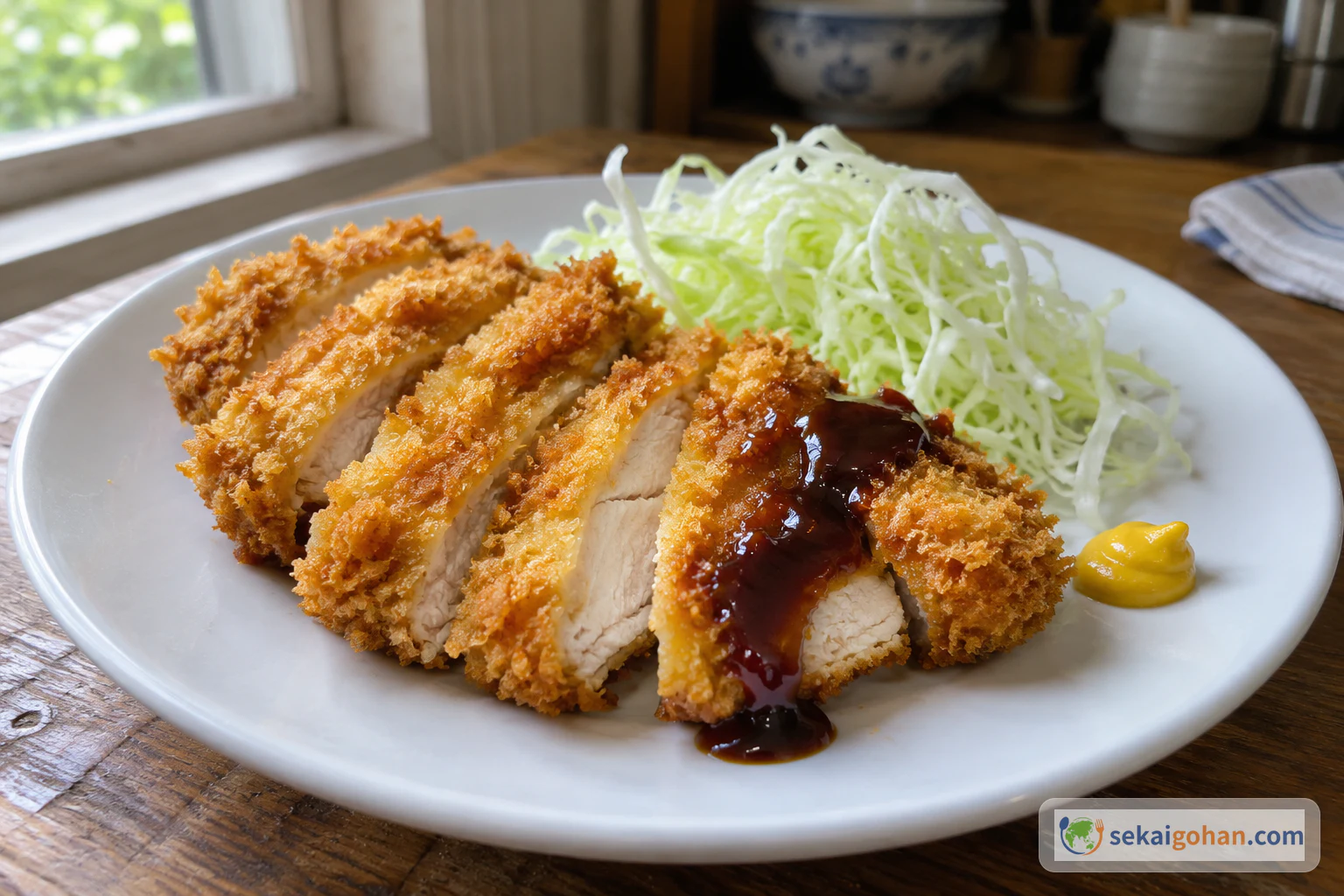
Cut each cutlet into easy bite-size strips and lay them on the plate. Pile the cabbage beside them. Pour tonkatsu sauce over the cutlet and add a dab of mustard at the side. Serve while the crust still crackles under the knife and steam rises from the cut faces.