Ingredients and steps on one page. Print it, or choose “Save as PDF” in the print dialog.
Sekai Gohan
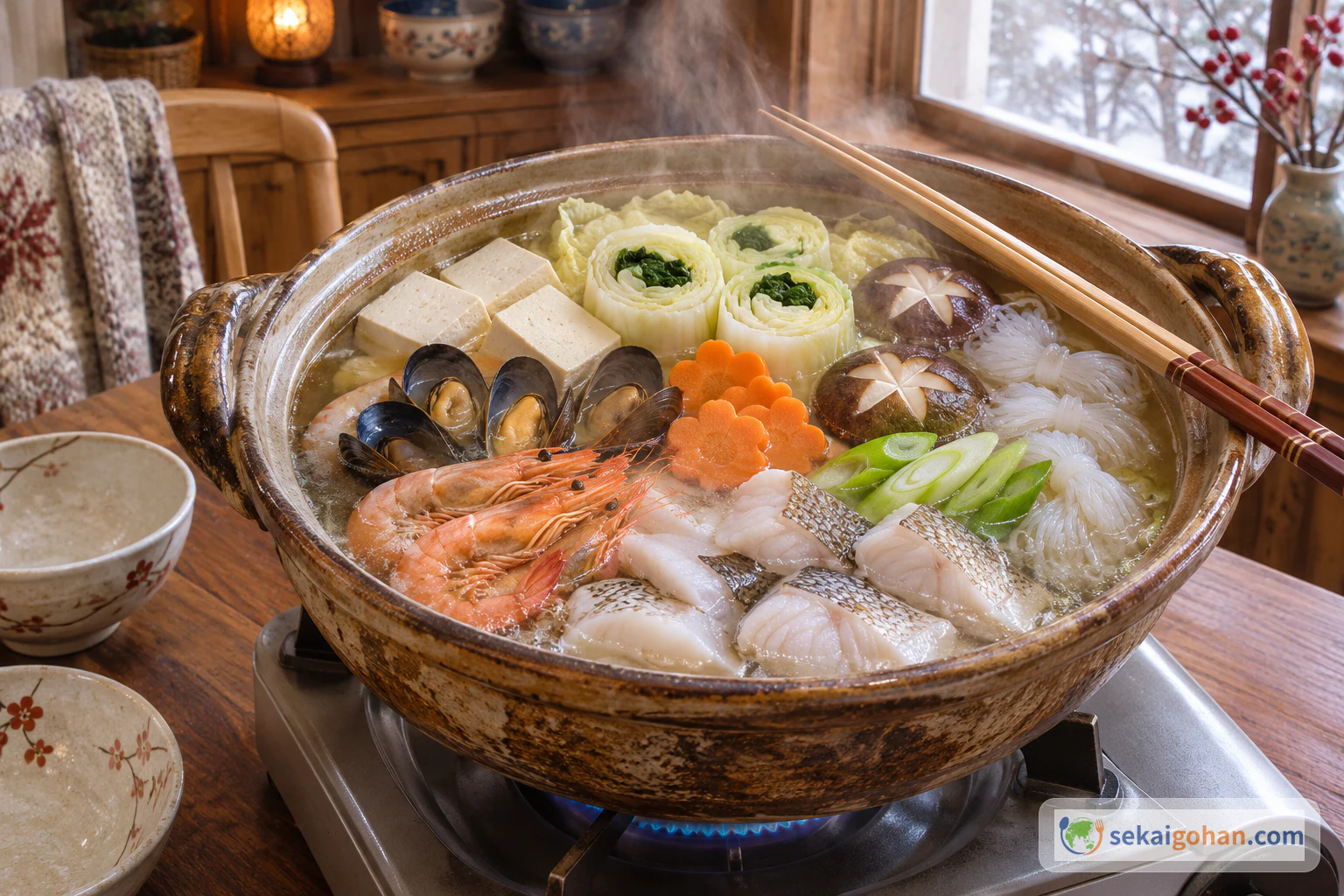
Yosenabe: Japanese Hot Pot of Seafood, Chicken and Vegetables
Ingredients
| Ingredient | Amount | Role |
|---|---|---|
| White fish fillet (blue eye cod or another mild white fish) | 5 oz (150 g) | Clean-tasting flesh that keeps the broth clear |
| Medium shrimp, head and shell on (about 1½ oz / 40 g each) | 4 | Heads and shells give the broth its seafood depth |
| Mussels, debearded and shells scrubbed | 4 | Briny sweetness that melts into the broth |
| Chicken thigh fillets | 5 oz (150 g) | Fat and savour for the broth |
| Napa cabbage leaves | 10 leaves (about 12 oz / 350 g) | Outer layer of the rolls |
| Spinach | ½ bunch (3½ oz / 100 g) | Green core of the rolls |
| Carrot | 2 oz (50 g) | Sweetness and colour |
| Scallions | 2 | Fresh, sharp aroma |
| Shiitake mushrooms | 6 | Woodsy aroma that seeps into the broth |
| Firm tofu (momen dofu) | 5 oz (150 g), ½ pack | Soft, warm bite |
| Knotted shirataki (shirataki musubi) | 5 oz (150 g), ½ pack | Soaks up broth; easy to pick up |
| Dashi (awase dashi, from kombu and katsuobushi) | 2½ cups (600 ml) | Base of the broth |
| Light soy sauce (usukuchi shoyu) | 2 tbsp + 2 tsp (40 ml) | Salt and seasoning while keeping the broth pale |
| Sake | 1 tbsp | Softens fishy notes |
| Mirin | ½ tbsp | Gentle sweetness |
| Shichimi togarashi | to taste (optional) | Heat and fragrance at the table |
| Cooked rice | as needed | Zosui at the end |
| Egg, beaten | as needed | Ribbons through the zosui |
| Scallions, finely sliced | a little | Topping for the zosui |
Steps
1Blanch the napa cabbage
Bring a large pot of water to a boil. Add the 10 cabbage leaves and cook for about 8–10 minutes, pressing them under the water as they float. Lift them out into a colander and keep the water at a boil for the spinach. The cabbage is ready when the thick white part of the stems is soft and translucent.
2Blanch and cool the spinach
Drop the spinach into the same boiling water for about 1 minute. As soon as its colour brightens, lift it out and plunge it into cold water. Leave it there until it is cool, then lift it out and line it up with all the stems facing one way. It is ready when it is vivid green and cool to the touch.
3Roll, squeeze and slice
Lay half of the cabbage leaves overlapping on a bamboo mat, or on baking paper. Place half the spinach along the near edge as a core and roll it up tightly into a log. Squeeze the whole log firmly to press out the water, then reshape it. Make a second roll with the rest, and cut both rolls into rounds 1½ inches (4 cm) thick. Each cut face should show a white ring around a green centre, and the rounds should stand without unrolling.
Squeeze hardWater left in the rolls dilutes the broth and makes the rounds fall apart. Squeeze the log firmly before cutting, and again lightly once it is reshaped.
4Make the broth
Pour the dashi, light soy sauce, sake and mirin into a pot and stir. Cover and bring to a boil over medium heat. Turn the heat off as soon as it boils and leave it covered while you prepare the rest. The broth is ready when it is clear, pale gold and smells of dashi.
5Cut the remaining ingredients
Cut the carrot and scallions on the diagonal into 2-inch (5 cm) lengths. Remove the shiitake stems; if you like, cut a cross or a flower pattern into the caps. Cut the tofu, chicken and fish into bite-size pieces. If your shirataki is not knotted, spread it out to about 8 inches (20 cm) and cut it in half so it is easy to pick up. Everything is ready when each ingredient sits in its own pile on the board.
6Arrange the pot
Arrange each ingredient in its own section of the donabe or wide pot: cabbage rolls, carrot, scallions, shiitake, tofu, shirataki, chicken and fish. Set the slower-cooking items, such as the cabbage rolls, carrot and tofu, lower in the pot, and set the tofu where it will not be knocked about. Place the shrimp and mussels in the centre. The pot is ready when every section is clearly separate and you can see where everything is at a glance.
7Simmer
Pour the broth gently down the side of the pot so the arrangement holds. Cover and bring to a boil over high heat, then lower to medium-low and simmer for about 5–8 minutes. Lift out leafy pieces early if they are done before the rest. Stop when everything is cooked right through: the shrimp and mussels completely cooked, the chicken and fish cooked through to the centre.
Serve straight awayThe seafood is at its best the moment it is cooked. Bring the pot to the table as soon as it is ready; overcooking toughens the shrimp and fish and clouds the broth.
8Serve at the table
Set the pot in the middle of the table, on a burner set low if you have one. Ladle broth into each small bowl along with a few pieces, picking them out with chopsticks. Season with a little shichimi if you like. The broth is already seasoned, so it needs nothing more than that.
9Finish with zosui
When the ingredients are gone, bring the leftover broth back to a simmer. Add cooked rice; 1 cup suits a pot for four, so with this pot for two, match the rice to the broth you have left. Pour the beaten egg over the surface and cook until it sets in soft ribbons. Scatter the sliced scallions over and serve. Udon works in place of rice.