Ingredients and steps on one page. Print it, or choose “Save as PDF” in the print dialog.
Sekai Gohan
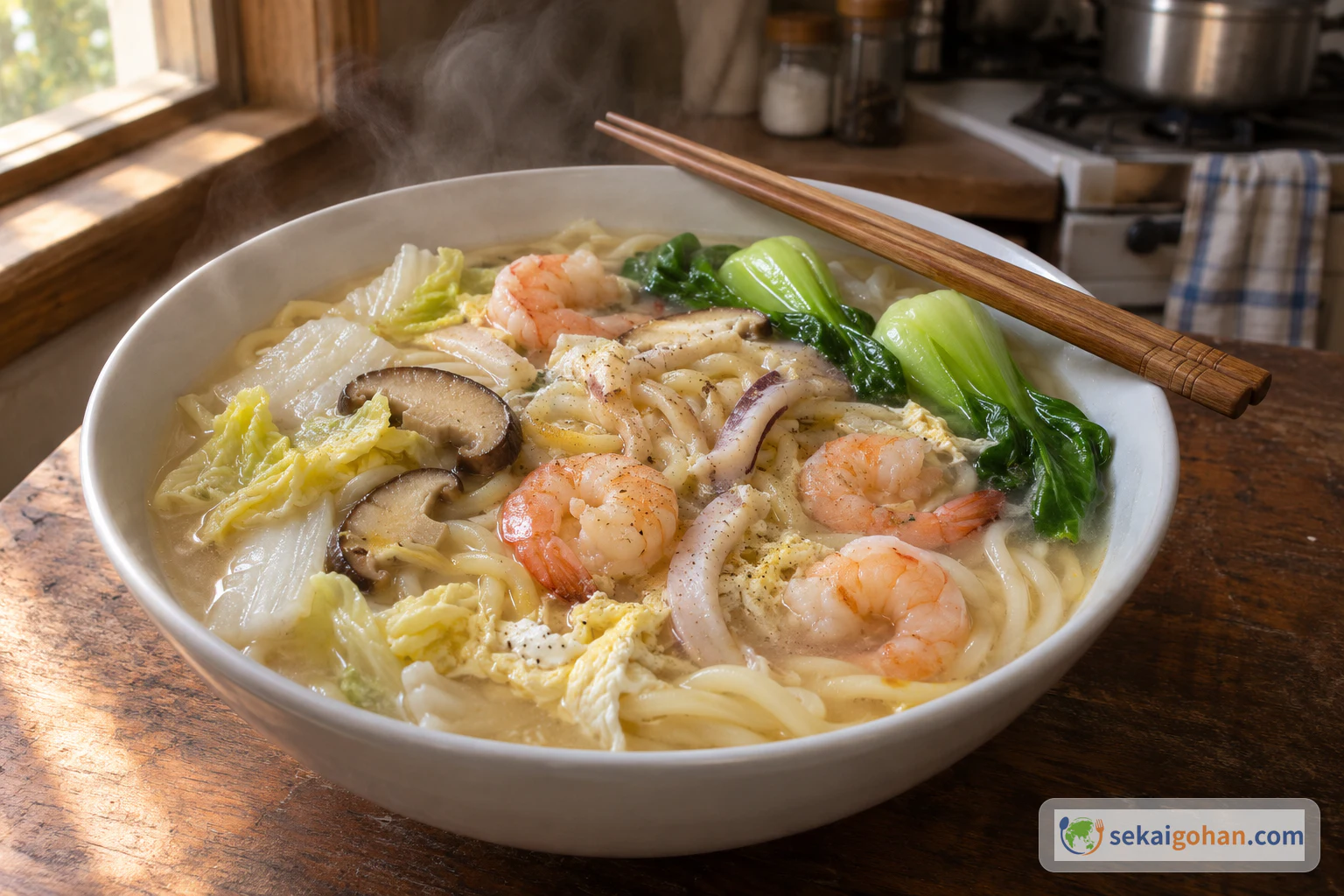
Udong: Korean-Chinese Mussel Broth Noodle Soup with Egg
Ingredients
| Ingredient | Amount | Role |
|---|---|---|
| Mussels, in the shell (홍합) | 14 oz (400 g) | The backbone of the broth, and a topping |
| Water (for boiling the mussels) | 2 quarts (2 L) | Becomes the soup |
| Squid (오징어) | 1 whole | Topping |
| Shrimp (새우) | 4 | Topping |
| Napa cabbage (배추) | 4 leaves | Sweetness in the broth, topping |
| Bok choy (청경채) | 2 heads | Green color, added last |
| Fresh shiitake (표고버섯) | 2 | Aroma and bite |
| Korean thick scallion (대파) | ½ stalk | Aroma |
| Carrot (당근) | ⅕ | Color and sweetness |
| Korean zucchini (애호박) | ⅕ | Sweetness and soft body |
| Onion (양파) | ½ | Sweetness in the broth |
| Korean green chilies (청양고추) | 2 | Fresh heat and aroma |
| Garlic (마늘) | 3 cloves | Aroma |
| Eggs (계란) | 2 | The egg ribbons |
| Frozen Chinese wheat noodles (냉동 중화면) | 3 portions (one package serving each) | The noodles |
| Chicken stock powder (치킨스톡) | 1 spoonful | Depth |
| Oyster sauce (굴 소스) | ½ spoonful | Savoriness and salt |
| Salt | to taste | Final seasoning |
| Pepper, white preferred | to taste | Aroma |
Steps
1Scrub the mussels and pull the beards
Hold the mussels under running water and scrub each shell with your hands. Pull off the fibrous threads that stick out of the shell. Throw away any mussel with a cracked shell, and any that sits open and does not close. Do this on a board kept for shellfish, or wash and sanitize the board and knife afterward. Move on when the shells are glossy blue-black with no grit or threads left on them.
2Boil the mussels from cold water
Put the mussels and the 2 quarts (2 L) of water into the deep pot together, then turn on the heat. Starting from cold lets the shells open easily. Once it boils, drop to medium so the broth does not churn cloudy, and keep it going until the shells open and the mussel meat reaches 185–194°F (85–90°C) at the center for at least 90 seconds. Discard any mussel that stays shut. Lift the mussels out with the slotted spoon. About 1⅔ quarts (1.6 L) of faintly milky cooking water is left in the pot.
3Shell the mussels and prepare the seafood
Slip the mussel meat out of the shells into a small bowl and throw the shells away. Taking them out makes the bowl easier to eat and keeps shell fragments out of the soup. Cut the squid roughly into thick strips. Peel the shrimp and pull out the dark vein along the back, which carries a fishy taste. You are ready when you have a bowl of shell-free mussel meat, a pile of squid strips and four clean shrimp.
4Cut the vegetables into finger-joint chunks
Cut the napa cabbage, bok choy, shiitake, scallion, carrot, zucchini and onion into rough chunks about the size of a finger joint. Thin shreds fall apart in the broth, and chunks keep their bite even after simmering. Mince the garlic and slice the chilies, and set them aside with the bok choy, because those three go in later. The board is ready when it holds a heap of uneven chunks with no fine shreds among them.
5Simmer the vegetables in the mussel water
Bring the mussel cooking water to a boil over high heat. Add every vegetable and the shiitake, holding back the garlic, chilies and bok choy. The slower-cooking vegetables go in first so the bok choy keeps its green and the chilies keep their fresh smell for later. Simmer until the cabbage ribs start turning translucent and soft while every piece still keeps its shape.
6Season and bubble for 5 minutes
When the pot comes back to a lively boil, add the chicken stock powder, the oyster sauce, a little salt and some pepper. Let it bubble for 5 minutes, which draws the sweetness of the cabbage and onion into the broth. Hold back on extra oyster sauce, since it muddies the color. Move on when the broth looks faintly white and tastes clearly of sweet vegetables.
7Add the seafood, garlic, chilies and bok choy
Add the squid, shrimp and mussel meat, then the minced garlic and sliced chilies. Lay the bok choy on top and boil for 1–2 minutes until it wilts. Seafood turns rubbery with long cooking, so keep this short, but make sure the shrimp and squid reach 185°F (85°C) at the center for at least 1 minute. The pot is ready when the squid is opaque white, the shrimp are pink and curled, and the bok choy is limp and bright green. Turn the heat down to a gentle simmer.
8Loosen the noodles and shake them dry
In the second pot, bring water to a boil and drop in the frozen noodles. Loosen them with chopsticks and cook for the time on the package. Tip them into the colander and shake hard, because water clinging to the noodles thins the soup. Keep the noodle water out of the soup. Divide the noodles among the warmed bowls once no more water drips from the colander.
9Pile on the toppings and pour in the egg
Lift the vegetables and seafood out of the soup with the slotted spoon and pile them high on the noodles. Keep the soup at a low bubble, because egg poured into broth with the heat off sets poorly. Pour the beaten eggs in a thin stream around the edge of the pot, a little at a time, and do not stir. Stirring breaks the egg into fine bits that cloud the broth. Wait until the egg has set into soft, pale, fully cooked ribbons.
10Salt the soup and ladle it over
Taste the soup and add salt until it is seasoned the way you like it. Ladle the soup and egg over the vegetables and seafood so the noodles sit half submerged. Grind white pepper over the top. Serve while the bowls are still steaming.