Ingredients and steps on one page. Print it, or choose “Save as PDF” in the print dialog.
Sekai Gohan
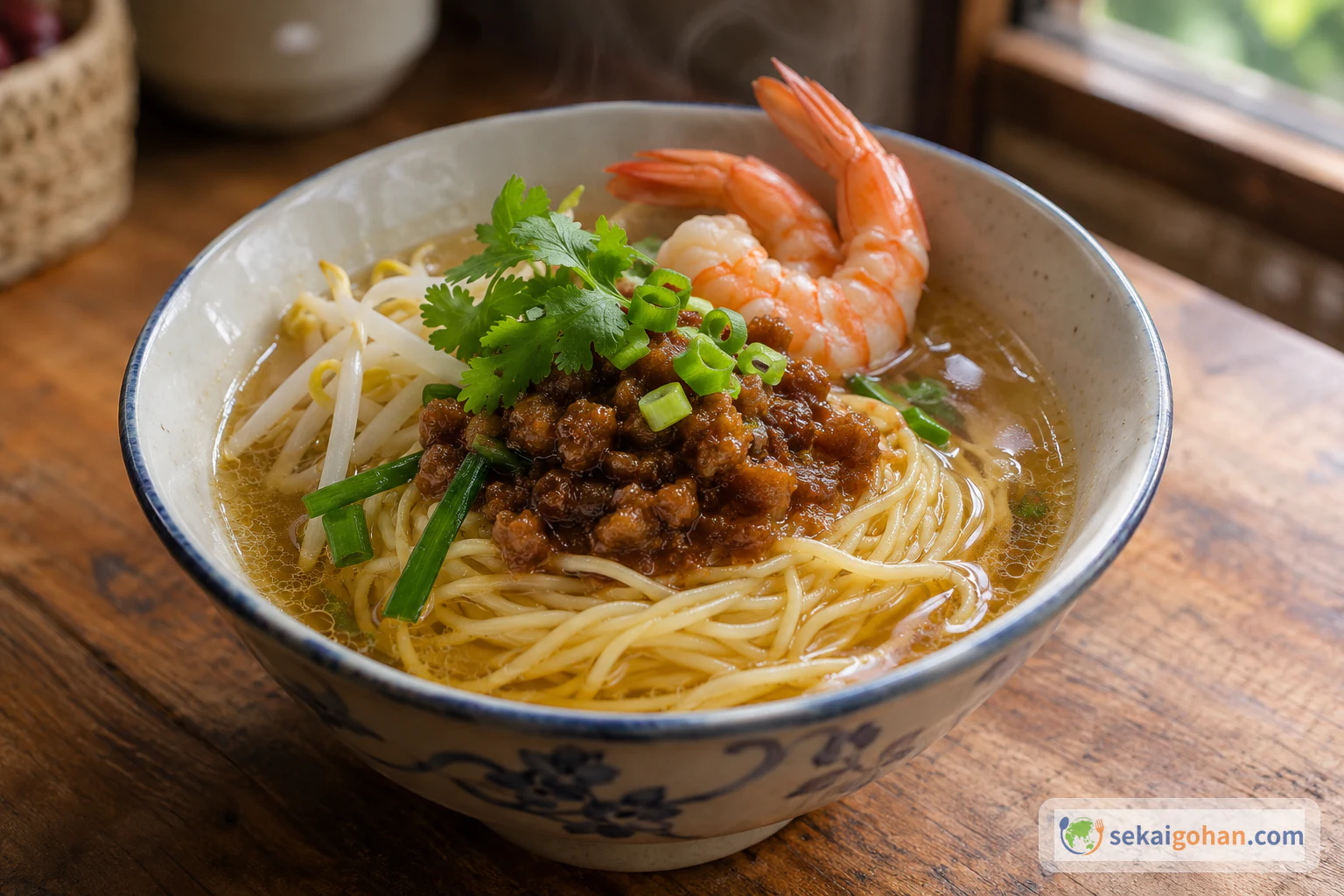
Ta-a-mi: Tainan Small-Bowl Noodles in Shrimp Broth
Ingredients
For the broth
| Ingredient | Amount | Role |
|---|---|---|
| Pork bones or chicken bones (豬大骨/雞骨) | as needed | Body of the stock |
| Water | as needed | Fill the pot about four-fifths |
| Green onion, green parts | a few pieces | Aroma in the stock |
| Ginger | a few slices | Clears the meaty smell |
| Shrimp heads and shells | from the 4 shrimp below | The base flavor of the broth |
| Neutral oil | a little | For toasting the shells |
| Dried shrimp (蝦米) | about 1 tsp (optional) | Deeper shrimp flavor |
| Dried flounder (扁魚) | optional | Extra savory depth |
For the braised pork sauce
| Ingredient | Amount | Role |
|---|---|---|
| Ground pork with some fat (絞肉) | ½ jin, ⅔ lb (300 g) | The meat of the sauce |
| Neutral oil | a little | For browning the pork |
| Soy sauce (醬油) | 1 rice bowl | Color and salt |
| Ground white pepper | a pinch | Aroma |
| Fried shallots (油蔥酥) | 1 rice bowl | The defining aroma of Taiwanese pork sauce |
| Fried garlic (蒜頭酥) | 2 tbsp | Toasty garlic note |
| Rock sugar (冰糖) | 1 tsp | Sweetness and gloss |
| Water | 2 rice bowls | Braising liquid |
For the bowls
| Ingredient | Amount | Role |
|---|---|---|
| Thin oil noodles (油麵) | 2 bundles, about 4¼ oz (120 g) | Springy alkaline egg noodles |
| Shrimp-and-bone broth (from above) | 3⅓ cups (800 ml) | The soup |
| Braised pork sauce (from above) | 4–6 tbsp | 2–3 tbsp per bowl |
| Head-on, shell-on white shrimp | 4 | Bodies on top, heads and shells in the broth |
| Bean sprouts | 1¾ oz (50 g) | Crunch under the noodles |
| Chinese chives (韭菜) | ¾ oz (20 g) | Green, garlicky note |
| Green onion | 1 | Sliced thin for the top |
| Garlic, freshly grated | 1 tsp (optional) | Raw bite, ½ tsp per bowl |
| Black vinegar | a few drops to ½ tsp per bowl | Sharpens the broth |
| Cilantro | a little | Fresh top note |
| Salt and white pepper | to taste | Seasoning the broth |
| Soy-braised egg | optional | Served alongside |
Steps
1Blanch the bones
Put the pork or chicken bones in a stockpot and cover them with cold water. Bring it up slowly over medium-low heat. As it nears a simmer, grey foam and blood rise to the surface. Drain everything into a colander, rinse each bone under running water and wash out the pot. Move on when the bones are clean of grey scum.
2Simmer the stock
Return the bones to the clean pot and add fresh water to about four-fifths full. Add the green onion tops and the ginger slices. Keep it over low to medium heat for 40–60 minutes, or 1½–2 hours for a deeper stock. A hard boil turns the stock milky white. It is right when the surface stays clear with a steady stream of fine bubbles. Lift out the bones and aromatics, and keep the stock hot.
3Toast the shrimp heads and shells
Twist the heads off the 4 shrimp and peel the shells, leaving the tails on the bodies. Cover the bodies and refrigerate them until step 7. Heat a little oil in a wide, deep pan over medium heat, add the heads and shells, and press them against the pan as their moisture cooks off. When they turn deep coral red with browned spots and smell toasty, pour in the hot stock. It hisses and sends up a cloud of shrimp-scented steam.
4Simmer, season and strain the broth
Add the dried shrimp, and the dried flounder if you are using it. Simmer for about 10 minutes, then season with salt and white pepper. Strain through a fine-mesh strainer, pressing on the shells, and keep 3⅓ cups (800 ml) hot over low heat for the bowls. The broth is ready when it has turned pale orange to amber and smells of shrimp first, pork second. Reducing it further only makes it salty.
5Brown the pork with soy sauce and aromatics
Heat a little oil in a heavy saucepan over medium heat. Add the ground pork and break it up as it cooks until the pink is gone and the fat runs. Pour in the soy sauce, add the white pepper and stir. Add the fried shallots and fried garlic and stir until the pan smells of toasted shallot and the soy bubbles around the meat.
6Braise the pork sauce for 20 minutes
Add the rock sugar and the water and bring to a boil. Turn the heat to low, cover and braise for 20 minutes, stirring from the bottom now and then so nothing catches. The sauce is done when the liquid has dropped, the meat is glossy and a layer of fat has separated on the surface. Stop there. Cooking it dry scorches the shallots.
7Cook the shrimp and ready the toppings
Bring a large pot of water to a full boil, which you will also use for the noodles. Drop in the shrimp bodies and cook until they curl and turn opaque through the thickest part, with no grey translucence left. Lift them out. Slice the green onion thin, cut the chives into short lengths, and wash and dry the cilantro. Grate the garlic last so it is fresh.
8Cook the noodles with the sprouts
Put one bundle of noodles in the bottom of the wire strainer basket and lower it into the boiling water. Fresh oil noodles take about 3 minutes, and noodles sold already cooked need only a quick dip to heat through. For the last 10–15 seconds, lay half the bean sprouts on top of the noodles. At the same time, blanch half the chives for 10–15 seconds in the small pot. Lift and drain both well. The noodles should be hot and springy and the sprouts glossy but still crisp.
9Build the bowl
Turn the basket over into a small bowl so the noodles land on top and cover the sprouts. Add ½ tsp grated garlic, a few drops of black vinegar and 2–3 tbsp pork sauce. Ladle in hot broth to four-fifths full. Lay 2 shrimp on top with their tails up, then add the chives, green onion and cilantro, and repeat for the second bowl. Steam should be rising, with a sheen of pork fat spreading across the broth.
10Stir once and eat at once
Carry the bowls straight to the table. Before the first bite, lift the noodles from the bottom and turn them once, so the garlic and vinegar that sank under the broth come up with them. The clear broth clouds a little as the pork sauce mixes in. Eat while the noodles still spring back.