Ingredients and steps on one page. Print it, or choose “Save as PDF” in the print dialog.
Sekai Gohan
Kabanosy: Thin Polish Smoked Pork Sausage in Sheep Casings
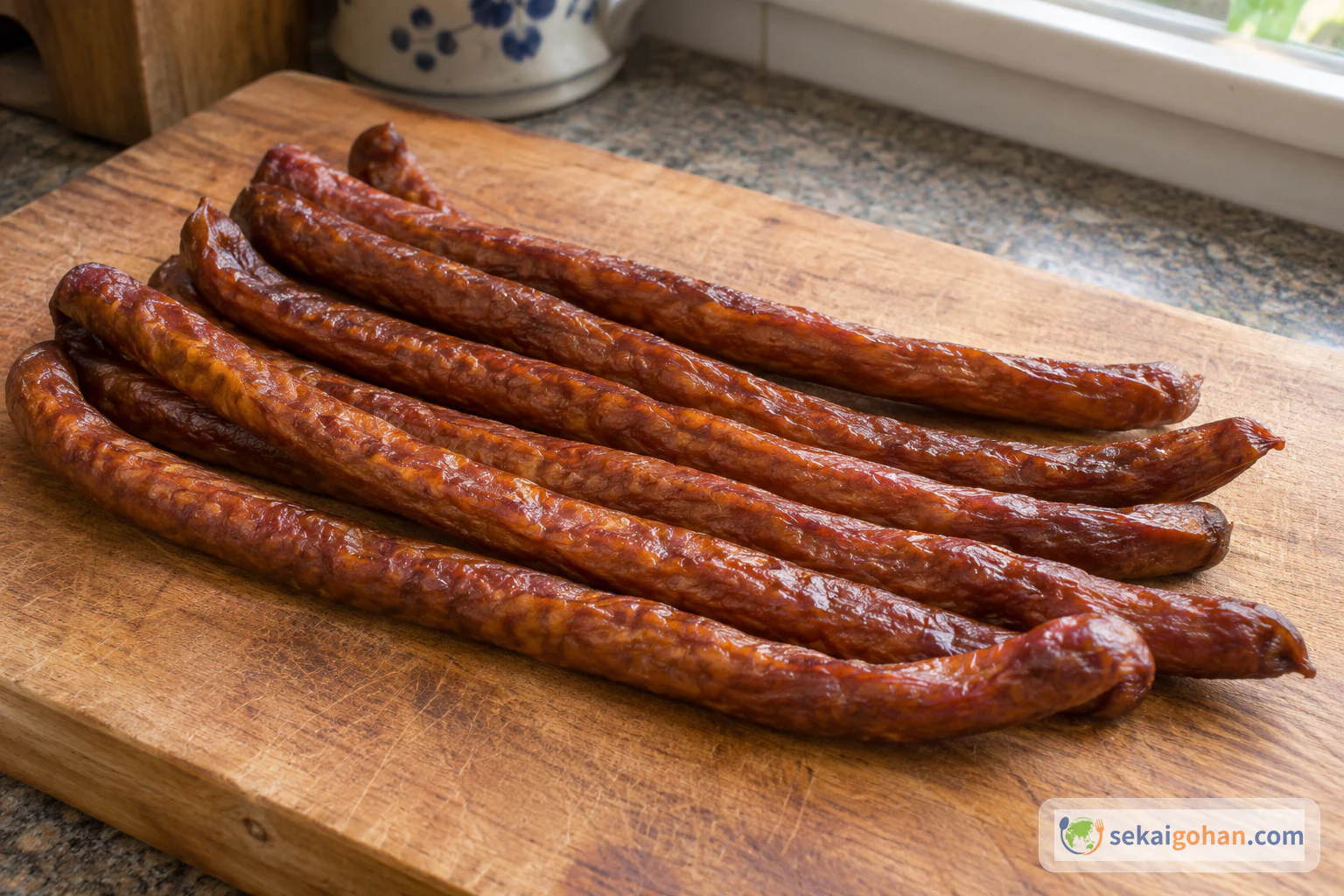
Ingredients
| Ingredient | Amount | Role |
|---|---|---|
| Pork, lean and fatty cuts (wieprzowina) | 2.2 lb (1,000 g) | The whole sausage. Lean meat is ground coarser and fattier meat finer |
| Salt | 0.6 oz (18 g) | Seasons the meat and draws out protein so the paste binds |
| Cure #1 (curing salt with sodium nitrite) | 0.09 oz (2.5 g) | Color and protection. If your product's label gives a different dose, use the label's dose |
| Black pepper, freshly ground | 0.07 oz (2 g) | The main heat |
| Nutmeg, ground | 0.04 oz (1 g) | Sweet, woody aroma |
| Caraway seeds, ground (kminek) | 0.04 oz (1 g) | The Polish signature spice |
| Sugar | 0.04 oz (1 g) | Rounds off the salt |
| Cold water | scant ½ cup (100 ml) | Loosens the paste so it binds and stuffs |
| Salted sheep casings, about ⅞ inch (22 mm) | as needed | The thin casing that sets the shape and bite |
Steps
1Chill and grind the pork
Keep the pork in the refrigerator until you grind it, at about 39°F (4°C). Grind the lean meat through the 3/8-inch (8 mm) plate and the fattier meat through the 3/16-inch (5 mm) plate, both into a cold bowl. Work quickly, and if the meat starts to feel soft, return the bowl to the refrigerator before the next batch. The grind is right when you can see distinct white flecks of fat and the meat still feels cold in your hand.
2Season and knead to a sticky paste
Combine both grinds in a large bowl and scatter the salt, cure, pepper, nutmeg, ground caraway and sugar over the meat. Pour in the cold water a little at a time, kneading with your hands between additions. Keep working until the loose grains of meat come together into one sticky mass. It's ready when it pulls away from the side of the bowl and lifts in a heavy, stringy clump.
3Stuff the casings into one long rope
Soak the salted sheep casings in water to rinse the salt out, then slide one onto the stuffer's nozzle. Fill it with the paste, easing out air as you go, and prick any trapped bubbles with a needle. Mark the rope into links of 24–28 inches (60–70 cm), but keep it in one continuous piece. It's right when the rope is evenly thick along its whole length, with no twists and no streaks of air under the casing.
4Rest the rope at room temperature
Lay the rope on a board at room temperature for 30–60 minutes. Use this time to light the smoker and bring it to 104–122°F (40–50°C), with a thermometer inside so you can see it hold steady. Leave the sausage alone while it rests. Move on when the casing feels dry and smooth under a fingertip and barely sticky.
5Smoke at a low, steady heat
Hang the rope in the smoker and hold it at 104–122°F (40–50°C) for 50–60 minutes. This warm smoke is for aroma and color. The center gets cooked in the next step. Check the thermometer now and then and adjust the heat to stay in range. The smoke is done when the casing has turned from pale yellow to light brown and feels dry all over.
6Bake until the center reaches 158°F (70°C)
Move the sausage to an oven, or keep it in the smoker, at 140–194°F (60–90°C), and bake for about 20 minutes until the casing turns dark brown. Push a probe thermometer into the center of the thickest part. Keep baking until it reads 158°F (70°C) or higher. If it falls short, give it more time and check again. When it's done, the casing is taut and the sausage springs back when you press it.
7Rinse, separate and chill
Take the sausage out and rinse it under cold running water to cool the surface quickly. Cut the rope apart at the links and lay the pieces on a rack to drain. Pack them into a clean container and refrigerate them promptly. A properly cooled kabanos holds its shape when pressed, with no clear fat weeping from a cut end.