Ingredients and steps on one page. Print it, or choose “Save as PDF” in the print dialog.
Sekai Gohan
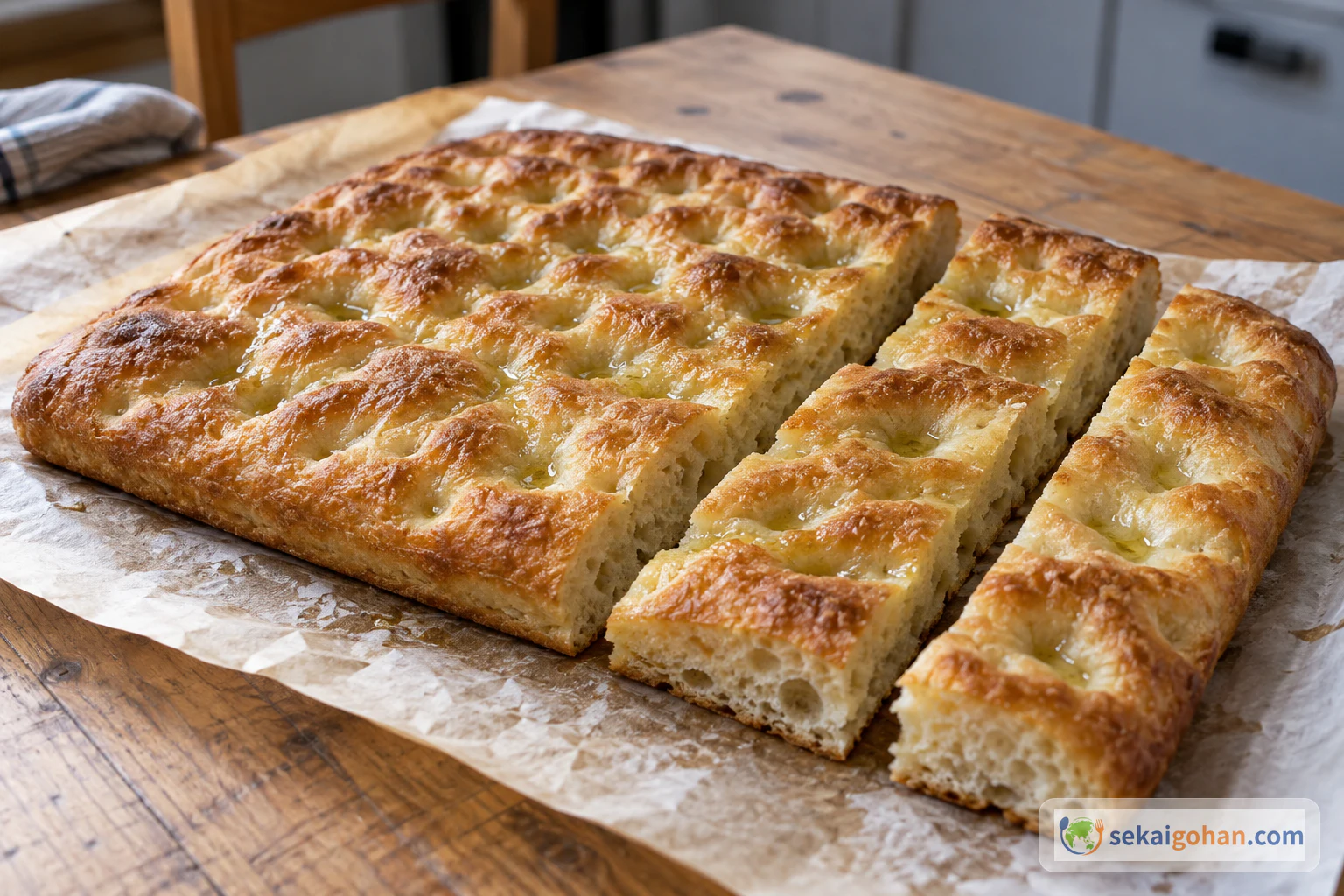
Focaccia Genovese: Genoa-Style Flatbread with Brine and Olive Oil in the Dimples (Fügassa)
Ingredients
Dough
| Ingredient | Amount | Role and notes |
|---|---|---|
| Tipo 00 flour | 14 oz (400g) | A 00 flour of W280. "00" is an Italian milling/refinement grade, not a synonym for cake flour or bread flour |
| Manitoba flour | 9 oz (250g) | A strong Manitoba flour of W400 |
| Water, room temperature | 12 oz (335g) | Most goes in first; the rest is added with the malt and salt |
| Fine salt | 13g | For the dough |
| Malt | 10g | For the dough |
| Fresh brewer's yeast | 18g | Crumbled; added after the salt |
| Extra-virgin olive oil | 1 oz (30g) | Kneaded into the dough |
Trays and surface
| Ingredient | Amount | Role and notes |
|---|---|---|
| Extra-virgin olive oil, for the trays | 1 oz (30g) | 15g per tray |
| Extra-virgin olive oil, for the surface | 2 oz (60g) | 1 oz (30g) per tray, poured over the dimpled dough |
Brine
| Ingredient | Amount | Role and notes |
|---|---|---|
| Water | 7 oz (200g) | Mixed with the salt below |
| Salt | 10g | Dissolved in the water |
Steps
1Mix the two flours with most of the water
In a large bowl, combine the 14 oz (400g) tipo 00 flour and 9 oz (250g) Manitoba flour. Pour in most of the 12 oz (335g) room-temperature water, holding back a little, and mix until the flour has taken up the water and you have a rough, shaggy mass. It will look uneven at this stage; that is expected.
2Add the malt and salt, the rest of the water, then the yeast
Add the 10g malt and 13g salt, then the remaining water, and work it in. After that, crumble in the 18g fresh yeast: salt goes in before the yeast. If some dry patches remain while mixing, don't reach for more flour straight away; keep working the dough and let the water distribute.
3Knead hard, then work in the dough oil
Turn the dough onto the work surface and knead vigorously, pushing it out and folding it back, to build gluten. When it begins to come together evenly, add the 1 oz (30g) dough oil and keep kneading until it has been fully absorbed. Knead for 13–15 minutes, judging by the dough: it should be smooth and elastic, with no slick of oil left on the outside.
A light dusting of flour on the surface is fine if the dough is hard to handle. Just don't keep adding flour; that changes the formula.
4Divide, fold in three and rest
Divide the whole dough into two equal pieces, each about 1 lb (500g). Shape each piece into a rectangle, fold it in three, and set it seam-side down. Cover with a cloth and rest for about 30 minutes.
5Oil the trays and stretch the dough to 70–80% of the tray
Spread 15g olive oil over each tray. Using your fingers and the rolling pin, stretch one piece of dough and lay it in a tray, covering about 70–80% of it. Do the same with the second piece. Cover both and rest for 20–30 minutes. The dough will resist at first; the rest is what lets it go further next time.
6Stretch to the edges, keep a rim, and rest about an hour
Gently stretch each piece all the way to the edges of the tray, leaving a slightly raised rim around the outside. Make sure the dough sits flat against the oiled tray; that keeps the liquid you add later on top of the bread instead of running underneath it. Cover with a cloth and let rest for about 1 hour.
7Press dimples with three fingers
Hold three fingers together at a slight angle and press them into the dough to make dimples about 0.5 inches (1 cm) apart, row after row across the surface. Press firmly but don't go through the dough to the tray. These three-finger dimples are closer together and more regular than the scattered holes of many other focaccia recipes.
8Add the surface oil and brine, then the final rise uncovered
Stir the 7 oz (200g) water and 10g salt together until the salt dissolves. Over each tray, pour 1 oz (30g) of the surface olive oil and about 3.25 oz (90g) of the brine, letting the liquid settle into the dimples. Stop once the dimples are holding liquid; the leftover brine does not all need to go on. Leave the trays uncovered for the final rise, 40–45 minutes.
9Bake at 450°F (230°C) until golden
Bake in an oven preheated to 450°F (230°C) on the static (conventional) setting for about 15 minutes. Ovens vary, so use the color as the endpoint: take the focaccia out when the top is evenly golden. If your oven fits only one tray, bake them one after the other. Let the focaccia sit for a few minutes before cutting.