Ingredients and steps on one page. Print it, or choose “Save as PDF” in the print dialog.
Sekai Gohan
Bolo Pretu: Caribbean Black Fruit Cake with Liqueur-Soaked Fruit
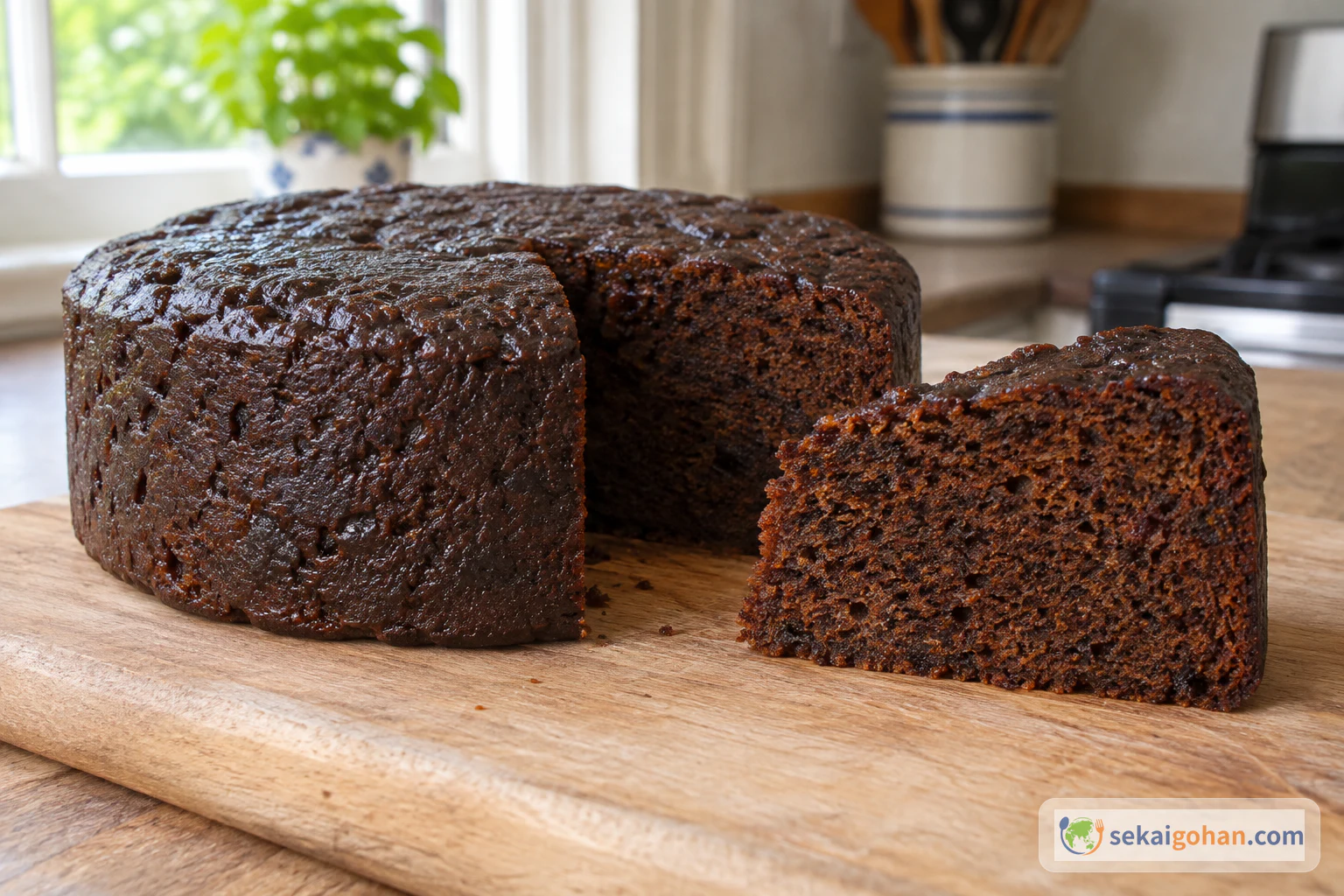
Ingredients
| Ingredient | Amount | Role |
|---|---|---|
| Raisins | 1 lb (454 g) | Sweetness and body |
| Prunes, pitted | 1 lb (454 g) | Deep colour and a sticky, moist crumb |
| Currants | 1 lb (454 g) | A sharper, tart note |
| Glazed lemon peel | ½ lb (227 g) | Citrus aroma |
| Glazed lime peel (or glazed papaya) | ½ lb (227 g) | Citrus aroma |
| Dark corn syrup | 1 cup (240 ml) | Colour, stickiness and sweetness in the soak |
| Cherry Heering (cherry liqueur) | ½ bottle, about 12½ fl oz (375 ml) | The soaking liquor |
| Cognac, for the soak | 6 tbsp (90 ml) | Flavour in the soak |
| Cognac, for brushing | a little | Keeps the finished cake moist |
| Blanched almonds | ½ lb (227 g) | Nutty richness, ground fine |
| Flour | ½ lb (227 g) | Holds the batter together |
| Unsalted butter | ¾ lb (340 g) | Richness |
| Brown sugar | ½ lb (227 g) | Sweetness and colour |
| Ground cinnamon | 1 tsp | Warm spice |
| Ground nutmeg | 1 tsp | Warm spice |
| Ground cloves | ½ tsp | Sharp, dark spice |
| Large eggs | 10 | Structure and richness |
Steps
1Grind the fruit and mix the soak
Grind the raisins, prunes, currants, lemon peel and lime peel in a food processor or through a meat grinder until they turn into a dark, sticky paste. Scrape it into a large container. Stir the dark corn syrup, the Cherry Heering and the 6 tbsp cognac together, pour it over the fruit and mix well. Stop when no dry clumps of fruit remain and the whole mass is evenly dark and wet.
2Cover and let the fruit soak
Close the container tightly so nothing gets in and the spirits do not evaporate. Leave it for at least 2 days. A full week is ideal. On baking day, open it and give it a stir. The paste is ready when it smells strongly of cherry and cognac and the liquid has soaked into the fruit. If it smells sour or off, or shows mould, throw it away.
3Prepare the almonds, flour, oven and pan
Grind the blanched almonds fine and set them aside in their own bowl. Sift the flour into a second bowl. Heat the oven to 300°F (150°C) with a rack in the lower part of the oven. Butter the pan, then line the bottom and sides with parchment. You are ready when the almonds look like a pale, sandy meal, the flour is light and lump-free, and the paper sits flat against the butter.
4Cream the butter, sugar and spices
Put the soft butter, brown sugar, cinnamon, nutmeg and cloves in the large bowl. Beat them together with a mixer or a wooden spoon, scraping down the sides now and then. Keep going until the mixture is smooth and creamy, a shade lighter than when you started and soft enough to hold the trail of the beaters.
5Add the eggs one at a time
Crack the first egg into a small cup, check that no shell has fallen in, then tip it into the creamed butter and beat. Repeat with each of the 10 eggs, one at a time. Throw the shells away in a separate bowl so none of them get near the batter. Wait until each egg has disappeared into a smooth cream before you add the next.
Ten eggs, ten small additionsAdding the eggs one at a time keeps the rich creamed base smooth. The cup lets you catch any piece of shell before it can disappear into a dark batter where you would never find it again.
6Fold in the fruit, almonds and flour
Add the soaked fruit paste, the ground almonds and the sifted flour to the egg mixture. Fold with a spatula in wide strokes, lifting from the bottom of the bowl and turning the batter over. The batter is ready when it is thick, dense and evenly dark brown, with no streaks of flour or pale butter left.
7Fill the pan and smooth the top
Scrape the batter into the lined pan. Spread it into the edges, then smooth the top level with the spatula. Set the pan on the lower rack of the hot oven. The batter is ready to bake when the surface is flat and even all the way to the paper.
Protect the bottomThis is a heavy batter that sits in the oven for a long time, and the base is where it catches first. Line the pan with paper and bake on the lower rack so the bottom stays dark and moist instead of scorching.
8Bake and test with a skewer
Bake for 1 hour, then push a bamboo skewer into the centre of the cake. If wet batter clings to it, close the oven and test again every 15 minutes. Use oven mitts each time you reach in. The cake is done when the skewer comes out with no batter on it.
Hot panThe pan and the oven rack are very hot. Use dry oven mitts for every skewer check, and set the finished cake on a heat-safe rack.
9Cool, brush with cognac and wrap
Let the cake cool completely in the pan on a rack, then lift it out onto a board. Brush a little cognac over the surface. Wrap the cake in aluminum foil, put it in an airtight container and refrigerate it. It is ready to put away when the surface looks moist all over and the foil sits snug around the cake.