Ingredients and steps on one page. Print it, or choose “Save as PDF” in the print dialog.
Sekai Gohan
Frog Cake: Adelaide Sponge Squares Under Green Fondant
Ingredients
| Ingredient | Amount | Role |
|---|---|---|
| Butter, for the pan | a little | Greases the pan under the parchment |
| Unsalted butter, softened (sponge) | 7 oz (200 g) | Fat for the sponge; must be at room temperature |
| Caster sugar (superfine sugar) | 7 oz (200 g) | Sweetness and a stable batter |
| Eggs, medium | 4 | Moisture, structure and lift; all go into the sponge |
| Self-raising flour | 7 oz (200 g) | Flour with leavening already mixed in |
| Baking powder | 1 tsp | Extra lift |
| Milk | 1 tbsp | Loosens the batter |
| Unsalted butter, softened (buttercream) | 5¼ oz (150 g) | Body of the buttercream |
| Icing sugar (powdered sugar), sifted | 7½ oz (210 g) | Sweetness and stiffness for the dome |
| Vanilla extract | 1 tsp | Scent for the buttercream |
| Strawberry jam | 5¼–5¾ oz (150–160 g) | The sharp layer and the red line |
| Green ready-to-roll icing (fondant, sugar paste) | 1 lb 2 oz (500 g) | The outer skin and the eye bases |
| Green food colouring, gel | a little | Adjusts the green of the fondant |
| Royal icing | as needed | White of the eyes |
| Black writing icing | as needed | Pupils |
| Icing sugar (powdered sugar), for dusting | as needed | Keeps the fondant from sticking to the board and pin |
Steps
1Line the pan and mix the batter all at once
Heat the oven to 340°F (170°C). Rub a little butter over the pan and line it with parchment cut to fit, so the corners stand up and the base lies flat without creases. Paper that is too big lets batter run underneath. Put the sponge butter, caster sugar, eggs, self-raising flour, baking powder and milk into one bowl and beat with an electric mixer until the batter is smooth, soft and glossy. Scrape it into the pan and level the top. No specks of flour remain, and the batter falls from the beaters in a thick ribbon.
2Bake and cool completely in the pan
Bake for 25–30 minutes. The edges turn golden, the centre springs back when you press it lightly, and a skewer pushed into the middle comes out clean. If batter clings to the skewer, bake 5 minutes more and test again. The eggs have to be cooked right through to the centre. Set the pan on a wire rack and leave the sponge in it until cold all the way through. The pan feels cool to the touch underneath.
3Split the sponge into two layers
Lift the cold sponge out by the parchment and peel the paper away. Lay it on a board and cut it horizontally into two even layers with a long serrated knife, using long, gentle strokes and keeping the blade flat. A warm sponge tears and crumbles here, which is why it must be cold. You have two layers of the same thickness with flat, fine-crumbed cut faces.
4Spread the jam and stack the layers
Spread the strawberry jam over the cut face of the bottom layer with an offset palette knife, thinly and evenly, right to the edges. Set the top layer back on and press gently with a flat hand. Thick jam squeezes out and slides when you cut. The jam is thin enough that the sponge shows through it.
5Cut into 1½-inch squares
Score the top of the cake at 1½-inch (4 cm) intervals in both directions as a guide. Cut along the marks by pressing the knife straight down in one firm push. Sawing back and forth makes the layers shift. Lift the squares apart and set them on a parchment-lined tray. The cut faces stand straight and the jam line runs level.
Press, don't sawEvery square becomes a base for a dome and a sheet of fondant. Straight walls and sharp corners now give a smart frog later, and a squashed corner shows through the green skin.
6Make the buttercream
Beat the second portion of butter in a clean bowl until it turns pale. Add the icing sugar in two additions, mixing each one in on low so the sugar does not fly. Add the vanilla, then beat on medium speed for 5 minutes. Keep the full amount of icing sugar, because a softer cream will not hold a dome. The buttercream is smooth and pale and stands in a thick ribbon on the lifted beaters.
7Pipe the domes and chill
Spoon part of the buttercream into a piping bag fitted with the ⅜-inch (1 cm) plain nozzle and twist the top closed. Hold the bag upright over the centre of a square and pipe a 1-inch (2.5 cm) dome, then lift away cleanly. Keep the rest of the buttercream for the sides. Refrigerate the tray for 30 minutes. The domes stand up by themselves with smooth surfaces and no ridges.
8Crumb-coat the sides
Take the tray out and spread a thin layer of the remaining buttercream over the four sides of each cake with a small palette knife. Leave the chilled dome alone. This coat holds down the crumbs, which otherwise come up under the fondant. A thick coat rounds the corners and makes the fondant wrinkle. The sponge colour still shows through, and no crumbs sit on the surface.
When the buttercream runs shortIf there is not enough buttercream left for every cake, spread the sides thinner. Do not make a larger batch. The coat only needs to hold the crumbs.
9Roll the fondant and wrap each cake
If you want a deeper green, knead a little gel colouring into the fondant first. Dust the board and rolling pin with icing sugar and roll the fondant to ¼ inch (6 mm). Thinner fondant tears, and thicker fondant is heavy. Cut a square big enough to cover one cake, drape it over the dome, then smooth it down each side and around the corners with your palms. Trim the excess at the base. If it tears, press the edges together and patch with a small scrap. Wrapped cakes have sharp corners and no wrinkles or trapped air.
10Give each frog its face
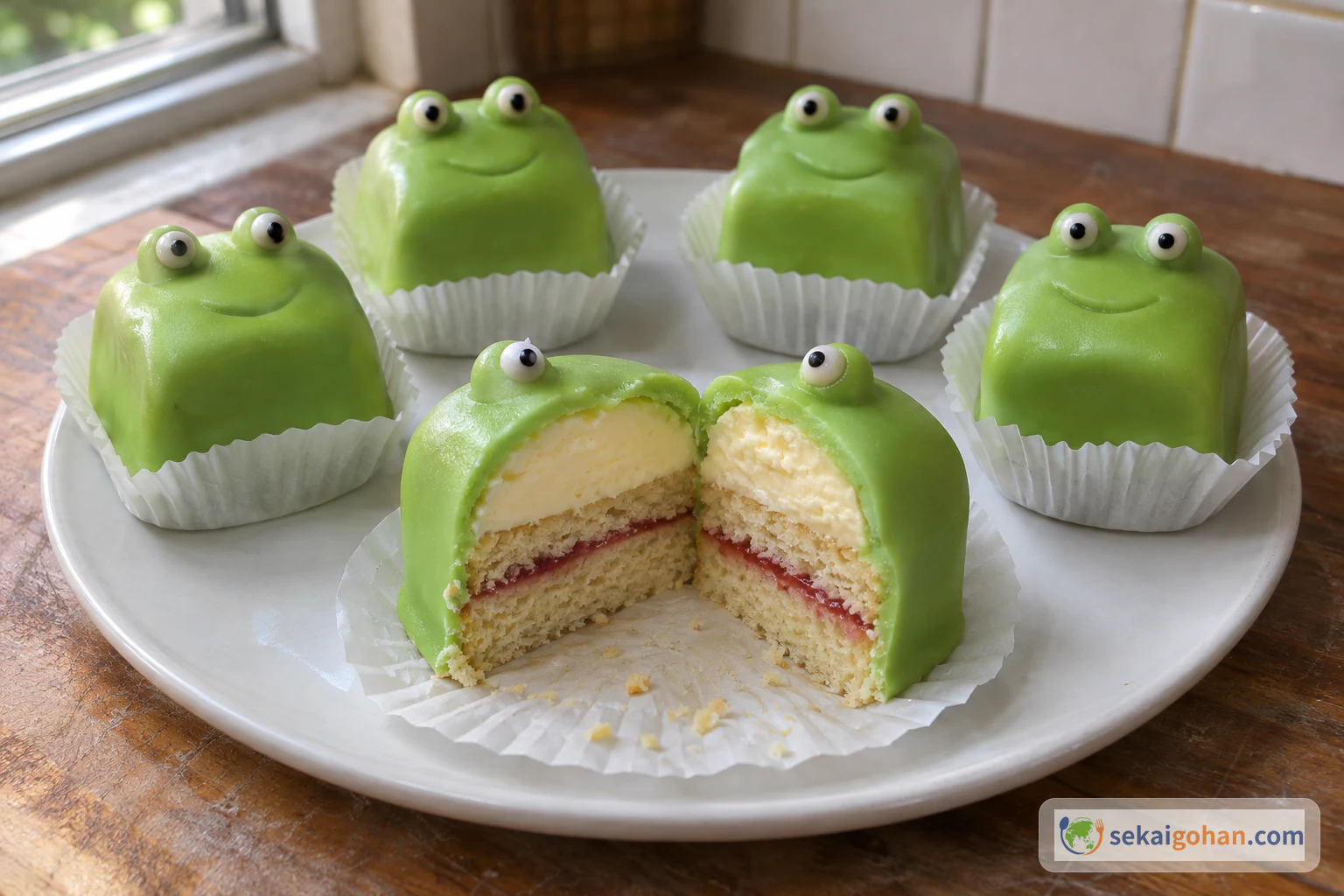
Roll two small balls of green fondant for each cake and press them onto the front of the dome as eye bases. Pipe a dot of white royal icing on each, then a smaller black pupil in the middle. Press the rim of a small round cutter into the fondant under the eyes to make a curved mouth. Both eyes sit at the same height with the pupils centred.
Cutting the mouth openAdelaide's frogs have the mouth cut open so the cream shows. To make that version, warm a knife in boiling water, dry it, and cut a slit under the eyes. Handle the hot water and the blade with care, and keep children back while you work.
11Set in paper cases and store cold
Stand each frog in a paper case, which also hides any bumps on the sides. Cover them with plastic wrap or put them in an airtight container so the fondant does not dry out. Keep them in the refrigerator, because buttercream is a dairy filling and must not sit at room temperature for long. Take them out only a short time before eating. The fondant has a soft shine and no beads of moisture.