Ingredients and steps on one page. Print it, or choose “Save as PDF” in the print dialog.
Sekai Gohan
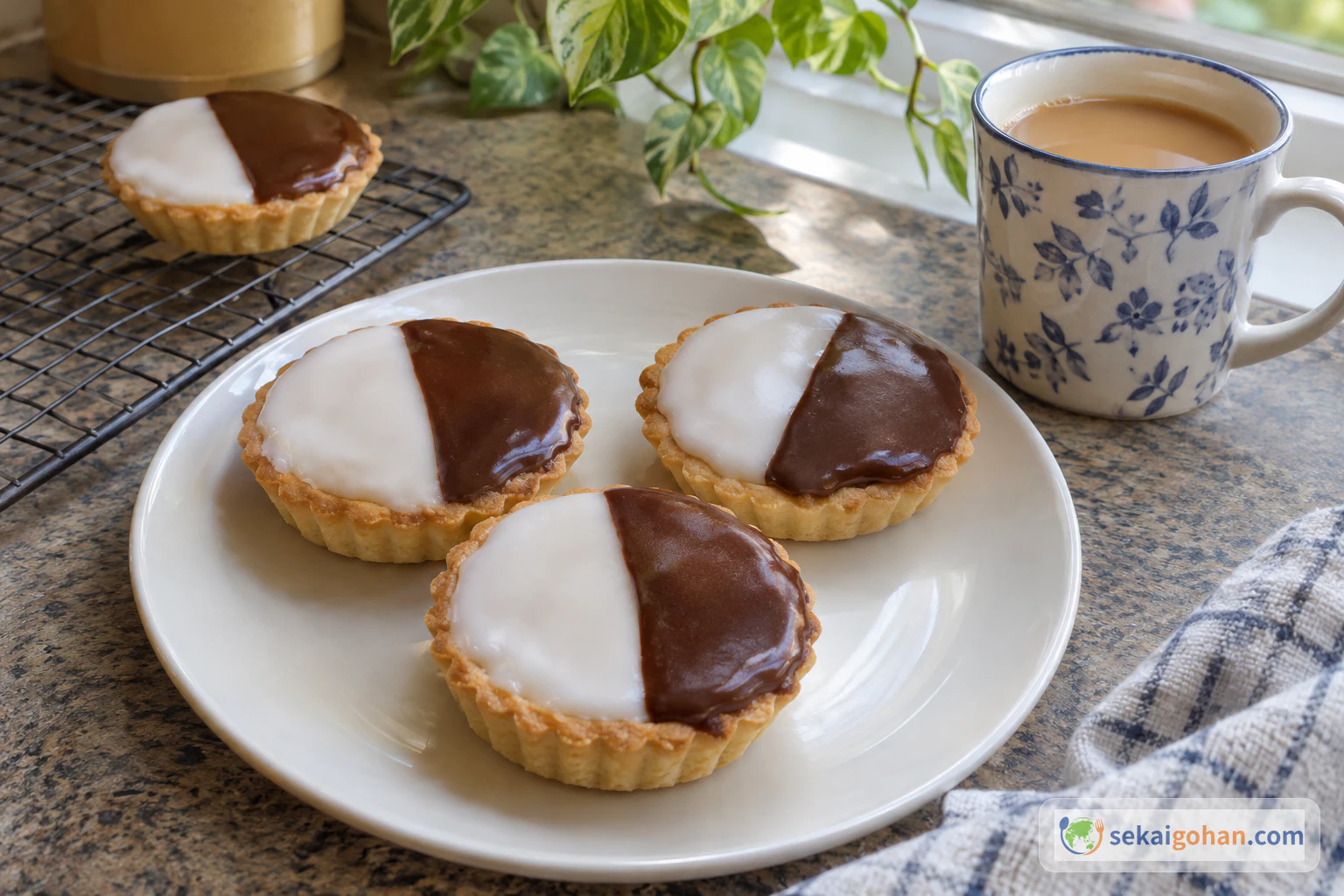
Neenish Tart: Australian Jam and Mock Cream Tart with Two-Tone Icing
Ingredients
| Ingredient | Amount | Role |
|---|---|---|
| Plain (all-purpose) flour | 1½ cups (225 g), plus extra for dusting | Pastry |
| Butter, chilled and cubed | 4¼ oz (120 g) | Pastry; keep it cold until it goes in |
| Egg yolk | 1 | Pastry |
| Iced water | 2 tbsp | Pastry |
| Raspberry jam | 1 cup (315 g) | Bottom layer of the filling |
| Caster sugar | ⅓ cup (80 g) | Mock cream syrup |
| Milk | 1 tbsp | Mock cream syrup |
| Cold water | 1 tbsp | Mock cream syrup |
| Boiling water | 1 tbsp | For dissolving the gelatine |
| Powdered gelatine | ½ tsp | Holds the mock cream in shape |
| Unsalted butter, at room temperature | 3½ oz (100 g) | Body of the mock cream |
| Vanilla essence | 1 tsp | Mock cream flavour |
| Icing sugar | 1½ cups (230 g) | Both icings |
| Milk | 2 tbsp, plus 1 tsp | 2 tbsp for the icing base, 1 tsp extra for the chocolate half |
| Cocoa powder (unsweetened) | 1½ tbsp | Chocolate icing |
Steps
1Rub the butter into the flour
Heat the oven to 390°F (200°C). Put the flour and the cold cubed butter in a food processor and pulse until the mixture looks like fine crumbs with no visible lumps of butter. Add the egg yolk and iced water and run the machine again. Stop the moment the crumbs begin to clump together but before they form a ball.
Cold butter, cold waterThe chilled butter and iced water are what keep the pastry short and crumbly. Stop processing as soon as it clumps; working it further makes a tough case that shrinks in the oven.
2Roll, cut and line the tin
Tip the crumbs onto a floured bench and knead lightly just until they hold together, then divide in two. Roll one half to ⅛ inch (3 mm) thick and cut out 6 rounds with the 3-inch (8 cm) cutter. Press them into 6 holes of the muffin tin, then repeat with the other half. Refrigerate the lined tin for 15 minutes, until the pastry is firm and cold.
3Make the gelatine syrup
Put the caster sugar, milk and cold water in a small saucepan over medium-low heat and stir until the sugar has dissolved and the liquid no longer feels gritty. Take the pan off the heat. In a ramekin, stir the gelatine into the boiling water with a fork until it dissolves. Add it to the sugar mixture and leave it to cool for 15 minutes.
4Beat the mock cream
Beat the room-temperature unsalted butter with the vanilla essence until it turns pale and creamy. Pour in the cooled syrup a little at a time, beating after each addition so it disappears into the butter. Keep going until all the syrup is in and the cream is smooth and white. Cover the bowl and set it aside.
Patience with the syrupAdd the syrup only after its full 15 minutes of cooling, and in small amounts. Warm syrup or a single pour softens the butter and leaves a slack filling that will not stay flat under the icing.
5Prick and bake the cases
Take the tin from the refrigerator and prick the base of each case several times with a fork. Bake at 390°F (200°C) for 10 minutes, or until the pastry is golden. The pricked bases let steam escape, so the cases bake empty with no paper or weights. Set the tin on a wire rack and cool for 15 minutes, until the cases are cool enough to fill.
6Pour in the jam
Warm the raspberry jam in a saucepan over medium heat for 2 minutes, stirring, until it loosens and runs. Strain it into a heatproof jug to remove seeds and lumps. Pour it into the baked cases, sharing it evenly among all twelve. Leave them for 5 minutes, until the jam has settled into a smooth layer.
Hot jam and hot waterWarmed jam is very hot and sticks to skin. Pour it from the jug slowly, and take the same care with the pan of hot water used for the icing in steps 9 and 10.
7Fill with mock cream
Spoon the mock cream over the jam, dividing it evenly among the cases. Smooth the top flat with a small palette knife. The surface should be level and even across the whole tart, ready to take the icing.
8Mix the two icings
Mix the icing sugar and 2 tbsp milk in a heatproof bowl until smooth. Divide it in half between two heatproof bowls. Stir the cocoa and the extra 1 tsp milk into one of them. You now have a white icing and a brown chocolate one; keep butter out of both.
9Ice the white half
Set the bowl of white icing over hot water and stir until it melts and turns smooth and glossy. Spread it over one half of each tart, taking it right to the centre line. Work on all twelve before you move on. Leave them for 5 minutes.
The straight lineA clean, straight join between the colours is the hardest part of the tart. Set the white edge first and let it firm before chocolate touches it; that edge is the guide you work against.
10Finish with chocolate
Warm the chocolate icing over hot water in the same way until smooth. Spread it over the uncovered half of each tart, easing it up to the white edge. Fill right into the join with no gap and no air pockets. The tart is finished when the top shows a neat line between white and chocolate.