Ingredients and steps on one page. Print it, or choose “Save as PDF” in the print dialog.
Sekai Gohan
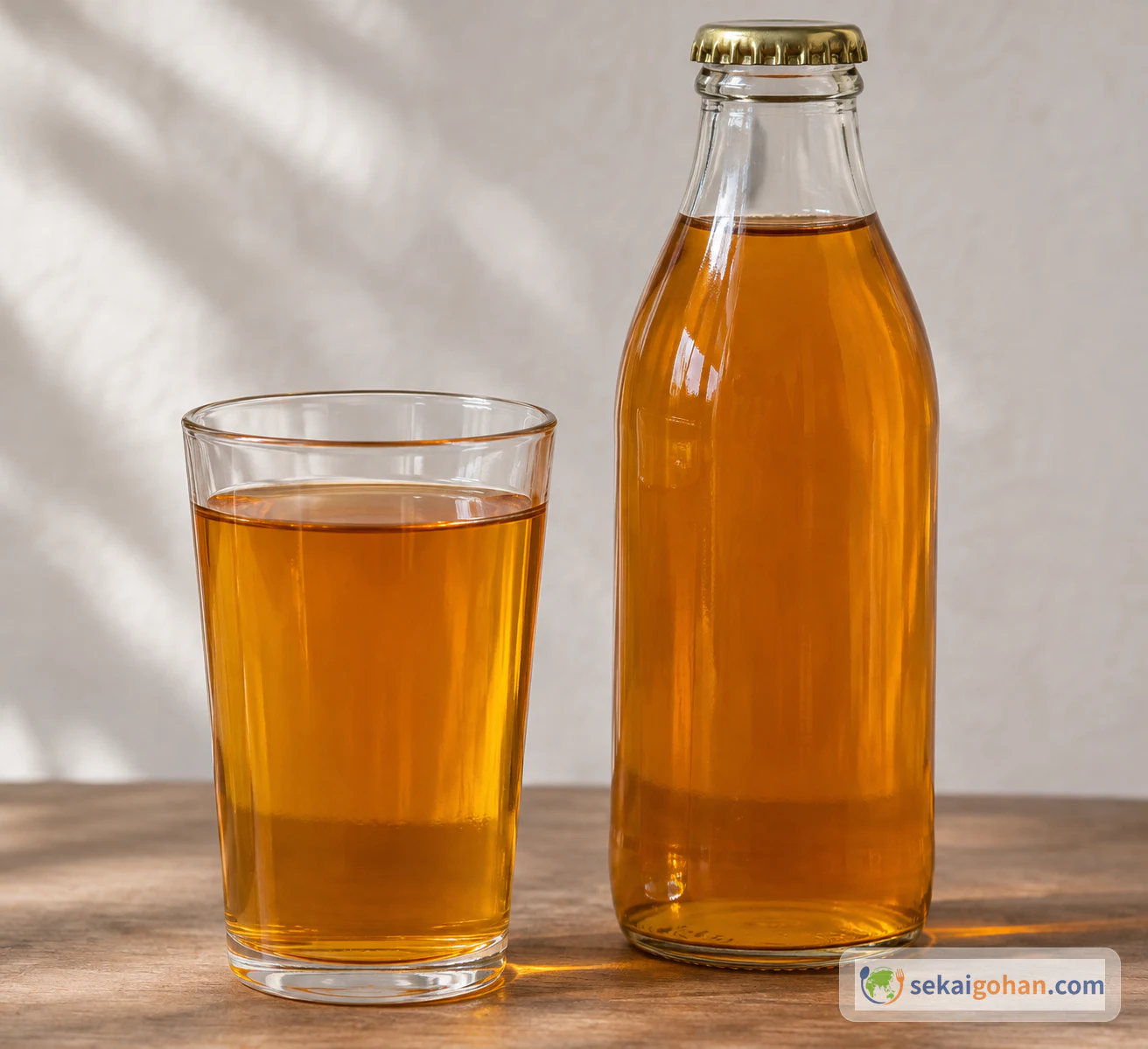
Cajuína: Clear Amber Cashew Apple Drink from Piauí
Ingredients
| Ingredient | Amount | Role |
|---|---|---|
| Ripe cashew apples (caju, pedúnculo do caju) | about 6.4 lb (2.9 kg), for about 2 quarts (2 L) of juice | The juice itself, with its sugar, acidity and vitamin C |
| Unflavored refined powdered gelatin (gelatina refinada em pó) | ⅓ oz (10 g) | Clarifier that pulls the tannins and fine pulp into curds |
| Water for dissolving the gelatin (água), 122–140°F (50–60°C) | 6 tbsp (90 ml) | Dissolves the gelatin into a pourable solution |
| Water for washing (água) | as needed | Sanitizing bath and washing the fruit |
Steps
1Detach the nuts
Use ripe cashew apples, picked in the morning when you can get them that way. Hold the fruit in one hand and lift the nut away from its base with the other. For a cleaner release, loop a nylon thread around the base, take it once around and pull; the nut comes away without tearing the fruit. Set the nuts aside whole. You are done when each fruit is intact with only a small, clean scar where the nut was.
2Sort, sanitize and wash
Go through the fruit and remove any that are unripe or damaged. Immerse the sorted fruit in a chlorine sanitizing bath. Lift it out and wash it in clean water. The fruit is ready when only firm, ripe, unbroken pieces remain and the washing water runs clear.
3Press the juice
Feed the cashew apples into the press. A good press returns about seven-tenths of the fruit's weight as juice, with the fibrous pulp leaving separately. Collect the juice in a clean vessel and discard the pulp. The juice should be pale yellow and cloudy, with no fibers floating in it.
4Clarify with gelatin
Dissolve the gelatin completely in the 122–140°F (50–60°C) water. Pour this solution into the juice a little at a time, stirring gently between additions. Stop adding when large white flocs form throughout the juice. Leave it to stand for 1 hour, until the curds have gathered and the liquid between them looks lighter.
Watch the curds, not a measureThe right amount of gelatin shows itself. Small specks mean add more solution; large, separate curds mean stop. Always dissolve the gelatin first, since dry powder dropped into juice clumps instead of clearing it.
5Filter in several passes
Line the funnel with one cotton cloth and pour the rested juice through it into a clean jug. Change to a fresh cloth and pour the filtered juice through again. Repeat for three or four passes in a row, one cloth at a time. The juice is ready when it runs clear and pale yellow and the last cloth holds almost nothing.
6Preheat the juice
Pour the clear juice into the stainless steel pot. Heat it to 185–195°F (85–90°C) and hold it there for 15–20 minutes, checking with the thermometer. At this heat the juice begins to caramelize lightly, which deepens its color and flavor. Move on when it steams gently and the color has warmed a shade.
7Fill and cap hot
Pour the hot juice through the funnel into the bottles while it is still at 160–175°F (70–80°C). Cap each bottle immediately, while the juice is hot. As the bottles cool, a vacuum forms inside, which helps the drink keep. Each bottle is done when it is full and its cap is pressed down firmly.
Hot juice and hot glassFilling and the water bath involve scalding liquid and hot glass. Hold bottles with tongs or heat-resistant gloves, work on a stable surface, and keep cold water away from hot bottles.
8Boil the sealed bottles
Stand the capped bottles in the large pot of boiling water. Keep them in the boiling bath for 1 to 2 hours, never more than 2, since longer heating destroys vitamin C. Some makers boil for 2 to 3 hours for a deeper color. The bottles are done when the juice has turned amber.
9Cool slowly and store
Let cold water run gently into the pot around the bottles, a thin stream at a time. Keep adding water until the bath has cooled to 115–120°F (45–50°C). Cooling this gradually keeps the glass from cracking. Lift the bottles out, dry them, and store them at room temperature once they are cool to the touch.
Patience at the endA sudden shock of cold breaks hot bottles. A slow trickle into the bath is enough; never use an ice bath or run a jet of cold water over the glass.