Ingredients and steps on one page. Print it, or choose “Save as PDF” in the print dialog.
Sekai Gohan
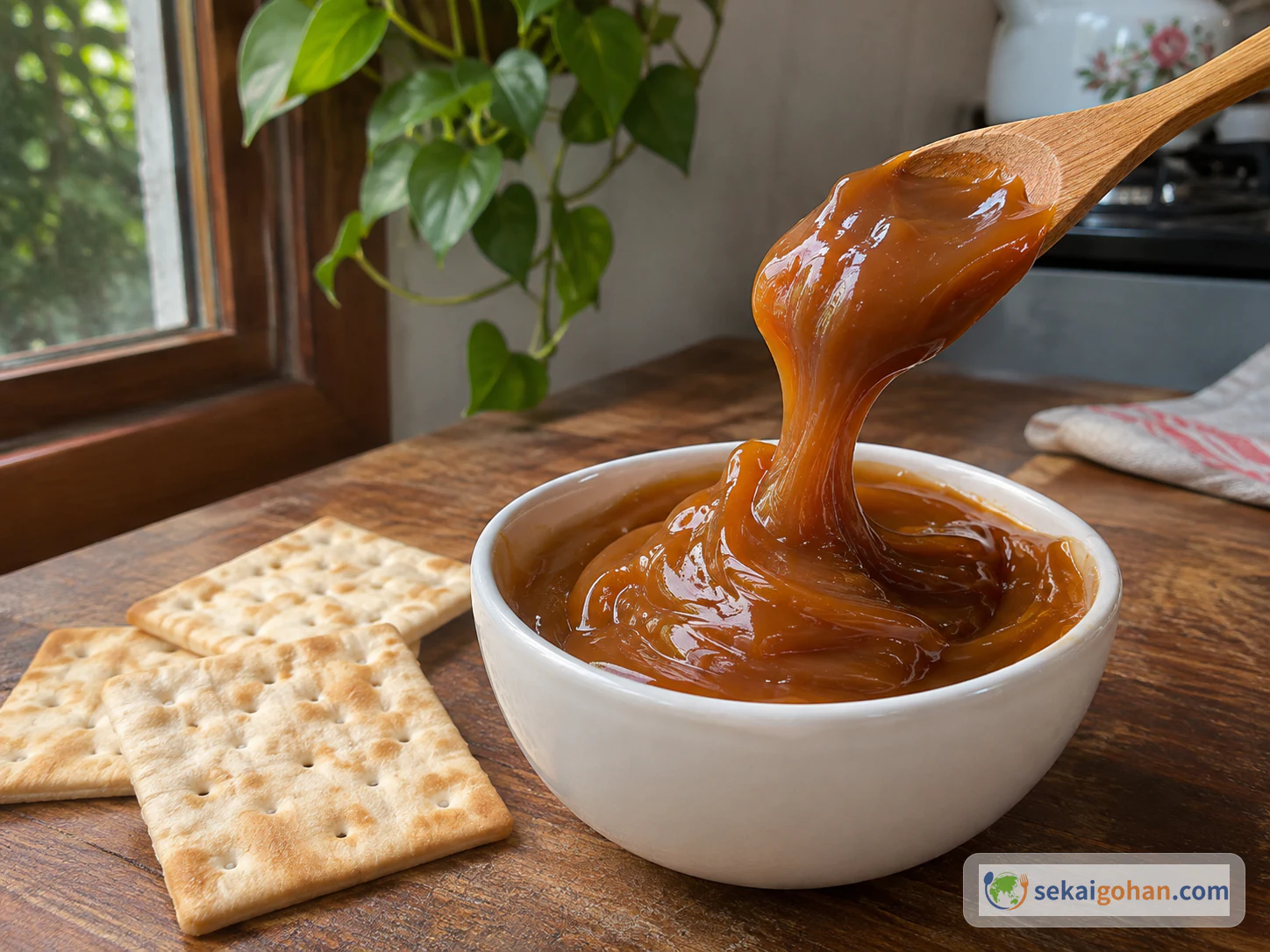
Doce de Leite: Slow-Cooked Brazilian Milk and Sugar Spread
Ingredients
| Ingredient | Amount | Role |
|---|---|---|
| Whole milk (leite integral) | 1 quart (1 L) | The body, sweetness and colour of the spread |
| Granulated sugar (açúcar) | 7 oz (200 g) | Sweetness, plus browning as it reduces |
| Salt (sal) | a pinch | Rounds the sweetness so it does not turn cloying |
| Baking soda (bicarbonato de sódio) | 1 tsp | Neutralizes acidity as the milk reduces, so it stays smooth and browns evenly |
Steps
1Combine the milk and sugar in a wide pot
Pour the milk into the wide, heavy-bottomed pot and add the sugar. Stir well with the spatula, scraping across the bottom so the sugar does not settle in a layer. Check the level. The milk should fill the pot only a third to halfway, leaving room for the foam to come. It is ready when the sugar is spread through the milk and only a few crystals still drift at the bottom.
2Bring to a boil and add the baking soda and salt
Set the pot over medium heat and stir now and then as it warms. When the milk boils, add the baking soda and the salt and stir straight away. A thick white foam surges up toward the rim. Keep stirring and the foam settles back down within moments. Move on when the surface is calm again.
3Simmer low, stirring every 5 minutes
Turn the heat down to low so the surface shows only gentle bubbles. Cook for about an hour in all. For the first 50 minutes or so, stir every 5 minutes, sweeping the spatula across the bottom and into the corners each time. Over that time the milk reduces and slowly turns from white to beige to light caramel. Move on when it has reduced well and is starting to thicken around the spatula.
4Stir constantly for the last 10 minutes
For about the last 10 minutes, do not leave the pot. Stir continuously, keeping the spatula moving over the whole base, because the thick mixture now catches and scorches easily. The colour deepens to amber and the surface turns glossy. You are close when the spatula leaves a trail that shows the bottom of the pot for a moment before it closes.
5Test for the ponto napê and turn off the heat
Lift the spatula, let it coat, and draw a finger across the back of it. At the ponto napê, the line stays open and does not run back together. Some cooks look instead for the mass pulling away from the sides of the pot, or drop a little into cold water and see whether it rolls into a ball between their fingers. Both of those signal a firmer set. For a spreadable jar, turn off the heat while it is still slightly soft, because it thickens as it cools.
6Cool and fill clean jars
Leave the pot off the heat to cool, stirring once or twice so a skin does not form. Once it has cooled, spoon it into clean glass jars, scraping the pot with the spatula. Put the lids on and refrigerate. It is done when the jars are full and the surface has settled smooth and level.