Ingredients and steps on one page. Print it, or choose “Save as PDF” in the print dialog.
Sekai Gohan
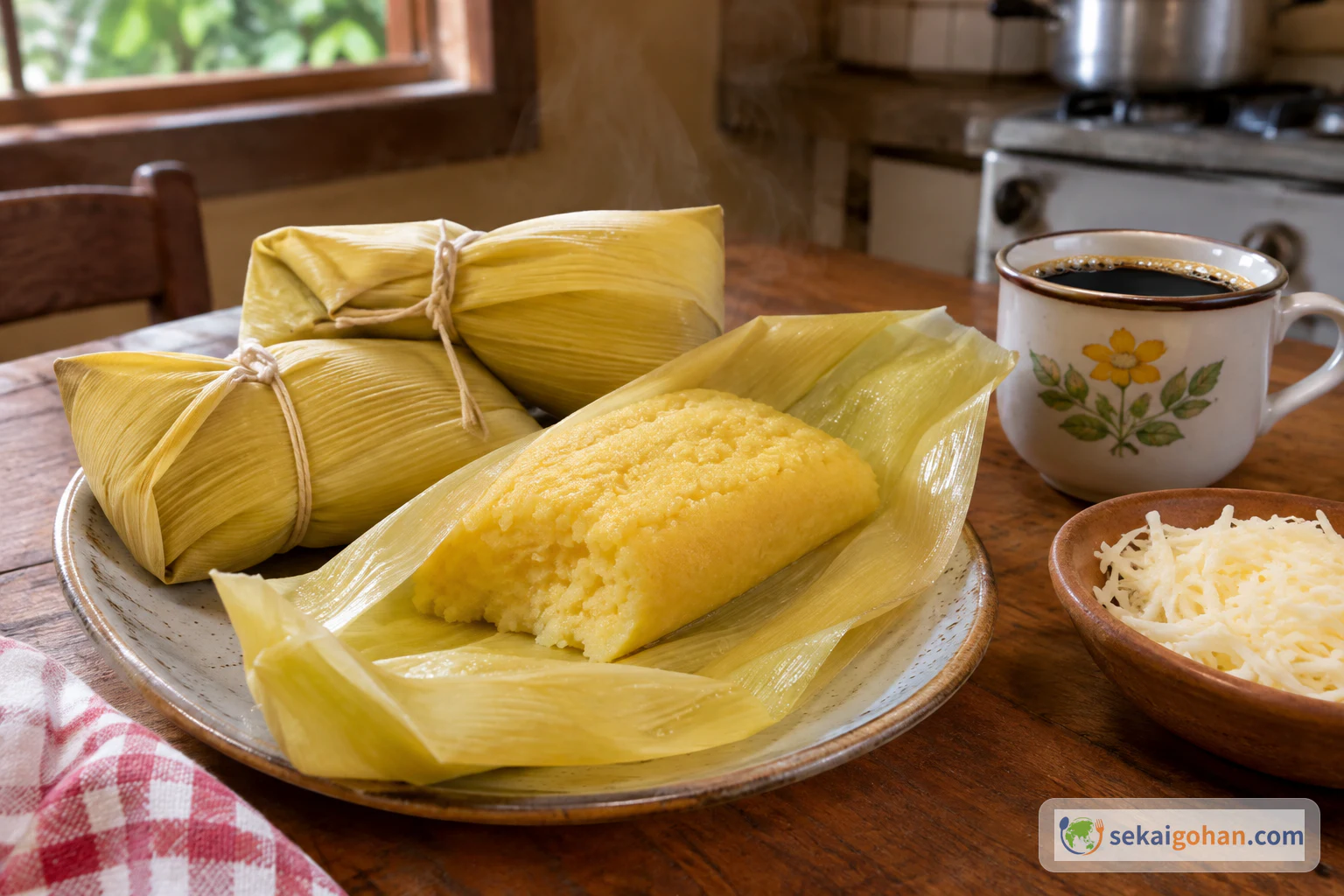
Pamonha: Brazilian Fresh Corn Parcels Boiled in Their Husks
Ingredients
| Ingredient | Amount | Role |
|---|---|---|
| Fresh corn in the husk (milho verde) | 12 ears | The paste; the husks become the wrappers |
| Water (água) | 1 cup | Loosens the kernels in the blender |
| Sugar (açúcar) | 2 cups | Sweetness |
| Fine shredded coconut (coco ralado fino) | 1 cup | Flavor and richness |
| Salt (sal) | a pinch | Sharpens the sweetness |
Steps
1Husk the corn and take off the kernels
Peel the husks from each ear slowly, working from the top down so the leaves come away whole. Stack the good husks to one side; they are your wrappers, so do not tear them. Pull away the silk, then stand each cob in a large bowl and slice the kernels off with a knife, or grate them. Keep going until the cobs are bare and you have a bowl of raw kernels and a tidy stack of intact husks.
2Blend the kernels with the water
Tip the kernels into the blender and pour in the 1 cup of water. Blend until the kernels break down completely. Stop and scrape down the sides with the spatula once or twice so nothing stays whole at the bottom. The paste is ready when it is thick and pale yellow, with no whole kernels left.
3Mix in the coconut, sugar and salt
Pour the corn paste into a large bowl. Add the fine coconut, the sugar and a pinch of salt. Stir well with the spatula, scraping up from the bottom of the bowl. Keep stirring until the sugar has dissolved into the paste and the coconut is evenly spread, with no dry pockets.
4Fill the husks
Overlap two or three husks so they make a broad leaf with no gaps. Cup them in one hand and spoon the paste into the center. Leave enough husk on every side to fold over the filling with room to spare. Fold the long sides in over the paste, then fold the ends up, so the parcel looks closed and no paste shows at the seams.
Fold before you fill too muchThe paste is loose, and an overfilled husk will not close. Fill less than you think, fold the ends in tight, and use an extra husk as a patch over any thin spot.
5Tie each parcel firmly
Hold the folds in place with one hand and wrap the string around the parcel. Tie it firmly, pulling the knot tight. Set each tied parcel on a tray as you go. Each one is done when it holds its shape on the tray and no paste seeps from the folds.
6Boil in fully boiling water
Bring the large pot of water to a full rolling boil before anything goes in. Lower the parcels into the water one at a time with the slotted spoon. Wait for the water to keep rolling between each one. If the water is only warm, the parcels fall apart. Boil for about 40 minutes.
The boil decides everythingA lukewarm pot is how pamonha turns to mush in the water. Add the parcels one by one so the temperature never drops far, and turn the heat up again if the bubbling slows.
Boiling waterLower and lift the parcels with a slotted spoon, never by hand, and keep the pot handle turned in. Cook the parcels all the way through; the paste is raw corn when it goes in.
7Lift out and cool
Lift each parcel out of the pot with the slotted spoon and let the water drain off for a moment. Set them on a rack in a cool place. Leave them alone while they cool. They are ready to open when you can hold one comfortably and the paste inside has set.
8Unwrap and serve
Cut or untie the string and fold back the husk. Set the pamonha on its own husk on the plate. Put out coffee and a small bowl of grated cheese. It is right when the paste holds its shape on the husk and gives softly under a spoon.