Ingredients and steps on one page. Print it, or choose “Save as PDF” in the print dialog.
Sekai Gohan
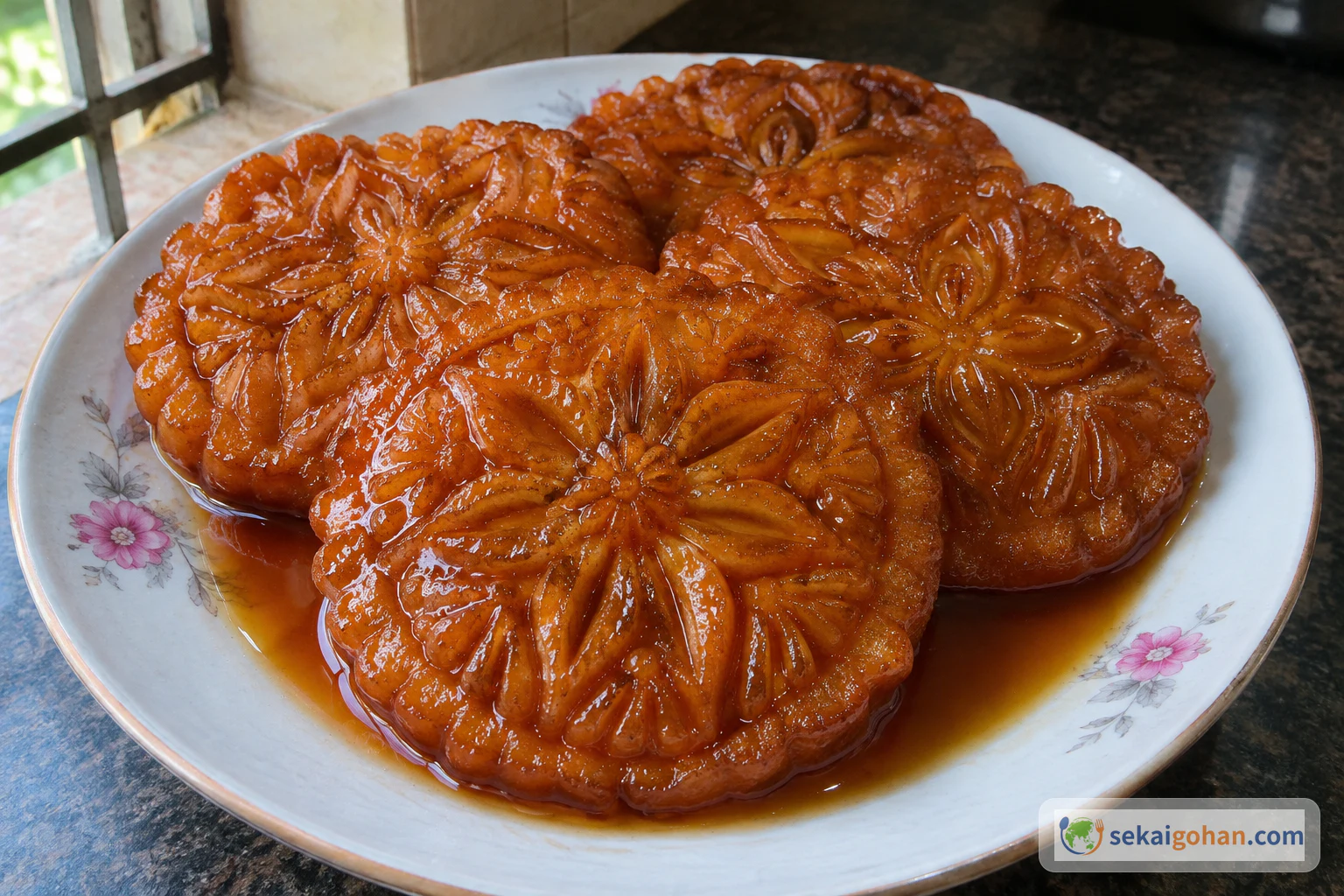
Nakshi Pitha: Bangladeshi Carved Rice Flour Cakes in Jaggery Syrup
Ingredients
| Ingredient | Amount | Role |
|---|---|---|
| Rice flour (atap rice flour) | 2 cups | The dough |
| Water | 2 cups | Boiled with the salt to scald the flour |
| Salt | ¼ tsp | Seasons the dough |
| Date-palm jaggery (khejur patali) | 1 cup | The syrup |
| Water, for the syrup | 1 cup | Dissolves the jaggery |
| Oil, for frying | as needed | Deep-frying the carved discs |
| Oil, for the board and surface | a little | Stops sticking while shaping and carving |
| Rice flour, for dusting | up to 1 tbsp, only if needed | Firms up a sticky dough |
Steps
1Scald the flour in boiling salted water
Put 2 cups water and ¼ tsp salt in the saucepan and stir until the salt dissolves. Bring it to a rolling boil, then tip in all the rice flour at once and stir hard with a wooden spoon until no dry flour is left. Turn off the heat, cover the pan and leave it on the stove for 10 minutes. Do not lift the lid during the rest, because the trapped steam finishes cooking the flour. The dough is ready when it looks like one thick, pale mass with no dry streaks.
2Knead while the dough is hot
Turn the dough out onto the work surface while it is still hot. Work it with a spatula or a damp cloth at first, then knead with the heel of your hand for 10–15 minutes. It is sticky at the start. If it stays sticky, work in dusting flour a little at a time, up to 1 tbsp. Keep going until the dough is smooth and pliable and no longer clings to your palm.
Keep it warmHot rice dough kneads smooth, but it stiffens as it cools and then cracks when you shape it. Knead straight after the rest and don't stop halfway.
3Divide and cover
Cut the dough into 5–6 equal portions with a bench scraper. Lay a damp cloth over all of them right away, and keep the ones waiting their turn covered the whole time. The portions should stay soft, with no dry skin forming on top.
4Press out a thick disc
Oil the work surface lightly and set one portion on it. Flatten it into a round disc about ½ inch (1.3 cm) thick. Run your fingers around the edge to smooth it into a neat curve with no cracks. Brush or rub a thin film of oil over the top. The disc is ready when it is even all over, keeps its shape and has a light sheen.
5Carve the pattern deep
Draw your design into the oiled surface with a toothpick. Start from a centre flower and work out to leaves or rings near the edge. Push each line in to more than half the depth of the dough. Shallow scratches close up in the hot oil. Lift the carved disc onto butter paper and cover it with a damp cloth, then shape and carve the rest the same way. A finished disc has clean, open grooves that you can see from across the counter.
6Fry one at a time over medium-low heat
Heat plenty of oil in the heavy-bottomed pot over medium-low heat. Slide in one carved disc and let it fry slowly, turning it so both sides colour evenly, for about 15–20 minutes per cake. It is done when it is golden brown and crisp all over, with the grooves still sharp. Lift it out and drain it well, then fry the next one.
Slow heat makes the cakeA disc this thick needs a long, gentle fry so it cooks to the centre. Over strong heat the outside burns before the inside is done. If a cake browns fast, turn the heat down before the next one goes in.
7Cook the jaggery syrup to one string
Put 1 cup khejur patali and 1 cup water in the second saucepan. Cook over medium heat, stirring until the jaggery dissolves, then let it simmer until it thickens and turns glossy. Test it by dropping a little onto a plate and letting it cool. When you pinch the cooled drop and pull your fingers apart, it should draw a single thread. That is one-string consistency, and the syrup is ready.
8Soak the warm cakes in warm syrup
While the cakes and the syrup are both still warm, put the cakes into the syrup. Leave them for 2–3 minutes, spooning syrup over the top so it runs into the grooves. Lift each one out with tongs and let the excess drip back into the pan. A finished cake is coated and shiny, with the carved pattern still clear under the syrup.