Ingredients and steps on one page. Print it, or choose “Save as PDF” in the print dialog.
Sekai Gohan
Jaleba: Indian Large-Spiral Jalebi in Warm Saffron Syrup

Ingredients
| Ingredient | Amount | Role |
|---|---|---|
| All-purpose flour (maida) | 2 cups (250 g) | The whole batter, with the water below |
| Water, for the batter | 1¼ cups (300 ml) | Loosens the flour into a pourable batter that ferments overnight |
| Oil | as needed | For frying only; it never goes into the batter |
| Sugar | 4 cups (1 kg) | The syrup |
| Water, for the syrup | 1¼ cups (300 ml) | Dissolves the sugar |
| Saffron | a few strands | Gold colour and aroma in the syrup |
Steps
1Combine the sugar and water and bring them to a boil
Put the sugar and the syrup water in the saucepan. Stir them together before the heat goes on, so the sugar is wet through and nothing settles dry at the bottom. Set the pan over the heat and keep stirring now and then as it warms. Keep heating until it comes to a boil, with bubbles rising across the surface.
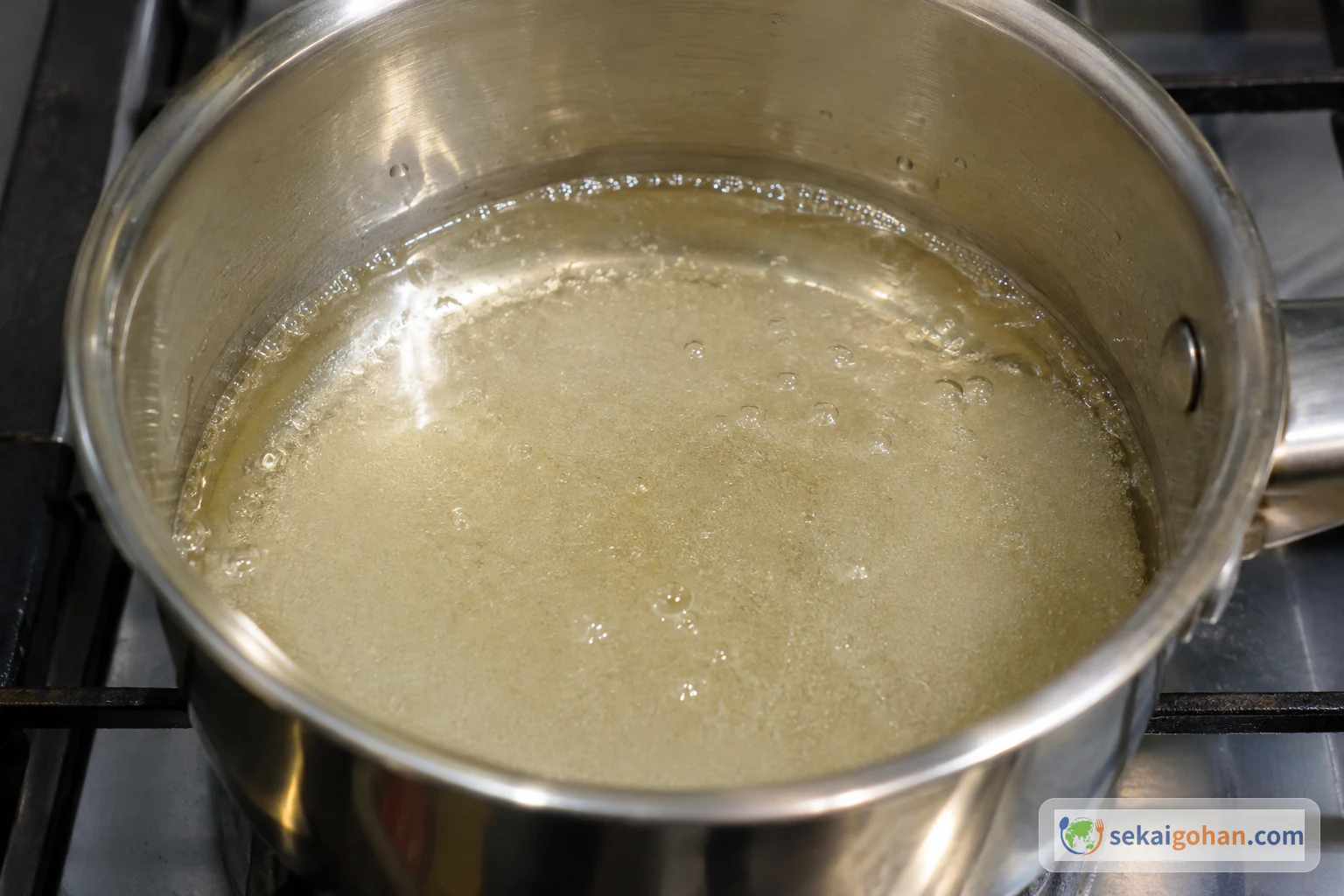
The first bubbles break through the cloudy liquid as the sugar dissolves 2Add the saffron and finish the syrup
Once the syrup boils, drop in the saffron strands. Let it bubble until it is a light syrup, neither thick nor watery. Take it off the heat and leave it in its pan, because the fried jaleba will go into this same syrup while it is warm. Hot sugar syrup burns badly, so keep your hands and face back when you lean over it.
Thick or thin decides the biteA syrup that is too thick sits on the surface and goes sticky; one that is too thin soaks the jaleba soft. Aim for a light, flowing syrup.
3Mix the batter
Put the maida in a clean bowl and pour in the batter water. Stir with a spoon, scraping down the sides so no dry flour clings to the rim. Keep going until every lump has gone. The batter is ready when it is smooth and pourable.
4Leave the batter overnight in a warm spot
Cover the bowl with its lid set slightly ajar, leaving a gap instead of sealing it. Set it in a warm corner of the kitchen and leave it overnight. In the morning, lift the lid and look and smell before you do anything else. Go on only when it smells clean, with no mould and no unexpected colour.
Fermenting the batterWash your hands and use a clean bowl, lid and spoon. Leave the batter overnight in a warm spot with the lid ajar. If it smells wrong, grows mould or turns an unexpected colour, throw the whole batch away and start again.
5Whip air into the batter by hand
Work the fermented batter with your hand, beating and lifting it against the side of the bowl. Keep at it for about 10 minutes, resting your arm for a moment when it tires and then going again. The batter loosens and lightens as you go. Stop when fine bubbles run all through it and the surface looks airy.
Rest, then whip againShort pauses keep your strokes strong to the end. Weak, slow stirring for the last minutes leaves the batter heavy, and heavy batter fries dense.
6Fill the squeeze bottle
Set the clean squeeze bottle upright, tipping it slightly toward the bowl. Pour the whipped batter in steadily so it fills without trapping big air pockets. Cap it and give it a gentle squeeze over the bowl to bring the batter to the tip. It is ready when a steady, unbroken line flows out with light pressure.
7Heat the frying oil
Pour oil into the flat-bottomed pan, enough to fry a spiral flat in one layer. Set it over the heat. Keep your syrup pan, skimmer and serving plate within reach so you are not walking away later. Heat the oil until it is hot. Warm the syrup again if it has cooled.
Hot oilStay at the stove the whole time the oil is on the heat; if you have to step away, turn the heat off first. Use a stove with overheat protection if you have one. Never pour water on burning oil.
8Pipe one large spiral into the oil
Squeeze a small test coil first to check the thickness of the strand. Then, holding the bottle just above the oil, start at the centre and draw the batter outward in wide, connected circles. Keep the pressure steady so the line stays slender and even all the way round. The spiral is right when the loops are connected and hold together.
9Fry until crisp and light brown
Let the spiral fry, watching the colour change from pale to golden. Slide the skimmer under an edge to check the underside. Do not let it go dark. Lift it out when the whole spiral is crisp and light brown.
10Move it straight into the warm syrup
Let the oil drip off for a moment, then lower the hot spiral into the warm syrup. Turn it gently so syrup reaches every coil. Lift it out when it gleams all over. Repeat the piping, frying and soaking with the rest of the batter, one spiral at a time.
11Serve
Set each jaleba on a plate on its own. Serve it as it is, or put rabri, milk or curd alongside for anyone who wants them. Eat it soon, while the coils are still crisp at the edges and soaked through. It is at its best when the syrup still shines on the surface.