Ingredients and steps on one page. Print it, or choose “Save as PDF” in the print dialog.
Sekai Gohan
Vattayappam: Kerala Steamed Fermented Rice and Coconut Cake
Ingredients
| Ingredient | Amount | Role |
|---|---|---|
| Fine raw rice flour (non-glutinous) | 2 cups | The body of the cake |
| Broken rice or rice flour | 1 tbsp | Cooked into a thick starch paste (thari kachiyathu) that holds the air bubbles |
| Grated coconut | 1 cup (240 ml), lightly packed | Flavour and moisture |
| Active dry yeast | ½ tsp | Leavening |
| Cardamom seeds | ¼ tsp | The only spice |
| Water | 2½–3 cups, as needed | ½ cup for the starch, ¼ cup (60 ml) for the yeast, the rest to loosen the batter |
| Salt | ⅛ tsp | Sharpens the sweetness |
| Sugar | ¾ cup, divided | 1 tbsp feeds the yeast, 2 tbsp go into the coconut, the remaining 9 tbsp after fermentation |
| Oil (coconut oil works well) | a little | Greasing the pan |
Steps
1Cook the starch paste
Bring ½ cup water to a boil in a small saucepan. Stir in 1 tbsp broken rice or rice flour and keep stirring for about a minute while it cooks. The water disappears into a thick, glossy paste. Take it off the heat and let it cool until it is just warm to the touch. This cooked starch holds the bubbles in place, doing the job gluten does in a wheat cake.
2Wake up the yeast
Warm ¼ cup (60 ml) water to 100°F (38°C), which feels comfortably warm on your wrist. Stir in 1 tbsp sugar until it dissolves, sprinkle ½ tsp yeast over the top, and leave it for 5 to 10 minutes. A layer of foam on the surface means the yeast is alive. If nothing foams, the yeast is dead: throw it out and start again with fresh yeast.
3Grind the coconut with sugar
Put the grated coconut and 2 tbsp sugar in a mixer grinder or blender. Grind for 1 to 2 minutes, adding a splash of water only if the blades stall. Scrape down the jar and grind again until the paste is quite smooth. When you rub a little between your fingers and feel no stringy fibres, it is ready. Any coarse bits that remain make the cake rough.
4Mix a very thick batter
In a large bowl, combine 2 cups rice flour, the cooled starch paste, ⅛ tsp salt, the yeast mixture and the coconut paste. Add the remaining 1¾ to 2¼ cups water a little at a time, mixing well between additions, and stop as soon as the batter comes together. It should be as thick as idli batter or thicker, so a spoon pushed into it stays upright. Thin batter sinks in the steamer and turns dense.
5Let it rise
Cover the bowl and set it in a warm spot for 6 to 8 hours. In cold weather, put it somewhere warm, such as an oven that was warmed and then switched off, or an insulated box, but never heat the batter directly. In hot weather it can rise too fast, so move the covered bowl to the refrigerator to slow it down. It is ready when the batter has nearly doubled and the surface is covered with small active bubbles.
6Add the cardamom and remaining sugar
Crush ¼ tsp cardamom seeds finely. Sprinkle them over the risen batter with the remaining 9 tbsp sugar. Fold everything in gently until the sugar disappears and no streaks remain. Most of the sugar goes in now, after the rise, so it does not change how the yeast works during fermentation.
7Fill the pan and rest it
Brush the bottom and sides of the 8- to 9-inch (20–23 cm) pan with a thin layer of oil. Pour in batter to half the pan's depth and leave it for 15 to 20 minutes. Meanwhile, bring the water in the steamer to a boil and set the rack so it sits clearly above the waterline. When fresh bubbles appear on the surface of the batter, lower the pan onto the rack.
8Steam until a skewer comes out clean
Cover the steamer and steam on medium heat for 20 minutes. If you use a pressure cooker as the steamer, leave the steam vent open and never bring it to pressure. Lift the lid tilted away from you so steam does not hit your face and drips do not fall on the cake. The cake is done when its sides have pulled slightly away from the pan and a bamboo skewer pushed into the centre comes out clean.
9Cool, then slice
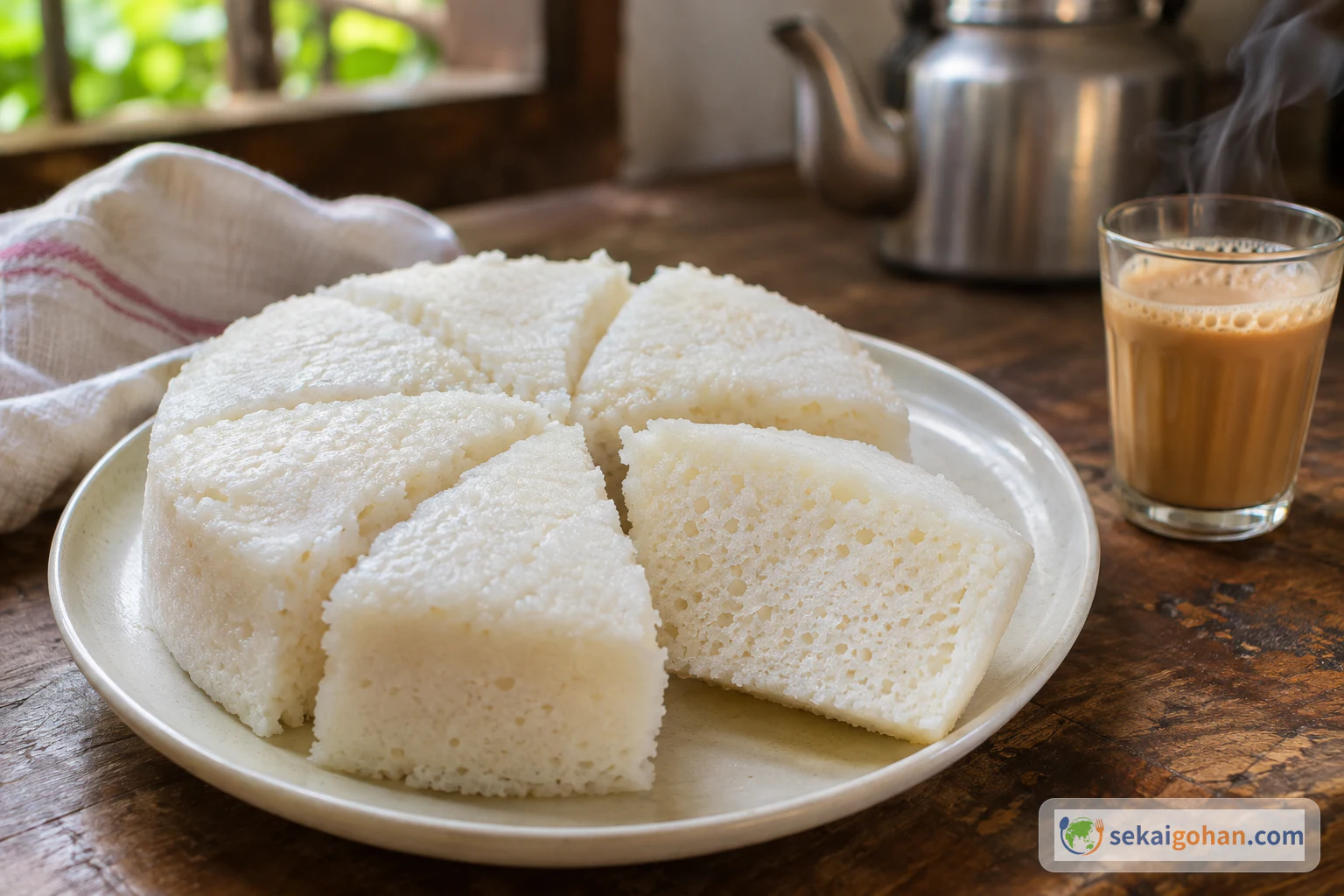
Lift the pan out of the steamer and let the cake cool to room temperature in the pan. Run a knife around the edge and turn it out onto a board. Cut it into wedges with a sharp knife, wiping the blade if it drags. Cut hot, the cake tears. Cooled, it gives clean faces with the fine holes showing.