Ingredients and steps on one page. Print it, or choose “Save as PDF” in the print dialog.
Sekai Gohan
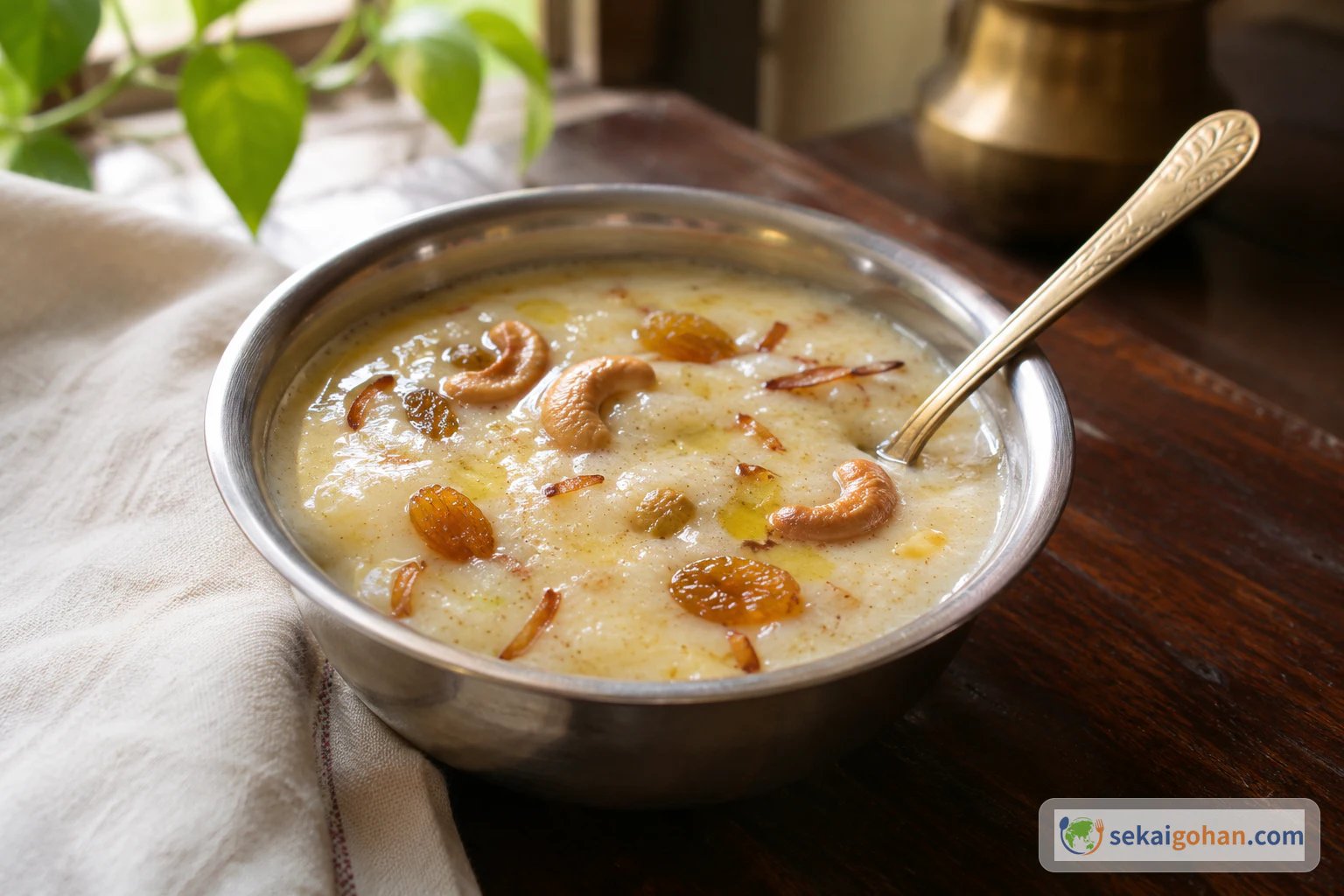
Rava Payasam: Malabar Semolina and Milk Pudding with Fried Onion
Ingredients
| Ingredient | Amount | Role |
|---|---|---|
| Semolina (rava), roasted | 5¼ oz (150 g) | Body of the pudding; it drinks up the milk and thickens it |
| Milk | 8½ cups (2 L) | The only cooking liquid |
| Sugar | 6¼ oz (175 g) | Sweetness |
| Onion, thinly sliced | 1 | The Malabar topping; fried in ghee and poured over |
| Ghee | 2 tbsp | Fat for frying the topping; all of it goes into the small pan |
| Cashew nuts, broken | 1 oz (30 g) | Crunch and toasty flavour on top |
| Raisins (onakka munthiri) | 1 oz (30 g) | Little bursts of sweetness on top |
| Cardamom powder | 1 tsp | Fresh, cool aroma at the finish |
Steps
1Roast the semolina pale in a dry pan
Put the semolina in a dry, heavy pan over low heat, with no ghee or oil. Stir it constantly with a wooden spatula so every grain touches the hot pan and none sits still. Soon it begins to smell of toasted wheat. Take it off the heat as soon as that smell rises, while the grains are still the same pale colour they started as, and tip it into a bowl so the hot pan does not keep cooking it.
2Bring the milk to a boil in the heavy pot
Pour the milk into the heavy, deep pot and set it over medium-low heat. Stir now and then, sweeping the spatula across the bottom, where milk catches first. As it nears the boil, a ring of bubbles forms at the edge and the foam begins to climb. It is ready when the whole surface trembles with small bubbles and the foam starts to rise. Turn the heat down a little before it can spill.
3Dissolve the sugar in the milk
Add the sugar to the boiling milk and stir it straight away so it does not settle in a heap on the bottom. Keep the milk at a gentle simmer while you stir. Draw the spatula slowly across the base of the pot to check for grit. The milk is ready for the semolina when the spatula no longer drags any sugar across the bottom and the surface is smooth and white again.
4Sprinkle in the semolina without lumps
Hold the bowl of roasted semolina in one hand and sprinkle it into the simmering milk a little at a time. With the other hand, stir gently and without stopping. A whisk does this job well. Let each small handful disappear into the milk before the next one goes in. When all of it is in, the grains are scattered evenly through the milk with no lumps clinging to the spatula or the side of the pot.
Slow hand, busy whiskLumps form in the first seconds, when a clump of semolina meets hot milk without being stirred apart. Pour slowly and keep the whisk moving the whole time, and the pot stays smooth from the start.
5Simmer on low until creamy
Turn the heat to low and let the pot cook gently. Stir often, sweeping the spatula across the bottom and into the corners. The milk slowly turns creamy as the semolina drinks it up, and the bubbles become slower and heavier. Keep going until it is thick but still flows. Lifted on the spatula it falls back in a soft ribbon, and a line drawn through it holds for a moment before closing.
Stop while it still poursRava payasam is a flowing sweet, and it thickens further as it cools in the bowl. Take it to a pourable, creamy ribbon and no further. If it mounds and holds its shape on the spatula, it has crossed into a different, firmer kind of sweet.
6Add the cardamom and take it off the heat
Sprinkle the cardamom powder evenly over the thickened payasam. Stir it through from the bottom so no pocket of powder stays on top. This is the last thing to go into the pot. Take the pot off the heat right away and set it aside. It is done when the steam rising from the pot smells of cardamom.
7Fry the onion, cashews and raisins in ghee
Set the small pan over medium-low heat and melt the ghee in it. Add the onion, cashews and raisins and fry them, stirring all the time. Keep the heat gentle, because scorched onion or nuts make the topping bitter. The topping is ready when the onion is soft and translucent with lightly golden edges, the cashews are pale gold and the raisins are plump and glossy.
8Pour the topping over and serve hot
Pour the hot topping straight over the payasam, ghee and all. Scrape the last slivers of onion out of the pan with a spoon. Let the onion, nuts and raisins scatter across the surface instead of stirring them in. Ladle into small bowls and serve hot, while the ghee still pools in golden streaks at the edges.