Ingredients and steps on one page. Print it, or choose “Save as PDF” in the print dialog.
Sekai Gohan
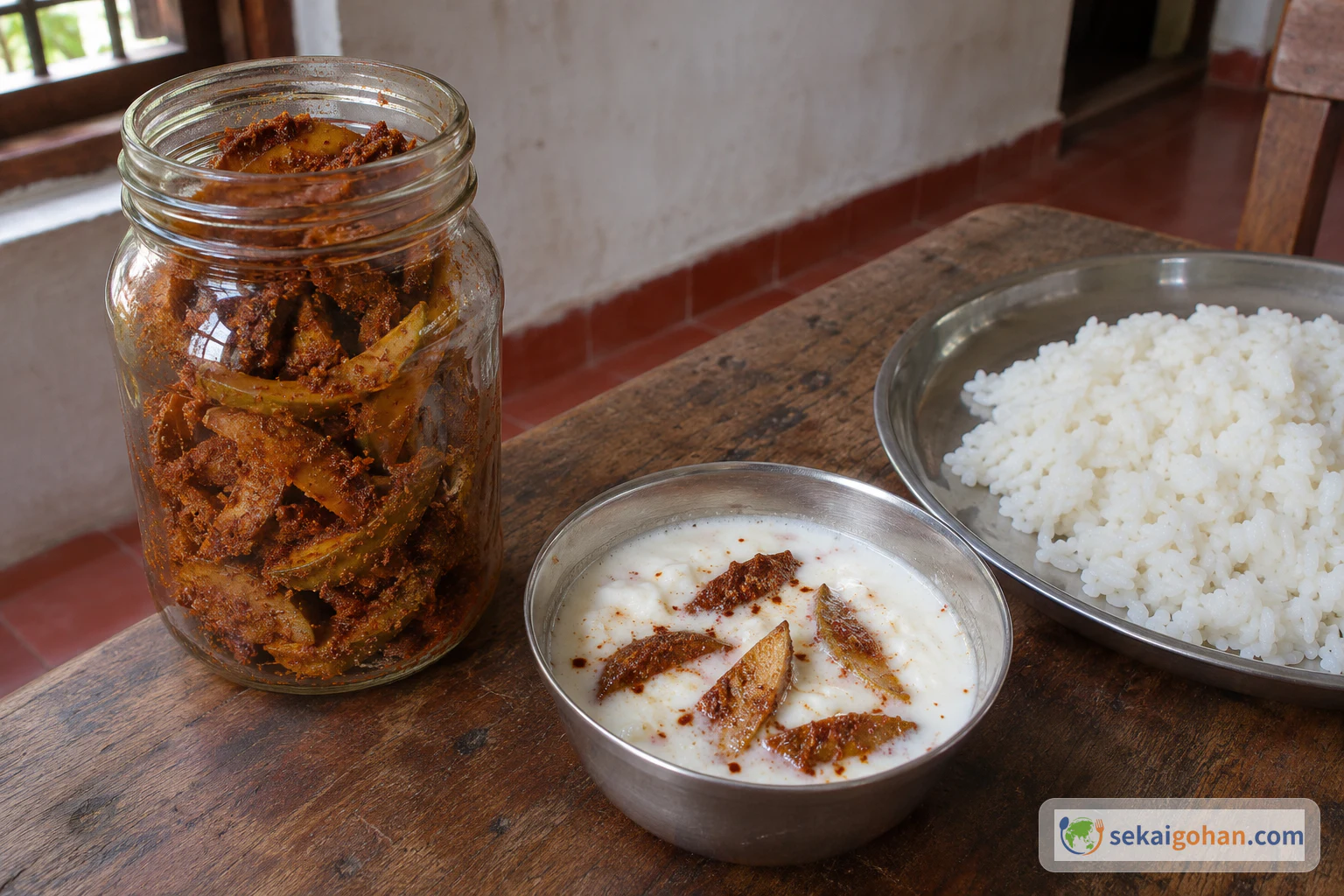
Thuramanga: Wayanad Salted Sun-Dried Green Mango
Ingredients
| Ingredient | Amount | Role |
|---|---|---|
| Green (unripe) mangoes (pacha manga) | 3 | The body of the preserve: sourness, flesh and chew |
| Salt (uppu) | as needed | Draws out water, keeps the fruit, seasons it |
| Red chili powder (mulakupodi) | 1 tbsp | Heat and red colour |
| Fennel seeds (valiya jeerakam) | 1 tsp | The sweet aroma that marks the dish |
| Cumin seeds (cheriya jeerakam) | ¼ tsp | An earthy base note under the fennel |
| Whole black peppercorns (kurumulaku) | 1 tsp | Deep, lingering heat |
| Plain unsweetened curd (yogurt), to serve | about 2 tbsp per person | Softens the salt and heat at the table |
| Cooked white rice, to serve | as needed | What thuramanga is eaten with |
Steps
1Boil the mangoes whole
Wash the three mangoes and lower them whole into a deep pot of water that covers them completely. Bring the water to a boil and cook for at least 20 minutes; larger fruit needs longer. Keep every mango submerged, since a shallow pan leaves the tops raw. They are done when the skin has turned from bright green to yellow-green, a skewer slips through the skin with no resistance, and the whole fruit gives slightly when you press it.
2Cool, stone and cut
Lift the mangoes into a colander and let them cool until you can hold them comfortably in your hand. Cut down each side of the flat stone, then cut the flesh into pieces about 1½–2 inches (4–5 cm) long and ⅝–¾ inch (1.5–2 cm) thick. Pieces that are too small dry into leather; pieces that are too big stay wet in the centre. The knife should slide through cleanly and the cut edges should hold their shape. If the flesh smears, the fruit is still too hot.
3Rub with salt
Put the pieces in a wide bowl and rub salt over every face, one piece at a time, with your hands. Aim for a light, even coat with no bare patches and no thick crust. The surface goes damp as soon as the salt touches it, and within 10 to 20 minutes beads of moisture rise from the cut faces. Taste a corner: the salt comes forward, but the sourness should still lead.
Salt by hand, piece by pieceTossing everything in a bowl leaves some pieces crusted and others bare. Too little salt and a piece spoils on the tray; too much and it tastes only of salt, even after the curd. Rubbing each piece gives you the even coat that carries the batch through the drying days.
4Lay out in the sun
Spread the pieces on a raised tray or rack in a single layer, with space between them so no two touch. Drape a thin mesh net over the top to keep insects and dust off. Set the tray in full sun where air moves freely. Carry it indoors every night, because dew and night damp undo a day's drying. By the end of the first day the edges of the pieces have just begun to shrink.
Keep the drying cleanWash your hands and use a clean, dry tray, bowl and jar. Keep the salting even and give the mango its full days of sun. Check every piece each morning and evening. If any of the batch shows white, blue or black spots, goes slimy, smells sour or off, or turns an unexpected colour, throw the whole batch away.
5Dry for three to four days
Put the tray out again each morning. Weak sun or a humid spell stretches the time; cloud and rain bring mould. If damp weather settles in, finish the batch in a food dehydrator following its manual, or stop and discard it rather than leaving it out longer. The mango is ready when the surface is dry and no longer sticks to your fingers, a press still meets a springy give, the edges have pulled in, and the cut faces have turned from translucent to whitish.
Stop before rock-hardBring the tray in while the pieces still bend. Mango dried to stone stays too tough to chew, even after a stir in curd.
6Dry-roast the spices
Put the fennel seeds, cumin seeds and black peppercorns in a small heavy pan over low heat. Stir them steadily until the fennel and cumin take on a light colour and the kitchen smells sweet and warm. When the peppercorns start to crackle, turn off the heat. Tip the chili powder into the hot pan and stir it through the seeds. Powdered chili scorches in seconds over a live flame and turns bitter, so the warmth left in the pan is enough; never let it scorch.
7Grind the spice powder
Let the pan cool for a moment, then grind the mixture in a spice grinder or pound it in a mortar. A coarse grind keeps a little crunch on the mango; a fine one coats more smoothly. Grind right before coating, when the aroma is strongest. The powder is ready when it is an even rust-brown with no whole peppercorns left.
8Coat the dried mango
Put the dried pieces in a wide bowl. Sprinkle the spice powder over them a little at a time, tossing and rubbing with your hands so it presses into the surface. Stop when every face carries an even coat. If powder is left in the bowl, leave it there; forcing all of it on makes the mango harshly hot. The pieces look deep amber under a dusty red coat, and only a little loose powder remains.
9Pack into the jar
Pack the coated pieces into a clean, completely dry airtight jar with a dry spoon. Seal the lid and keep the jar in the refrigerator. The mango is ready to eat right away, and over a few days in the jar the spice settles into the fruit and its edge softens. Look through the glass before closing: the pieces should sit loosely, evenly red, with no damp patches.
10Stir into curd and serve with rice
For each person, spoon about 2 tbsp of plain unsweetened curd into a small bowl and add 2 or 3 pieces of thuramanga. Stir them through just before eating so the spice blooms into the curd. Serve beside freshly cooked rice and eat a little of both in each mouthful. Add more curd or fewer pieces to taste. The curd turns pink-orange and the mango softens at the edges while staying chewy in the centre.