Ingredients and steps on one page. Print it, or choose “Save as PDF” in the print dialog.
Sekai Gohan
String Hoppers: Sri Lankan Steamed Rice-Flour Noodle Nests
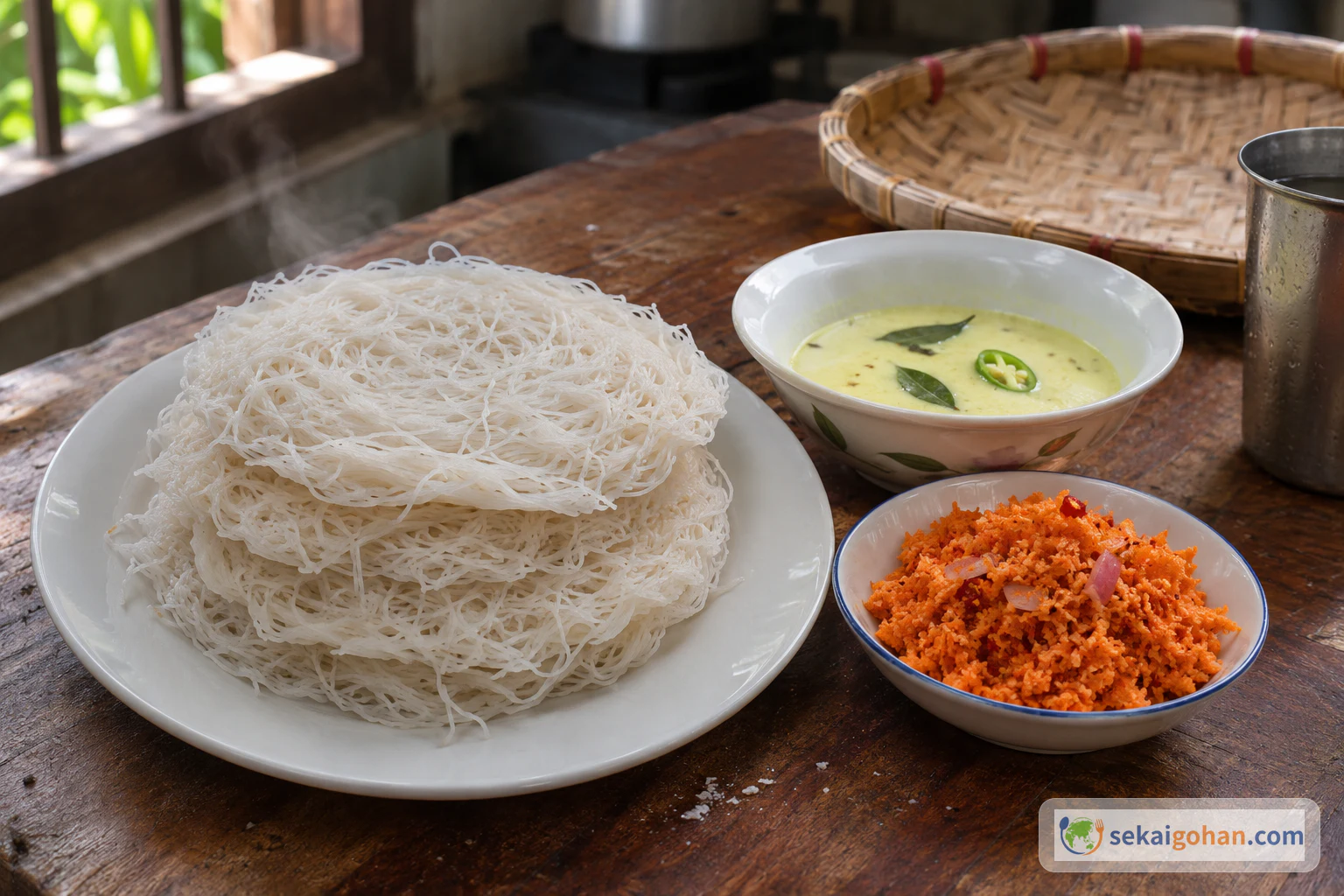
Ingredients
| Ingredient | Amount | Role |
|---|---|---|
| Rice flour for string hoppers, roasted, white or red (string hopper flour, idiappa flour) | 12½ oz (350 g) | The whole body of the dough; its roast and grind set the texture of the strands |
| Salt | 0.2 oz (6 g) | Seasons the strands, which are eaten with little else on them |
| Lukewarm water | 1⅔ cups (400 ml), plus more as needed if the flour is dry | Binds the dough; the warmth gives lighter, softer nests |
| Vegetable oil or coconut oil | 1 tsp | A thin film on the trays so the nests lift off cleanly |
Steps
1Mix the flour and salt
Put the flour and salt in a large bowl. Stir with a wooden spoon, lifting from the bottom of the bowl, until the salt has vanished into the flour. Leave the water aside for now. Salt stirred through dry flour spreads evenly, while salt that meets wet dough leaves salty and bland patches. Move on when the flour looks uniform and falls loose from the spoon.
2Add the lukewarm water a little at a time
Pour a little of the water into the flour and stir. Add the next splash only once the last one has been taken up. Pouring it all in at once is what makes the dough sticky, because different parts of the flour absorb water at different speeds. Keep going until the flour gathers into soft, damp lumps. Some dry flour around the lumps is fine at this stage.
3Knead into a soft dough
Gather the lumps with your hands and press the remaining dry flour into them. Knead until everything forms one smooth mass. If it cracks or feels stiff, work in a small splash of water; if it clings to your palm, work in a pinch of flour, kneading well after each addition. The dough is right when it is slightly tacky but leaves your hand clean, holds together when squeezed, and is about as soft as play dough.
The dough decides the strandsToo stiff and the threads snap as they leave the press. Too soft and they spread and fuse on the tray into a sheet. Correct the dough here, while it is still warm, rather than fighting it in the press.
4Heat the steamer and oil the trays
Bring water to a boil in the steamer base. Brush each tray with a thin, even film of oil; too much oil makes the dough slide around as it lands. Set out only as many trays as fit in the steamer in one go, about ten in a home steamer, and keep the second set ready. Fill the press about four-fifths full with warm dough: an overfilled press will not close, and the dough squeezes out at the sides. You are ready when steam is rising steadily and every tray has a light sheen with no pools of oil.
5Press the nests
Hold the press over a tray and squeeze steadily while moving your hand in circles, so the threads fall in a spiral and build up into a flat nest. Keep the layers even and stay inside the rim of the tray. When the nest is complete, pinch the threads off at the plate with a finger and move to the next tray. Refill the press as it empties. Each nest is ready when it is flat, evenly thick and has no strands hanging over the edge.
6Steam until firm and springy
Set the trays in the steaming steamer. If you stack them, keep the overlap as small as possible so steam reaches every nest. Cover and steam fairly thick nests for 5 to 6 minutes. Lift the lid away from you, then touch a nest lightly with a fingertip or the back of a spoon. It is done when it feels firm, springy and not sticky; if it is still tacky, give it a little longer and test again.
Trust your finger over the clockThick nests and a lightly loaded steamer take 5 to 6 minutes. Thinner nests or a fuller steamer can take 8 to 10. The raw rice flour must be steamed through completely, so let the touch test decide. Over-steamed nests dry out and turn hard, so test early.
SteamOpen the steamer lid away from your face and lift hot trays with a folded cloth. Steam burns faster than boiling water splashes.
7Stack them covered and steam the next batch
Ease the nests off the trays and stack them straight into a lidded container. Left in the open air, they dry and stiffen within minutes. Put the second set of pressed trays into the steamer, then oil the emptied trays and press the next batch. You are on track when the stack in the container stays soft and pliable and each new batch comes off as springy as the first.