Ingredients and steps on one page. Print it, or choose “Save as PDF” in the print dialog.
Sekai Gohan
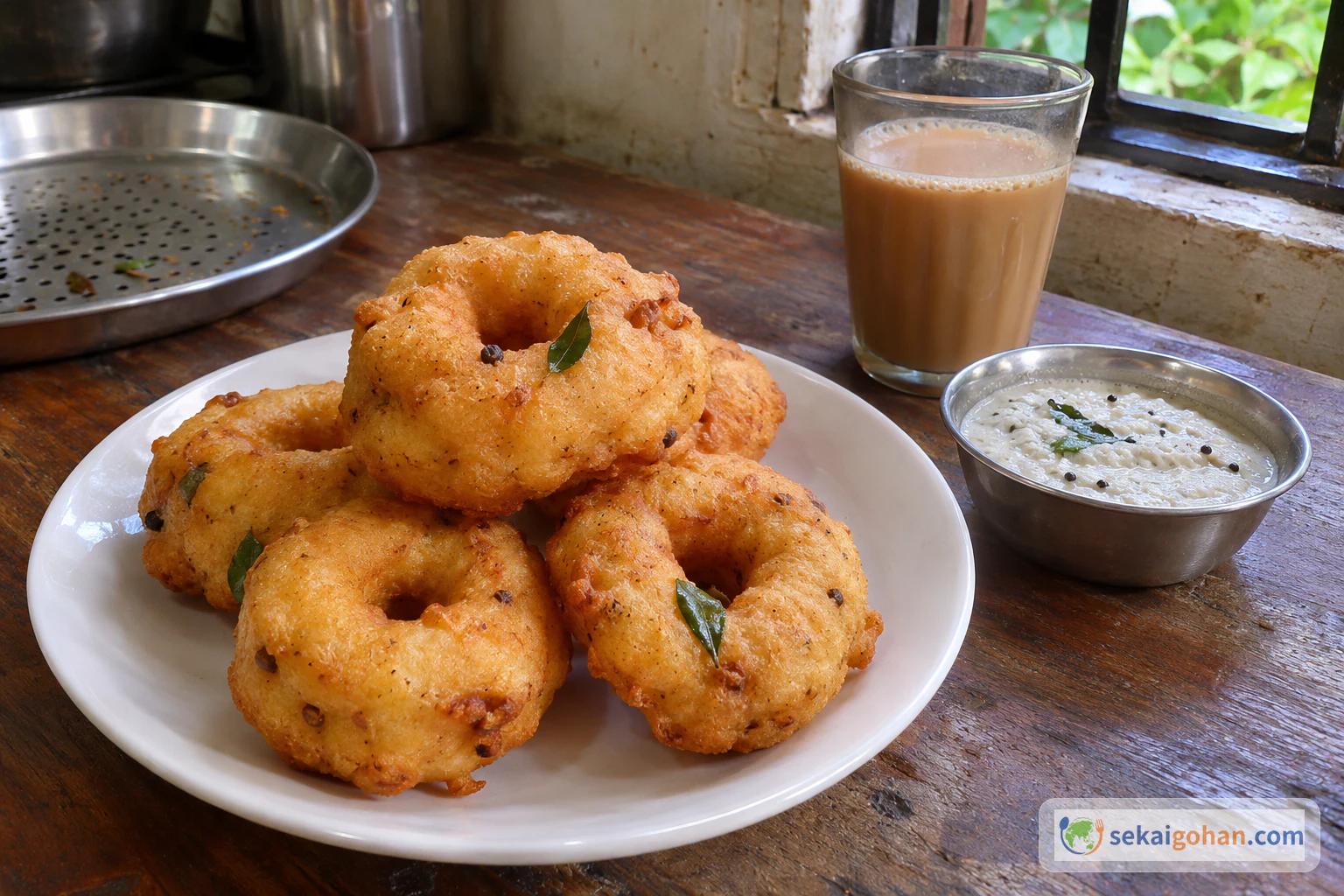
Ulundu Vade: Sri Lankan Fried Urad Dal Ring Fritters
Ingredients
| Ingredient | Amount | Role |
|---|---|---|
| Split skinned urad dal (ulundu; split skinned black gram) | 9 oz (250 g) | The whole batter; gives the soft, airy crumb and the body that holds a ring |
| Cold water | 2 tbsp to 3 tbsp + 1 tsp (30–50 ml), always under 50 ml | Loosens the paste while grinding |
| Onion | 1½ oz (40 g) | Sweetness and small soft pockets in the crumb |
| Green chilies | 5 to 7 | Heat and a fresh green bite |
| Curry leaves | A few | The aroma that makes it taste Sri Lankan |
| Salt | To taste | Seasons the dal before grinding |
| Water for soaking and rinsing | As needed | Softens and cleans the dal |
| Neutral oil for deep-frying | As needed | Frying |
Steps
1Soak, rinse, drain and salt the dal
Put the urad dal in a bowl and pour in enough water to cover it well. Leave it to soak for at least 4 hours. Pour off the soaking water, rinse the dal in fresh water, and tip it into a colander to drain off the excess. Sprinkle the salt over the drained dal and toss until every grain is coated; this is the only salt the batter gets. Move on when the grains are plump, creamy white and no water drips from the colander.
2Grind to a coarse paste and let it rest
Put the salted dal in a food processor or blender and start grinding. Add the cold water a spoonful at a time while the blade runs, and keep the total under 50 ml. Grind to a thick, coarse paste with visible grain rather than a smooth, pourable batter. Scrape it into a bowl and leave it to rest for 2 to 3 hours. It is right when the paste stands in stiff ridges and soft peaks and does not run off a spoon.
Water decides the vadeEvery extra spoonful of water makes the batter harder to shape, makes it soak up oil in the pot and makes it spit harder. Add the cold water slowly and stop as soon as the blade turns the paste. A stiff paste is what you want.
3Chop the onion, chilies and curry leaves
While the batter rests, chop the onion finely. Slice the green chilies into thin rounds, using fewer for a milder vade and more for a hotter one. Shred the curry leaves finely so they spread through the batter in small flecks. Keep the three in separate piles on the board. Stop when the onion is in fine, even bits and the leaves are cut small.
4Fold the aromatics into the batter
Tip the onion, chilies and curry leaves onto the rested batter. Fold them through with your hand or a spoon, turning the batter up from the bottom of the bowl. Keep going until the green and white flecks are spread evenly through the whole batch. The batter should stay heavy and drop from the spoon in a slow, thick dollop; if it spreads into a puddle, it is too loose to shape by hand.
5Heat the oil slowly
Pour the oil into a deep pot so the vade can float freely, and clip a thermometer to the side. Set the burner to low heat and let the oil warm slowly. Keep the batter and the hand-water bowl on the counter, away from the pot. Use a thermometer and keep the oil steady between 325°F and 375°F (163°C and 191°C), a general frying range for lentil fritters, with a calm surface and no smoke.
Hot oil and a wet batterThe batter is wet, and water in hot oil spits. Keep the grinding water under the limit, let excess water drip off your palm before each ring goes in, and lower each one in gently close to the surface. Keep the thermometer in the oil for the whole session; oil that is too cool soaks into the vade, and oil that is too hot burns the outside before the middle cooks.
6Wet your palm and shape a ring
Set a bowl of water next to the batter and wet your palm before every single vade. Scoop up a medium ball of batter and press it gently flat on your palm. Push your thumb through the centre to open a clear hole, then smooth the edge into an even ring. Some cooks shape on a square of banana leaf instead of the hand. The ring is right when it sits on your palm without sagging, with a clean hole and the same thickness all round.
Why the hole mattersUlundu vade batter is thick, and the hole lets heat reach the middle from the inside as well as the outside. A ring that is too thick, or one where the hole has closed up, browns outside and stays raw in the centre. Fresh water on the palm for each ring keeps the batter from sticking to your hand.
7Fry in small batches until golden
Slide each ring from your palm into the oil and fry four or five at a time. If two touch and stick, separate them straight away with the slotted spoon. Turn them and fry until both sides are deep golden brown. Lift out the first one, break it open and check the centre before frying the rest. A cooked centre is soft, pale and airy, with no wet, pasty core.
Cook it all the way throughThere is no raw or fermented step in this recipe. Never taste the raw dal batter, and fry every vade until the centre is fully cooked. If the first one is pasty inside, make the rings thinner and keep the oil in range before you continue.
8Drain and serve hot
Lift each vade out with the slotted spoon and let the oil drip back into the pot for a moment. Set them on a wire rack over a tray, or on paper towels. Go back to shaping and frying, wetting your palm for every ring, until the batter is used up. Serve them hot, while the edge still crackles when you break one open.