

Lift the steamer lid, and the kitchen turns into Kathmandu
Dumpling day always makes a bit of a mess. A bowl of kneaded dough, chopped onion, the smell of ginger, a small dish of water at your elbow. These are the same ingredients you might use for pan-fried potstickers, but roll the wrappers thin, line them up in a steamer, and you land somewhere else entirely: Nepali momo (मम).
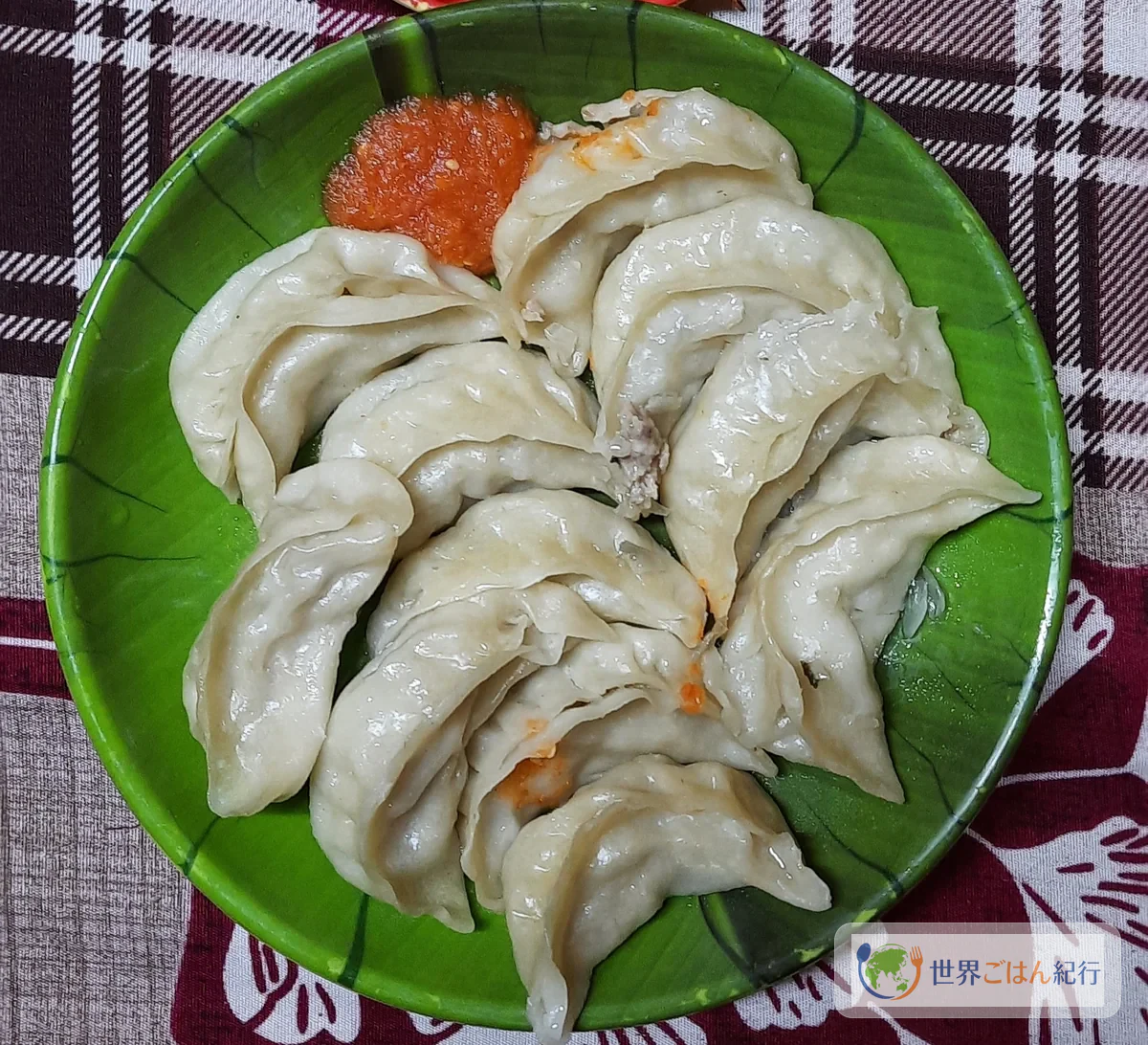
Momo are thin wheat-flour wrappers filled with meat or vegetables, steamed and eaten with a spicy tomato-based achar. They are Nepal's national snack. On the streets of Kathmandu you find them everywhere, from tiny eateries to dedicated momo shops, and at home they are a sociable dish: someone folds, someone steams, someone makes the achar, and the roles sort themselves out.

The first question at home is whether to make your own wrappers or use store-bought dumpling wrappers. The short answer: for your first batch, large store-bought wrappers work. To get closer to a true momo texture, though, make the wrapper a little thicker than you would for potstickers, work the filling until it is sticky enough to hold its juices, and serve it with a roasted tomato and sesame achar instead of a soy-vinegar dip.
If dal bhat (in Japanese) is Nepal's everyday meal, momo are what you make when people get together. This recipe centers on a home-style version with ground chicken, then branches out to a buff-style momo, veg momo and jhol momo. Along the way it separates what you can swap freely from what should stay as the backbone of the flavor.
In English it is written momo, and in Nepali मम. As a dish name, people rarely fuss over singular and plural and simply say "momo."
Where the dish comes from: from Tibetan trade to Nepali tables

Momo are hard to trace to a single origin. Smithsonian Magazine notes that momo are widely believed to have taken root in Nepal through trade with Tibet, while several other stories survive as well, involving Newar merchants (the Indigenous people of the Kathmandu Valley) and migration across the Himalayan region.
What matters here is that momo are not simply "Tibetan dumplings": they picked up new aromas in Nepal. Tibetan-style momo tend toward a plain, ginger-forward flavor, while Nepali momo use garlic, onion, cumin, coriander, timur (Nepali Sichuan pepper) and cilantro, and come with plenty of tomato or sesame achar.
Around Kathmandu you commonly see white steamed momo, kothey momo browned on one side, jhol momo in a thin spicy broth, and fried momo. Water buffalo buff momo are a classic too, but buffalo meat is hard to find in most home kitchens, so ground chicken or ground pork is the realistic choice.
| Type | Its place in Nepal | Making it at home |
|---|---|---|
| Steamed momo | The most basic. Steamed and served with achar | The one to make first. Least likely to go wrong |
| Buff momo | Filled with water buffalo. Popular in Kathmandu | Get close with a beef-pork mix or ground pork |
| Chicken momo | Easy to handle at home and in Nepali restaurants abroad | Ground chicken thigh is the easiest |
| Veg momo | Cabbage, mushrooms, tofu, cheese and more | Use pressed tofu and mushrooms to make up for the lack of meat juices |
| Jhol momo | Served under a thin, spicy broth | Make it by thinning the achar with water |
| Kothey momo | Browned on one side, then steamed | A good match for store-bought dumpling wrappers |
The difference from Japanese or Chinese-style potstickers lies not in a crisp bottom but in steam and sauce. Potstickers get a crunchy base and are dipped in soy-vinegar or chili oil. Momo are steamed until the wrapper turns soft and springy, and are eaten for the aromas of tomato, sesame, chili, garlic and timur. Hold on to that, and the same flour and ground meat become a very different dish.
Ingredients (serves 4, about 28 momo): plan the juices and the achar first

For 4 people, plan on about 28 momo for a light meal. To make it a full dinner, add a simple dal and stir-fried greens from dal bhat (in Japanese), so the meal isn't just meat and flour.
Wrappers
| Ingredient | Amount | Substitutes & notes |
|---|---|---|
| All-purpose flour | 300 g | Or 200 g cake flour + 100 g bread flour |
| Salt | 1/2 tsp | Seasons the wrapper |
| Vegetable oil | 2 tsp | Keeps the wrappers from drying out |
| Lukewarm water | 150–170 ml | Adjust to how the dough feels |
Chicken filling
| Ingredient | Amount | Substitutes & notes |
|---|---|---|
| Ground chicken thigh | 450 g | About 1 lb. Ground pork or a beef-pork mix also works |
| Onion | 1/2 (100 g) | Red onion is closer to Nepali style |
| Cabbage | 120 g | Napa cabbage works too. Squeeze out the water |
| Scallions | 2 | Thinly sliced |
| Cilantro | 20 g | If you don't like it, use more scallions |
| Garlic | 2 cloves | Grated |
| Ginger | 1 knob | Grated |
| Ground cumin | 1 tsp | Toasting and grinding whole seeds boosts the aroma |
| Ground coriander | 1 tsp | Worth not skipping |
| Timur | 1/3 tsp | If unavailable, a little Sichuan pepper + black pepper |
| Salt | 1 tsp | Helps the meat turn sticky |
| Black pepper | 1/3 tsp | White pepper is fine |
| Vegetable oil | 1 tbsp | Adds juiciness. Don't lean too heavily on sesame oil |
| Water or chicken stock | 2 tbsp | Work it in a little at a time |
Tomato-sesame achar
| Ingredient | Amount | Substitutes & notes |
|---|---|---|
| Tomatoes | 3 (about 450 g) | Fully ripe is best. Fresh rather than canned |
| White sesame seeds | 3 tbsp | Toast whole seeds, then grind; not pre-ground |
| Dried red chilies | 2 | Remove the seeds for less heat |
| Garlic | 1 clove | Roasting it gives a rounder flavor |
| Ginger | 1 cm | Keeps a fresh bite |
| Mustard oil | 1 tbsp | If unavailable, rice bran oil + a little hot mustard |
| Lemon juice | 1 tbsp | Lime works too |
| Timur | A pinch | If unavailable, the tiniest bit of Sichuan pepper |
| Salt | 1/2 tsp, or more | Adjust to taste |
| Water | 2–5 tbsp | Use more if making jhol momo |
This recipe contains wheat, chicken and sesame. If you use store-bought dumpling wrappers, some brands contain soy, egg or dairy. For veg momo, check the labels on both the wrappers and the seasonings as well.
Ingredients and tools for this dish
Timur gives momo a distinctly Nepali lift, but there's no need to buy a big bag at the start. If you can't find it, use a small amount of Sichuan pepper and keep the numbing effect in check. Look for timur at South Asian or Nepali grocery stores, or online.
A bamboo steamer keeps the surface of the wrappers from turning sticky, and you can bring it straight to the table. A metal steamer works too; line it with a cloth or parchment paper so the momo don't stick.
If you are making the achar, toast the white sesame seeds and grind them coarsely in a mortar to bring out their aroma. A food processor is fine, but a slightly grainy texture clings to the momo better than a perfectly smooth one.
Method: don't overfill, and let the steaming time do the cooking
Momo look difficult, but most failures come down to three things: overfilling, dried-out wrappers and sticking to the steamer. Getting the moisture of the wrapper and the amount of filling right matters more than perfecting the fold.


