
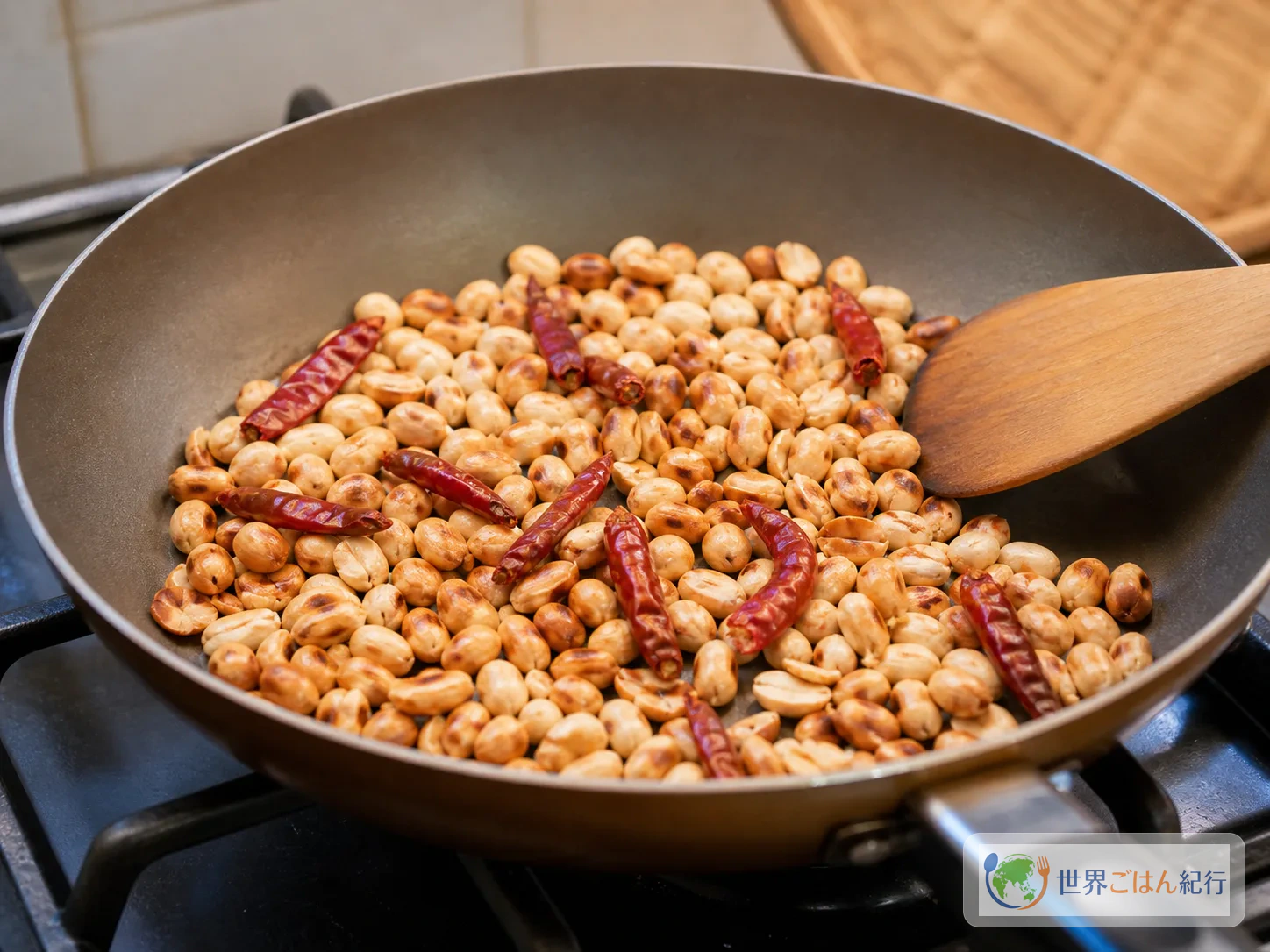
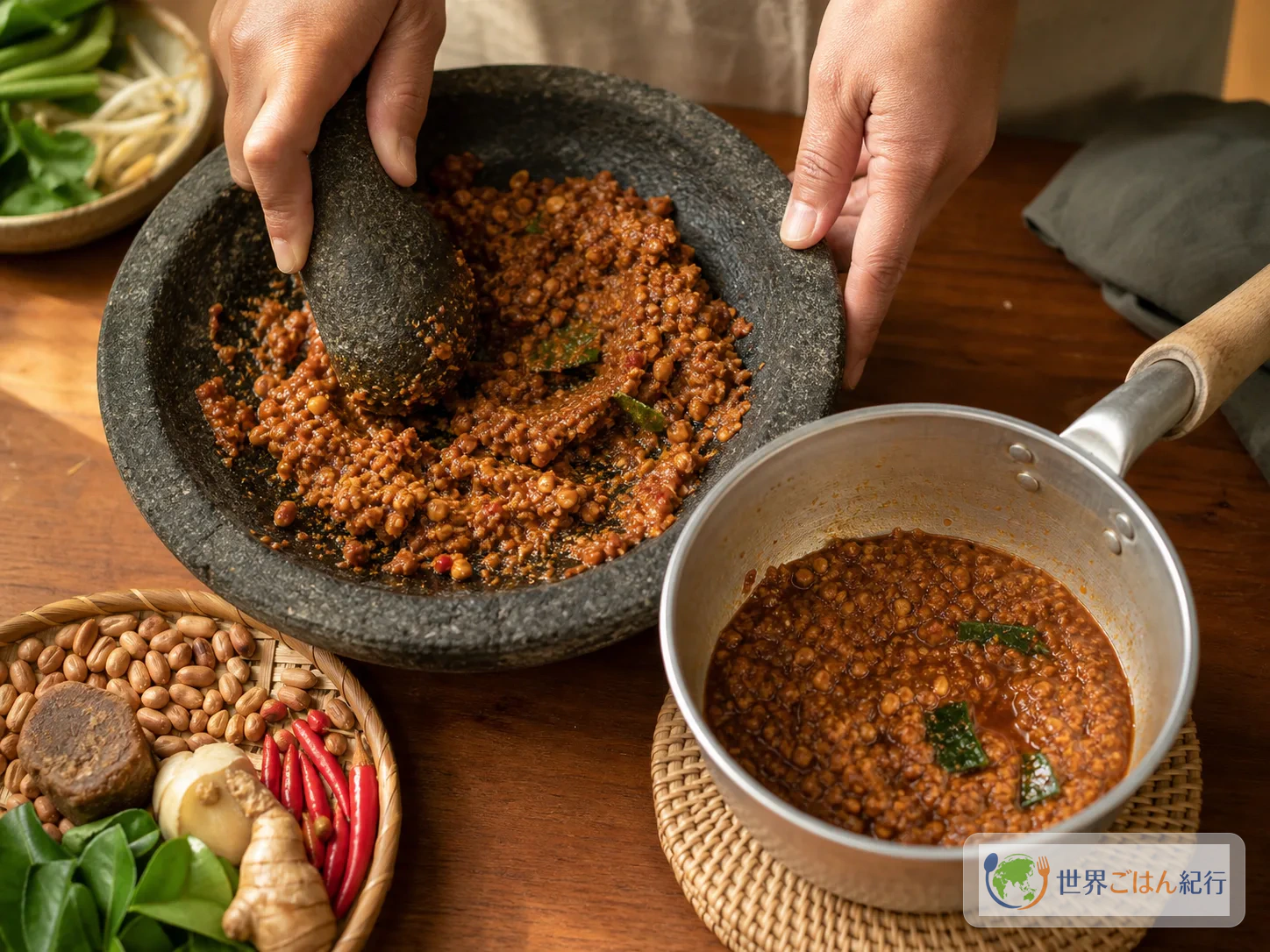
The smell of roasted peanuts catches up with the green vegetables
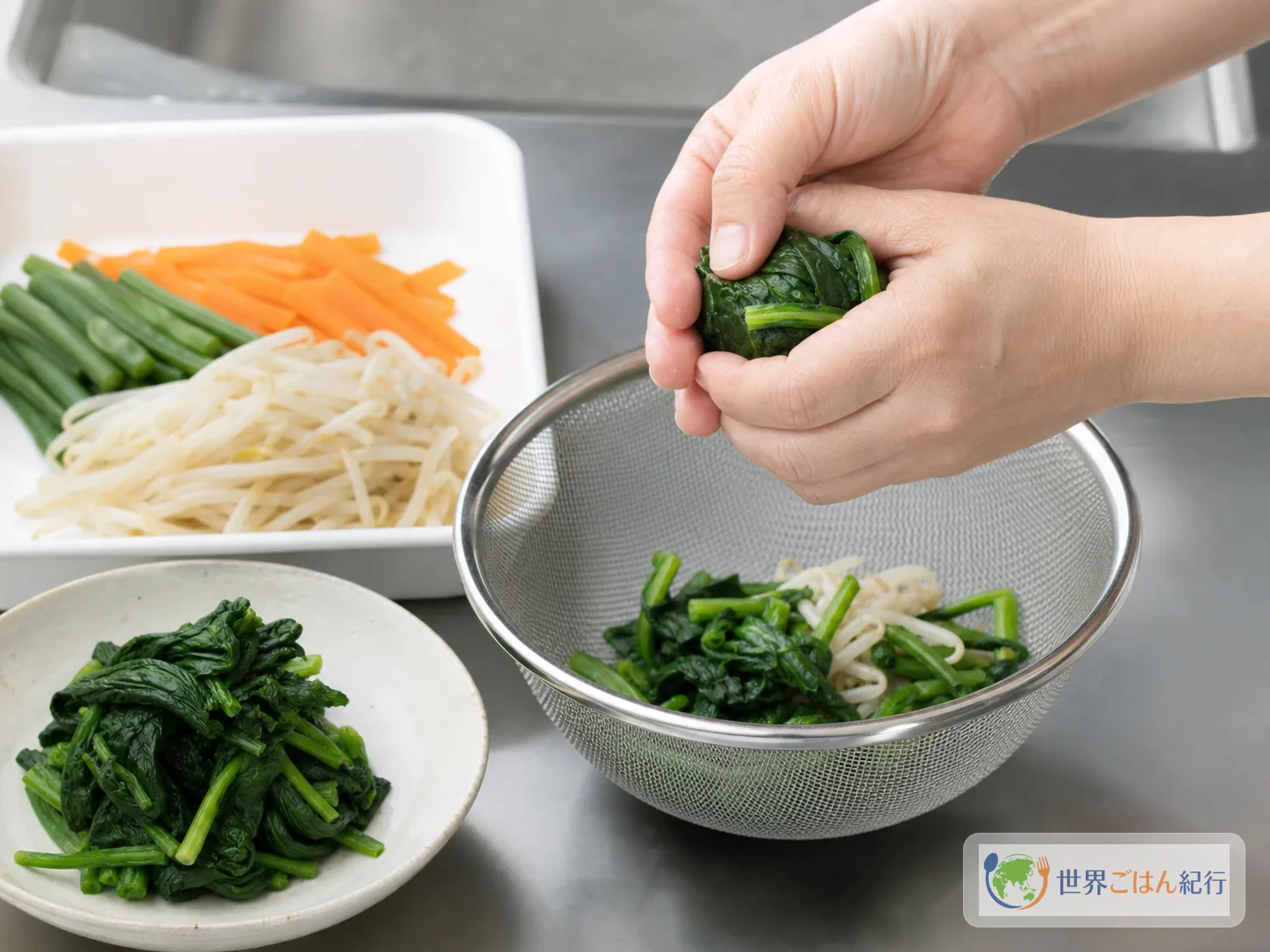
You lift the spinach out of the pot and squeeze it. Water pools at the bottom of the colander, and the green deepens a little. Next to it, you hear roasted peanuts being crushed. Spoon the reddish-brown sauce over the still-steaming vegetables, and sweetness, heat, and the green scent of citrus settle on top of one another.
Picture a first-time dinner: you may be tempted to blanch every vegetable and only then start on the sauce. That is the first fork in the road. Pecel is not a dish of soft, long-cooked vegetables. You stop the heat for each vegetable separately, shed the extra water, and combine the sauce right before eating. If the vegetables are watery, the roasted flavor of the peanuts thins out and every bite tastes the same.
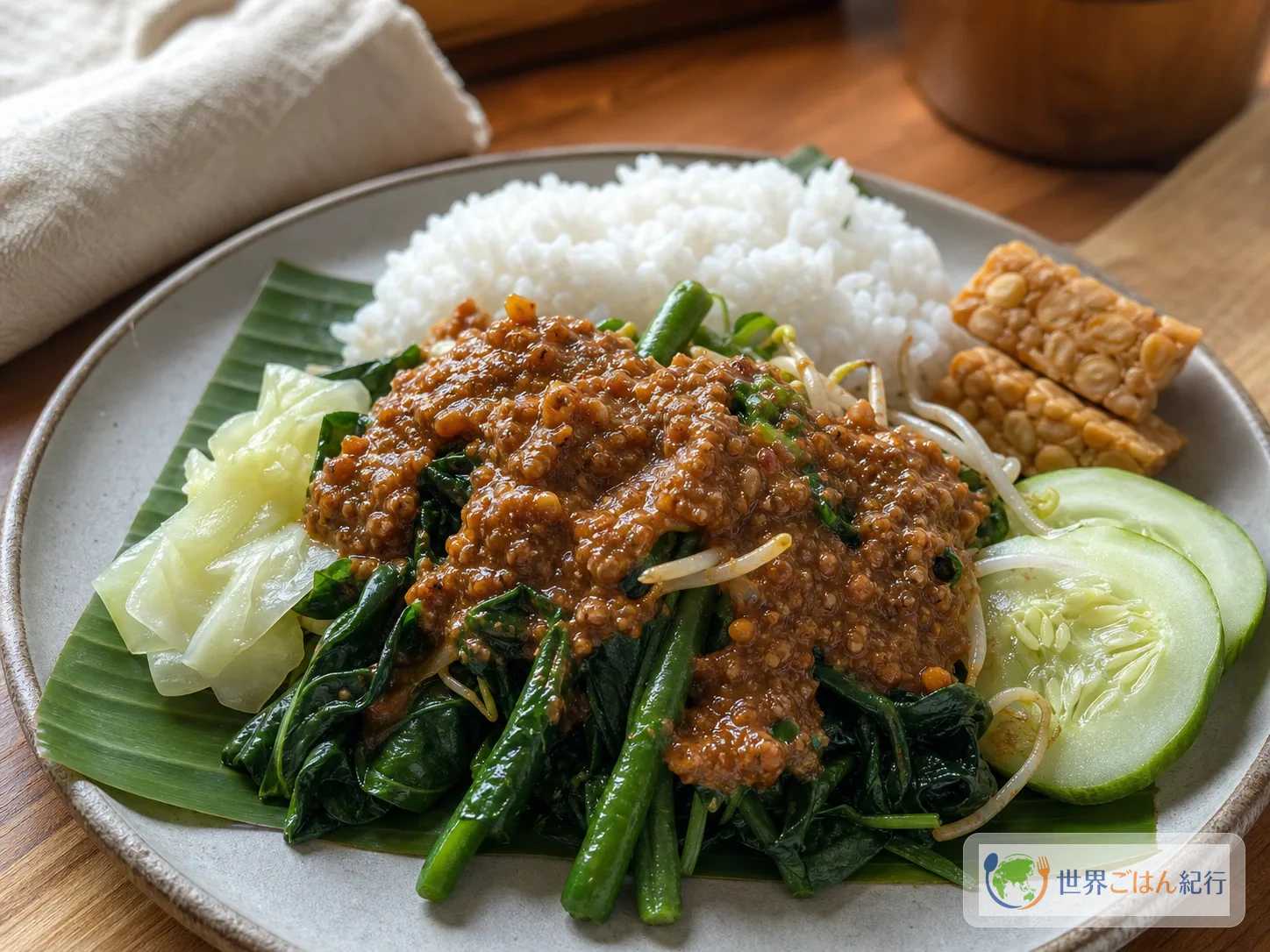
Pecel is a dish of blanched vegetables loved on the island of Java, Indonesia. Spinach, green beans, bean sprouts, and cabbage are topped with a peanut and chile sauce and eaten with rice, fried tofu, and tempeh. To bring it to your own table, the shortcut is not swapping in rare ingredients but deciding first how much water the vegetables carry and how thick the sauce should be.
Here, Javanese pecel is scaled for a home kitchen. The sauce uses roasted peanuts, kencur, makrut lime leaf, and tamarind. Kencur smells different from ginger or galangal, so what changes if you cannot find it is stated plainly. Heat is adjusted in the sauce rather than fixed in the pot. Not having to give everyone the same level of spice is one of the nice things about this dish.
The green scent of the vegetables, the richness of roasted peanuts, the lift of kencur and makrut lime leaf, and the sourness of tamarind are the foundation of pecel. Turning up the chile alone will not make it pecel. Do not overcook the vegetables, make the sauce slightly thick, and combine them right before eating.
The story of pecel: a kitchen seen through the word "crush"
Pecel is the name of a dish of vegetables with peanut sauce, and it can also refer to the sauce itself. One explanation links the Javanese word "pecel" to the meaning "to crush or press," and a commentary from Universitas Bakrie Press likewise explains the name through the step of crushing peanuts and aromatics into a sauce. It is not just chopping finely with a knife: you crush roasted peanuts and bring chile, garlic, kencur, sugar, and sourness into one. The motion of cooking has stayed inside the name.
There are regional differences too. The Indonesian Ministry of Education and Culture's intangible cultural heritage database lists "Pecel Madiun" from Madiun, East Java, as a dish registered in 2022. Within pecel, each city has its own combination of vegetables, sauce, and accompaniments. If you recreate Madiun-style pecel at home, you will want to include the whole scene, with blanched vegetables and rice prepared and the sauce spooned over at the table, rather than just making the sauce and taking it out of a jar. The sauce alone leaves out the moment of eating it with vegetables and rice.
A tourism page for Blitar, East Java, lists kencur, coriander, candlenut, chile, peanuts, makrut lime leaf, palm sugar, and salt among the aromatics of nasi pecel. Each household has its own blend, but it makes clear which ingredients are easy to get wrong in your own kitchen. Do not turn the peanuts into plain sweet peanut butter. Do not settle for lemon juice in place of the lime leaf. Do not replace kencur with the same amount of ginger. If you know these differences in advance, the flavor stays on course even when you change the vegetables.
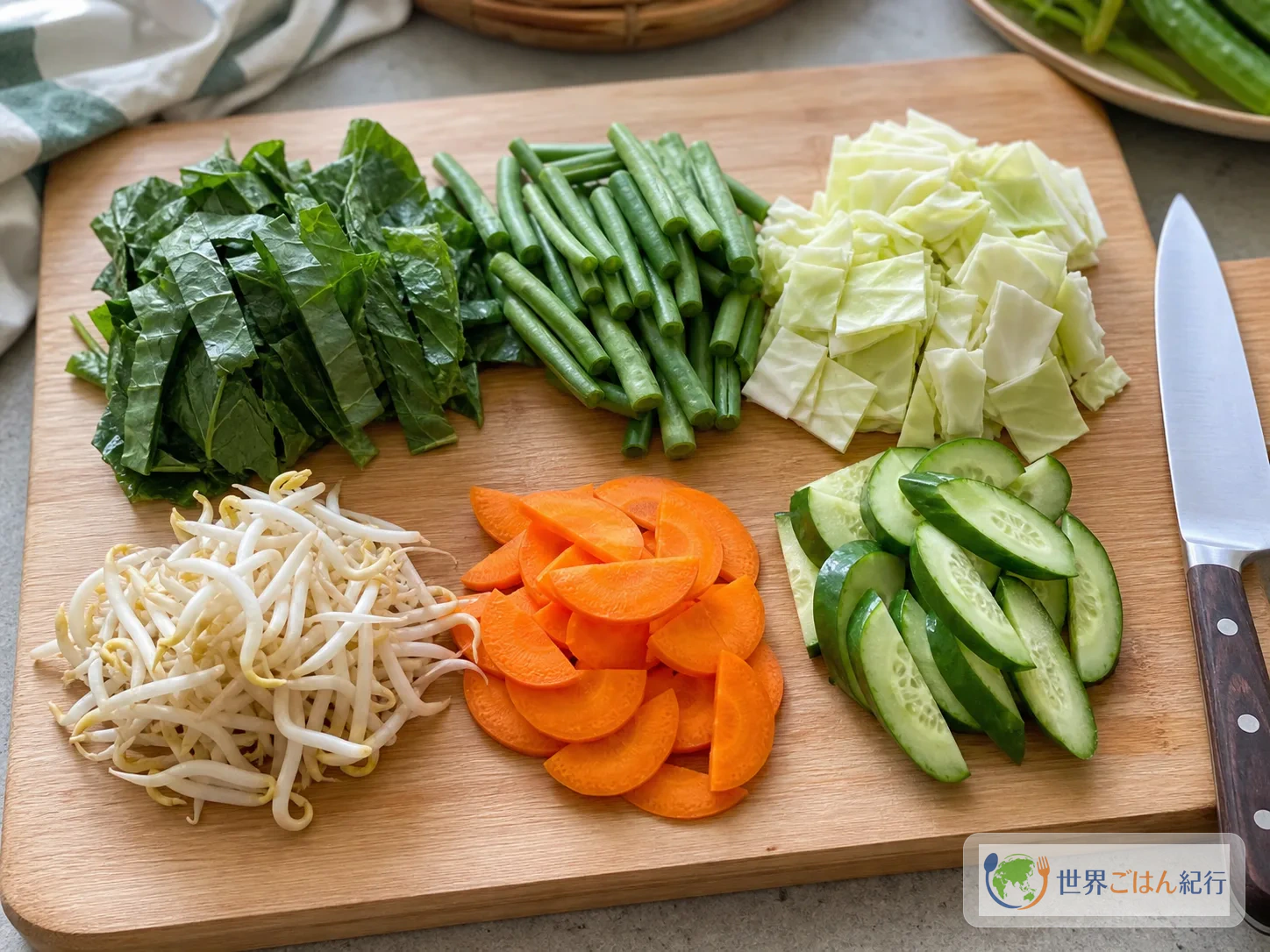
Pecel is often explained alongside gado-gado. Both use vegetables and peanut sauce, but pecel is easiest to understand when built around blanched greens and sprouts with a strongly aromatic sauce. You may add potatoes, tofu, and boiled eggs to the plate as in gado-gado, but the more you add, the more sauce you need. For a first plate, limit yourself to about four vegetables so the aroma of the sauce stays visible; this fails less often.
The way it is served also carries a sense of place. There is nasi pecel with rice, a form poured over compressed rice cakes such as lontong or ketupat, and a form with fried tempeh or tofu on the side. The nasi pecel introduced on the Blitar tourism page is also presented as a dish eaten with a staple, not just vegetables and sauce. Plain white rice is enough. Rather than piling only vegetables on a large platter, putting rice in a bowl and adding sauce little by little lets you set the richness yourself.
Ingredients that give pause: buy the aroma, or start with what you have
Pecel can be made by gathering the vegetables at an ordinary grocery store and filling in only the aromatic ingredients from an Asian grocer or online. The order of consideration is makrut lime leaf, kencur, and how you handle the peanuts. Below are only the items whose role in this sauce is clear.
Makrut lime leaves are for people who will cook again
Makrut lime leaf adds the green citrus scent that comes out when you tear the leaf, rather than the sourness of lemon juice. Pecel uses only 2 leaves, but they also go into Indonesian urap, nasi goreng, and curries. If you are only trying this once, you can skip them and grate a little lemon zest instead. The taste is not the same.
Buy them if you have room for a small bag in the freezer and already know what you will cook next. Check the quantity and the freezing instructions on the package.
A food processor: can it reach a small amount?
The sauce can also be made in a mortar. Put the peanuts in a bag, crush them roughly with a rolling pin, chop the aromatics with a knife, and mix in a bowl. If you use a food processor, check that the blade reaches 100 g of peanuts plus the aromatics and that small-batch operation is supported.
A large-capacity processor (3.6 L class) is oversized for one plate of pecel. It makes sense for someone who also plans to use it for nut pastes, curry bases, and make-ahead sauces. For others, starting with a mortar and not buying anything is the better choice. If you do buy one, check the capacity, blade shape, and small-batch performance.
Sambal oelek adjusts the heat
If you can get 2 fresh red chiles, you do not need sambal oelek. A paste in the refrigerator lets you add 1 tsp at a time, which helps when family members want different heat or you cannot finish a bag of chiles. You can also grind in half and let people add the rest at the table instead of putting it all into the pecel sauce from the start.
The condition for buying it is that you can read the ingredient list and adjust the taste. Besides chile, some products contain garlic, vinegar, and sugar. Check the ingredients and quantity, and cut the sugar from 35 g to 30 g, for example, to suit the product. If you make it with fresh chiles, skip it.
Do not serve this sauce to anyone with a peanut allergy. Store-bought sambal oelek and pecel seasonings may also contain shrimp, fish sauce, or soy. If you are making it vegan, check the label, and wash shared utensils before use.
Method: do not overcook the vegetables, and make the sauce slightly thick
Make the sauce first and cook the vegetables afterward. If you blanch every vegetable before making the sauce, water tends to come back into the colander. Prepare a pot, a frying pan, and a mortar or food processor.
Plating decides the flavor: do not pour on all the sauce at once
If you serve the vegetables on a large platter, build height in this order: spinach, cabbage, green beans, bean sprouts. Lay the cucumber alongside and add pan-fried tofu or tempeh. Do not pour the whole quantity of sauce at once; start with about 2 tbsp per person. Lay the spoon flat and spread it thinly over the surface, leaving the rest so that anyone who wants more can add it.
Finished pecel has sauce covering the surface of the vegetables without leaving a puddle at the bottom of the plate. A few peanut bits remain, and after the earthy scent of kencur, the makrut lime leaf cuts through green. If you are eating it with rice, make the sauce a bit thicker so the sweetness of the rice does not blur its outline.
If water seeps out after you mix the vegetables and sauce, move only the vegetables to a colander and return them to the plate. In a separate pot, warm the sauce over low heat for 30 seconds and add only 2 tsp of unsalted peanuts to restore its thickness. Do not thin it with water, because that pushes the flavor further away.
Cooking tips: four decisions that keep it pecel
Cooking vegetables "in the same pot" does not mean lifting them out together
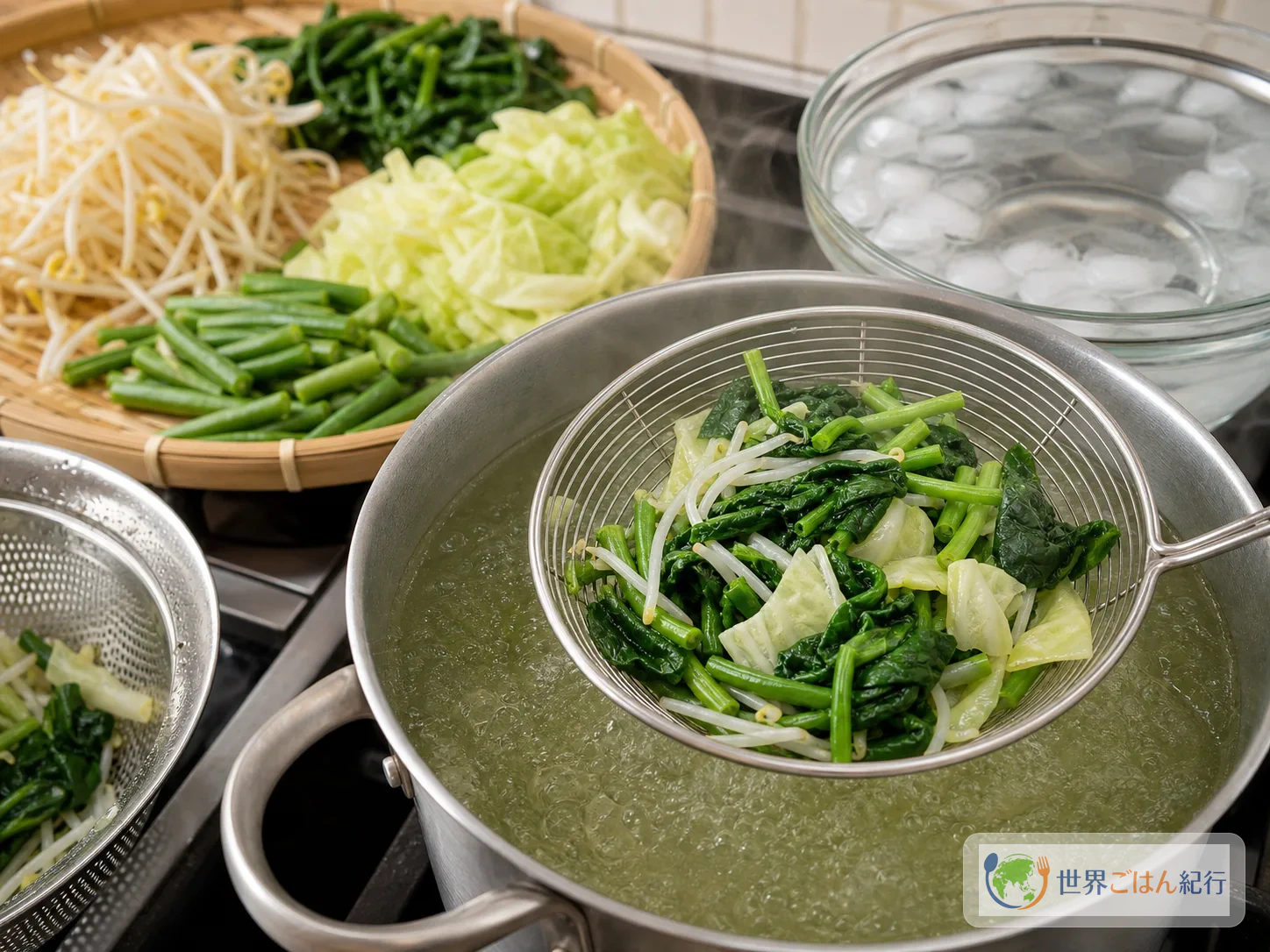
To avoid extra pots, cook them one after another in the same water. But if you add spinach and green beans at the same time, one of them has to compromise. By the time the beans are tender, the spinach has lost its color. Set times, lift each out on schedule, and reuse a single colander; you will also have less to wash.
Use a small amount of kencur to keep its aroma
Kencur is a relative of ginger, but it is not just an ingredient that adds ginger's heat. Its character is an earthy, slightly camphor-like scent that cuts through. The first time, stick to 10 g, and if you substitute galangal, keep it to 15 g. If you use the same amount of ginger, the sauce drifts toward a ginger dressing.
Put the sauce on cooled vegetables
If you pour all of the hot sauce over hot vegetables, water tends to come out of the vegetables. Let the vegetables cool a little and let the sauce cool to about body temperature before combining. Even when eating right away, keep them separate until just before plating.
Decide the sourness last
The strength of tamarind varies by product. Use 15 g as the first benchmark, and if the sourness is weak, add 1 tsp at a time. Rather than adding sweetness to make up the difference, taking a small portion of the sauce aside to adjust keeps you from losing the whole batch.
Regional differences and variations: the vegetables and the sauce move even within pecel
Madiun style, with rice as the star
If you have the registered dish "Pecel Madiun" in mind, put the blanched vegetables on white rice and serve the sauce on the side. Adding fried tempeh, tofu, and crackers turns a light side dish into a meal. Keeping the sauce mild and letting people add heat at the table also makes it easy to serve a family that wants different levels of spice.
Using Blitar's aromatics as a guide
The aromatics introduced for Blitar's nasi pecel include kencur, coriander, candlenut, and makrut lime leaf. Adding 1 tsp of coriander seeds and 1 candlenut to this sauce gives more toastiness and body. Because you are adding nuts, reducing the peanuts to 90 g keeps it from getting too heavy. This is a home adaptation based on the ingredients introduced for Blitar, not a blend that represents all recipes in the region.
Vegetables that are easy to swap in a home kitchen
If you can get water spinach, replace half of the spinach with it. Komatsuna, broccoli, and okra also work. As a guide, broccoli florets cut to 2 cm take 2 minutes, and okra rubbed with salt takes 1 minute 30 seconds. Watery lettuce and tomatoes are better added at the table rather than mixed into the blanched vegetables, so that the sauce is not diluted.
A version for children, without heat
Leave out the red chiles and start with 30 g of palm sugar and 12 g of tamarind. Add 1 tsp of sambal oelek only to the adults' plates. Splitting the sauce in two means you do not have to cook the vegetables again in a separate pot.
If you substitute the peanuts
If there is no peanut allergy, you can make it with 80 g of unsweetened peanut butter. The grain and aroma of roasted peanuts will be reduced, so I recommend the original ingredient for the first plate. For an allergy-friendly version, roast unsalted sunflower seeds and crush the same amount finely. In that case, think of it as "pecel-style blanched vegetables" and label it as a dish that imitates the peanut flavor.
Storage and frequently asked questions
Can I make it ahead?
Cool the vegetables and sauce separately and refrigerate them in clean airtight containers. Use up the vegetables by the next day and the sauce within 2 days; this helps preserve the aroma and texture of the greens. USDA FSIS advises using cooked leftovers within 3 to 4 days in the refrigerator and cooling them quickly in shallow containers. Taking into account how often a home refrigerator is opened and the moisture in the vegetables, this recipe gives a shorter quality guideline. Do not eat anything that has sat at room temperature for a long time, and when reheating, warm only the sauce and do not rewarm the vegetables too much.
Can I blanch the vegetables the day before?
You can, but spinach and bean sprouts are better blanched on the day. If you are preparing the day before, blanch only the green beans, carrot, and cabbage, cool them, and squeeze out the water. The next day, add the cucumber and leafy greens, warm the sauce, and combine.
I do not have kencur
Galangal at 15 g is the first choice. If you have neither, 5 g of ginger and a little black pepper can set the scent in the right direction, but the heat will come forward. Do not use 10 g or more of ginger to try to make it taste like kencur. The condition for buying kencur is that you plan to keep cooking Indonesian food. If this is a one-time dish, you can skip it and build the axis of peanuts, chile, and tamarind first.
The sauce is too sweet
Pecel sauce has the sweetness of palm sugar, but if only the sugar taste remains, add 1 tsp of tamarind and a pinch of salt, each in a separate dish and tried separately. If you add chile to hide it, only the heat goes up. If you use store-bought sambal oelek, it may already contain sugar and vinegar, so do not put in 35 g of palm sugar from the start; begin at 25 g.
How is it different from gado-gado and urap?
Gado-gado leans toward widening the plate with tofu, potatoes, and eggs, and urap toward tossing vegetables with seasoned coconut. Pecel centers on blanched vegetables and the aromatics of the peanut sauce. Because they are similar, comparing the thickness of the sauce and how the vegetables are cooked will show the differences better than making all three on the same day.
Can I store it with all the sauce on?
I do not recommend it. Water comes out of the vegetables and the sauce is thinner the next day. Put on only 2 tbsp at a time for what you are eating, and keep the rest in a separate container. If the sauce stiffens, loosen it by mixing in warm water 1 tsp at a time.
Nutrition (approximate, per serving)
| Energy | Protein | Fat | Carbohydrates | Fiber | Salt equivalent |
|---|---|---|---|---|---|
| about 360 kcal | about 13 g | about 17 g | about 42 g | about 8 g | about 1.6 g |
This is an estimate including peanuts, vegetables, white rice, and tofu. It varies with the peanuts and sauce used and with the nutrition labels of store-bought products. If you have an allergy, check the ingredient label before the nutrition figures.
Sources
- Indonesian Ministry of Education and Culture, intangible cultural heritage database, "Pecel Madiun" (registration year and region, accessed July 2026)
- Kementerian Pariwisata, "Produk Wisata Nasi Pecel Khas Blitar" (Blitar aromatics and how it is eaten, accessed July 2026)
- Universitas Bakrie Press, "PECEL: Kuliner Ikonik Jawa Timur dan Potensi Pangan Lokal" (the name and the crushing step, accessed July 2026)
- Tasty Indonesian Food, "Pecel" (how the vegetables and sauce are assembled, accessed July 2026)
- USDA FSIS, "Keep Food Safe! Food Safety Basics" (cooling and storing leftovers, accessed July 2026)
Note: nutrition information is an approximate per-serving figure calculated from the listed ingredients. It varies with each product's nutrition label, the amount of peanuts, and the thickness of the sauce.



