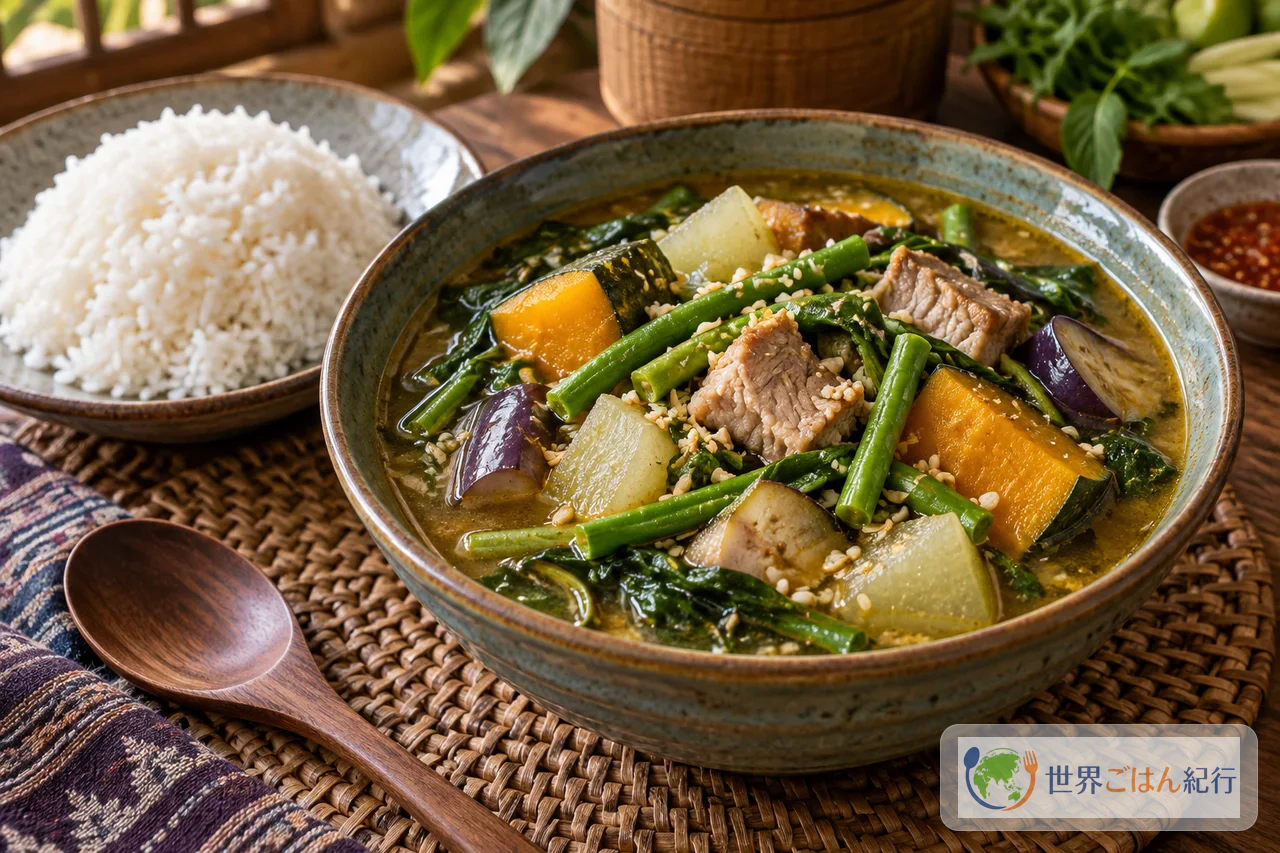
The saltiness of fermented fish and the scent of lemongrass lie over warm, white coconut sauce. What decides each bite is not only the dip. The water of cucumber, the sourness of green mango and the crunch of cabbage catch the rich sauce.
Prahok ktis is a Cambodian dish in which prahok, the country's fermented fish paste, is simmered with pork, aromatics and coconut. Khmer and English spellings vary, but the heart of the dish does not. It doesn't hide the fermented fish; it rounds it with sweetness and fat, and you scoop it up with raw vegetables.
In your own kitchen, you check in order the saltiness and aroma of the prahok, the richness of the coconut milk and the doneness of the ground pork. Replace the fish stock and coconut cream of local recipes with one can of coconut milk, choose the green fruit from what you can get, and you can make 4 servings that keep the axis of flavor.
Unlike amok (in Japanese), where fish is steamed in coconut, prahok ktis simmers fermented fish with pork and is eaten by dipping vegetables in it. Even among coconut dishes of the same country, the treatment of fish and the way it is eaten at the table differ.
A Cambodian Plate of Fermented Fish, Scooped Up with Vegetables

Prahok is a paste of freshwater fish that has been salted and fermented. It is not a seasoning that uses only the liquid like fish sauce; the fish flesh and the umami of fermentation remain in it. So right after it goes into the pot the aroma is distinct, but layered with pork fat, the sweetness of coconut and the acidity of tamarind, the sharp edge of the saltiness loosens.
The way to eat this dish is to take the sauce little by little with a spoon onto vegetables. If you put vegetables in the pot from the start, they release water, thinning the flavor and losing their crunch. Put the warm dip in the middle of a bowl and spread cut vegetables and fruit around it, and within one plate you can move between richness and lightness.
If, startled by the smell, you cut the prahok too much, it veers toward coconut-flavored pork crumble. Keep the saltiness of the fermented fish and dilute each bite with the water of the vegetables: that is the judgment for making this dish outside Cambodia. For the first time, start with the 60 g below and adjust the differences in saltiness between products with the salt at the end.
Ingredients (The Base of Aromatics, and Vegetables for the Table)

This serves 4. One local recipe uses 150 g prahok to 1 kg pork. Here 60 g prahok goes with 400 g ground pork, scaling that ratio down for home. Prahok differs in saltiness by product, so don't put in all the salt at the start.
Kroeung is the base of Cambodian cooking, turning aromatics into a single paste. The yellow kroeung described in sources combines lemongrass, galangal, garlic, shallots, makrut lime leaf, turmeric and so on. Here galangal is replaced by ginger and makrut lime leaf is dropped for a little lemon zest, keeping layers of aroma.
For lemongrass, choose fresh or frozen stalks rather than dried powder, and a thin citrus scent remains in the simmer. A small pack from an import store is enough for one time, but if you also use it for tom yum or curry, dividing frozen stalks into portions wastes less.
Prahok is not something always available at a neighborhood supermarket, so it is worth seeking as the main ingredient. If you are trying it once and a nearby import store has a small size, you needn't order online. Even if the product names are similar, fish sauce, shrimp paste and chili paste are different things. Check not only the product name but that the ingredients show a fermented fish paste with fish and salt, plus the size and refrigerated or room-temperature storage conditions.
Method (Fry the Aromatics, Leave Some Coconut for the End)
If you start on high heat to weaken the smell of fermented fish, only the aromatics scorch and the saltiness of the prahok sticks to the bottom of the pan. The order is: open the aromatics in oil, fry the pork, simmer in coconut, then add a little at the end.
Tips for the Finish (Don't Erase the Aroma, Put the Saltiness Behind)

The aroma of prahok does not disappear with heating. Pass its umami to the aromatics and pork, layer coconut and acidity over it, and land it at a place where it isn't too rich when eaten with vegetables. If tasting from the pot alone it seems a bit strong, but the saltiness settles when you dip cucumber or cabbage, the finish is right.
If the fish aroma comes forward during simmering, before diluting with water add 50 ml coconut milk and simmer 3 minutes over low heat. If still strong, add 30 g mushrooms and simmer 2 minutes. Halving the prahok from the start reduces not only the saltiness but the depth of fermentation, so next time lowering from 60 g to 40 g is easier to control.
Oil floating on the surface with white granules visible doesn't necessarily mean it is inedible. Turn off the heat, add 30 ml water and mix 1 minute over low heat, scraping the bottom with a whisk. Boiling again over high heat makes the separation worse, so stop when the surface is smooth again and a spatula's track stays for just a moment.
If you stack cut vegetables in a bowl, the water of the tomato and cucumber runs onto the plate. Cut the cabbage in 3 cm squares and press with a dry cloth, and set tomatoes cut side down for 5 minutes. Even if water comes out, don't return the vegetables to the pot; dip a little dip onto each.
Crushing the kroeung in a mortar leaves thin fibers of lemongrass that move slowly into the aromatic oil. A spice mill that evens out the size of grains is also useful for households that use dried chilies and peppercorns often. If you already have a mortar and are making it just this once, you needn't buy anything new.
Keep the bowl, knife and cutting board that touched raw pork and prahok separate from the tools used for vegetables and plating. Cook the pork not just until the red is gone but to at least 75°C for at least 1 minute at the center. Wash raw vegetables under running water and pat dry, and if serving elderly people, small children, pregnant people or people in weak health, don't force raw side vegetables; replace them with briefly cooked vegetables.
What You Can Change Is Heat and Vegetables; What You Don't Is the Fermented Fish

Changing the vegetables served makes prahok ktis easy to fit to the season. But the moment you replace the fermented fish with another seasoning, the center of the flavor moves to a different dish. Without hiding substitutions, decide first what remains and what is lost.
- Reduce the heat: Seed the dried red chili and use only 1/2. So that heat can be added later, don't put chili powder in the pot; set it in a small dish.
- Add acidity with fruit: If no green mango, choose a hard green apple, starfruit or a sour citrus. Sweet ripe mango overlaps with the dip's sweetness and ends up different from the crunch of green fruit.
- Replace the small eggplants: Pea eggplants simmered whole release sauce when bitten. Bell pepper cut in 1 cm squares or eggplant in 1.5 cm squares is added in the last 5 minutes so it doesn't break down.
- Lower the fish aroma a little: Reduce prahok to 40 g and add salt at the end after tasting. The aroma gets gentler, but the weight of coconut and pork rises, so serve plenty of vegetables.
- Do not use fermented fish: Combining 40 g anchovy paste and 20 g miso supplements saltiness and umami. But it is a home-style variation using fermented seasonings, not Cambodian prahok ktis. To avoid fish, use no anchovy either and make it with 100 g mushrooms and 30 g miso.
- Eat it wrapped: Take a little rice and layer dip, cucumber and cabbage. If wrapping in lettuce, wipe the leaves dry and don't use too much sauce so the leaf doesn't tear.
Background: Preserving Lake Fish and Eating It with Vegetables

Prahok has been studied as a preserved food that supports Cambodian meals. The movement of water in Tonle Sap lake and the Mekong changes with the seasons: fish gather in the flood of the rainy season, and fishing and processing come in the dry season. Research materials describe a seasonal flow in which the water rises from May to October and fish are caught and processed from December to March. The technique of salting and fermenting fish is household wisdom for using the ingredients of the catch season in another season.
Prahok, with this background, is not just a specially strong-smelling seasoning. Within a diet centered on rice and fish, it is a flavor base used in small amounts in everyday cooking. With the fermentation period, fish type, salt amount and storage conditions, the aroma, particle size and saltiness change. Research has reported sensory differences in prahok by region, so even within Cambodia it cannot be fixed to one flavor.
Dishes combining yellow kroeung and prahok vary by household and region. The prahok ktis introduced by a Siem Reap chef uses pork, mushrooms, small eggplants, tamarind, coconut water and coconut cream, and in some cases fish. This recipe's blend omits fish fillets and consolidates into canned coconut milk and water as a home version that keeps the skeleton of the dish while avoiding too many extra purchases.
Laos and northeastern Thailand also have seasonings and dishes that use fermented fish. Even where aromas are similar, the processing of the fish, the saltiness and how it is added to dishes are not the same. It is more accurate to think that each has its own flavor within a related food culture than to swap prahok one-to-one with Laos's padaek or Thailand's pla ra.
The Cambodian meal is basically rice at the center with several dishes laid out and shared among family and friends. The use of the spoon as the main utensil, with a fork to push food onto it, is also described. Vegetables served with prahok ktis are not only to brighten the look. They are so that each bite of the strong fermented fish flavor is caught by juicy vegetables and rice.
When re-creating it outside Cambodia, prahok alone cannot be completely replaced by fish sauce or miso. If you can't get it, record the difference in flavor as a substitute version and decide whether to seek fermented fish paste the next time you make it. Choose coconut milk, lemongrass and green fruit from what you can get, and keep the saltiness of fermented fish and the way of eating with vegetables, and you bring even the background of the dish's name to the table.
FAQ
What can I substitute if I can't find prahok?
Mixing 40 g anchovy paste and 20 g miso is a shortcut. But prahok is a paste in which freshwater fish flesh and fermented aroma remain, so even if saltiness and umami are similar, the aroma and the grains left on the tongue differ. For those who can eat fish, combining anchovy paste and miso makes it easier to build body than adding a little fish sauce. If made with a substitute, treat it not as the dish named in this article but as a home-style variation.
How do I tell the smell of prahok from a spoiled smell?
The strong aroma characteristic of fermented fish remains after heating. If there is blue-black mold, abnormal swelling when you open the container lid, an unusual putrid smell or sliminess, don't use it; discard it. Fermentation alone does not guarantee keeping quality, so give priority to the storage conditions on the product label and handling after opening.
Can I substitute Japanese eggplant for the small Thai eggplants?
Yes. Japanese eggplant is watery and soft, so cut into 1.5 cm squares and add in the last 5 minutes of simmering and it keeps its shape. Bell pepper gives a lighter texture, and green peas add the texture of round grains. Don't lengthen the simmer for any of them, so they don't release too much moisture into the sauce.
Is it OK to make it the day before?
Cool the dip a little, put it in a clean airtight container, refrigerate and aim to finish by the next day. Keep raw vegetables and rice separate and cut the vegetables just before eating. When reheating, heat the whole thing thoroughly over low heat and if it has lost moisture add 1 tbsp water at a time. Avoid cooling a once-heated dip again and again, and don't reuse leftover raw vegetables.
Can I make it if I don't eat fish or pork?
You can, but it becomes a different variation from prahok ktis. Without prahok and anchovy, increase the mushrooms to 100 g and adjust saltiness with 30 g miso, 5 ml soy sauce and coconut milk. If avoiding animal ingredients, check the ingredients of the miso and seasonings too. Since you cannot keep the aroma of fermented fish, eat it not as the same dish but as a vegetable dip that makes use of kroeung and coconut.
Can I make it without a mortar or spice mill?
Yes: slice the lemongrass as thin as possible with a knife and chop finely with the garlic, onion and ginger. If using a food processor, don't add water and stop every 5 seconds to check the coarseness. If the paste turns liquid, frying takes longer. If you already have a mortar or are making it just once, you needn't buy a dedicated tool.
What should I check if there are allergies?
Prahok contains fish and ground pork contains pork. Commercial seasonings and miso may contain soy and other ingredients, and coconut needs caution for some people. Check the ingredients and allergen labels on the product, and if sharing the same cutting board or knife, wash the fish and meat tools and the vegetable tools separately with detergent. Since the dish is served with raw vegetables, switch to cooked vegetables to suit the health of the eater.
Sources
- Tradition and Fermentation Science of prohok, an ethnic fermented fish product of Cambodia (Journal of Ethnic Foods. Checked prahok fermentation, seasonality around Tonle Sap, regional differences, and the ingredients and way of eating of prahok ktis. Accessed and checked August 30, 2026)
- Prahok Ktis Recipe from Cuisine Wat Damnak (Checked a Siem Reap chef's blend, the ratio of pork to prahok, coconut, tamarind, accompanying vegetables and ideas for substitution. Accessed and checked August 30, 2026)
- Cambodian Culture (Checked how Cambodian flavors are built, fermented foods, a table centered on rice with shared dishes, and the use of spoon and fork. Accessed and checked August 30, 2026)
- Six Points for Preventing Food Poisoning at Home (Japan's Ministry of Health, Labour and Welfare; in Japanese. Checked keeping raw meat and raw vegetable tools separate and the guide of cooking the center of meat to 75°C for at least 1 minute. Accessed and checked August 30, 2026)