


Sourness on the First Bite, Then Fish and Herbs Stretch Out

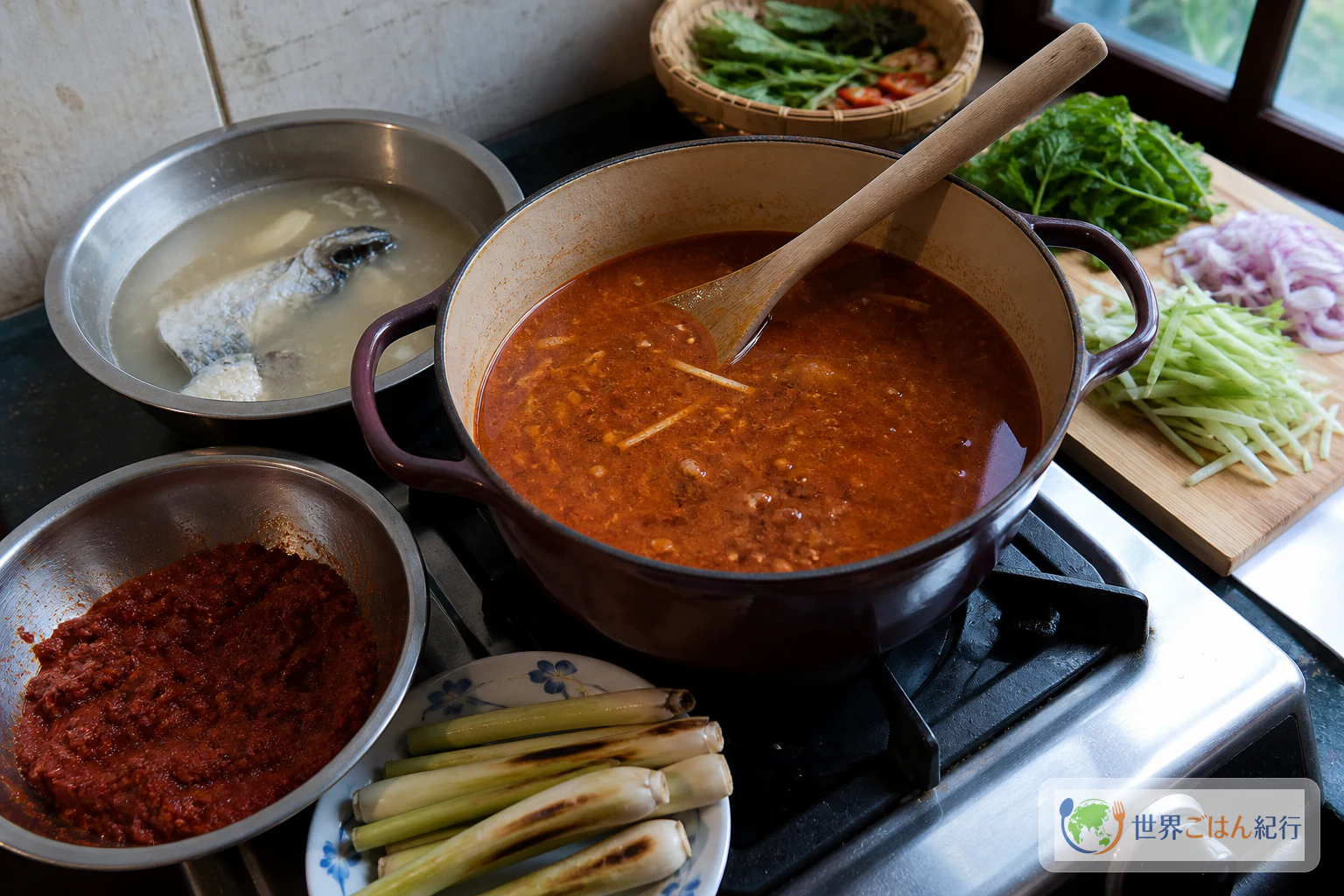
Beyond the steam, the red soup flows into the gaps between thick rice noodles. Bring the spoon close, and the sharp sourness of tamarind, the heat of chili, the fish stock, and the green scent of a mint-like herb rise one after another. With sweet pineapple and thin slices of cucumber alongside, this is not a noodle dish that pushes through with hot soup alone.
Assam laksa (Asam Laksa) is the signature fish-stock rice noodle dish of Penang, in northwestern Malaysia. In the Malaysia Tourism recipe, fish, thick rice noodles, chili, lemongrass, tamarind, and laksa leaf are combined, with cucumber, red onion, pineapple, mint, and lime on the side. Even when sourness and heat come first, a rich stock with the flesh of the fish left in supports it from behind, so the outline of the flavor does not blur.
Though also called "laksa," it goes in a different direction from curry laksa, which puts forward the round richness of coconut milk and spices. Assam laksa thins fish stock with water and moves forward with sourness and herbs. In a home kitchen, what separates the results is not boiling the fish too long and bringing out a fishy smell, not scorching the spice paste, and combining the sourness at the end.
The amounts are for 4 servings. With canned fish you can make it in a weekday pot, and with fresh fish you get a thickness closer to the local recipe of boiling and flaking the fish. On days when tamarind and herbs are all available, aim for the original sourness; on days when they are hard to find, understand the role of each substitute and rearrange them, and even if it becomes another noodle dish you will not lose the core of the flavor.
You taste sourness first, and the umami of the fish and the herbs linger afterward. Do not settle the flavor completely in the pot; finish so that lime, chili, and hae ko can be added at the table.
Ingredients (serves 4)

Tamarind adds a fruity sourness and a slight sweetness to the soup that lemon juice alone does not give. Pastes differ by product in thickness, presence of seeds and fibers, and degree of sweetening, so it is safer to check the ingredients and weight and decide by tasting, rather than adding the whole amount from the start. If you will make it only once, you can substitute lime and vinegar, but if you want to try the Penang sourness several times, it makes sense to buy a small jar of paste.
Fish, fermented shrimp paste, and hae ko contain seafood and crustaceans. Depending on the product, rice noodles may also contain wheat, so if you have allergies, check the ingredient labels and manufacturing lines. Knives and cutting boards used for fresh turmeric and herbs retain color and smell easily, so laying down a dedicated sheet makes cleanup easier.
Even in a version without fermented shrimp paste and hae ko, the ingredients of fish sauce and rice noodles differ by product. If you have an allergy, check the ingredients and manufacturing lines before deciding on substitutes.
Method: Thicken the Fish Stock and Do Not Scorch the Aromatics
The Axes of Flavor: Adjust Sourness, Fish, and Herbs Separately
Assam laksa is not a dish where you make everything richer in the same direction. Tamarind is the sourness, fish is the thickness, herbs are the aftertaste, and pineapple and cucumber step in between the heat and the spice. If one is too strong and you cover it by adding another, the whole soup turns heavy, so fix each by its role.
| Flavor element | Local-leaning ingredient | Adjustment at home | How to tell it is right |
|---|---|---|---|
| Sourness | Tamarind paste | Add lime at the table, with vinegar only as a small aid. | A round fruity sweetness remains after the sharp sourness. |
| Thickness of the fish | Mackerel, sardine, Spanish mackerel, etc. | With canned fish, do not use all the liquid; with fresh fish, strain the cooking liquid. | What stays on the tongue is the thickness of the stock, not a fishy smell. |
| Herbs | Laksa leaf, mint | Switch to Vietnamese mint, or a combination of mint and green shiso. | A green aroma rises when you bring the bowl close and cuts the simmered smell. |
| Sweetness | Palm sugar, pineapple | Make up with raw cane sugar and the fruit. | It does not erase the sourness; only the edge of the heat is rounded. |
| Fermented depth | Fermented shrimp paste, hae ko | Leave out if avoiding crustaceans; use only a little if substituting miso. | Apart from saltiness, a matured umami sits deeper. |
If the soup tastes "only sour," check the salt and the amount of fish before adding more tamarind. Conversely, if the fish stock is heavy, do not put a lot of lime in the pot; squeeze it bowl by bowl. If you separate the flavor you finish in the pot from the flavor you add at the table, you do not have to fix 4 servings at the same strength.
Noodles You Eat at a Penang Stall: There Is More Than One Laksa

When we speak of Penang's food culture, the dishes appear not just as a pot at home but as meals with people passing at the shared tables of stalls and hawker centers. In a bowl of assam laksa, a soup of boiled and flaked fish, thick rice noodles, cucumber, onion, pineapple, and herbs live together. Cold toppings and fruit enter the warm stock, and room is left for the eater to add lime and chili.
The Malaysia Tourism recipe combines a stock using fish such as mackerel with chili, onion, garlic, turmeric, galangal, lemongrass, and tamarind. That it lists both a way of boiling a whole fish and a simple way using canned fish shows that this is a dish whose method changes with local ingredients and the circumstances of the household.
Malaysia's national heritage list (2009) includes "Laksa asam" as a noodle dish. On the other hand, laksa across Malaysia is not of one kind, and the tourism board's laksa-related events also present the diverse laksa cultures of each state. Rather than fixing the origin of laksa to one source, looking at regional differences by state and the difference between fish stock and coconut milk captures the breadth of the dish more accurately. Read alongside Malaysian laksa, it keeps you from treating Penang's assam laksa as the same flavor as curry laksa with coconut milk, or laksa developed in other regions.
| Name and region | Star of the soup | Tendency of noodles and how to eat | Point to tell apart in Japan |
|---|---|---|---|
| Penang assam laksa | Fish, tamarind, chili, herbs | Thick rice noodles with fish flesh and raw toppings added. | Sourness stands in front, and no coconut milk is used. |
| Curry laksa types | Coconut milk, spices, seafood or chicken | The soup has a round richness, and the combination of toppings changes. | A different line from the sour fish stock built on tamarind. |
| Home substitute version | Fish you can get, ginger, mint, citrus | Shorten cooking time with canned fish and store-bought rice noodles. | Even with substitutions, keep the three layers of sourness, fish, and herbs. |
You cannot simply reduce the influence of different cultures to one pot, but from the viewpoint of a port-town table, you can see why fish stock, Southeast Asian aromatics, fermented seasonings, rice noodles, and raw fruit and vegetables overlap. The interest of assam laksa includes the room left to pile on toppings just before eating.
If You Substitute in a Home Kitchen: Decide What Aroma to Keep First

When local ingredients are not all available, rather than only bringing the names closer, decide which aromas and textures you want to keep. Galangal is earthier than ginger, with a slightly camphor-like aroma. Switching to ginger brings forward a sharp ginger smell, so a method is to add a very little lemon zest to supply brightness. But this does not reproduce galangal itself.
Chopping the spice paste with a knife before pounding lets you keep fibers while making the grains even.
| Local ingredient or state | Substitute in Japan | What changes | Judgment on using it |
|---|---|---|---|
| Boiling and flaking fresh fish | 3 cans of mackerel in water | The fish aroma is milder, and the time to make stock is shorter. | Suits weekday versions and times you want to avoid bones. |
| Thick laksa noodles | Thick rice vermicelli, rice flour noodles | The springiness of the noodles and how they lift the soup change. | Choosing rice noodles over udon keeps the outline of the dish. |
| Galangal | 25 g ginger plus a little lemon zest | The earthy smell lessens and a brighter heat increases. | A role substitution for when it is hard to find. |
| Laksa leaf | Mint plus green shiso | The sweet green aroma is weaker and a cooling feeling comes forward. | Prioritize adding fresh herbs at the end. |
| Fresh turmeric | Turmeric powder | The aroma rises more gently, and the color is more even. | Adjust from 5 g powder for 15 g fresh turmeric. |
| Hae ko | Leave out, or a little shrimp paste | The flavor of sweet fermented shrimp is thinner. | Do not force a substitute if there is a crustacean allergy. |
| Tamarind | Lime plus a little rice vinegar plus raw cane sugar | The round fruity acidity decreases and citrus aroma is stronger. | Fine for once. If you will make it many times, choose the paste. |
If you switch the fish to salmon, the fat and aroma are strong and the sourness of assam laksa tends to lose. White fish gives a lighter finish, but a fish whose flesh falls apart too much clouds the soup. With Japanese fish too, choosing by strength of fat, ease of removing bones, and clarity of the cooking liquid makes it easier to adjust.
Recovering from Failures: Touch the Sourness and Heat Last

Assam laksa is a dish that is easier to recover if you do not finish the flavor in the middle of simmering. Tamarind, lime, and chili in particular change in impression with cooking time and product. Before fixing the whole pot, take a little into a bowl and try the seasoning there, and you prevent the accident of pushing 4 servings to an extreme.
| What happened | Main cause | How to recover | What not to do |
|---|---|---|---|
| The paste is black and smells burnt | Heat too high; not enough moisture at the bottom | Move only the unburnt upper part to another pot and add a little stock. | Do not mix the scorch in or hide it with sugar. |
| The sourness is sharp and hard to drink | Added too much tamarind at once | Add 100 to 150 ml of stock at a time, and return a little fish flesh and salt. | Do not add more lime. |
| Too spicy | Chili seeds or variety differences | Thin with unsalted stock and add more noodles and pineapple. | Do not thin with water alone and erase the umami. |
| A fishy smell stands out | Boiled hard; used all of the fish liquid | Add lemongrass and adjust at the bowl with a little tamarind and herbs. | Do not add more fish while the smell remains. |
| The soup is watery | Paste fried too little; simmered too little | Take off the lid and reduce for 10 minutes over medium-low, then recheck salt and sourness. | Do not suddenly reduce over high heat. |
| The noodles went soft | Boiled ahead; soaked in soup for a long time | Do not boil more noodles; plate the next portion separately. | Do not try to restore soft noodles by washing in boiling water. |
Keep one small tasting dish and try tamarind, sugar, salt, and lime in turn in small amounts, and it is easier to see what is lacking. If you added sourness but no outline appears, it may be not sourness but saltiness or fish stock that is lacking.
6 Variations: From the Same Pot to Another Penang-Leaning Bowl

When you change ingredients, moving only one center of the flavor shows where the dish sits. A version that keeps fish, noodles, and sourness and changes only the herbs, a version that switches to fresh fish for a thicker stock, and a version that drops the fermented seasoning to lighten the seafood aroma each make a different table.
| Variation | What you change | Result | Who it suits |
|---|---|---|---|
| Fresh fish version | Boil 1 kg mackerel with lemongrass for 5 minutes and use the flesh and cooking liquid. | The fish stock is clearer than with canned fish, and the fibers of the flesh remain. | People who can prepare fish on the weekend. |
| Canned sardine version | Replace the canned mackerel with canned sardines in water. | The fish aroma and fat are a little stronger. | People who like a rich fish stock. |
| More herbs version | Add plenty of mint and green shiso at the end. | Heat and fat feel lighter. | People who want aroma to be the star. |
| More fruit version | Use 200 g pineapple and reduce the sugar by 2 to 3 g. | The edge of the sourness is rounded and it is easier to serve to children. | Tables that want less heat. |
| No crustacean version | Leave out the fermented shrimp paste and hae ko and use a little more fish. | The fermented depth drops, but the fish and herbs are clearer. | People who must avoid crustaceans. |
| Toppings on the side version | Each person adds cucumber, onion, lime, and chili. | The strength of heat and sourness can vary from the same soup. | Families with different tastes. |
You can also add coconut milk as in curry laksa, but at that point you move from sour fish-stock assam laksa to another laksa. It is not a question of deliciousness; it is a choice of what you want to keep.
Storage and Reheating: Do Not Leave the Fish Stock in the Pot

Store the soup, noodles, and toppings separately. Move the soup into a shallow container after cooking, let the heat go off, and refrigerate it. If you leave it in the pot at room temperature, the temperature of a liquid containing fish and aromatics is slow to fall and it spoils easily. Japan's Ministry of Health, Labour and Welfare also advises dividing leftover food into shallow containers, cooling it quickly, and reheating it thoroughly through the center before eating.
Use refrigerated soup within 1 to 2 days starting the next day, and boil only what you will eat in a separate pot. When reheating, keep it bubbling throughout so the center reaches 75 degrees C or more. Noodles are best used up the day they are boiled; do not put leftover noodles in the soup, but refrigerate them in a separate container and eat them by the next day. Cut the cucumber, mint, pineapple, and lime just before eating to keep aroma and texture.
To freeze, seal only the soup containing the fish flesh in single-serving portions, write the date, and use it soon. After thawing, adding sourness helps the aroma come back; do not refreeze. If there is an off smell different from a sour smell, a slime on the surface, or a swollen container, discard it without tasting.
If you store the soup with the noodles in it, the rice noodles absorb the liquid and break easily. Put only the amount you will eat into a bowl and pour the warmed soup over it.
FAQ: Questions About Sourness, Noodles, and Fish

Are assam laksa and curry laksa the same dish?
Both are noodle dishes called laksa, but the center of the flavor differs. Assam laksa centers on a sour fish stock of fish, tamarind, chili, and herbs, while the curry laksa types put forward the richness of coconut milk and spices. If you add coconut milk partway through the recipe, it changes into another direction.
Can I replace canned mackerel with fresh fish?
Yes. Boil the fish with lemongrass and water for about 5 minutes, take out the flesh, and strain the cooking liquid. Because the official recipe also has a method of boiling fresh fish and using the flesh and liquid, use it while watching the fat of the fish and how the flesh falls apart. It is easier to eat if you do not skip removing the bones and straining the liquid.
Can I make it with only lemon if I have no tamarind?
You can, but the taste becomes a lighter, brighter sourness. Combining lime juice, a little rice vinegar, and raw cane sugar, and adding it bowl by bowl rather than in the pot, makes it easier to adjust. Tamarind has not only sourness but also a fruity sweetness and body, so it will not taste the same.
I cannot get galangal.
Switch to 25 g ginger and add a very little lemon zest to supply the direction of the aroma. If you add too much ginger the heat sticks out, so first make it with the same amount. If you want to try the aroma of galangal, look for a paste or frozen product with ingredients and storage method clearly stated.
Can I make it with udon?
You can eat it, but compared with rice noodles the wheat aroma and springiness are stronger and the amount of soup absorbed changes. Trying thick rice vermicelli, sen lek, and rice flour noodles in that order makes it easier to keep the combination of fish stock and sourness. If you use udon, do not leave it soaking in the soup; put it in the bowl and eat right away.
Do I need both shrimp paste and hae ko?
Using both splits the soup's stock from the sweet fermented aroma you add at the table. If only one, prioritizing the fermented shrimp paste that goes into the pot and simmers gives depth overall. If you have a crustacean allergy, use neither and adjust with the amount of fish and herbs. Miso has a different flavor, so try it from a small amount.
Can I make it with only meat or vegetables?
You can make a sour rice noodle soup with vegetable stock and mushrooms, but it is a separate dish from assam laksa, which has the umami of fish at its core. If you make it as a plate for people who avoid seafood, check the ingredients of the fermented seasonings and keep the dish name and the taste difference separate in your mind.
Sources
- Malaysia Tourism Promotion Board, MOMC eMag 16, "Penang Asam Laksa" (official recipe, ingredients and amounts, preparing the fish, and cooking steps. Accessed and checked: 2 September 2026 (JST))
- Malaysia Tourism Promotion Board, "MY WARISAN LAKSA MANA? Festival Galore" (event material on laksa culture across Malaysia. Accessed and checked: 2 September 2026 (JST))
- Malaysia External Trade Development Corporation, "Malaysia Food & Beverage" (description of the flavor of Penang-style assam laksa. Accessed and checked: 2 September 2026 (JST))
- Department of National Heritage Malaysia, "Warisan Kebangsaan 2009" (listing of Laksa asam in the national heritage list. Accessed and checked: 2 September 2026 (JST))
- Ministry of Health, Labour and Welfare, Japan, "Preventing food poisoning at home" (hygiene notes on cooling, storing, and reheating stewed dishes. Accessed and checked: 2 September 2026 (JST))



