Kinilaw: Filipino Raw Fish Dressed in Coconut Vinegar and Citrus
How to make Filipino kinilaw at home: sashimi-grade white fish dressed with coconut vinegar, calamansi or lime, ginger and red onion. Covers how long the acid should work on the fish, regional styles, a coconut milk version, safe handling and substitutes.
This recipe was translated from the Japanese original by the Sekai Gohan editorial team. Read the original (Japanese)
Prep20 min
Total25 min
Serves2 servings
LevelEasy
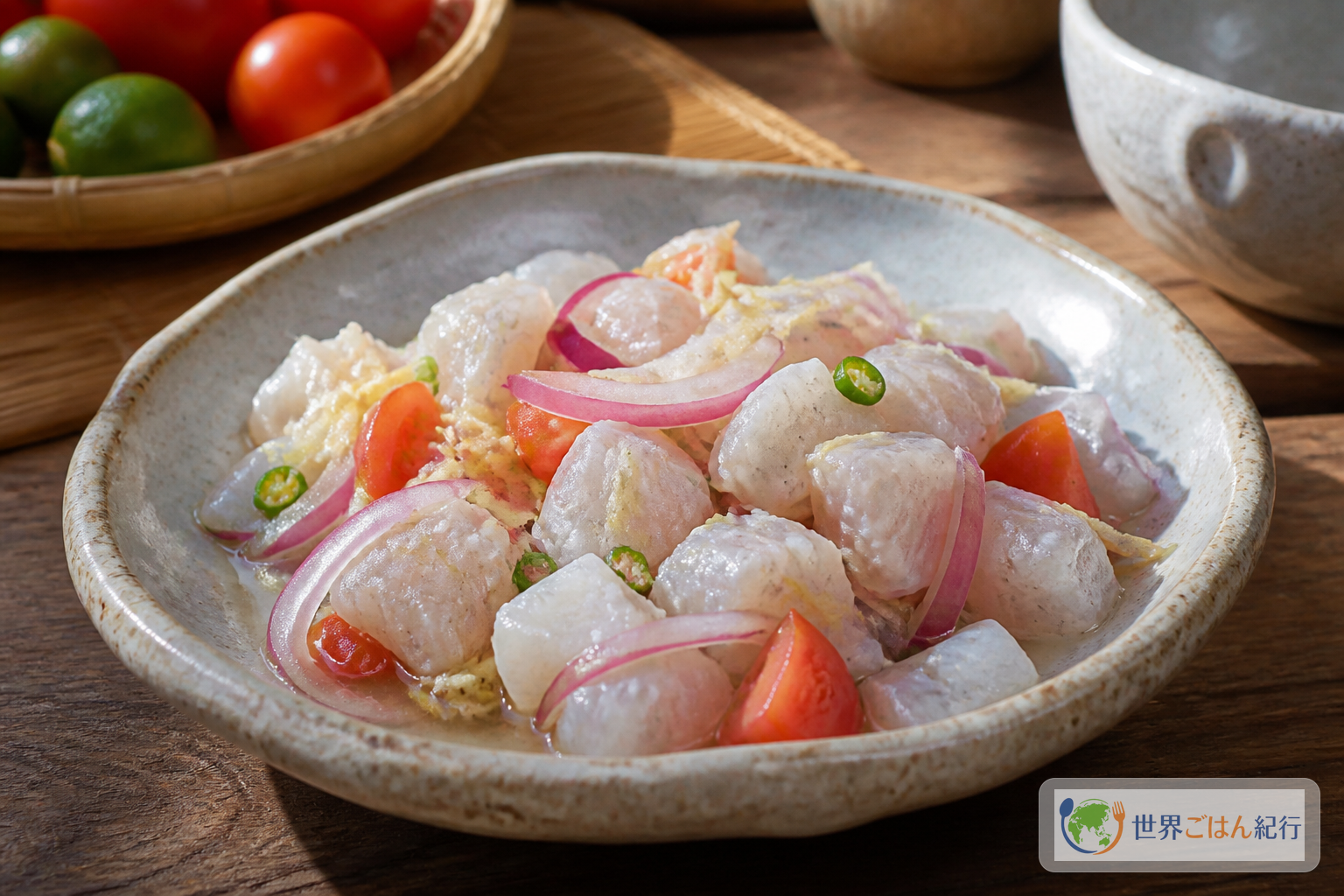
Filipino kinilaw, where vinegar redraws the edges of the fish
The moment the fish goes into the vinegar dressing, the translucent edges of the white flesh turn opaque.
Filipino kinilaw is a no-heat dish: seafood dressed with vinegar or citrus, ginger and onion.
Unlike cooking with heat, the acid only changes the proteins on the surface of the fish. It does not mean the fish is cooked.
The appeal of the dish lies in that cool, springy flesh and the raw texture you still feel when you bite into it.
The Philippines' National Nutrition Council describes kinilaw as a dish loved in the Visayas and Mindanao and eaten at carinderias and street-side eateries.
In regions where sea fish is close at hand, it is a way to eat the day's catch with the day's sourness, and it is less a side dish than a plate where the fish is the star.
Regional differences are clear, too.
In the Waray-speaking provinces of Samar, Leyte and Biliran, fish or vegetables are dressed with calamansi and vinegar, and coconut milk is added.
Around Davao, tuna kinilaw is well known, and on the coast of northern Luzon there is both kinilaw of shellfish in a vinegar dressing and inulam, which is cooked over heat.
What matters at home is not tracking down every Filipino ingredient.
It is keeping fish sold for raw eating cold, not letting it sit long once the acid goes in, and keeping the crunch of the ginger and onion.
Coconut vinegar and calamansi bring the aroma closer to the original, but rice vinegar and lime work perfectly well if you watch the state of the fish.
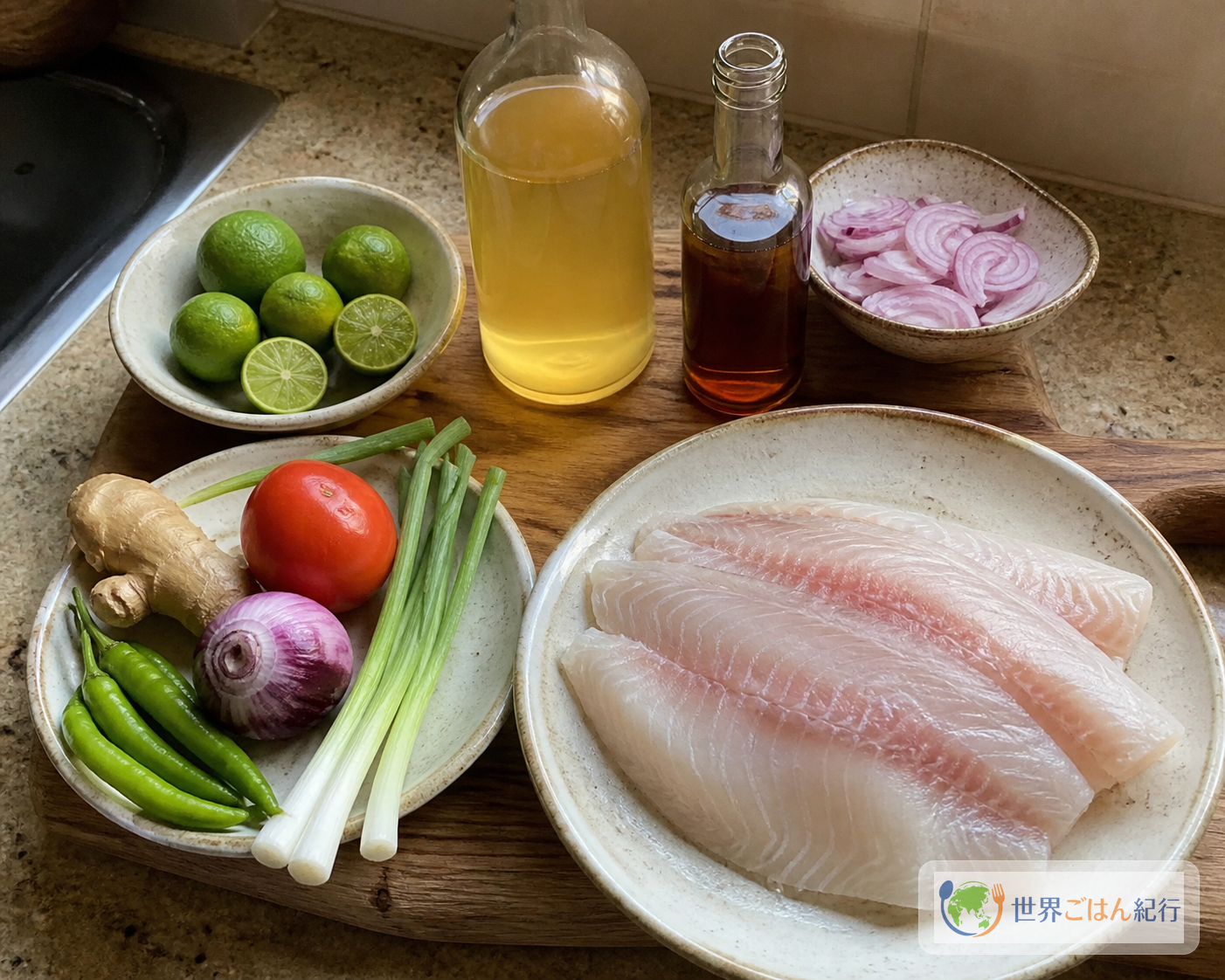
Ingredients (serves 2)
This uses 300 g of white fish, with a generous amount of dressing so it coats every surface.
Rather than rinsing the fish and making it watery, the first decision is to keep it cold until just before cutting and blot its surface dry with paper towels.
Besides the fish, kinilaw needs vinegar, citrus, ginger, onion and fish sauce
Ingredient
Amount
Substitutes & notes
White fish (sashimi-grade)
300 g
Sea bream, sea bass, amberjack and so on. Always confirm it is sold for raw consumption
Coconut vinegar
60 ml
Or 45 ml rice vinegar + 15 ml apple cider vinegar
Lime juice
30 ml
Use the same amount of calamansi if you have it. With other small sour citrus, start at 30 ml and adjust
Red onion
60 g
Sliced 2 mm thick. If very sharp, soak half of it in water for 30 seconds
Ginger
20 g
Peeled and cut into 2 mm matchsticks
Tomato
100 g
1 cm dice. Remove some seeds if there are many
Green chile
1
Sliced into rings. Use half for less heat
Scallions
20 g
Thinly sliced. 10 g cilantro also works
Patis (Filipino fish sauce)
5 ml
Or 1 g salt, or 5 ml Thai fish sauce you already have
Black pepper
0.5 g
A pinch
Ice
200 g
For keeping the fish cold. Never pour water directly on the fish
This dish uses raw fish
Use only fish sold for raw eating (sashimi- or sushi-grade), and keep it refrigerated until just before cutting.
Japan's Ministry of Health, Labour and Welfare notes that vinegar, salt, soy sauce and wasabi do not kill Anisakis parasites. Fish turning white in vinegar or citrus is not a sign that it has become safe.
If the dish is for someone who is pregnant, a child, an older adult or anyone with a weakened immune system, it is safer to skip raw fish and choose the cooked-fish or vegetable variations below.
Keep a separate cutting board, knife and bowl for raw fish, and wash them right after the meal.
Coconut vinegar has softer edges than rice vinegar and keeps a fermented, coconut-derived aroma.
If you are only trying the dish once, the substitutes in the table are plenty. If you plan to cook Filipino food regularly and want a rounder sourness, a bottle of coconut vinegar from a Filipino or Asian grocer, or online, is worth having.
Method: keep the fish cold and don't overdo the acid
The four steps run in this order: cut the fish, combine the aromatics, rest briefly, and serve right away.
Leaving the fish in strong acid for longer does not make it more authentic; watch the time so the center keeps its raw texture.
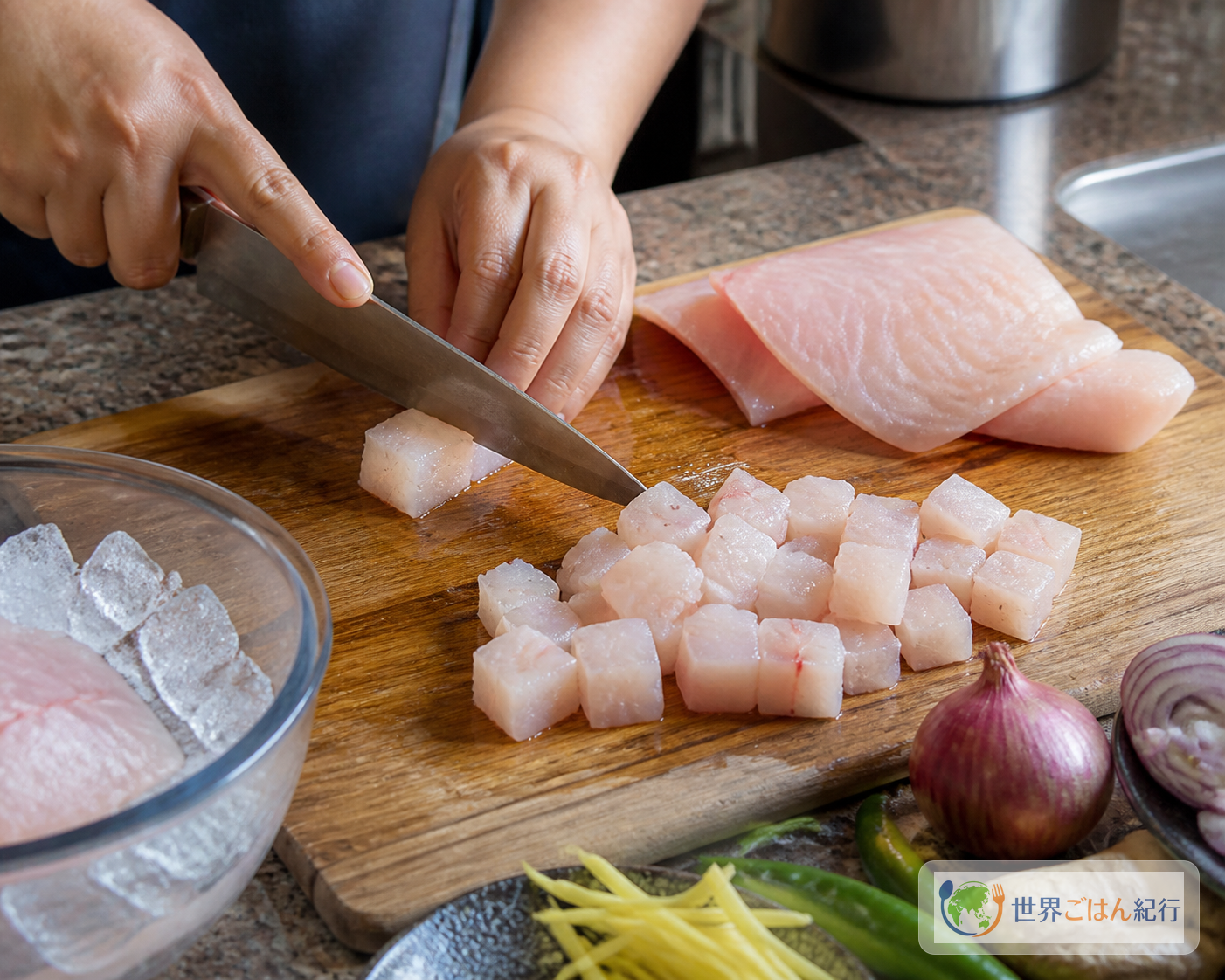
Cut the fish
5 min
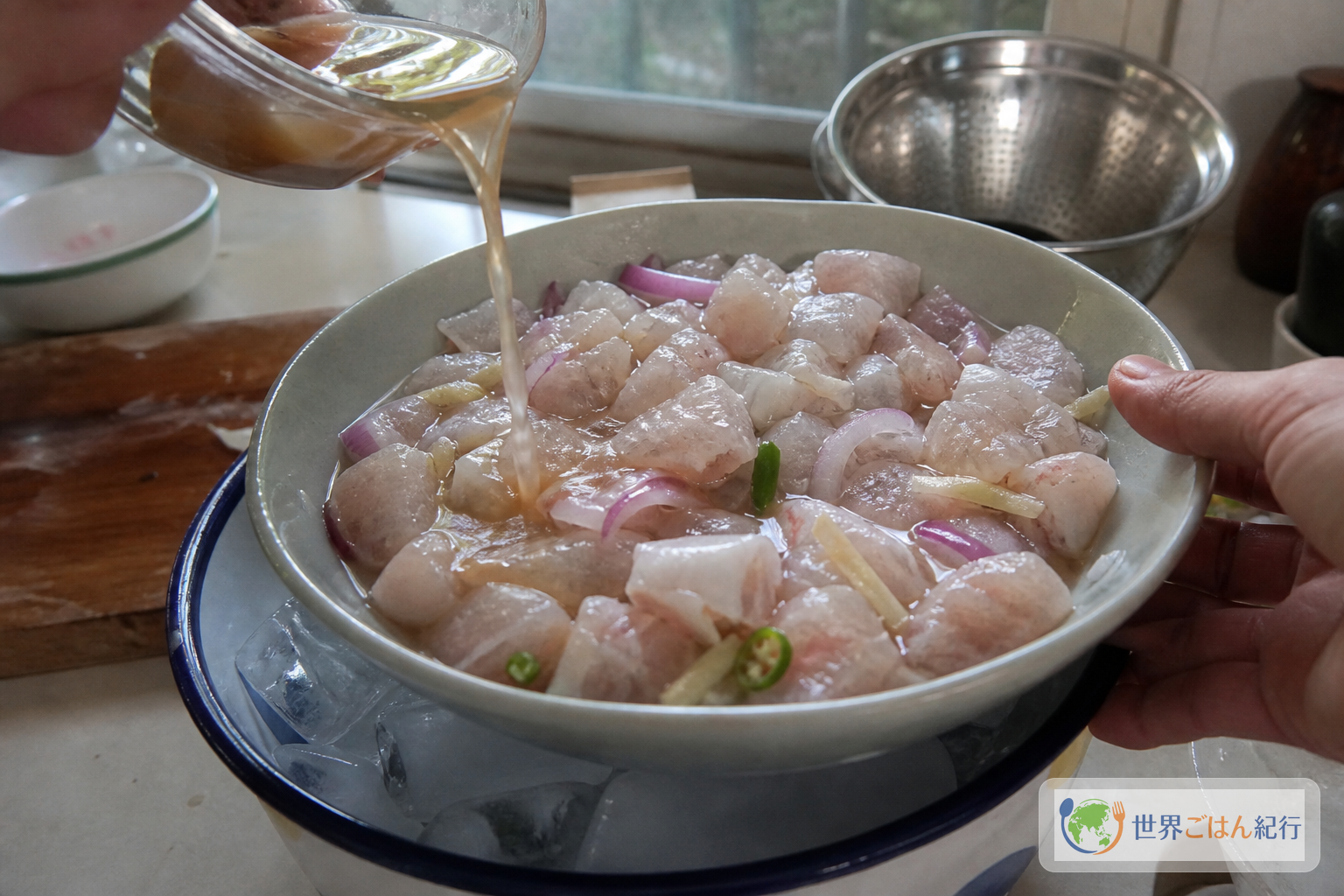
Take the 300 g of white fish out of the fridge and blot off any liquid with paper towels. Remove any skin or dark bloodline and cut into 1.5 cm cubes. Set a bowl over a second bowl filled with ice and keep the cut fish in the top bowl so melting water never touches it. Rinsing the fish under running water washes out flavor and makes it watery, so if anything bothers you, wipe it carefully with paper towels before cutting.
Keep the white fish chilled until the moment you cut it, and cut it into even 1.5 cm cubes
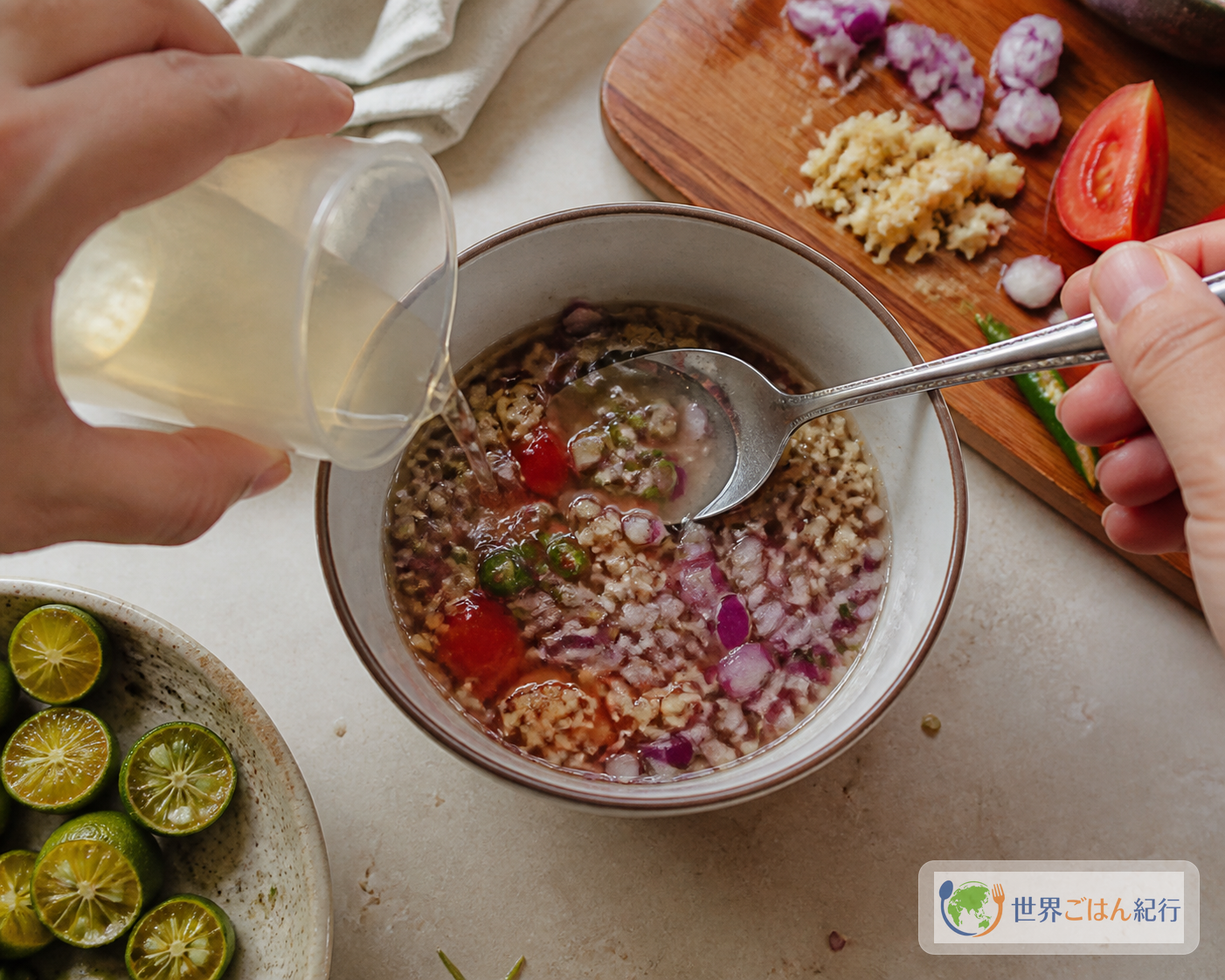
Combine the aromatics and the dressing
5 min
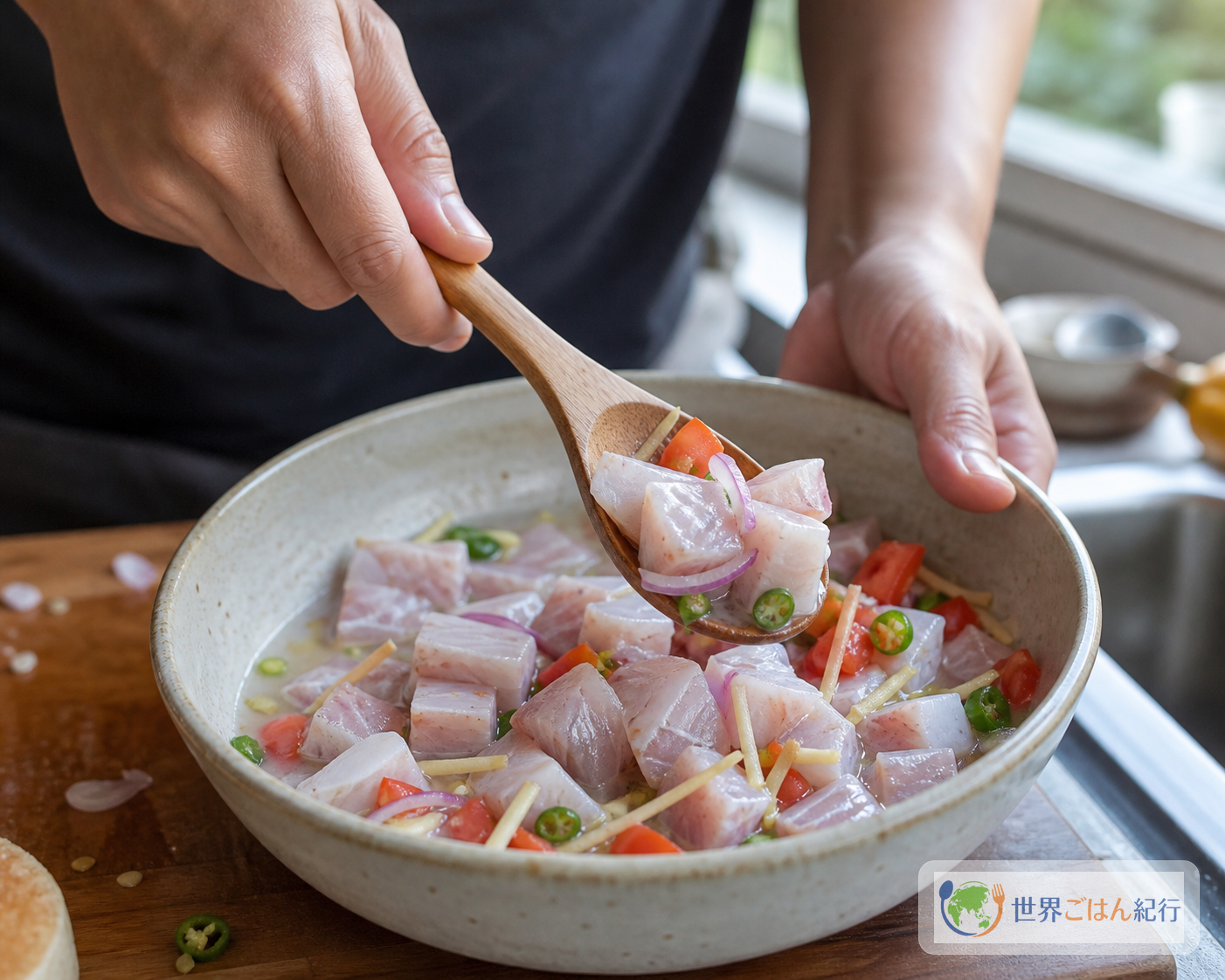
Slice the 60 g red onion 2 mm thick, cut the 20 g ginger into matchsticks, dice the 100 g tomato into 1 cm cubes and slice the green chile into thin rings. In another bowl, mix the 60 ml coconut vinegar, 30 ml lime juice, 5 ml patis and 0.5 g black pepper. Once the liquid is evenly combined, add only the red onion, ginger and chile. Hold the tomato and scallions back until the end so their water doesn't dilute the dressing.
Combine the dressing with the aromatics before it meets the fish so the heat and fragrance settle in
Pour on the dressing and rest in the fridge for 5 minutes
5 min
Pour all of the dressing over the fish, keeping the 1.5 cm cubes from piling up, and turn them over once from the bottom with a clean spoon. Put the whole thing, outer bowl of ice included, in the fridge for 5 minutes. When the corners of the fish have turned white and the center still has a little translucency, move on. If you left it 10 minutes or more and the surface has firmed up, drain off a little liquid and add more tomato to rebalance the sourness and texture.
Keep the dressed fish cold over ice, and check the surface color and the translucency in the center
Add the tomato and scallions, and serve right away
5 min
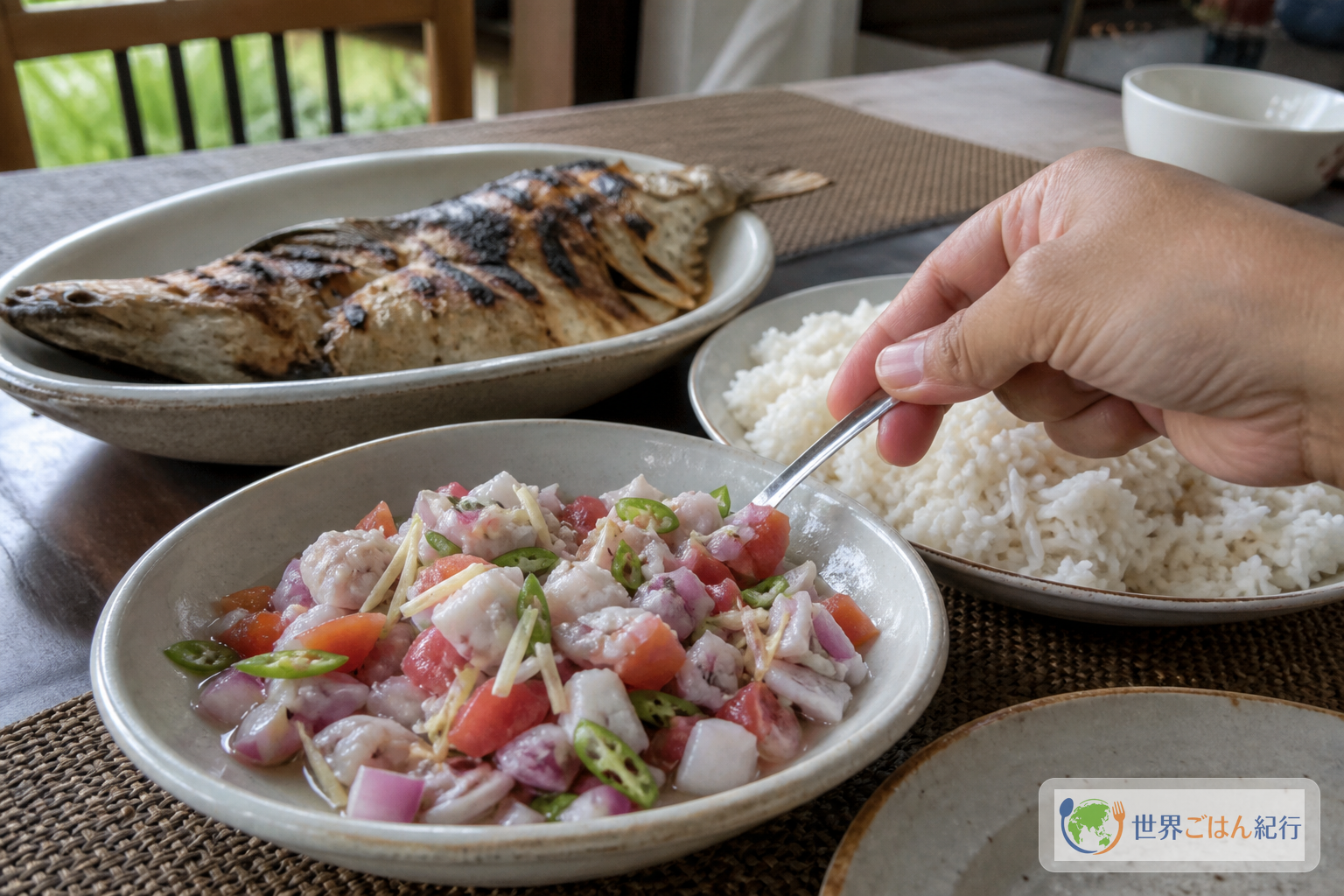
Add the 1 cm diced tomato and the scallions, sliced about 5 mm, and turn everything over from the bottom just twice. If it is too sour, spoon off about 15 ml of liquid and add 20 g more tomato. If it isn't sour enough, add 5 ml more coconut vinegar, tasting it separately first rather than pouring it straight onto the fish. Serve on a chilled plate next to hot rice or grilled fish. Kinilaw made with raw fish is not something to make ahead: once plated, finish it at that meal.
Add the tomato and scallions last and mix as few times as possible so the fish cubes keep their edges
Tips, regional styles and ways to serve kinilaw
If you balance the dish on sourness alone, the aroma of the fish, the bite of the onion and the saltiness of the fish sauce get lost one after another.
To recreate Philippine regional styles at home, decide how long the fish stays cold and how the aromatics are cut before worrying about the type of vinegar.
Kinilaw puts cold fish at the center and sits happily on the same table as hot rice and grilled fish
Reading the vinegar and the fish
Vinegar is not a safety device; it changes flavor and texture
Even when vinegar or citrus turns the surface of the fish white, it is not the same as cooking. Don't use how fast it turns white to judge freshness; prioritize buying fish sold for raw eating and keeping it cold. Acid can't mask off smells or sliminess either, so if the fish smells unpleasant before you cut it, don't use it; throw it away.
Sixty milliliters of coconut vinegar with 30 ml of lime gives a round sourness followed by lingering citrus. Rice vinegar alone tends to taste sharp and linear, so mix 45 ml rice vinegar with 15 ml apple cider vinegar. If you use calamansi, some juices are very aromatic, so start with 25 ml and add more as needed.
Buy Filipino fish sauce, or use what you have?
The recipe uses only 5 ml of patis, so there is no need to buy a big bottle just for kinilaw.
That said, if you also plan to make monggo (in Japanese) or sinigang (in Japanese) and want the fish-sauce aroma consistent across dishes, there is a reason to choose a Filipino brand.
If you are just trying this dish once, replace it with 1 g salt as in the table, or use 5 ml of Thai fish sauce if you already have some.
How the sourness and fish change in Samar and Davao
Waray-style kinilaw dresses fish or vegetables with calamansi and vinegar and adds coconut milk.
The sweet richness of coconut wraps around the sourness. At home, reduce the base dressing to 40 ml coconut vinegar and 20 ml lime, and add 40 ml coconut milk.
Stir it in after the fish has had its 5 minutes in the acid, and the white flesh keeps a coating of coconut flavor.
Adding coconut milk does not change the safety of raw fish, so handle the fish exactly as in the base recipe.
Articles introducing Davao's food culture feature tuna kinilaw as part of the coastal table.
With fattier tuna, keep the same 300 g but start the lime juice at 25 ml and increase the ginger to 25 g so its aroma isn't buried by the fat.
For mild sea bream or sea bass, on the other hand, don't add extra watery red onion or tomato, and go easy on the acid to keep the sweetness of the fish.
Variations for the table
Coconut milk version: The branch toward Waray flavors. Add 40 ml and serve cold.
Tuna version: The fish choice mentioned in Davao's food features. Use sashimi-grade red tuna and add 5 g more ginger.
Cooked shellfish version: If you can't get shellfish fit for raw eating, cook the shellfish until they open, cool them, then dress them. This leans toward inulam, the heat-cooked dish described in northern Luzon.
Vegetable version: To avoid raw fish, dress 120 g cucumber and 100 g tomato with the same dressing. It is a way to enjoy kinilaw's aromatics, not a claim to the same safety profile as the raw-fish dish.
If you want to crush the ginger and green chile finely into the dressing, a mortar and pestle gives a smoother aroma.
Simply cutting them into matchsticks with a knife is enough, so a mortar is only worth buying if you regularly make sambal or other pounded condiments.
FAQ
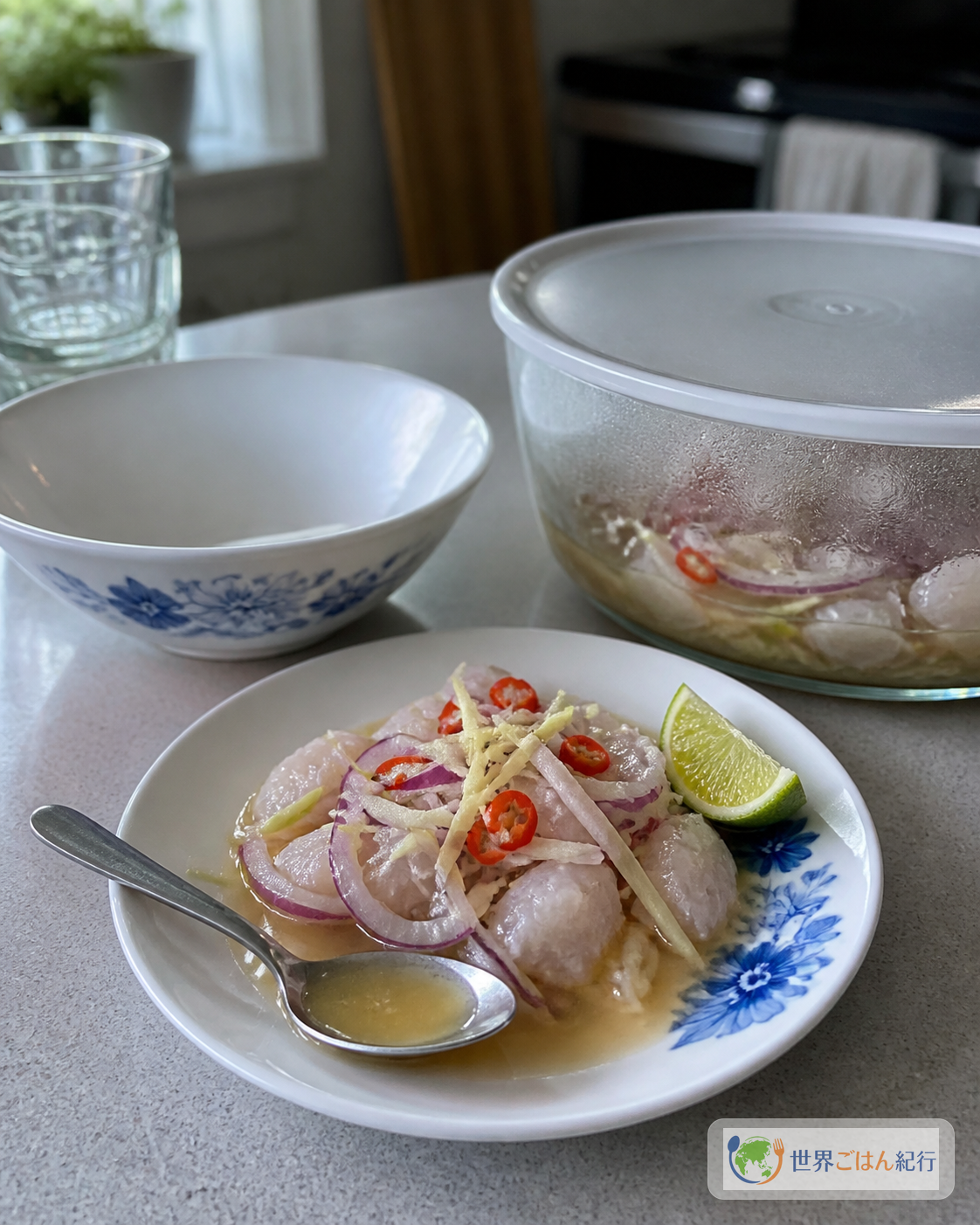
Kinilaw is kept cold and finished at the meal it is served
Does soaking raw fish in vinegar make it safe?
No.
Japan's Ministry of Health, Labour and Welfare warns that eating fish infected with Anisakis raw or undercooked can cause food poisoning, and that vinegar, salt, soy sauce and wasabi do not kill the parasite.
Kinilaw uses fish sold for raw eating, handled with proper temperature control and hygiene, and the sourness is there to be enjoyed as flavor.
If you have any doubt about how the fish has been handled, cook the fish to about 70°C (158°F), cool it and then dress it, or switch to the vegetable version.
Which fish is easiest to use?
Choose fish you can confirm is for raw consumption at the time of purchase, such as sashimi-grade sea bream, sea bass, amberjack or tuna.
More than the species, prioritize the raw-eating label, keeping it cold after purchase, and little liquid in the package.
Don't substitute freshwater fish without a raw-eating label or fish sold for cooking.
Can I make it with just rice vinegar if I don't have coconut vinegar?
Yes.
Mix 45 ml rice vinegar with 15 ml apple cider vinegar and combine with 30 ml lime juice.
Using 90 ml of rice vinegar alone tends to taste very sharp, so another option is to start with 60 ml rice vinegar and 25 ml lime on the fish, then adjust after 5 minutes.
How do I fix it if it gets too sour?
Remove about 15 ml of the dressing, add 20 g tomato, and turn it over just twice so the fish doesn't break up.
Adding water to dilute the sourness makes the flavor flat, so adjust with the moisture from vegetables instead.
If it is still too sharp, switch to the coconut milk version and round it out with 40 ml.
Can I eat leftover kinilaw the next day?
Don't save it for the next day.
Before plating, keep it cold only briefly over the ice bowl or in the fridge, and finish what is served at that meal.
Rather than carrying leftover raw fish into another dish, dress only as much as you will eat from the start; that makes things simpler for both hygiene and flavor.