Poisson Cru: Cold Tuna, Sharp Lime and Round Coconut Milk
The tuna is never cooked. Lime juice and salted water do not make it safe, even if the fish changes color. Use only fish labeled for raw eating and keep it cold. Anyone who is pregnant, young children, older adults and people with weakened immune systems should avoid raw or undercooked seafood.
In French Polynesia, this bowl of fish is not kept for one time of day. Tahiti Tourisme describes people eating poisson cru at lunch and dinner, and notes that some eat it even before breakfast. It also appears as a starter, a main dish or a light meal, at restaurants and on feast tables.
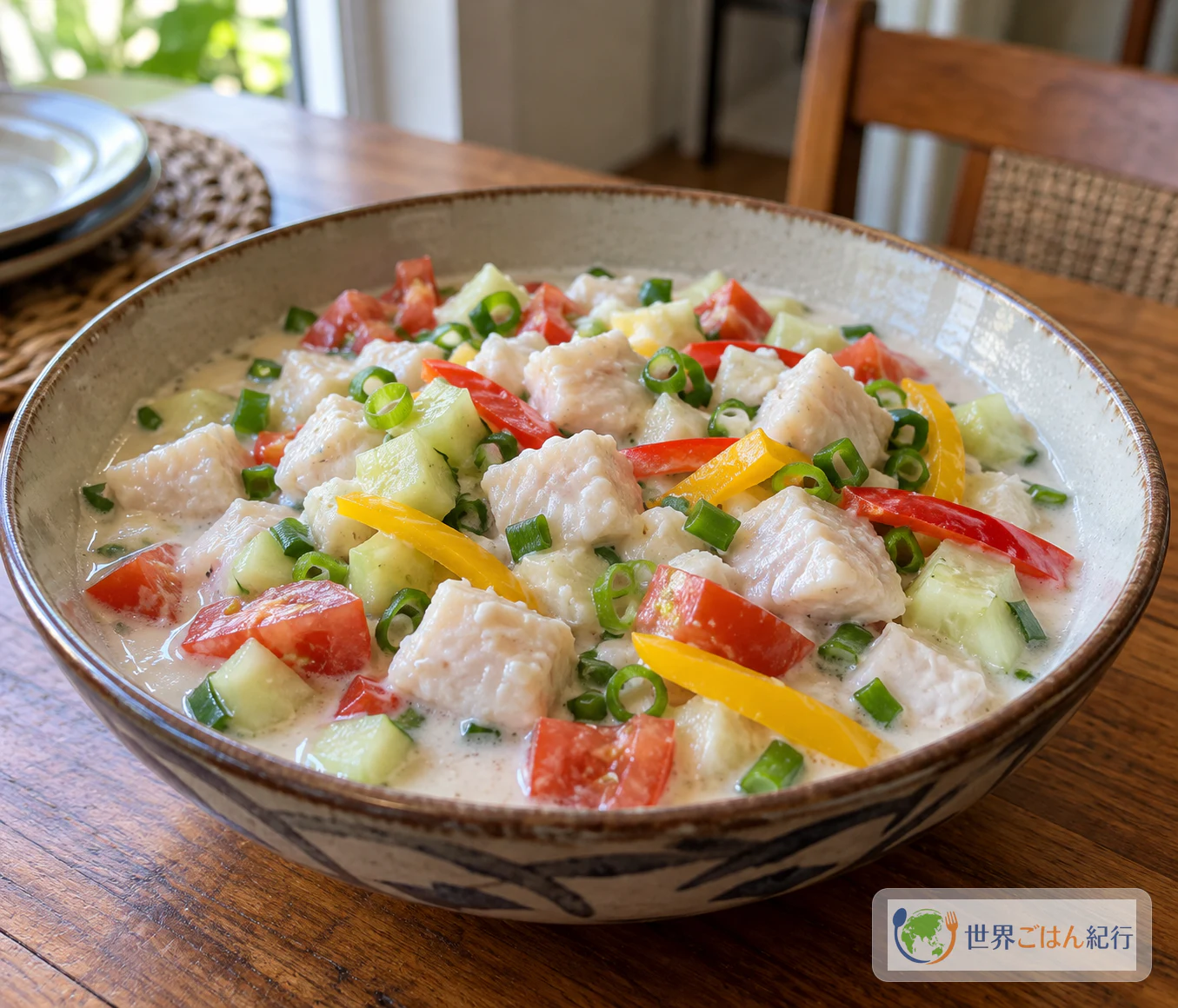
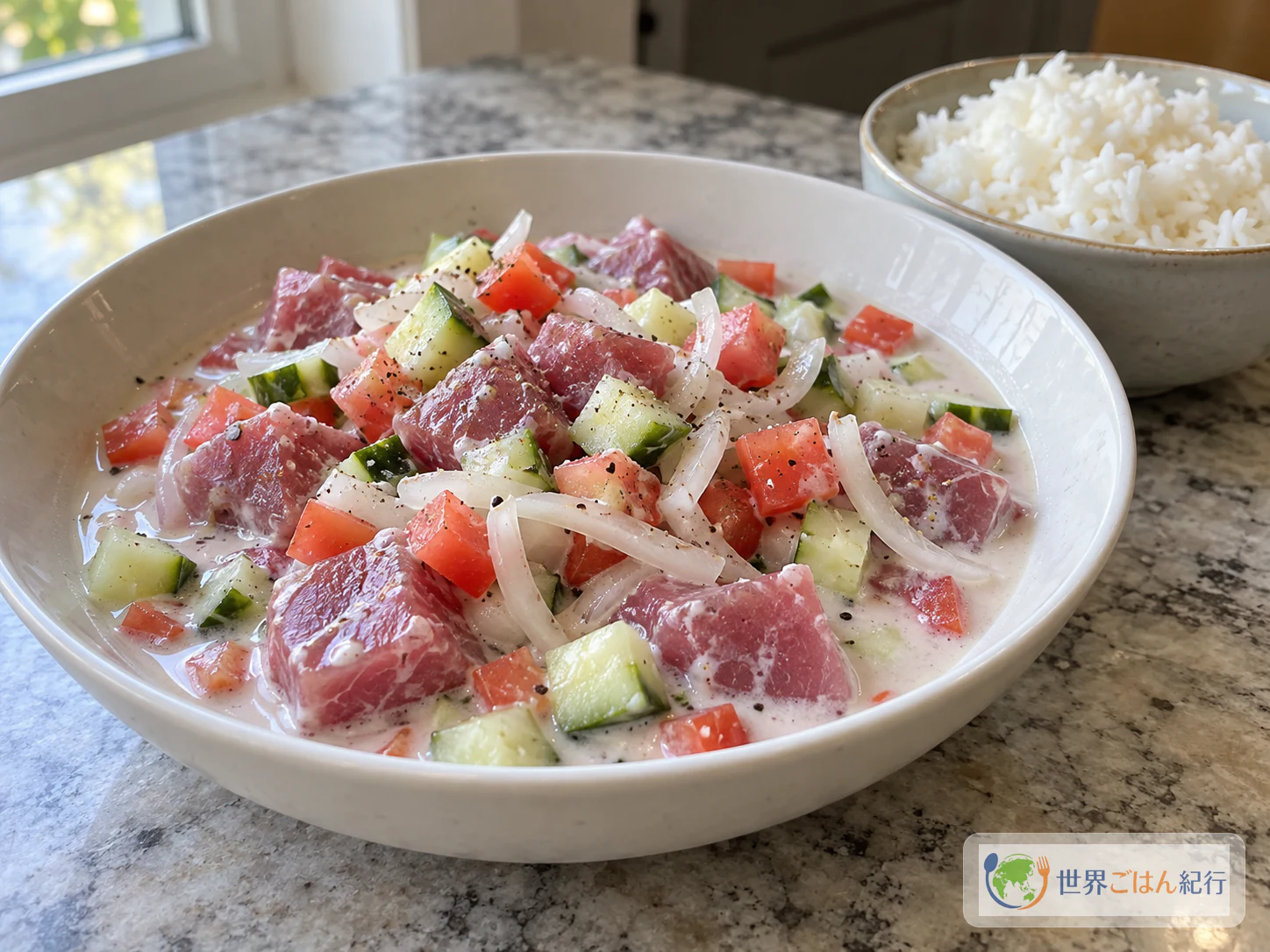
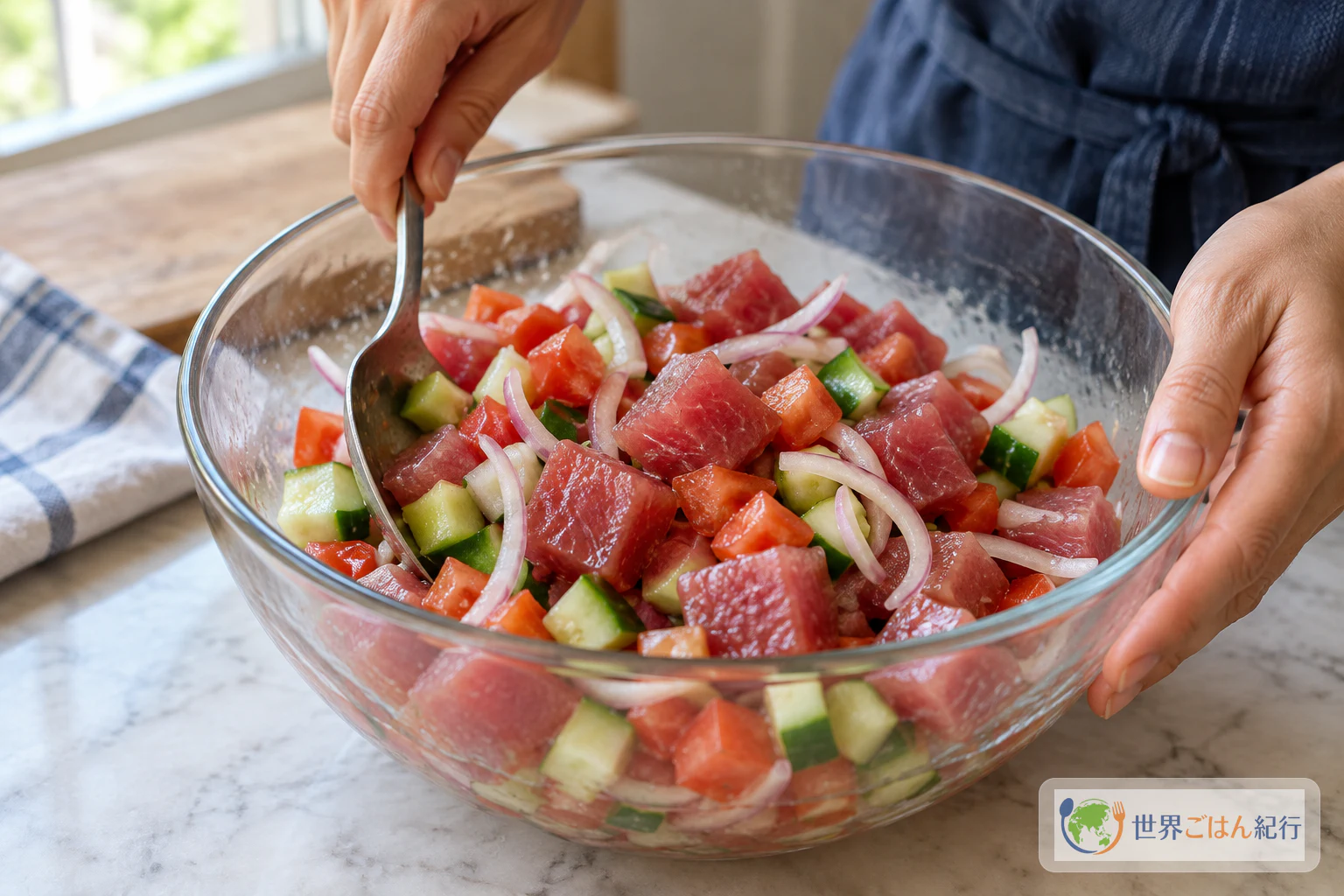
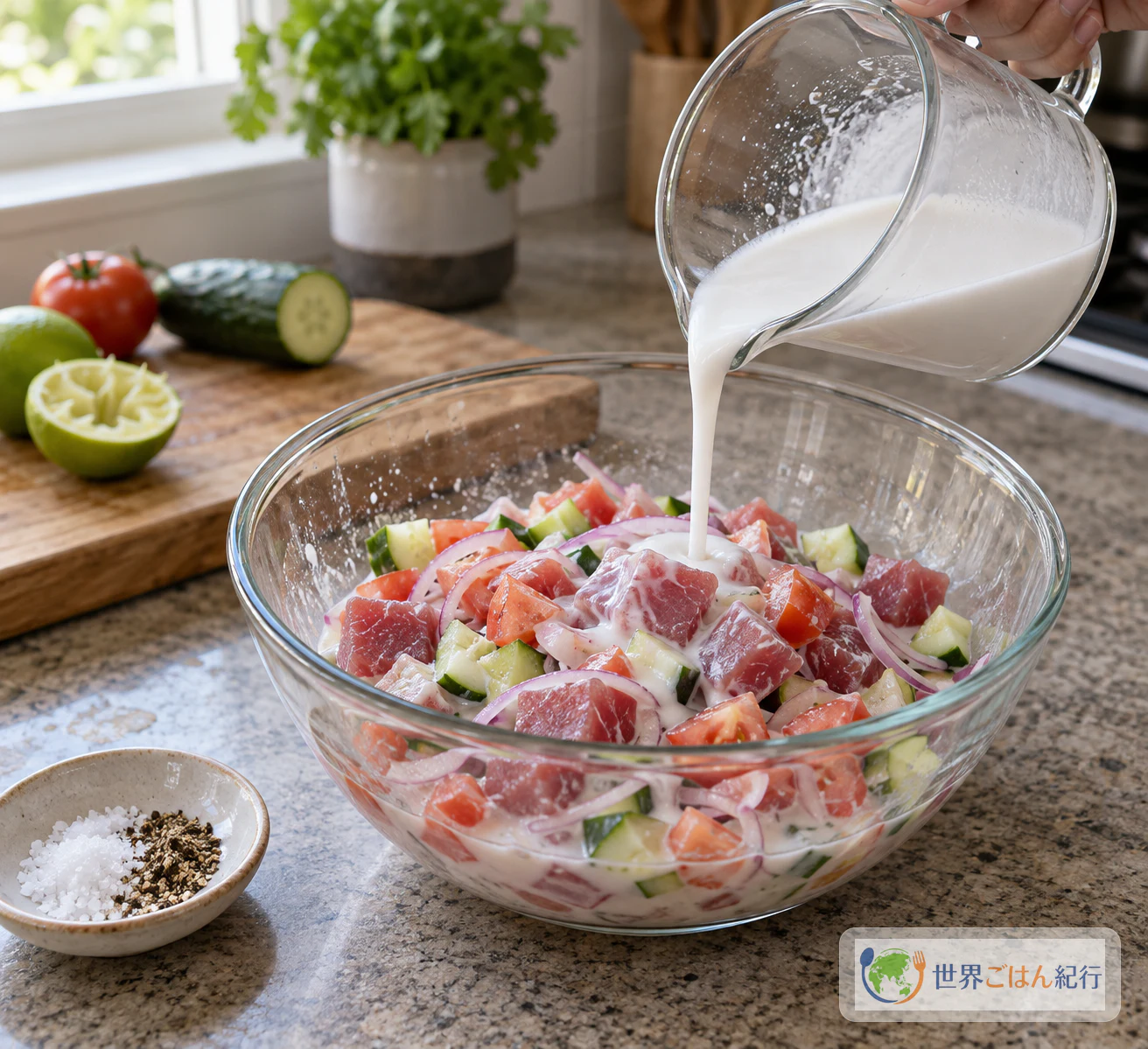
Poisson cru au lait de coco means raw fish with coconut milk, and Tahiti Tourisme also gives the name i'a ota ha'ari. The bowl is built from red tuna, lime, coconut milk, tomato, cucumber and onion. The coconut milk is a dressing here, not a liquid for cooking the fish.
This article follows one recipe from Tahiti Tourisme, which serves six and lists 30 minutes of preparation. The page does not give the size of the fish pieces, the strength of the salted water, the amount of salt and pepper, or the chilling time, and those details are not filled in with numbers here. The yield is the page's stated figure, not a measured count of plates. It is a tourism board's home recipe, not the only traditional formula. We have not kitchen-tested this recipe.
The first decision comes before any knife work: whether you can get suitable fish and whether everyone at the table should eat it raw. Fiji's kokoda is a close Pacific relative, but it is a separate dish from a different place. For more from these islands, visit our French Polynesia page.
Ingredients: Serves 6
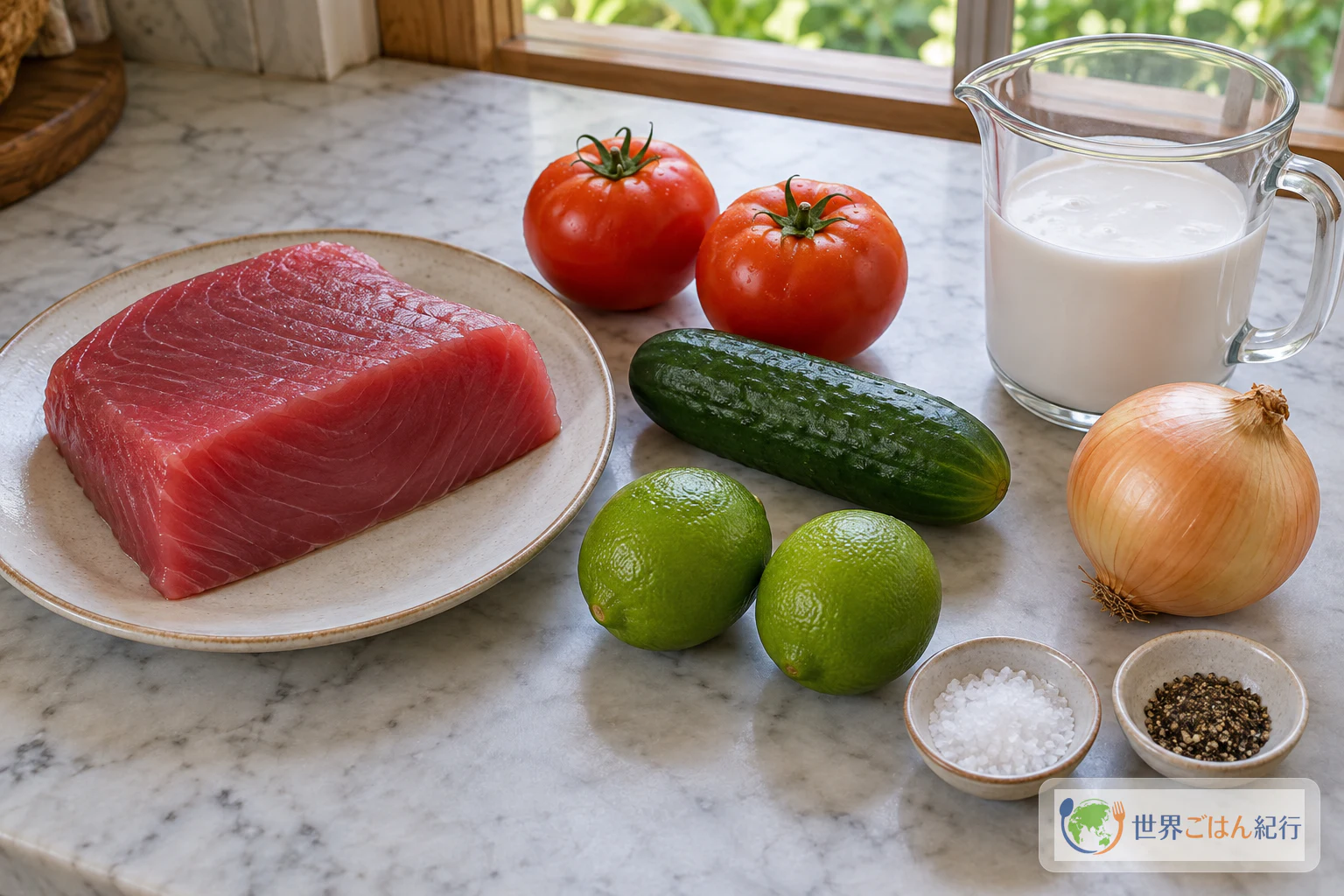
Use only red tuna labeled "for raw eating" or "sashimi" that the seller also confirms is meant to be eaten raw. Do not use fish sold for cooking, or offcuts of unclear purpose. This dish contains fish and coconut, so check the labels if anyone at the table has an allergy.
Equipment
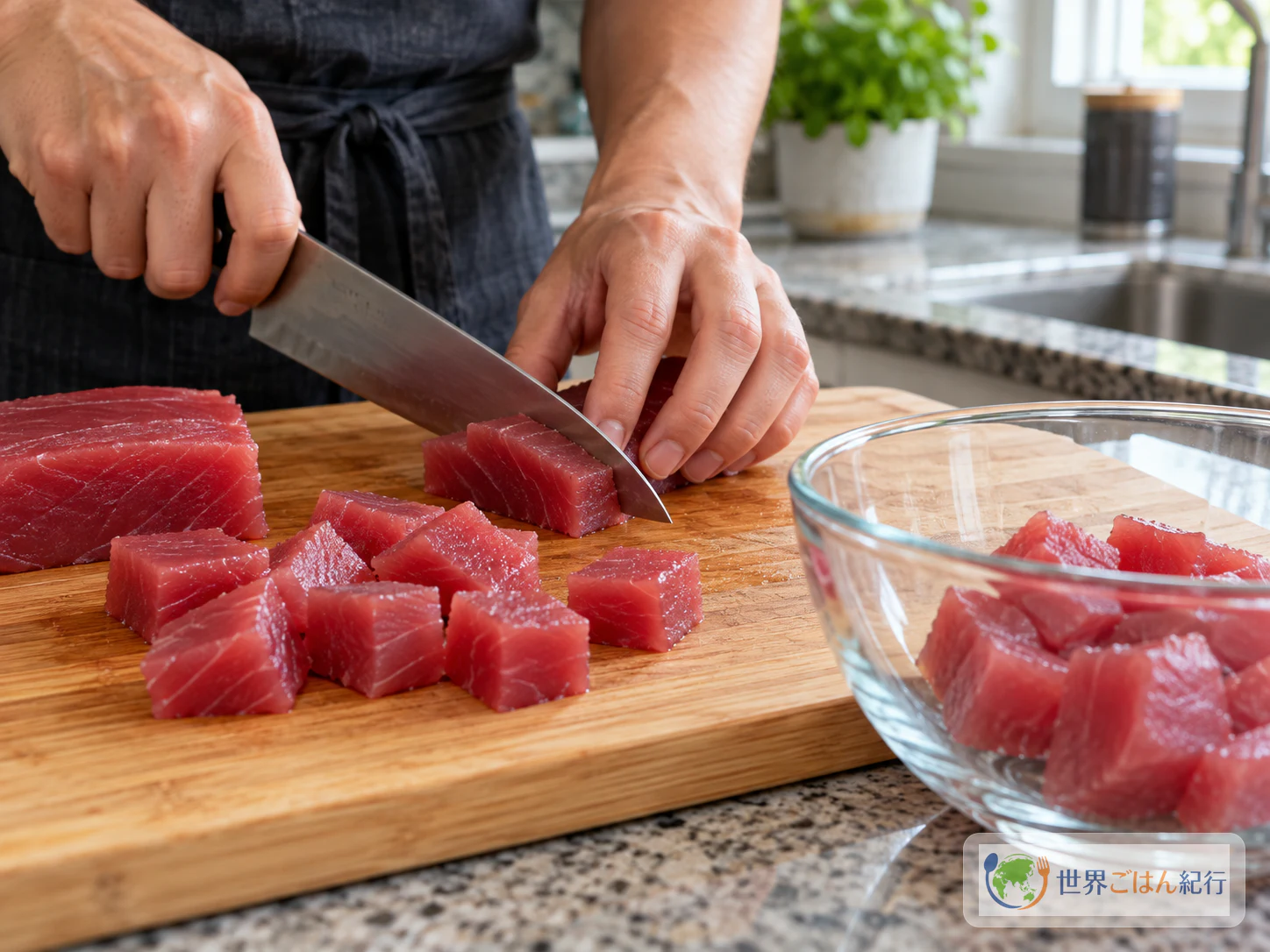
- Cutting board and knife used only for the raw fish
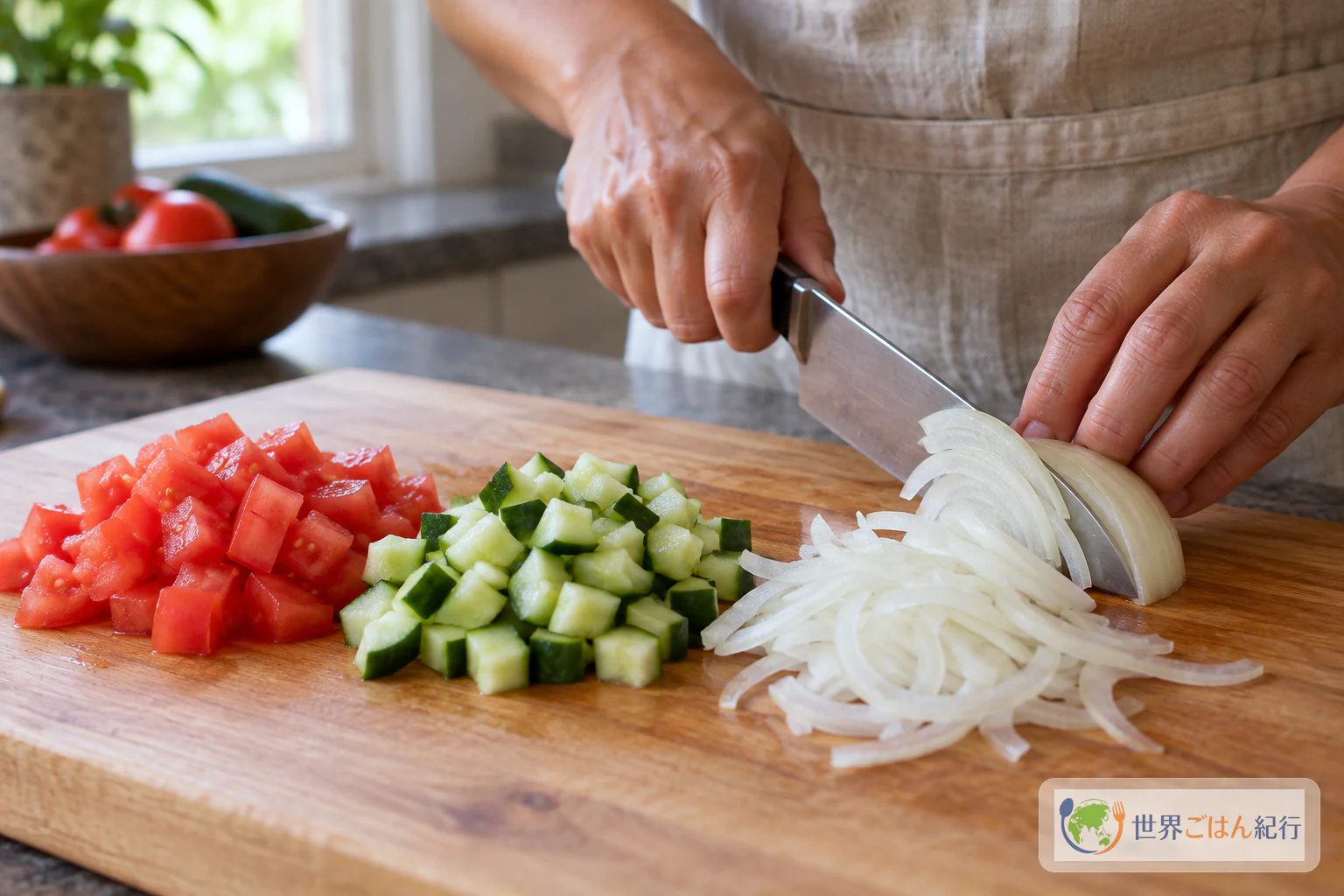
- A separate clean cutting board and knife for the vegetables
- Clean bowl for the raw fish, large enough to mix everything
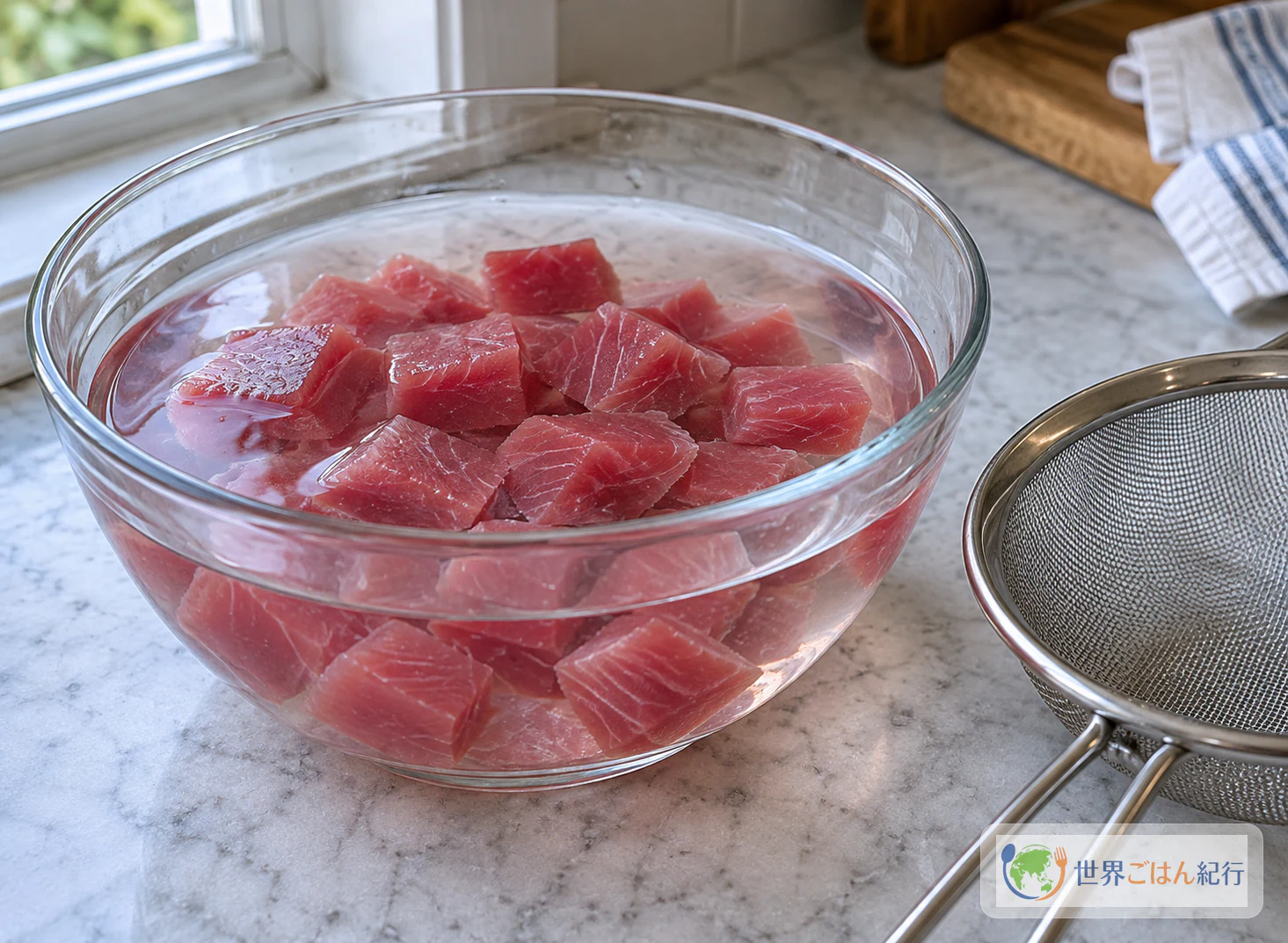
- Bowl for the salted water
- Fine strainer for draining the fish
Choosing the Fish, Coconut Milk and Limes
Fish. The label and the seller's advice decide this, not the look of the fish. Labeling differs from country to country, so ask if the wording is unclear. If you are still unsure about eating it raw, cook it thoroughly and make the separate dish described in the safety section below.
Coconut milk. Choose plain, unsweetened coconut milk in a can or carton, and avoid sweetened or flavored coconut drinks. Thickness varies by product, and it changes both the taste and how the dressing clings to the fish.
Limes. Lemon can stand in if you cannot find limes, but the acidity and aroma will be different.
Cucumber. If small cucumbers are hard to find, an ordinary cucumber from your local store is a practical swap.
Onion. If your onion is very sharp, you can rinse the slices in water as an optional adjustment.
Method: Keep the Fish Cold and Combine It Gently
Put each batch of raw fish back in the refrigerator whenever it is not being worked on, and keep the finished bowl cold until it reaches the table.
Lime Acidity and Raw-Fish Safety Are Separate Questions
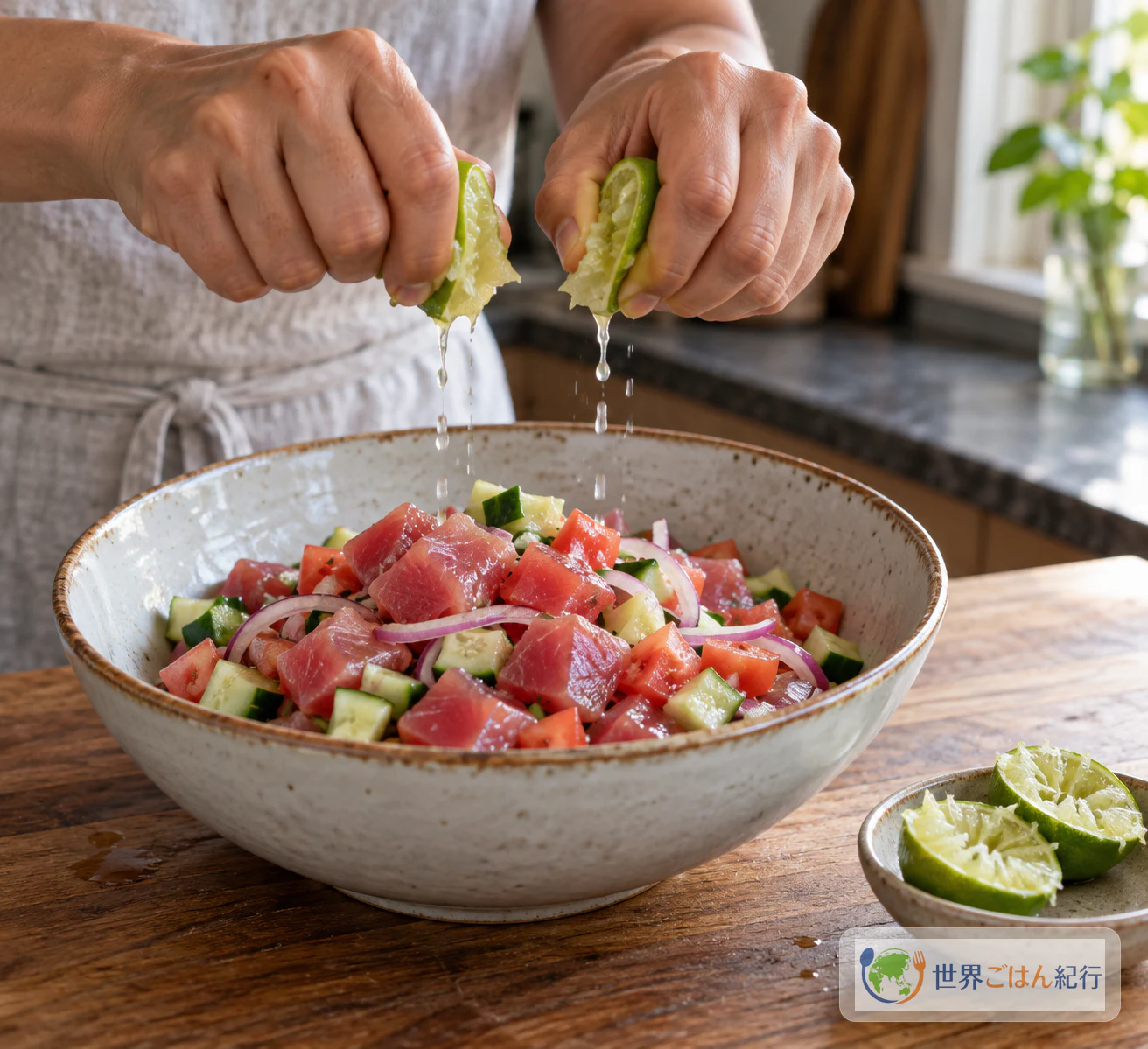
The change lime brings to fish is about texture and appearance. It is not the same as parasite control or cooking.
Parasites. Japan's Ministry of Health, Labour and Welfare (MHLW) notes that anisakis can occur in seafood, including tuna. It says ordinary vinegar treatment, salting, soy sauce and wasabi do not kill the larvae. Lime juice and salted water should be treated the same way: they do not kill them either.
Freezing. For food businesses, MHLW lists freezing at -20°C for at least 24 hours. That does not mean a home freezer can achieve the same result, so this article gives no home freezing instructions. The U.S. Food and Drug Administration (FDA) says freezing kills parasites but not all harmful germs, and its page gives no freezing temperature or time.
What to do at home. Buy fish labeled for raw eating, and look for larvae by eye and remove any you see. MHLW's household advice also covers choosing fresh fish, gutting whole fish soon after buying, and not eating the guts raw.
Keeping it cold. Refrigerate the fish as soon as you get it home. The FDA says seafood to be used within 2 days of purchase should be stored in a clean refrigerator at 40°F (about 4°C) or below. Keep the fish cold until just before use, chill the mixed dish right away, and finish it at that meal.
Keeping things separate. The FDA advises keeping germs from raw fish away from cooked and ready-to-eat foods. Use separate boards, knives and bowls for raw fish, wash your hands with soap and warm water for at least 20 seconds, and wash tools with soap and hot water.
Who should avoid the raw version
The FDA says people who are pregnant, children, older adults and people with weakened immune systems should avoid raw or undercooked seafood. This includes babies and young children.
For them, make a separate plate of poisson cru-style fish. Cook the fish thoroughly, cool it, and combine it with the same vegetables, lime and coconut milk. As a heating reference, MHLW's condition for food businesses is 70°C or higher, or 1 minute at 60°C. This cooked plate is an editorial suggestion with a different texture, not the Tahitian raw-fish dish and not a local variation.
Troubleshooting
| What happened | What to look at | What to do |
|---|---|---|
| The fish turned pale after the lime went in | Color says nothing about safety | Keep following the same cold handling and do not treat the fish as cooked |
| You are unsure the fish can be eaten raw | The label and the seller's advice | Do not serve it raw. Cook it thoroughly for the separate cooked plate |
| The tuna pieces broke up | Mixing too hard | Stop stirring and fold gently from now on |
| The flavor seems flat | Salt and pepper | Add a little at a time and taste between additions |
| The dish tastes sweet | Sweetened coconut drink | Next time use plain, unsweetened coconut milk |
| The onion is too sharp | A strong onion | Next time rinse the slices in water as an optional step |
| There is some left over | This dish is not for keeping | Serve smaller batches at the table from the cold bowl, and do not plan on leftovers for later |
Tuna and Beyond: Variations
Tahiti Tourisme names several changes to the basic bowl. No amounts are given for these, so add extras in small quantities and taste.
| Variation | What changes | Note |
|---|---|---|
| Other fish | Mahi-mahi or barracuda in place of tuna | Check with the seller that the fish is suitable for raw eating |
| Grated ginger | A small amount added | No amount is fixed; add a little at a time |
| Chili | Added to your taste | Adjust the heat to suit the table |
| Plated version | Fish sliced thinly and arranged on a plate, coconut milk poured over, vegetables placed around it | Same idea, different presentation |
| Poisson cru à la chinoise | Rice vinegar, carrot, tomato, cucumber, onion and ginger, sometimes with sugar | A separate version, not mixed into this recipe |
For comparison, a recipe published by Hawaiian Electric uses 2 pounds of fresh marlin, Japanese seedless cucumber, cherry tomatoes, white onion, green onions, 3 limes and 2 cans (13.5 oz) of coconut milk for 8 servings. It shows how far the dish can travel, but it is not an authority on Tahiti or proof of the dish's history, and its amounts are not used here.
With Rice, and at the Tahitian Table
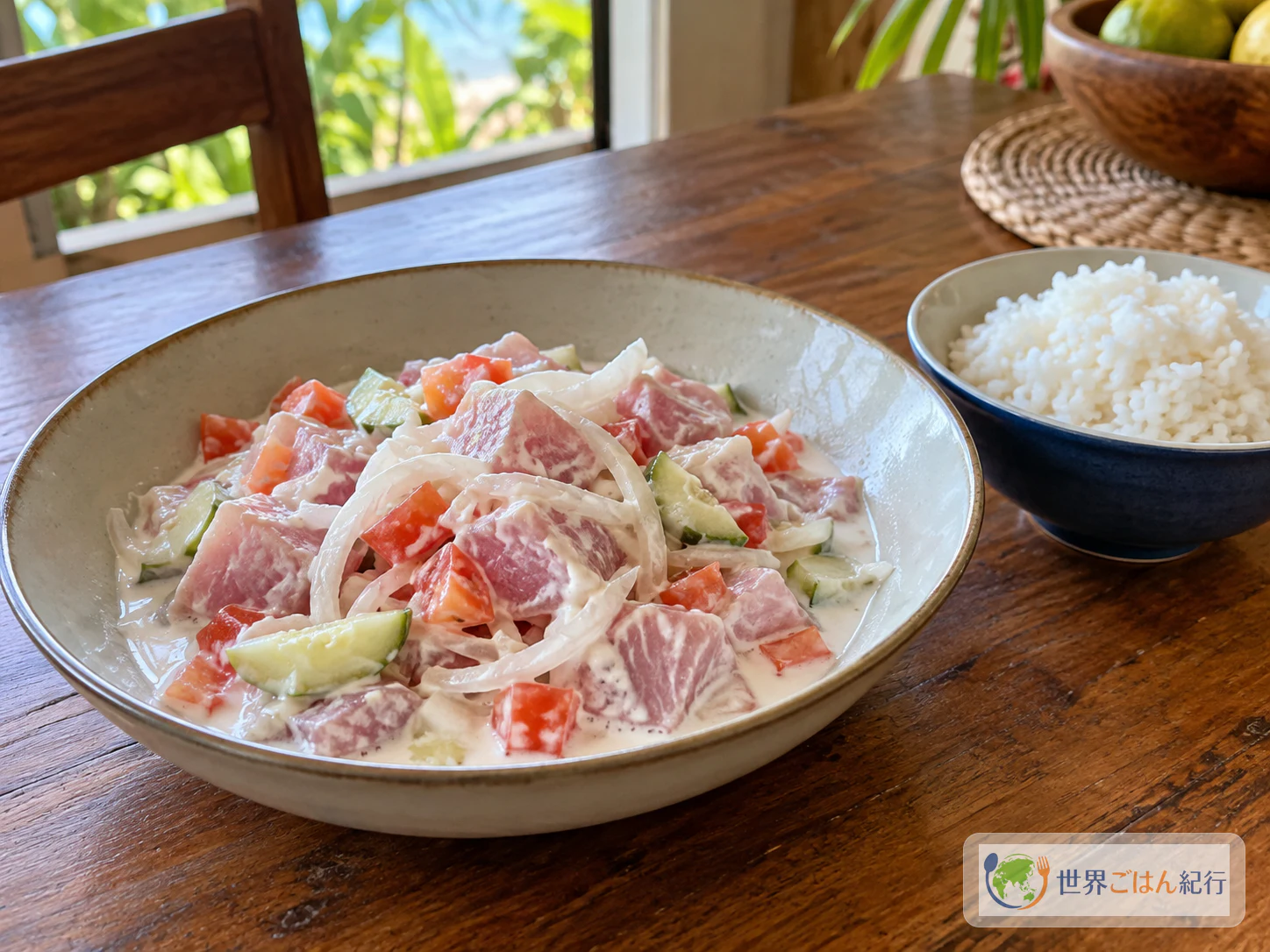
Tahiti Tourisme's recipe serves poisson cru with rice, and also mentions taro, cassava and breadfruit as accompaniments.
Its pages show several settings for the dish. It is widely served in restaurants as a light meal, starter or main dish. At a tama'ara'a, or feast, it may come out before the dishes from the ahima'a. The same pages also describe Sunday ma'a Tahiti meals and roulottes, the food trucks where locals and visitors eat side by side. These are tourism descriptions, not statistics, and no single scene is the one traditional way to eat it.
When and how the dish took shape, and how coconut and lime came into it, could not be confirmed from the sources used here, so this article tells no origin story.
Frequently Asked Questions
Is poisson cru the same as Fijian kokoda?
No. They are related Pacific dishes that share fish, citrus and coconut, but the country, name and recipes differ. This article covers the Tahitian version only.
If the lime turns the fish white, is it safe?
No. The change from acid is not the same as parasite control or cooking. Lime juice does not kill anisakis larvae.
Can I make it with fish other than tuna?
Tahiti Tourisme also mentions mahi-mahi and barracuda. Whichever fish you choose, the raw-eating label and the seller's advice come first. Never use fish sold for cooking in a raw dish.
Which coconut milk should I use?
The Tahiti Tourisme recipe does not name a type or thickness. Plain, unsweetened coconut milk is an editorial suggestion to keep the dish savory. Thicker or thinner products will change the taste and coating.
How long should I chill it?
The recipe says only to chill it a little and gives no time, so none is added here. Keep the bowl in the refrigerator after mixing and serve it cold right away.
Should the lime go in before the coconut milk?
The recipe describes the lime, coconut milk and seasoning together in one sequence, so there is no strict rule to follow. The steps above add the lime first simply for clarity.
What should I serve with it?
Rice is the basic choice. Tahiti Tourisme also mentions taro, cassava and breadfruit.
How long does it keep?
Do not make it ahead or keep it. Eat it cold right after chilling, and do not leave it at room temperature.
Sources
- Tahiti Tourisme, "Cooking raw fish with coconut milk." Recipe for six with ingredient amounts, the 5-minute salted-water soak, method and listed preparation time; when the dish is eaten; variations and accompaniments. https://www.tahititourisme.nz/cooking-raw-fish-with-coconut-milk/
- Tahiti Tourisme, "Traditional Polynesian and Tahitian Food Specialties." The name i'a ota ha'ari; the dish in restaurants, at roulottes and at tama'ara'a feasts. https://www.tahititourisme.nz/discover/tahitian-culture/polynesian-cuisine/
- Hawaiian Electric, The Electric Kitchen, "Tahitian Poisson Cru." A separate recipe used only as a comparison of ingredients and amounts. https://www.hawaiianelectric.com/recipes/find-a-recipe/tahitian-poisson-cru
- Ministry of Health, Labour and Welfare, Japan, "アニサキスによる食中毒を予防しましょう" (Preventing food poisoning from anisakis). Anisakis in seafood including tuna; treatments that do not kill the larvae; freezing and heating conditions for food businesses; household prevention. https://www.mhlw.go.jp/stf/seisakunitsuite/bunya/0000042953.html
- U.S. Food and Drug Administration, "Selecting and Serving Fresh and Frozen Seafood Safely." Refrigeration, preventing cross-contamination, handwashing and tool washing, the limits of freezing, and who should avoid raw or undercooked seafood. https://www.fda.gov/food/buy-store-serve-safe-food/selecting-and-serving-fresh-and-frozen-seafood-safely