Fresh Fish Salad with Coconut Milk: Cold Tuna, Bright Lime, White Coconut
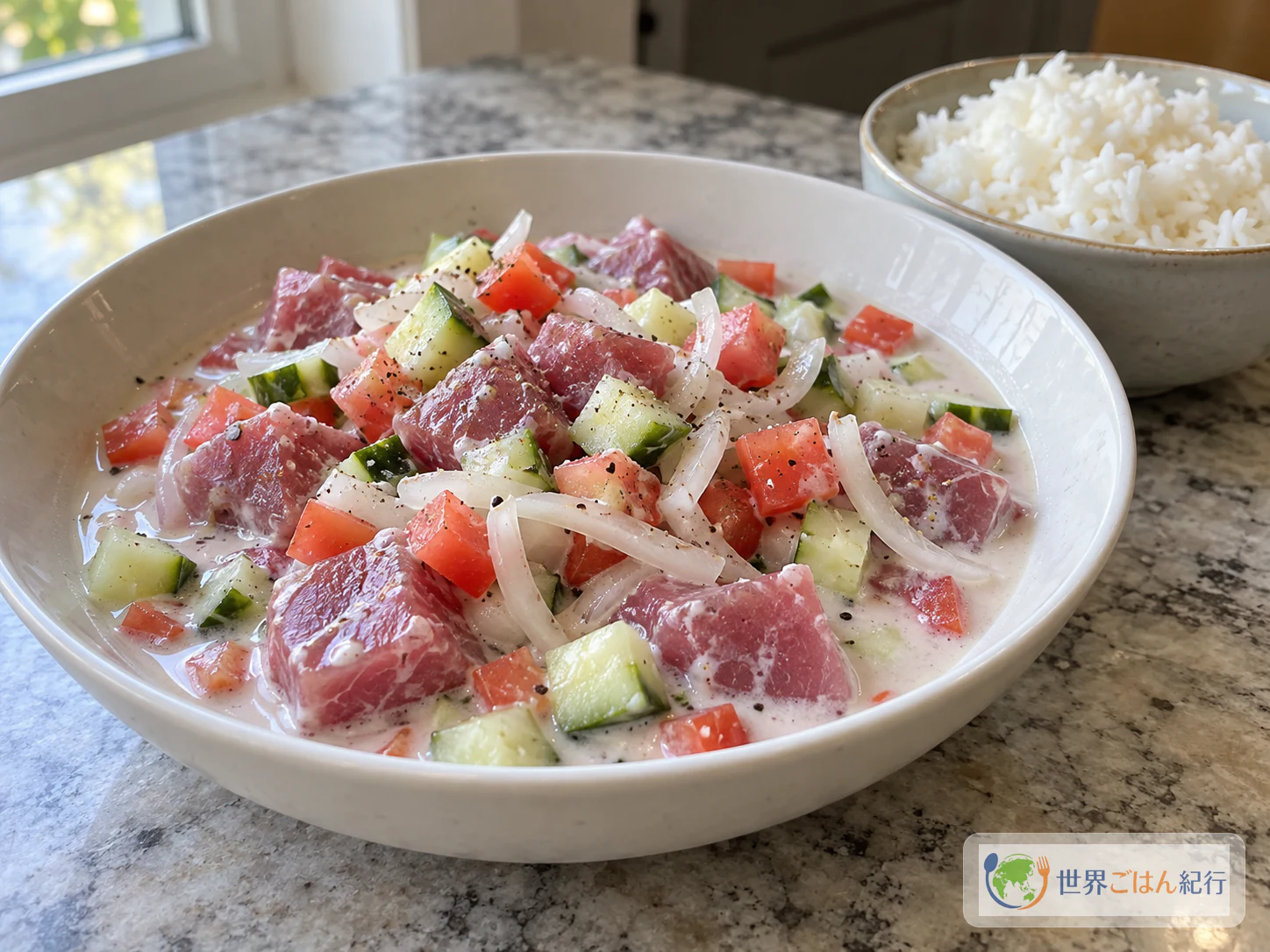
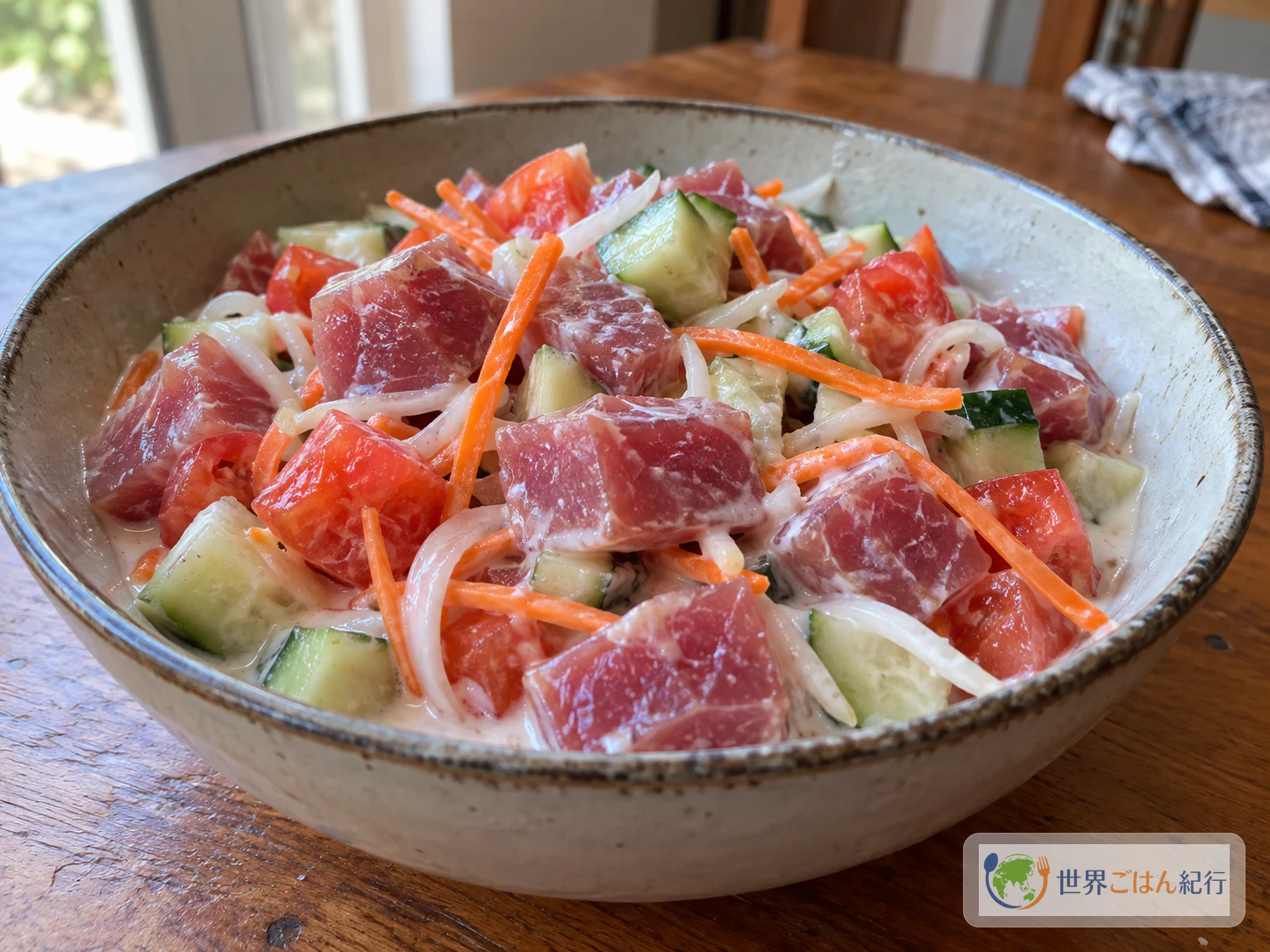
Deep red cubes of tuna that still taste of the fish, crisp vegetables, a sharp edge of lime and a soft white coat of coconut milk. Lime and coconut go in only at the very end, just before the salad reaches the table.
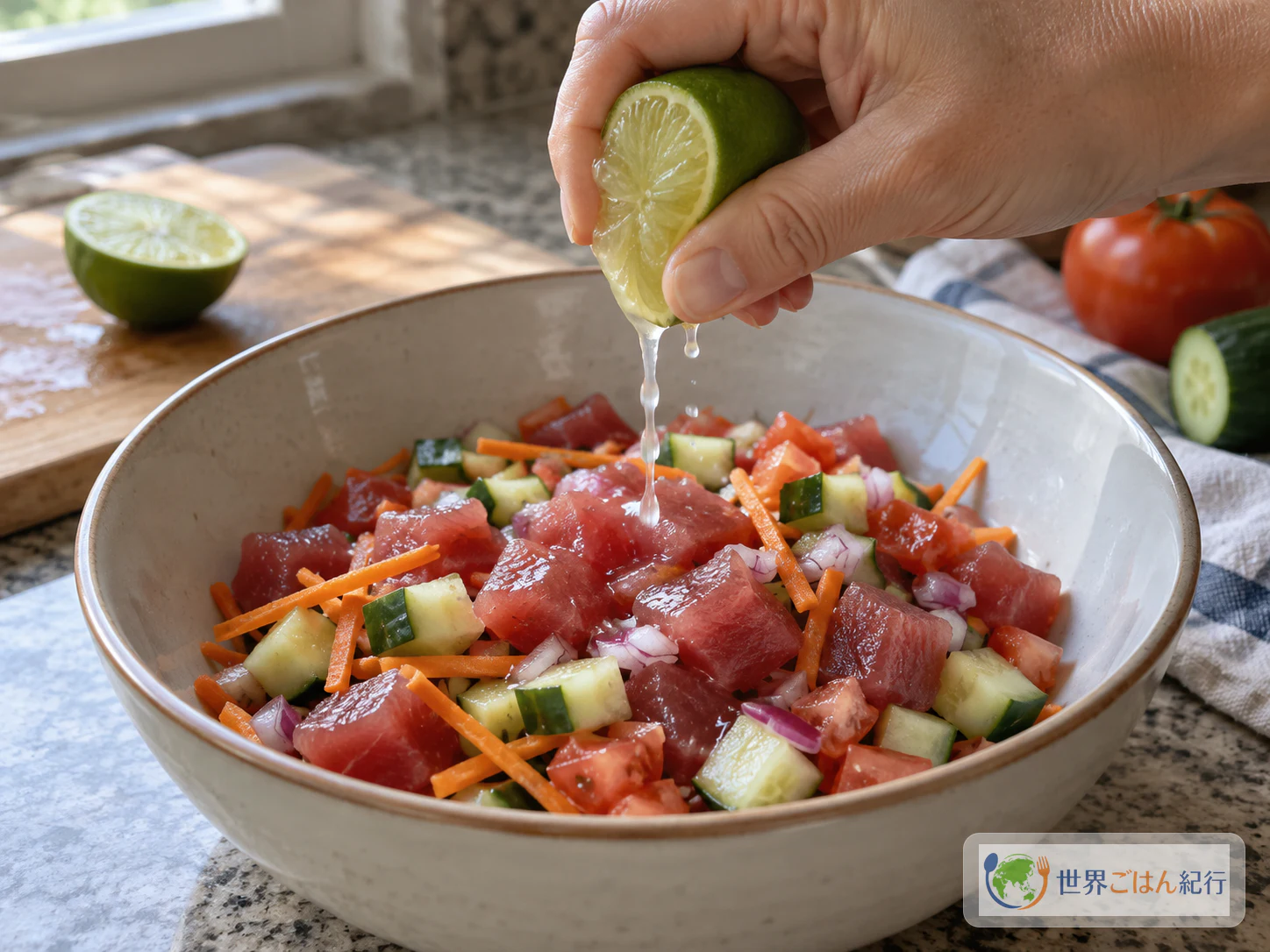
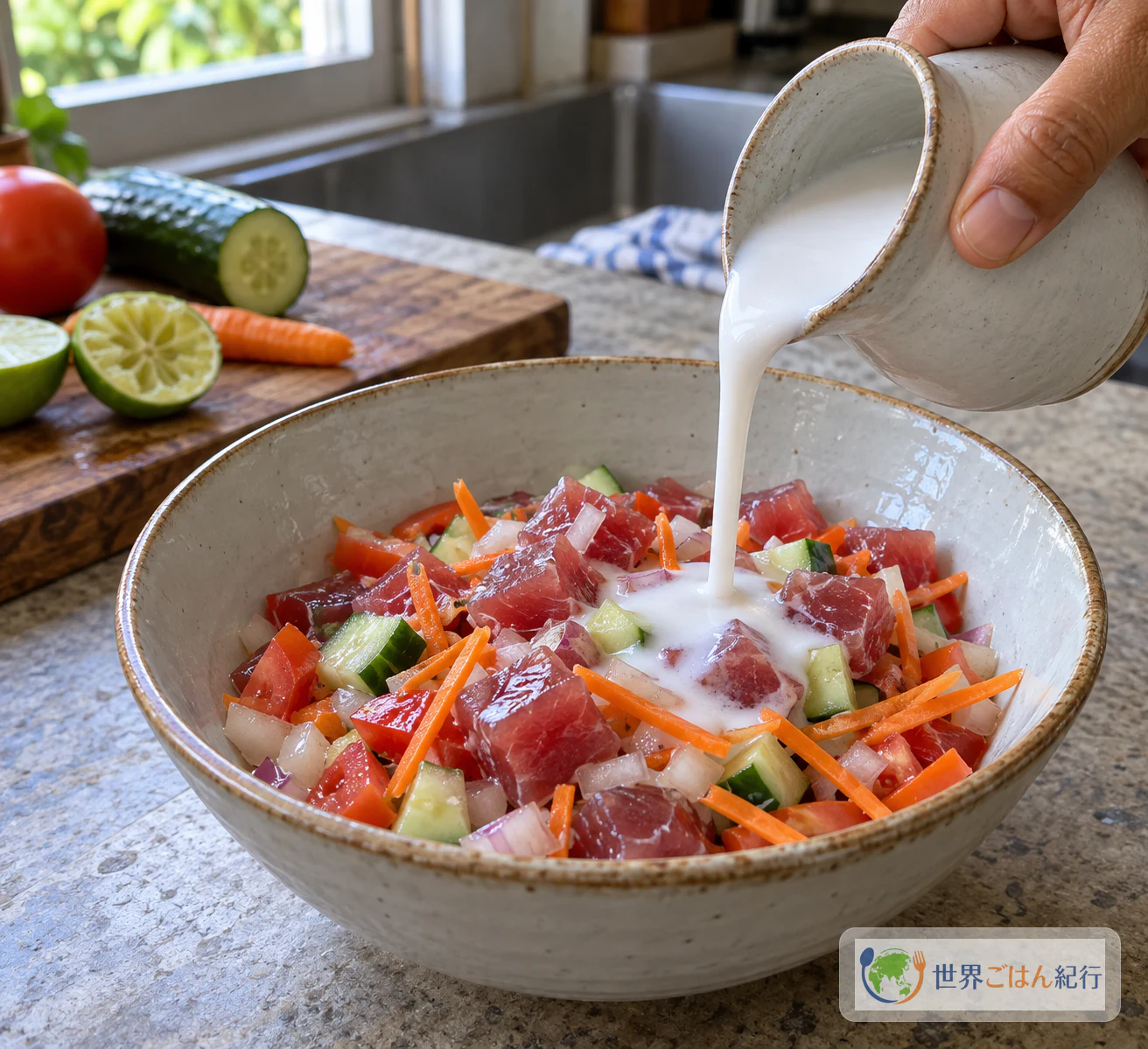
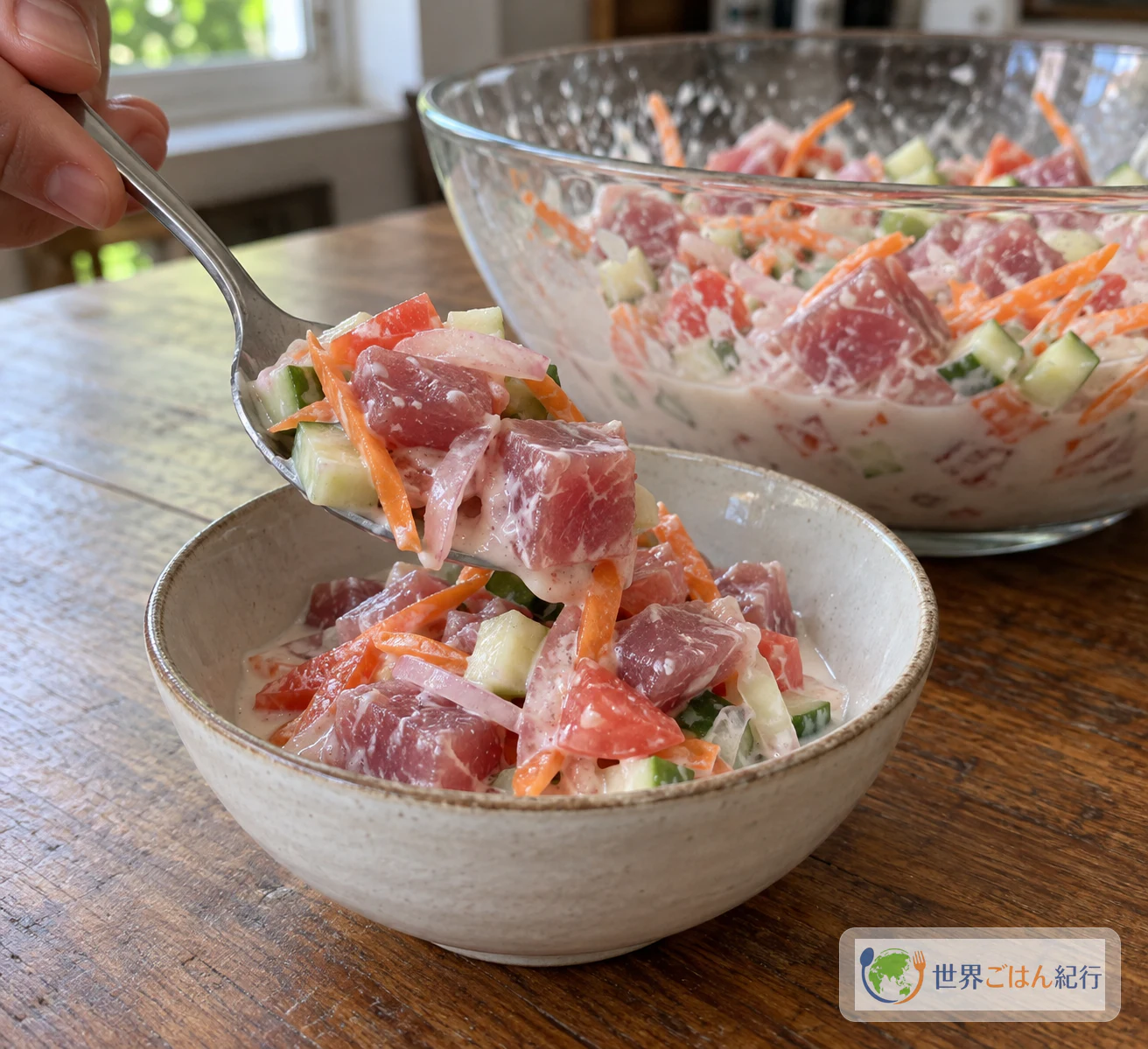
Cubes of raw tuna sit in a bowl with diced tomato, cucumber, finely cut onion and thin strips of carrot. Just before serving, lime juice is squeezed over the top and plain coconut milk is poured in, turning everything a pale, glossy white. The result is cool, tart and gently rich, with the vegetables still snapping between bites of fish.
The tourism office of Wallis and Futuna describes fresh fish salad as a popular dish on the islands, and names raw marinated fish salad with coconut milk as a local speciality. It also notes, plainly, that each family has its own recipe. So what follows is not "the" recipe of the islands, but one way to bring this cold, ocean-bright salad into a home kitchen far from the Pacific.
Fish and Coconut at the Heart of the Islands' Table
In Wallis and Futuna, fish and coconut are among the most prominent ingredients in local cooking, according to the territory's official tourism pages. The fish salad with coconut milk brings the two together in their simplest form: fish from the sea, milk from the coconut, and whatever vegetables and citrus are at hand.
The same tourism office explains that island cuisine draws on influences from other Pacific islands, including French Polynesia. One well-known variation it describes combines coconut milk with diced tomatoes, cucumber, carrot, onion and lime. That list is close to what goes into this bowl, and the carrot in particular comes from it. Because recipes vary from household to household, it is more useful to think of the dish as a shape (raw fish, crisp vegetables, citrus, coconut) than as a fixed formula.
Wallis and Futuna is its own territory, not part of French Polynesia, even though the two share French as a language of daily life and influence each other's cooking. That exchange is part of why a recipe from Tahiti can serve as a practical guide here without being mistaken for a Wallisian original.
One Pacific Family: Kokoda, Poisson Cru and This Salad
Across the Pacific, fish dressed with citrus and coconut appears under several regional names. The Pacific Community's recipe collection Pasifika Plates groups these together and describes how the texture and the way the fish is marinated vary between places such as Tahiti, New Caledonia and Fiji. Fiji's kokoda is one well-known member of this family; French Polynesia's poisson cru au lait de coco is another.
The fish salad of Wallis and Futuna clearly belongs to the same family, and there is no need to invent a separate origin for it. What makes it worth its own page is the local context: a dish the islands' own tourism office highlights, with family-to-family differences and a vegetable mix that includes carrot.
One practical difference is worth noticing. Some versions in this family let the fish rest in citrus for a while to change its texture. The Tahitian recipe used as the guide here does the opposite: citrus and coconut milk are added just before serving, so the tuna stays close to raw in color and texture. This recipe follows that last-minute approach.
Ingredients: Raw Tuna, Crisp Vegetables, Lime and Unsweetened Coconut Milk
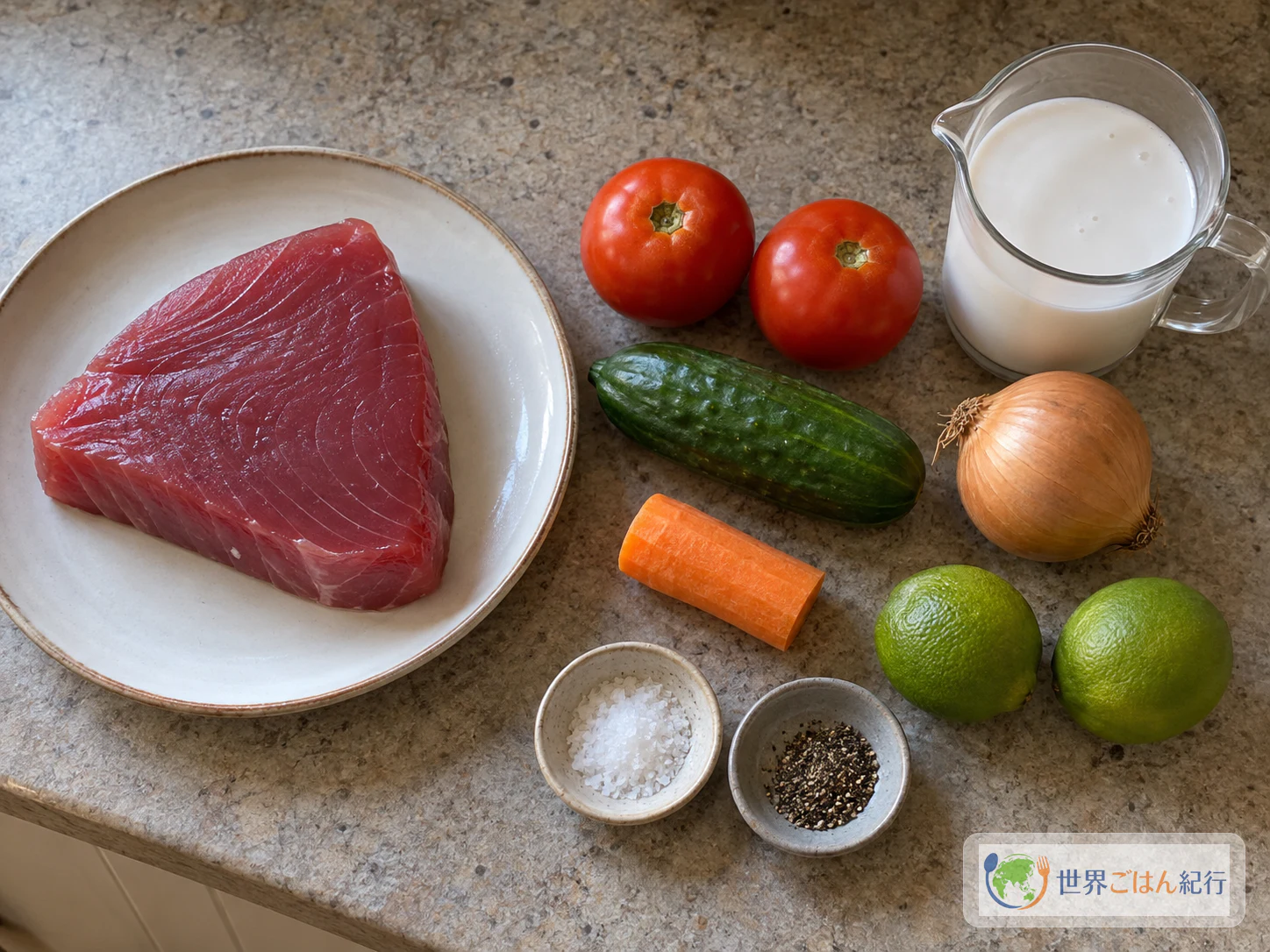
This is a home version, closely related to French Polynesian poisson cru au lait de coco. 50 g of carrot is added, reflecting the vegetable variation from Wallis and Futuna, and the fish is not soaked in seawater or salted water first. The amounts make one batch.
Choosing the Fish and Coconut Milk
Start with the fish. Buy tuna that is clearly sold for eating raw, from a shop you trust, and check the label or ask whether it has been handled with parasite control in mind, such as its freezing history. Japan's Ministry of Health, Labour and Welfare names visual checks and appropriate freezing or heating as ways to prevent anisakis food poisoning, and notes that ordinary vinegar treatment or salting does not kill the parasite. Do not quietly swap in general fresh fish or reef fish of unknown origin.
Then the coconut milk. Use plain, unsweetened coconut milk for cooking. Sweetened drinking products and coconut cream are not silent substitutes; they change the dish. Check the label of the product you buy for allergens and ingredients.
Citrus. The Tahitian recipe allows lemons or limes. This version uses limes, but lemons work if that is what you have. Juice content varies from fruit to fruit, so taste rather than measuring.
Fish sauce, soy sauce, chilli and fresh herbs are not part of this recipe, and they are not required to make the dish taste of the islands.
Lime juice turns the surface of fish pale and firm, but that change is not cooking and does not kill parasites or make raw fish safe. A fish that looks or smells fresh is not proof of safety either. Rely on fish sold for raw eating with appropriate parasite control, keep it cold, and use clean tools. If you prefer not to eat raw fish, see the cooked-fish version under Variations.
Equipment
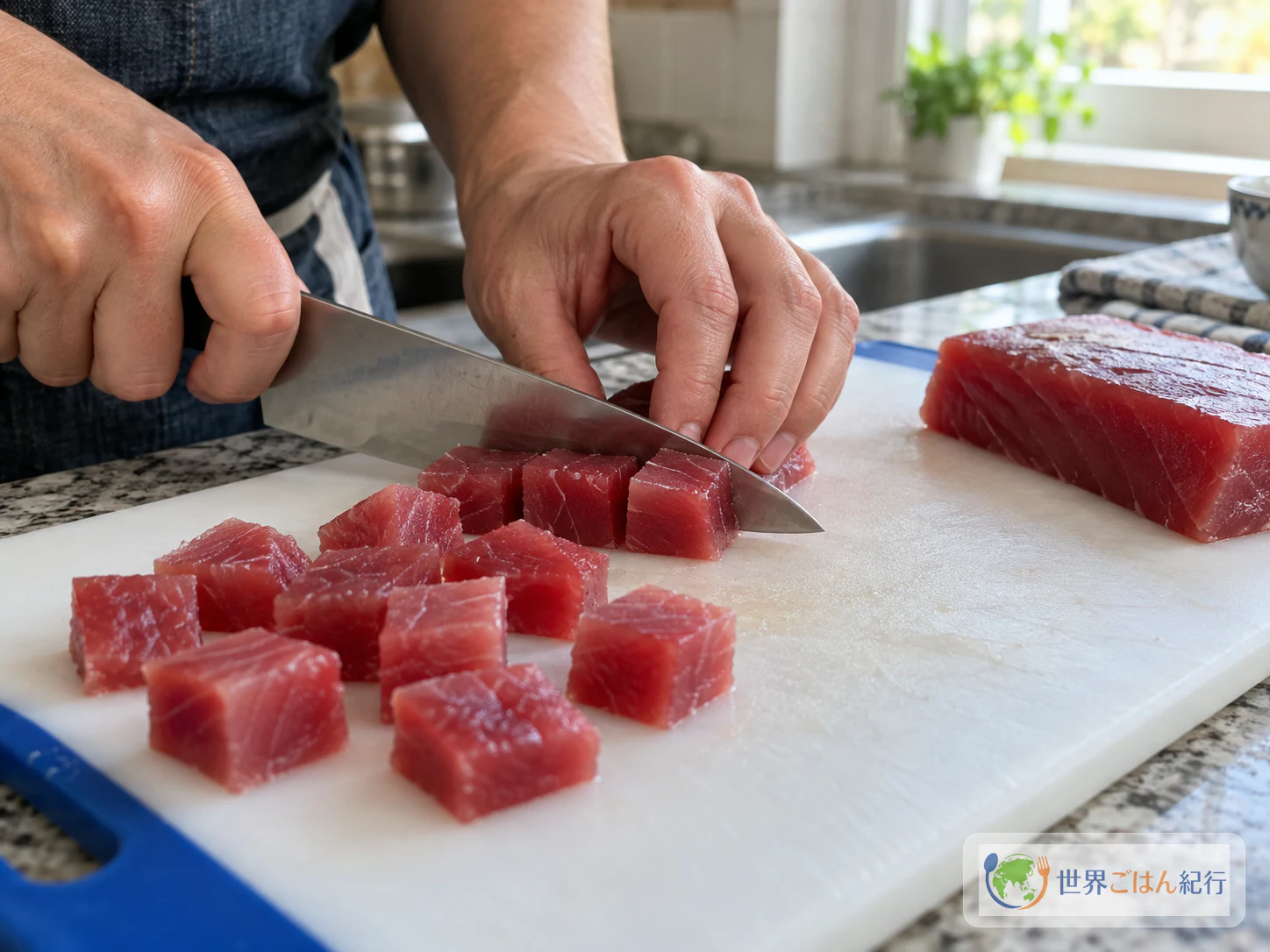
- A cutting board used only for the raw fish
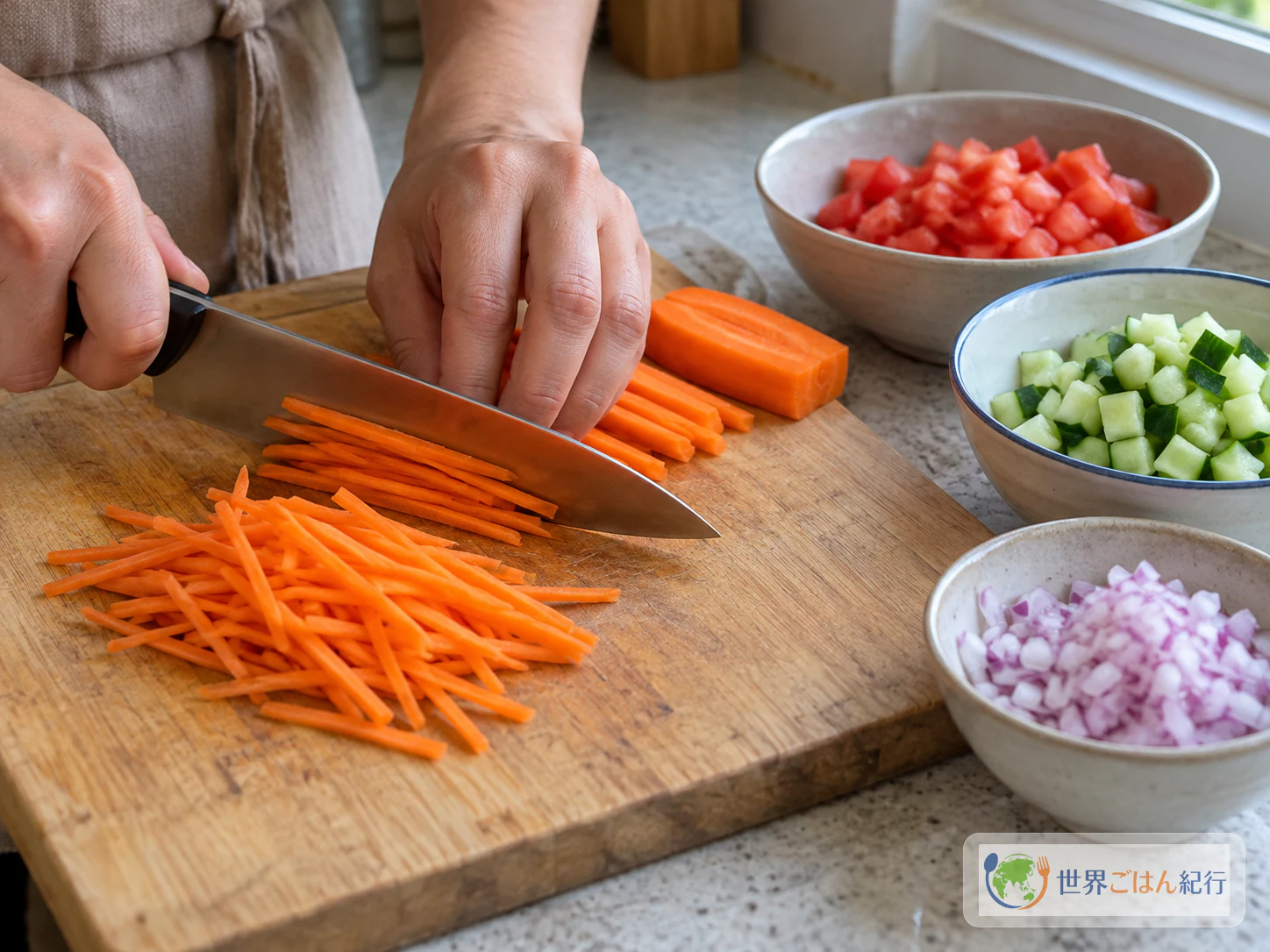
- A separate cutting board for the vegetables
- A sharp knife (washed between fish and vegetables)
- A large, clean bowl, chilled if possible
- A measuring cup for the coconut milk
- A citrus squeezer or your hands
- A clean spoon for tasting
- Small bowls for serving
Method: Cut, Combine, and Finish Just Before Serving
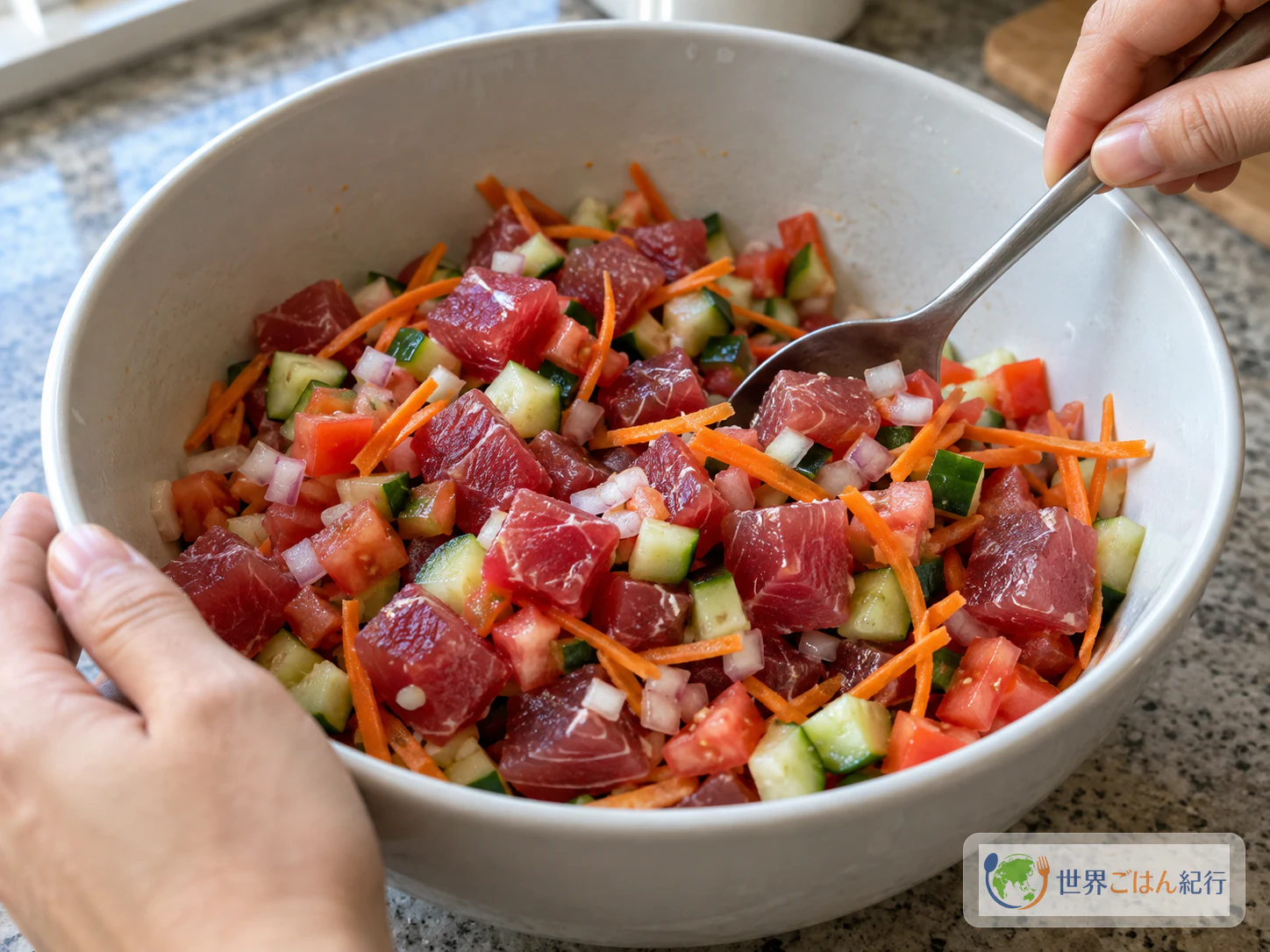
Steps 1 and 2 can be done ahead, with everything kept covered in the refrigerator. Steps 3 to 6 happen just before you eat.
When the Bowl Goes Wrong
| Problem | Likely cause | What to do |
|---|---|---|
| The salad is watery | It sat too long after the coconut milk went in, and the vegetables released liquid | Next time, add lime and coconut milk right before serving. A watery appearance does not establish that a bowl which has been left standing is safe to eat |
| Too sharp | Very juicy limes | Fold in a little more of the coconut milk if you have it, and season carefully with salt |
| Flat or dull | Not enough seasoning | Add salt a pinch at a time and taste again; a few more drops of lime can lift it |
| Too sweet or heavy | Sweetened coconut product or coconut cream was used | Next time choose plain unsweetened coconut milk |
| Fish has turned pale and firm | Long contact with citrus | This is a texture change, not cooking; next time add lime at the last moment |
Variations
Closer to the Tahitian recipe. Leave out the carrot and you have the vegetable mix of the Tahiti Tourisme recipe: tuna, tomato, cucumber, onion, citrus and coconut milk.
Lemon instead of lime. The Tahitian recipe accepts either. Lemon gives a slightly different citrus character; add it to taste.
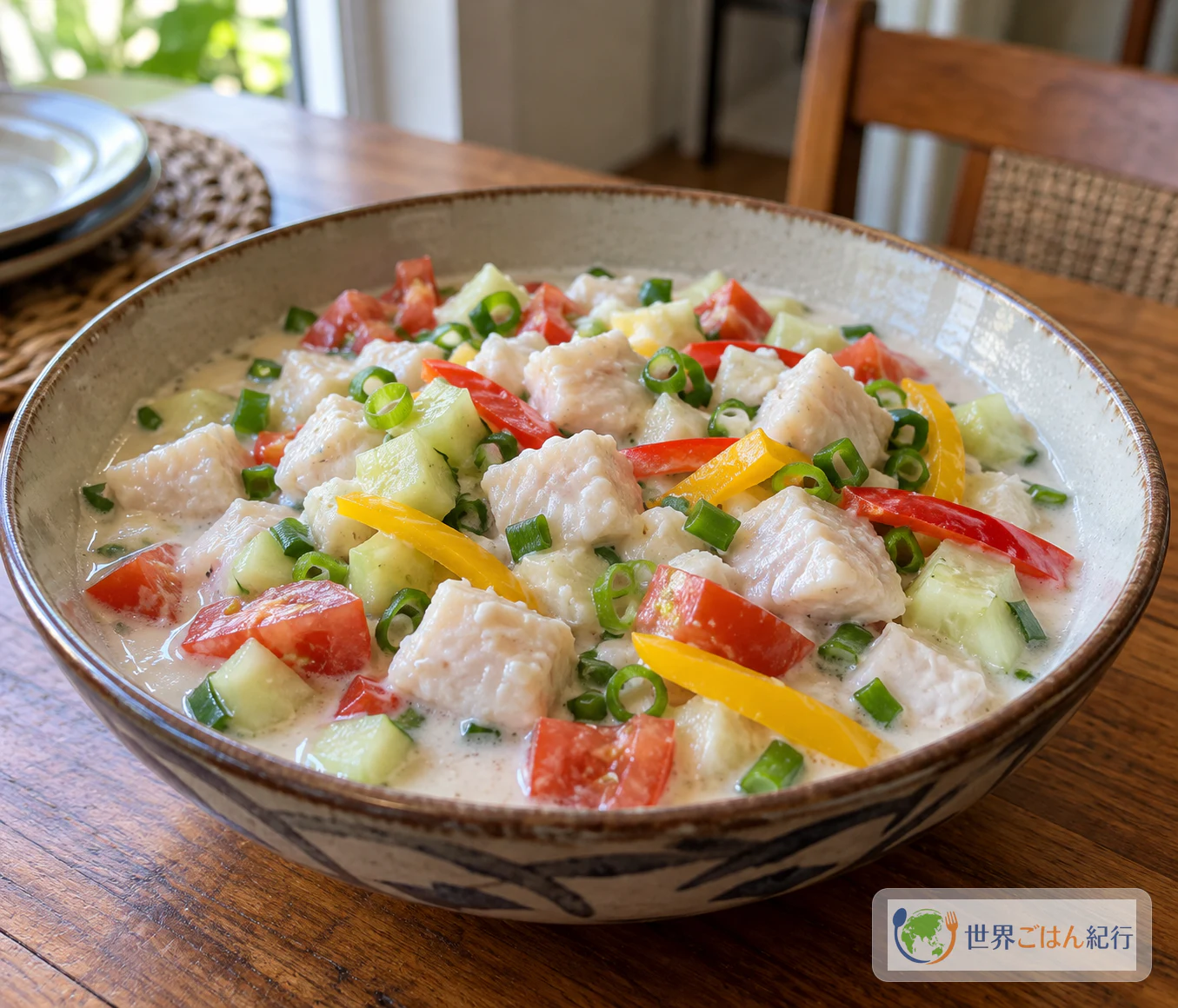
A cooked-fish version. If you would rather not eat raw fish, cook the fish thoroughly all the way through, cool it cleanly and quickly in the refrigerator, then combine it with the vegetables, lime and coconut milk as in steps 3 to 6. This is a separate home alternative, not the raw-fish dish of the islands or of the Tahitian recipe, and letting raw fish sit in lime for longer is not a substitute for cooking.
Your own family version. Since each family in Wallis and Futuna has its own recipe, adjusting the balance of vegetables to your taste stays true to the spirit of the dish.
Frequently Asked Questions
Does lime juice "cook" the fish?
No. Acid can turn the surface pale and firm, but that is not heating and it does not kill parasites. Japan's Ministry of Health, Labour and Welfare notes that ordinary vinegar treatment or salting does not kill anisakis. Safety depends on choosing fish sold for raw eating with proper parasite control, keeping it cold, and using clean tools.
Why skip the salted-water soak in the Tahitian recipe?
The original briefly soaks the fish in seawater or salted water before draining it. Seawater is not a practical option in most kitchens, and the concentration of the salted water is not specified, so this home version leaves the step out and seasons with salt at the end instead.
How much juice do 2 limes give?
It varies from fruit to fruit, so this recipe does not fix a measurement. Squeeze both, then taste and adjust the seasoning.
Can I make it ahead?
You can cut the fish and vegetables ahead and keep them covered in the refrigerator separately. Combine them and add the lime and coconut milk just before serving. Keep everything chilled and do not leave it out at room temperature for long.
What about leftovers?
This salad is meant to be eaten as soon as it is made. No safe storage period can be given for it, so make an amount you will finish, and do not plan on serving it again the next day as a raw-fish dish.
Is this the same as Fiji's kokoda?
They belong to the same Pacific family of fish dressed with citrus and coconut. This version follows a last-minute finish rather than a longer marination, and it reflects the vegetable mix described for Wallis and Futuna.
Back to the Islands
On islands where fish and coconut are everywhere, a bowl like this needs little more than a sharp knife, a few vegetables and good timing. The tourism office's own words, that each family has its own recipe, are a reminder that there is no single right version. If you enjoy this one, Fiji's kokoda is a natural next step: the same family of flavors, shaped by a different island's habits.
Sources
- Wallis and Futuna Tourism, "Island cuisine & eating out." Island cuisine incorporating Pacific influences including French Polynesia; fresh fish salad as a popular dish; a variation with coconut milk, diced tomatoes, cucumber, carrot, onion and lime; recipes vary. https://wallis-futuna.travel/en/what-to-see-do/eating-out?start=8
- Wallis and Futuna Tourism, "Island savours." Raw marinated fish salad with coconut milk as a local speciality; each family has its own recipe; fish and coconut prominent in local cuisine. https://wallis-futuna.travel/en/discover-our-islands/island-savours
- Tahiti Tourisme, "Prepare a 'poisson cru au lait de coco'." The closely related French Polynesian recipe used as the basis for the main quantities (500 g tuna, 2 tomatoes, 1 small cucumber, 2 lemons or limes, 1 onion, 250 ml coconut milk, salt and pepper), its brief salted-water soak, and adding citrus and coconut milk before serving. https://tahititourisme.pf/en-pf/activities/a-taste-of-the-islands/prepare-a-poisson-cru-au-lait-de-coco/
- Pacific Community (SPC), Pasifika Plates (2015), pp. 34–35. Several regional names for the citrus-and-coconut fish dish family, and the range of textures and marinating approaches across places such as Tahiti, New Caledonia and Fiji. https://www.sistalibrary.com.vu/wp-content/uploads/2020/05/Pasifika_Plates.pdf
- Ministry of Health, Labour and Welfare (Japan), "アニサキスによる食中毒を予防しましょう" (Preventing anisakis food poisoning; in Japanese). Visual checks and appropriate freezing or heating for raw seafood; ordinary vinegar treatment or salting does not kill anisakis. https://www.mhlw.go.jp/stf/seisakunitsuite/bunya/0000042953.html
- Ministry of Health, Labour and Welfare (Japan), "家庭での食中毒予防" (Preventing food poisoning at home; in Japanese). Preventing cross-contamination between raw fish and other foods; refrigeration and not leaving food at room temperature for long. https://www.mhlw.go.jp/stf/seisakunitsuite/bunya/kenkou_iryou/shokuhin/syokuchu/01_00008.html