


The story of tacu tacu: beans and rice pressed into one
Take rice out of the refrigerator and loosen it with chopsticks, and it doesn't come back like freshly cooked rice. Add beans and it will come together, but the moment it goes into the pan the white and brown grains are still loose.
Then you layer the fragrance of fried onion and garlic and the fruity smell of the yellow chile. Mash some of the beans with a wooden spoon and press the rice in. Let one side cook undisturbed, and only the bottom of the soft bean-and-rice mixture becomes a single thin cracker.
This is Peru's tacu tacu. In the recipe from the Peru tourism board, canary beans, rice, onion, garlic and yellow ají are combined, and the beans and rice are stir-fried to the same texture before shaping. The local quantities are large, so here it is scaled to 480 g cooked beans and 600 g cold rice, which is easy to handle at home. As in the official recipe's ingredients and method, the key is not turning the beans into a complete paste.
What keeps tacu tacu from being just bean fried rice isn't a lot of seasoning. It's matching the moisture, pressing it firm and waiting until the browned surface sets. You can form it without ají amarillo, but the aroma of the yellow chile goes missing, so it makes sense to decide whether to buy it based on whether you will use it in other dishes.
You will learn when to press the beans and rice into one, the signs that the surface is browned, and what to do about ají amarillo. If you're nervous about flipping one big cake, there's also a way to divide it into two small ones from the start.
On a day when you want to build the meal starting with a cold appetizer, Peruvian causa limeña (in Japanese) pairs well. Make tacu tacu the main dish, and try the sweet-sour stir-fry flavor of lomo saltado (in Japanese) on another day; the uses of ají become easier to see.
Ingredients (serves 4)

If the beans still have liquid, the mixture spreads in the pan. For canned beans, drain in a sieve for 10 minutes and pat the surface with paper towels. The rice, too, is easier to flip if you spread it on a tray and let the surface of the grains dry, rather than using it with steam still rising.
If you can't get ají amarillo
Ají amarillo is not just a seasoning that adds heat. PROMPERÚ's food culture guide, "5 condimentos únicos del Perú," also lists it among the seasonings that characterize Peruvian cooking, appearing in many dishes. Finely chopping 1/2 a yellow bell pepper and adding a pinch of cayenne gets close in color and heat, but the aroma of ripe chile won't be the same.
If you only make this once, yellow bell pepper and a little cayenne are enough, accepting the difference from the Peruvian aroma. If you'll also use about 30 g in causa limeña (in Japanese) or stir-fries, ají amarillo paste from a Latin American grocer or online is worth having.
Instructions: build the crisp surface
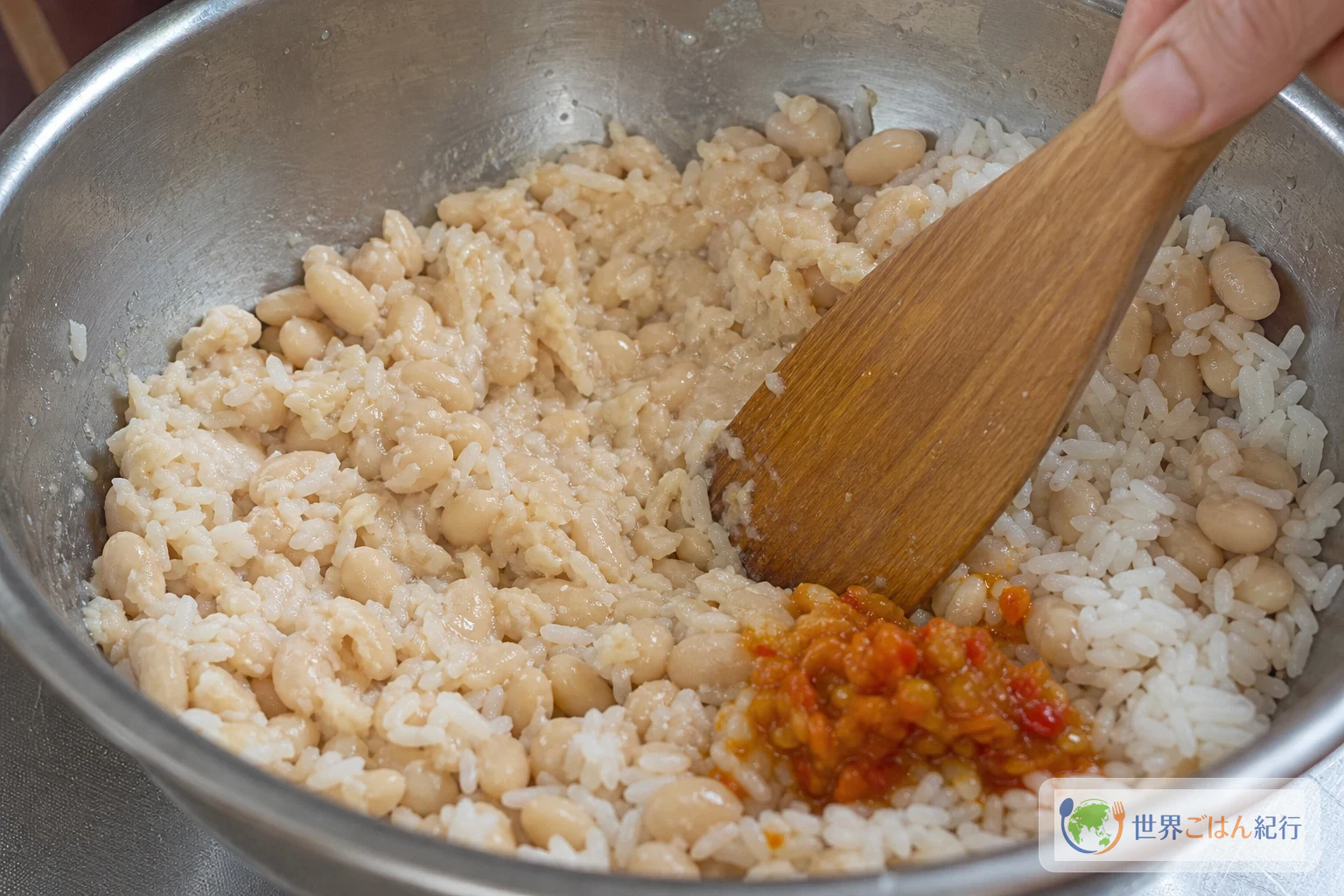
You don't need to turn the beans and rice into a smooth paste. The mashed beans act as glue, and the rice grains form the skeleton of the crust. The steps below make two large tacu tacu, each 15 to 16 cm (6 in) across and 2 cm (3/4 in) thick.
Cooking tips: judging bean moisture and the browned surface

Success with tacu tacu depends more on "where you stop" than on the ingredient list. If you mash all the beans, you get a uniform mash. On the other hand, leave too much bean shape and the surface cracks and won't form one cake.
- The beans are drained and no water is pooling at the bottom of the bowl.
- Only a third of the beans are mashed, with white pieces and skins visible.
- It holds together when pressed with the spoon and doesn't fall apart when lifted.
- After shaping it has rested 5 minutes and the surface isn't wet and shiny.
If you're unsure whether to add water, first press one spot of the mixture firmly. If the mark stays, no water is needed. Add 1 tbsp bean cooking liquid only when it's crumbly and cracks. If you've added too much water, it's easier to recover by cooking in small portions, and you avoid adding flour and diluting the bean aroma.
If you touch the crust again and again with the spatula while it sets, only the surface peels off before the bottom has firmed. Wait until the toasty sound once weakens and the edge has dried, then slide the spatula in. Whether you can wait those few minutes is what separates tacu tacu from bean fried rice.
Cookware

You can make it in a heavy skillet without special equipment. A flat-bottomed pan of 24 to 26 cm (9.5 to 10 in) is enough for small 10 cm rounds, and for a large 15 to 16 cm cake a flat griddle that fits your stove makes flipping easier. Check that the base is flat and suits your heat source, including induction, and that it is light enough to lift and flip.
For small ones in a skillet, a heavy pan of around 26 cm is easier to handle than a thin one. A stable base keeps the browning from concentrating in one spot even on medium-low heat, and the mixture is less likely to break when flipped.
How to rescue it when it won't brown

Tacu tacu is a dish where a failure can be rescued without throwing out the ingredients. However, trying again over high heat blackens only the outside and can't fix the bean aroma. Look at how it crumbles and decide whether to fix the heat or the moisture.
| Condition | Main cause | How to fix |
|---|---|---|
| The mixture spreads in the pan | Moisture from the beans or onion | Divide into 4 small rounds and cook 4 minutes per side over medium-low heat |
| Cracks at the edge | Beans not mashed enough, or the mixture is dry | Mix in just 1 tbsp cooking liquid and rest 5 minutes |
| Only the bottom is black | Heat too high, preheated too long | Cool the pan 10 seconds on a damp towel and go to medium-low |
| No browning | Surface is wet, or moved midway | Don't press with the spatula; wait about 5 minutes per side |
| Breaks when flipped | Too thick, or flipped before the edge set | Shape smaller and add 1 to 2 minutes until the edge dries |
Adding flour when the mixture is watery is an option, but it changes the aroma of the beans and rice. Cook off moisture, cook it smaller, and if it's still difficult, eat it as fried rice. In that order, nothing you bought goes to waste.
Variations: protect the crust more than the choice of bean

Tacu tacu is a dish whose core idea holds up even when you change the bean. Different beans absorb different amounts of water and have different skin toughness, so don't swap the same amounts mechanically.
Lighter with white beans
If you don't have canary beans, you can make it with white or cannellini beans. Their skins are thin and mash easily, so start by mashing 1/4 rather than 1/3 and see. With soft canned beans, almost no extra cooking liquid is needed.
Pull it together with lentils
Lentils have thin skins and the mixture comes together quickly. Of the 480 g cooked lentils, mash half coarsely and add the rest whole. The lentil aroma is mild, so leaving out the ají and oregano flattens the flavor.
A version without pork lard
The official recipe includes a step using pork lard, but it is replaced with neutral oil here. Leave out the egg too and it can be made with plant-based ingredients. In that case, rather than adding more oil, a well-seasoned salsa with lime and cilantro gives a lighter finish.
The "poor man's" plate with an egg
The official Peruvian recipe presents it with a fried egg as "estilo pobre." The egg adds the richness of yolk to a plate of just beans and rice. If you don't like soft yolk, cook it hard, and cook the bean cake first and prepare the egg on a separate plate.
Serve with seafood or meat
PROMPERÚ's introduction also shows examples that combine beef or fried egg with seafood, pork, chicken and plant-based toppings. Rather than mixing seafood into the tacu tacu mixture, serving it separately after cooking is easier for managing moisture, and food allergy checks can be done separately.
Back to the local table: what goes on the plate

Once you make tacu tacu, you notice that beans and rice alone make a perfectly good staple. Even so, on local plates there are ways of eating it that add fried egg, meat or seafood to widen the satisfaction of lunch. The Peru tourism board's recipe shows the form with an egg, and PROMPERÚ's introduction touches on combinations with beef, fried egg, seafood, pork and chicken.
On a home plate, egg and tart red onion are enough. Mix 70 g thinly sliced red onion with lime juice, cilantro and salt and set it beside the finished tacu tacu. The lime cuts the heaviness of the beans and the cilantro lightens the surface oil, so the plate tightens even on days you don't buy meat.
To connect tacu tacu to a Peruvian menu, you can start with cold ceviche (in Japanese) and put the warm beans and rice after it. On days you add meat, it's easier to manage the weight of the meal if you stop at egg and onion rather than layering on anticuchos.
There is no single explanation settled locally for the origin of the dish's name. Aida Tam Fox explains it as repeated sounds of the Quechua word for "to mash," while researcher Jorge Yeshayahu points to links with Swahili and Afro-Peruvian expressions. Rather than fixing the origin to one explanation, looking together at the motion of pressing rice and beans into one dish, the food culture that grew up on the coast and the history of several cultures overlapping gets closer to the dish.
Storage and FAQ

With a dish that uses cooked rice, decide the storage steps before the aroma. Japan's Ministry of Health, Labour and Welfare advises against leaving food at room temperature after cooking as a measure against Bacillus cereus, and recommends dividing it into portions and refrigerating promptly. For rice dishes, also check the Ministry's food safety information (in Japanese).
Use the rice and beans straight from the refrigerator, and don't let the mixed batter wait long at room temperature. To save leftovers, spread them in a shallow container, let the heat go and refrigerate. For quality, use them up within the next day. To eat, warm both sides in a skillet and check that the center is hot. Anything left at room temperature for a long time should not be used, whatever it looks or smells like.
Don't leave the rice before cooking, the mixture with beans, or the finished tacu tacu in the pot or at room temperature for long. To store it, portion it into shallow containers and refrigerate promptly, and reheat until hot through the center. If serving with eggs, cook them thoroughly, yolk included.
What if I don't have ají amarillo?
Finely chop 1/2 a yellow bell pepper, cook it with the onion and add a pinch of cayenne. This makes up the color and heat, but the fruity aroma is weaker. Replacing it with hot sauce alone puts the acidity forward, so keep it small in tacu tacu.
Can I make it with canned beans?
Yes. Just draining the liquid is sometimes not enough, so let them sit in a sieve for 10 minutes and wipe the surface before using. If the beans are too soft, start by mashing 1/4.
What if I only have freshly cooked rice?
Spread it thinly on a tray and cool for about 30 minutes to let the surface steam off. Combined with the beans while hot, the moisture increases and it breaks easily when flipped. Make it the same day and don't leave the cooled rice at room temperature for long.
What if I'm afraid of flipping?
Divide it into 4 rounds of 10 cm across and 1.5 cm thick. About 4 minutes on one side and 3 to 4 on the other is easier to handle than flipping onto a plate. The rule of not moving it until the crust sets is the same even when made small.
Any cautions when serving with eggs or seafood?
When serving eggs, seafood or meat, check the labels of the ingredients you use and your household's allergy management. Serving seafood separately rather than mixing it into the mixture makes it easier to divide by person. If you share utensils, wash them before use.
What are the nutrition figures?
For one serving, a quarter of the beans-and-rice base: about 440 kcal, 14 g protein, 14 g fat, 66 g carbohydrate, 10 g fiber and about 1.7 g salt equivalent. These are estimates that vary with the canned beans, oil and salt you use, and do not include eggs, meat or toppings. If you have dietary restrictions, check the labels of what you buy and the amounts you actually use.
Sources
- A mixture of Peruvian and African flavors: the history of tacu tacu (PROMPERÚ, 2022, English)
- Tacu Tacu (Peru tourism board, English)
- Game Day Food Safety Tips (FoodSafety.gov, US government, English)
- Patrimonio Cultural Inmaterial Afroperuano (Peru Ministry of Culture, Spanish)
- 5 condimentos únicos del Perú (PROMPERÚ, Spanish)
The origin of the dish was sorted by comparing the researchers' explanations in PROMPERÚ's introduction with the Afro-Peruvian cultural background set out by the Peru Ministry of Culture. The recipe's amounts and method follow the Peru tourism board's official recipe, adjusted to quantities easy to handle in a home kitchen.


