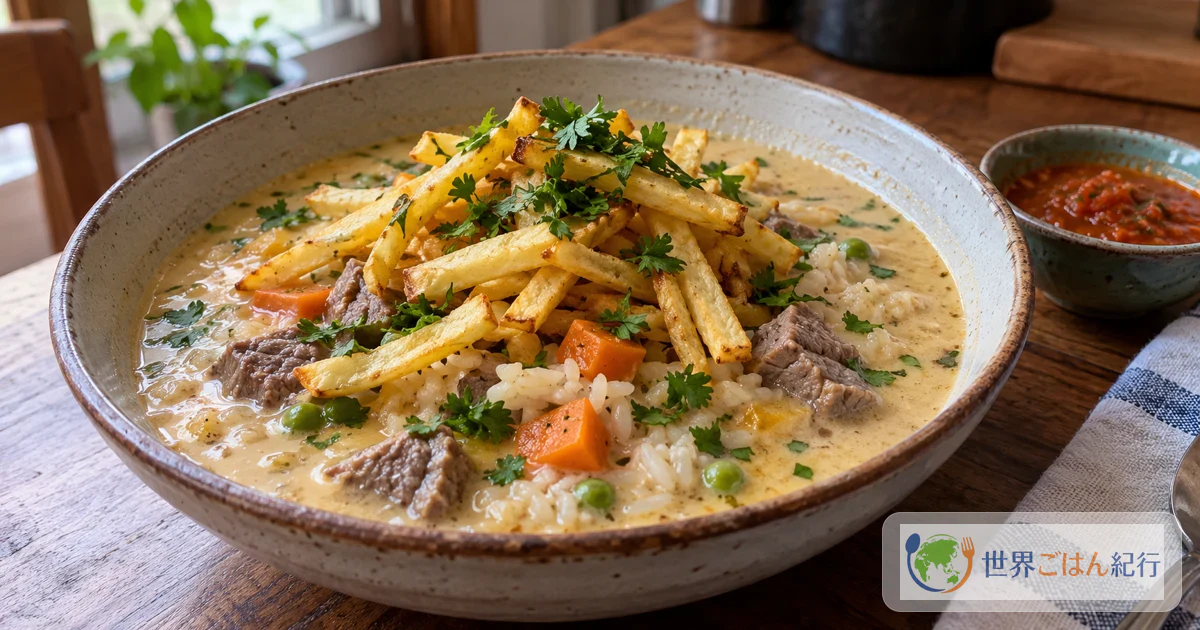
The Story of Revuelto Gramajo: Eggs and Shoestring Potatoes From a Late-Night Canteen
At a late dinner in Buenos Aires, a plate arrives with thin potatoes that still smell of frying oil, loosely tangled with eggs. Lift it with a fork and the potatoes on top are light, while the eggs underneath are just slightly runny. The aroma is of french fries, but the mouthfeel is close to scrambled eggs. Revuelto gramajo is an Argentine egg dish that lives in between.
In Spanish, revuelto refers to a dish in which eggs are stirred together with other ingredients. Gramajo is often said to come from a person's name, but whose plate it was, whether it spread from hotel cooking, or whether it ties to the meals of military officers or the upper class is explained differently depending on the source. Rather than settling on one origin, looking at the form shared by local recipes, "eggs, ham, and shoestring potatoes pulled together in a short time", is more useful in the kitchen.
What is hard in a home kitchen is keeping the generosity of an Argentine canteen while not setting the eggs too hard and not letting the potatoes go soggy. Cut the potatoes thin and remove moisture. Don't mix all the potatoes in at the end; fold in only half into the eggs. Turn off the heat at the point where you feel "it's still a little early". That alone brings the outline closer even with supermarket eggs and sliced loin ham.
If you build a menu in the Argentine vein, pairing empanadas as a starter, chimichurri on meat days, milanesa (in Japanese) on days you crisp-fry thin cutlets, and locro (in Japanese) for a cold-season stew connects them as one country's table. Reading it beside Uruguay's hearty sandwich, the chivito, also makes the use of eggs, meat, and potatoes around the Río de la Plata look connected.
The Local Table and Regional Differences: A Dish You Mix, Without Mixing Too Much
Revuelto gramajo is both a home dish and a canteen dish. On the plate the eggs, ham, and potatoes are one, but from the cook's side their roles are separate. Potatoes are lightness, eggs are the binder, and ham is saltiness and meaty aroma. If you stir-fry everything together from the start, the potatoes soak up the egg and turn heavy, drifting toward an oily potato salad. Local recipes too often have you fry the potatoes separately, keep them warm, and combine them with the eggs and ham.
Depending on region and restaurant, there are versions with green peas, onion, bacon, cream, or mushrooms. Cocineros Argentinos presents a flow of frying thin potatoes called papas pay, warming ham in butter, and keeping the eggs soft at the "punto babé" stage. On the other hand, there is also a type like the El País recipe that includes onion, bacon, and green peas and sets the eggs firmer. Rather than settling on one, it is easier to make if you see it as a dish that takes in each household's or restaurant's "this is how I want to eat it today".
Making it outside Argentina, it is easier if you separate what you may change from what to protect. For the ham, don't hunt for jamón cocido itself; thick-sliced loin ham is fine. If you dislike green peas, leave them out. If you add bacon, reduce the amount and cut the salt too. But keep these: cutting the potatoes thin, not letting the oil temperature drop too much, and not keeping the eggs on the heat to the end. If you hold to these, even with ingredients from the refrigerator it has the lightness of revuelto gramajo, not "a potato omelet".
The story of the name is interesting, but we do not fix on one here. Wikipedia explains it as a dish named for Artemio Gramajo, while Cucinare presents the confusion when the dish's origin is told in Buenos Aires and the debate over what is authentic. In this article we treat the origin stories as reading, and in cooking center on the combination of eggs, ham, and shoestring potatoes shared by local recipes.
Ingredients (serves 4): Think of the Potatoes, Eggs, and Ham Separately

Either waxy potatoes or floury potatoes will work. Waxy potatoes are less likely to break when cut into strips and keep their shape after frying. Floury potatoes bring out aroma but break easily and tend to taste floury once combined with the eggs. The first time, choosing a waxy potato makes it less likely to fail.
For the ham, rather than thin slices, slicing a slightly thicker loin ham into 5 mm widths moves it toward the local jamón cocido. Substituting bacon brings a stronger smoky smell and fat and moves toward a different dish. If you use it, reduce to 80 g and cut the salt to 1/2 tsp.
For the green peas, use frozen rather than canned. Canned peas have a lot of moisture, and their aroma tends to blur when mixed into the eggs. Pour boiling water over them while frozen and drain in a sieve before using.
It uses eggs, milk, and pork. If you have allergies or religious restrictions, don't force substitutions and call it the same dish; reconstruct it as a different dish without egg or without pork.
Where to Draw the Line to Approach the Original in a Home Kitchen
Because the ingredients are familiar, this dish easily becomes something else if you substitute too much. Rather than hunting for rare ingredients, protect the order of textures. Lightly fry the potatoes first, warm the ham briefly, bring the eggs together softly, and then fold the potatoes in. This order matters more than any brand of ingredient.
| Point of hesitation | Judgment to keep | Judgment you may swap |
|---|---|---|
| Potatoes | Cut into strips of 1.5 to 2 mm | Choose among waxy, floury, or frozen shoestring |
| Ham | Cut thick and don't brown strongly | Loin ham, boneless ham. If bacon, up to 80 g |
| Eggs | Stop over low heat when about 70% has set | Cream is unnecessary. If added, up to 1 tbsp |
| Green peas | Drain before adding | Can be left out. Don't add watery vegetables |
| Oil | Keep it around 170°C | Shallow pan-frying also works, but takes longer |
On days you use frozen potatoes, choose only the thin shoestring type. Thick french fries are satisfying, but when mixed with eggs the fluffy center wins out and moves away from the lightness of revuelto gramajo. Even with frozen product, fry a little shorter than the label time and leave room for the eggs' residual heat.
A version with bacon is tasty, but the smoky aroma comes forward. If you want to approach the mild saltiness of the jamón cocido served in Argentine canteens, use a thick loin ham. Warming the ham lightly once the butter's bubbles turn fine, without browning it hard, keeps it from fighting the eggs.
What to Think About When Shopping: Pans Geared to Thin Cutting and Oil Temperature
Revuelto gramajo is a dish of "cutting thin", "not missing the oil temperature", and "bringing the eggs together briefly" more than of special spices. Potatoes, eggs, and ham can be found at any supermarket, so the only gear we point to is what reduces failures in the kitchen. Steadying the oil temperature and the contact surface of the pan makes a clearer difference in the result than adding more ingredient cards.
The heavy frying pan you fill with oil and the small frying pan that brings the eggs together briefly have different roles. If you manage with one, prioritize the heavy frying pan, and if you are unsure about managing oil temperature, adding a thermometer steadies things. A home that already has a deep frying pot only needs a thermometer added, and a 20 cm frying pan for the eggs can be replaced with what you have.
You do not need to gather the equipment all at once. The priority is, in order, a pot where you can lightly fry shoestring potatoes, a tool to read the oil temperature, and a small frying pan to bring the eggs together briefly.
| What you already have | What to add if buying | Reason |
|---|---|---|
| A deep pot | A frying thermometer | You only need to supplement oil-temperature judgment |
| Only thin frying pans | A 26 cm heavy frying pan | Oil temperature drops less and potatoes overlap less |
| Only a 26 cm frying pan | A 20 cm frying pan | The eggs do not spread too far, making it easier to form soft curds |
| You have all of them | Nothing to buy | Concentrate on how you cut and the sequence |
The gear is not specific to revuelto gramajo. A frying thermometer is also useful for oil temperature in akara (in Japanese) and fricassé. A heavy frying pan can go to the high-heat stir-fry of lomo saltado, and a small frying pan to egg dishes in general, so choose what will see the most use in your kitchen.
Why It Fails: Soggy, Hard Eggs, Too Salty

| Problem | Cause | Fix |
|---|---|---|
| Potatoes are soggy | Fried with moisture left, or oil below 160°C | After soaking, press with a cloth, wait for 170°C, and fry half at a time |
| Eggs are hard | Added eggs over high heat, or kept heating after mixing in the potatoes | Lower to low heat before adding the eggs, and turn off the heat when 70% has set |
| Whole dish is salty | Ham and salt were both strong | If the ham is salty, reduce the egg salt to 1/4 tsp and add more at the end |
| Oily | Stacked the fried potatoes on paper | Spread on a rack to drain the oil and let steam escape |
| Potatoes burn | Fried the too-thin parts over high heat | Keep the bubbling steady over medium heat and take them out while the color is still light |
The most common failure is frying the potatoes to the "finished color of french fries". In revuelto gramajo, they take the eggs' residual heat afterward. Stopping a little before fried potatoes you would eat freshly fried, where just the ends are lightly colored, makes them just right after mixing.
Another fork in the road is the order of adding the eggs. If you return the potatoes to the pan first and then add the eggs, the potatoes absorb the egg liquid and turn heavy at once. Set the eggs softly first, and fold in the potatoes after turning off the heat, and the crisp outer parts remain.
The ham's saltiness is also easy to overlook. Japanese loin ham differs in salt content by product. Taste a bit of the end before cutting, and if it is salty, reduce the egg salt to 1/4 tsp. If it is bland, you can add salt at the end, but salty eggs cannot be taken back. Since you also salt the potatoes, it is just right to start the egg mixture on the restrained side.
When the eggs turn dry and crumbly, look at the size of the pan as well as the heat. Pouring 5 eggs into a 26 cm frying pan spreads them thin and they set at once. A pan of about 20 cm gives the eggs thickness and leaves time to turn them in big strokes. If you only have a large pan, try turning off the heat 30 seconds after adding the eggs and bringing them together with residual heat.
How to Eat It and Storage: Not a Make-Ahead Dish, but One to Serve at Once

Revuelto gramajo is not suited to making ahead. Eggs firm up as they cool and potatoes absorb humidity. If you move steps forward, limit it to cutting the potatoes thin and soaking them in water, or cutting the ham. Do the frying of the potatoes and the combining with the eggs just before eating.
If there are leftovers, keep them in the refrigerator until the next day. Once cooled slightly, put them in an airtight container and refrigerate within 2 hours. To reheat, put the frying pan over low heat, spread 1 tsp of oil thinly, and warm for only 1 to 2 minutes. But the soft-set quality of the eggs and the lightness of the potatoes will not come back. Making half the amount rather than turning it into leftovers preserves what is special about this dish.
At the table, a salad with acidity, thinly toasted bread, and light red wine or sparkling water go well. Served as the star of a late-night or lunch meal rather than beside a meat main, you can enjoy the layering of eggs and potatoes. Adding a little chimichurri cuts the aroma of oil and suits an everyday table. On days you want to center a meat dish, putting a small portion beside asado blurs the impression less if you instead save it for a light meal on another day.
If you divide the work, do it like this.
| What can be done ahead | How to store it | What to do right before eating |
|---|---|---|
| Cut the potatoes | Soak in water and refrigerate, up to 2 hours | Wipe thoroughly dry and fry |
| Cut the ham | Seal and refrigerate, same day | Warm briefly in butter |
| Chop the parsley | Wrap in damp paper and refrigerate, same day | Scatter just before plating |
| Fry the potatoes | Not recommended ahead | Fry right before eating |
| Beat the eggs | Not recommended ahead | Mix in salt and cook immediately |
FAQ
Can I make it with frozen french fries?
You can, but choose the shoestring type and fry 1 to 2 minutes shorter than the label. Thick frozen potatoes turn heavy when mixed with eggs and do not give the lightness of the local papas paille. Some frozen potatoes already carry salt, so start with 1/4 tsp of salt in the eggs.
Do I have to include the green peas?
In local recipes some include them and some don't. Adding 40 g helps bring together the canteen-style color and sweetness. If you dislike them, it still works without them, but adding watery vegetables instead loosens the eggs, so avoid that. If you include them, pour boiling water over them while frozen and drain them in a sieve before using.
Can I substitute prosciutto or bacon?
Prosciutto is salty and tends to harden when cooked, so it is not suitable. If you use bacon, reduce it to 80 g and the egg salt to 1/4 tsp. It brings a smoky aroma, so to get closer to Argentina's jamón cocido, thick loin ham is easier to handle.
Can I pan-fry instead of deep-frying?
You can pan-fry thin potatoes in extra oil. But since not everything touches the pan at once, it takes 15 to 18 minutes, and crisp parts and limp parts tend to mix. If you want to reduce the frying oil, put 1 cm of oil in a 20 cm frying pan and pan-fry in small amounts.
Can I put it in a lunch box?
We don't recommend it. Eggs and fried potatoes lose texture when they cool, and since it is finished on the soft-set side it is not suited to carrying. If making it for a lunch box, you would cook the eggs through to the center and pack the potatoes separately, but then it is safer to think of it as a different dish.
Can I make the eggs even runnier?
At home, avoid finishing too runny. Cooking continues with residual heat after plating, but it is not suited to carrying or making ahead. In this article the guide is that about 70% sets in the pan and it settles a little after plating. When serving small children, older people, or pregnant people, cook the eggs thoroughly to the center.
Sources
- Cocineros Argentinos - Revuelto Gramajo (accessed 2026-07-01)
- El País / Proyecto Cocina - Revuelto Gramajo (accessed 2026-07-01)
- Cucinare - La verdadera historia del Revuelto Gramajo (accessed 2026-07-01)
- Wikipedia - Revuelto Gramajo (accessed 2026-07-01)