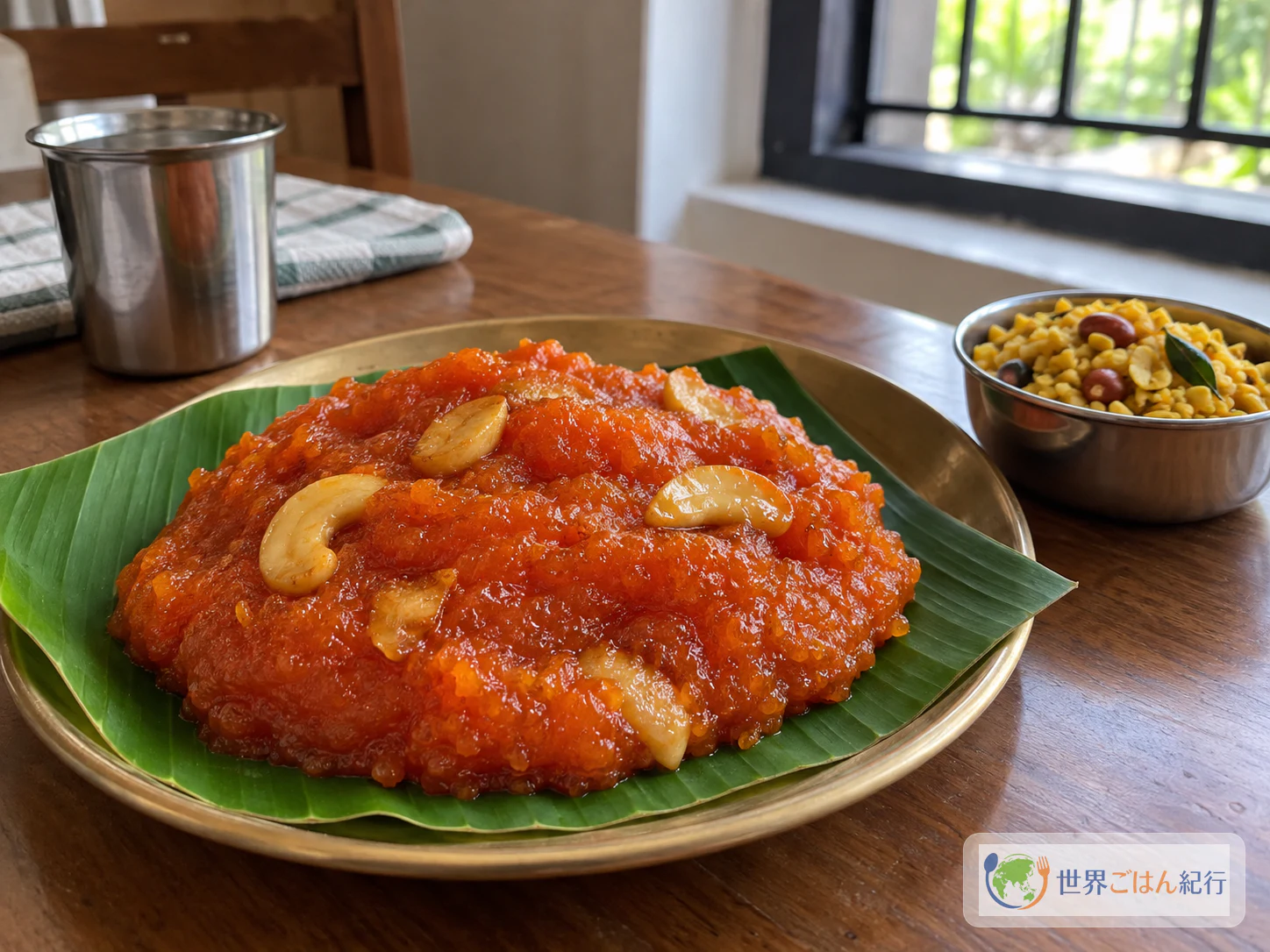
Ashoka Halwa: The Pot Loosens, Then Turns Glossy
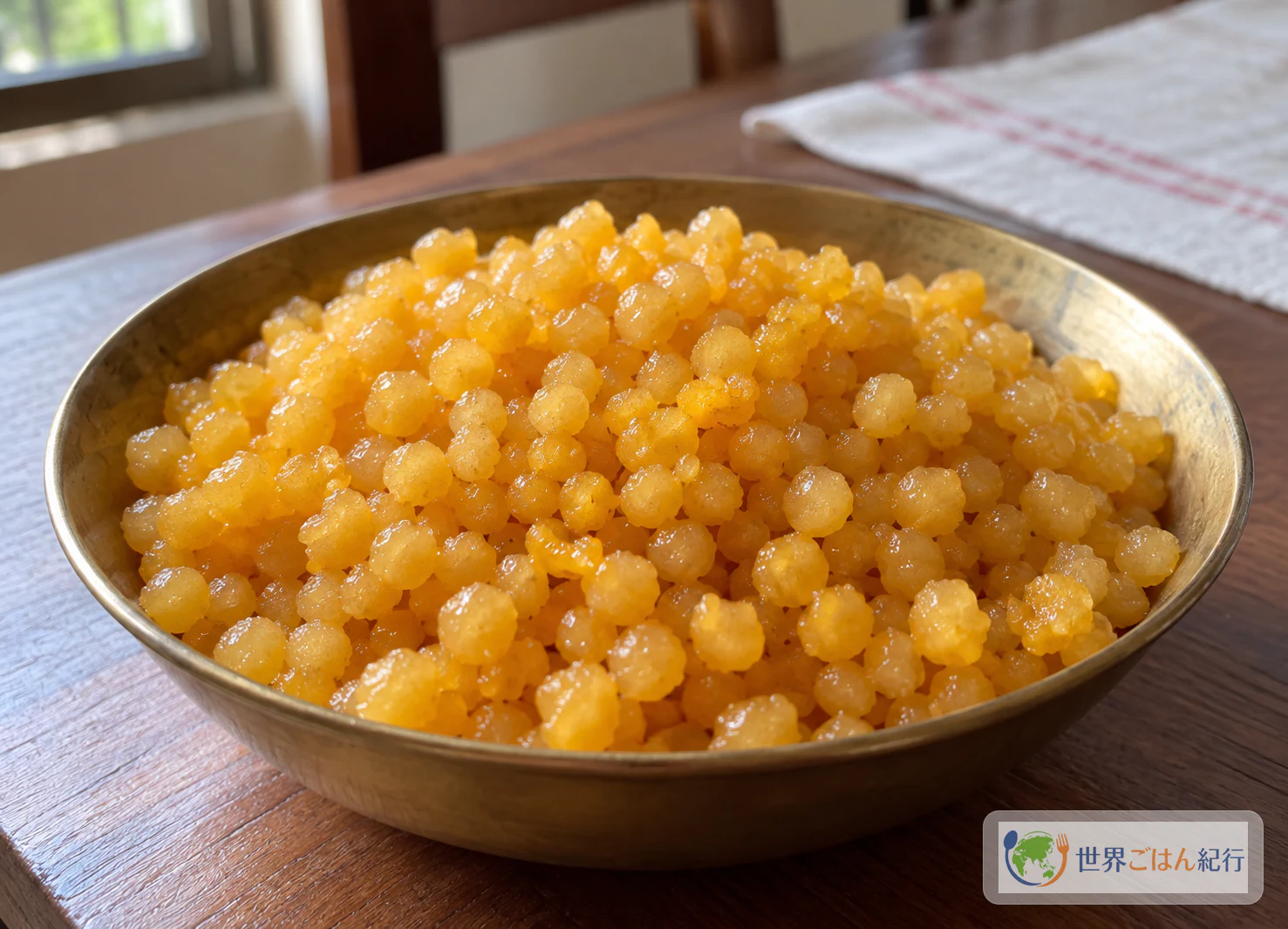
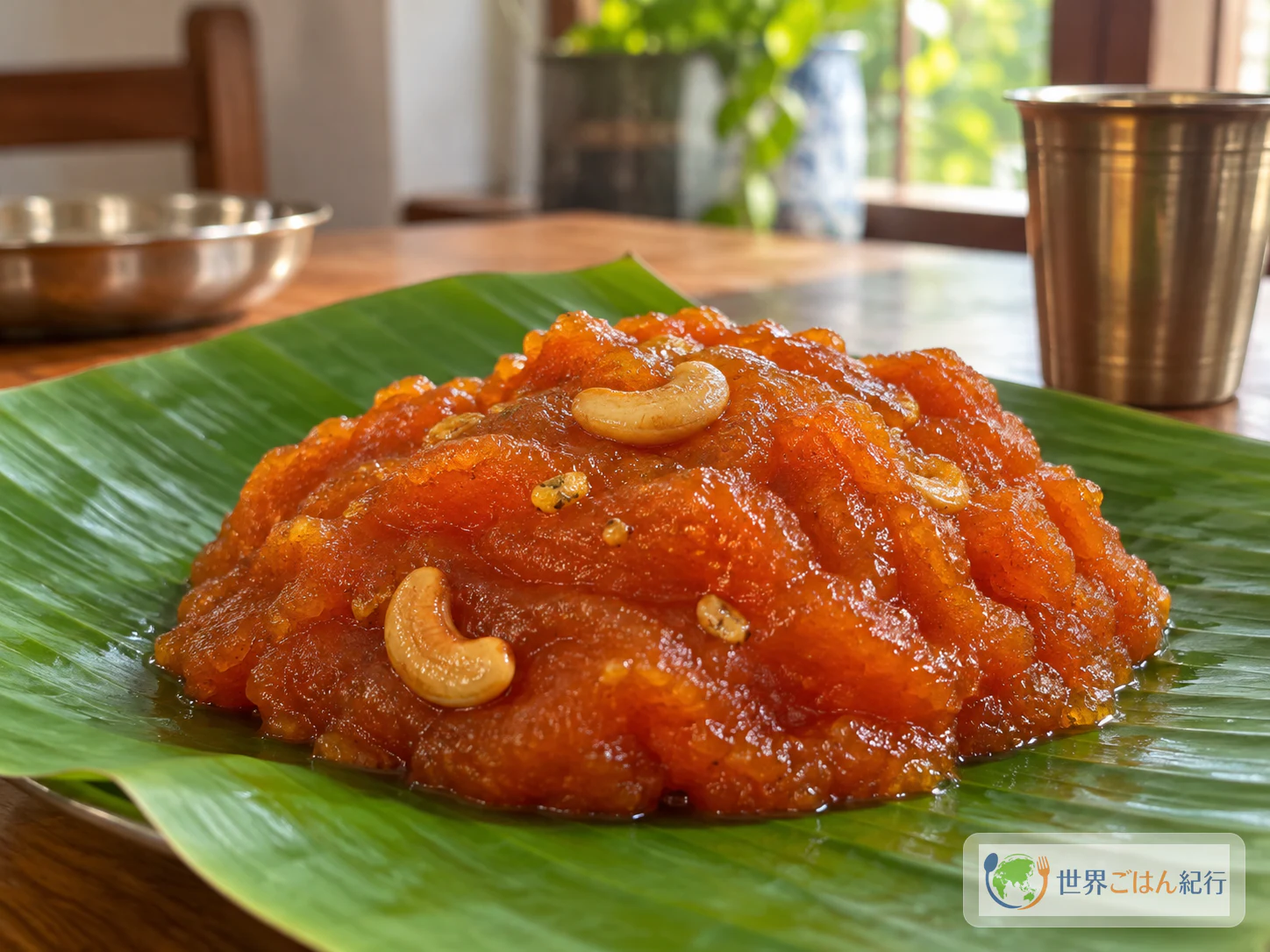
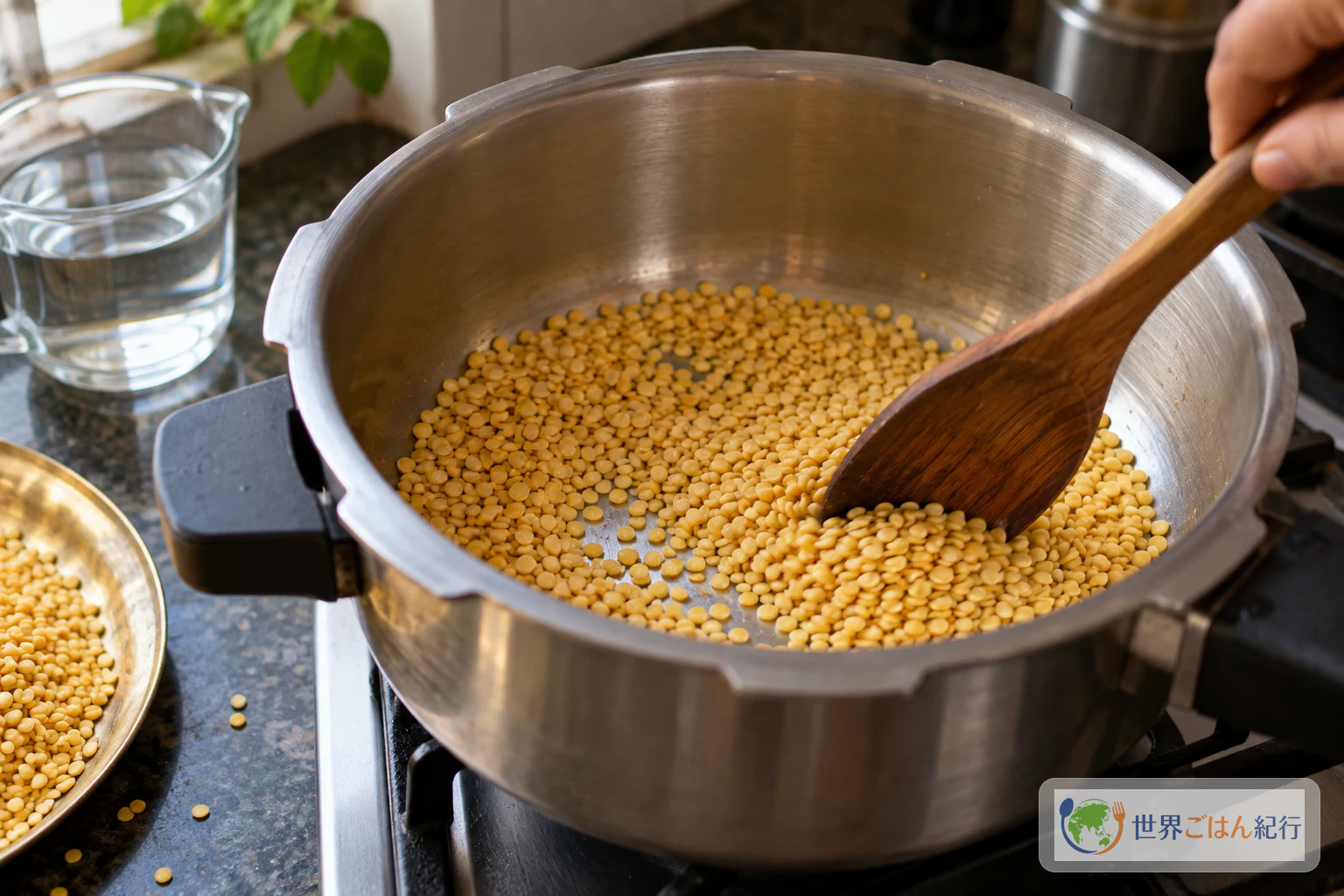
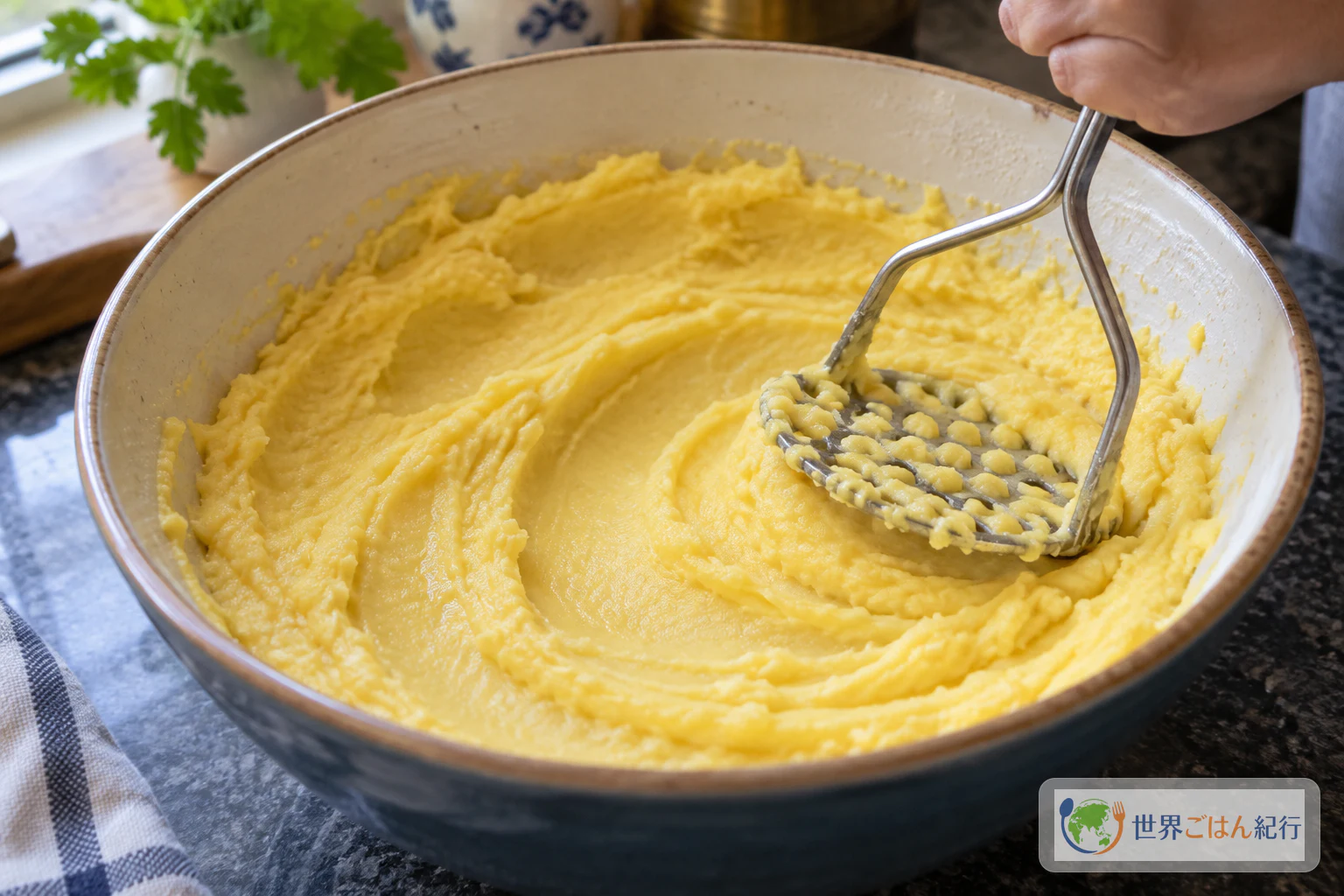
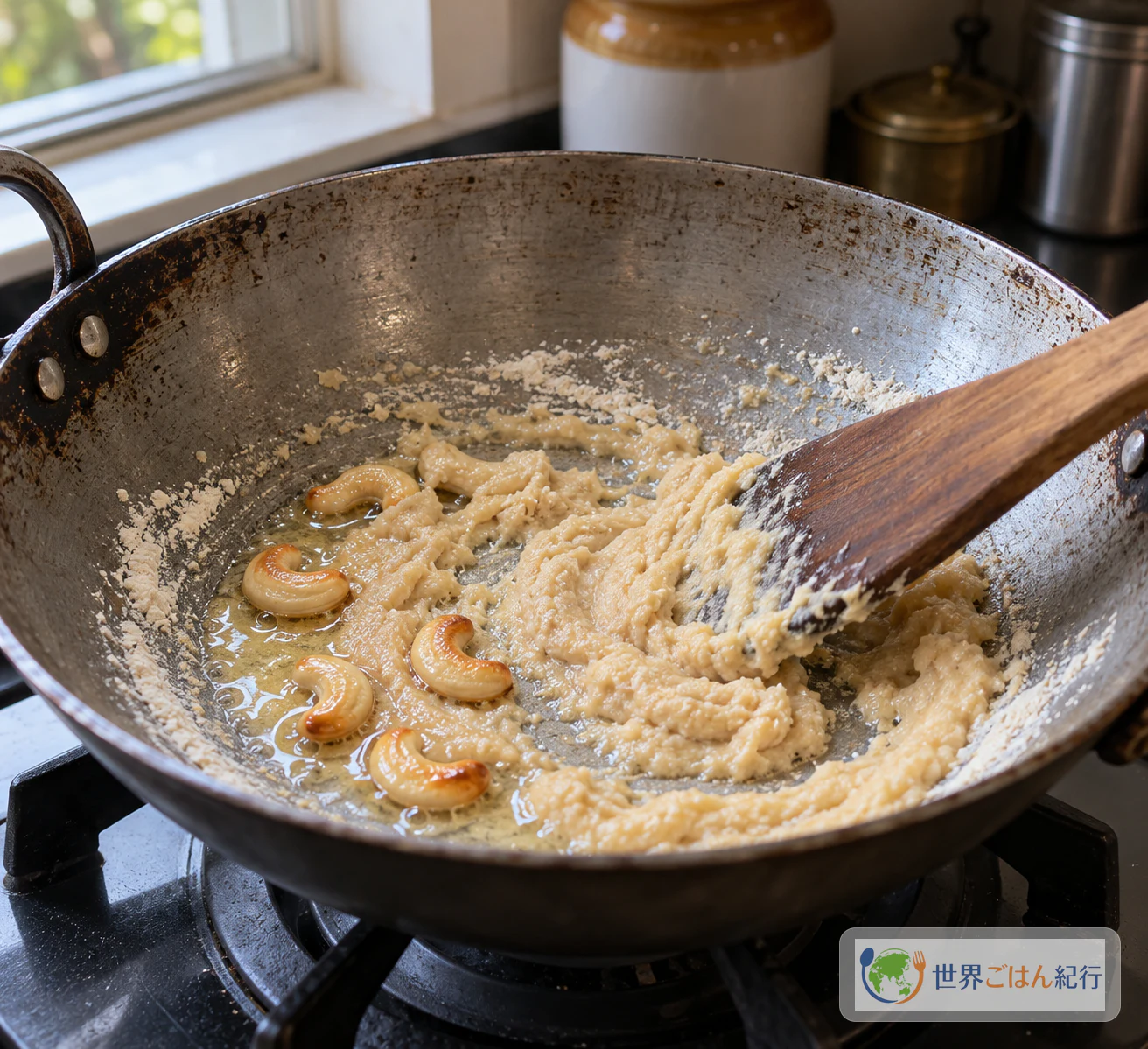
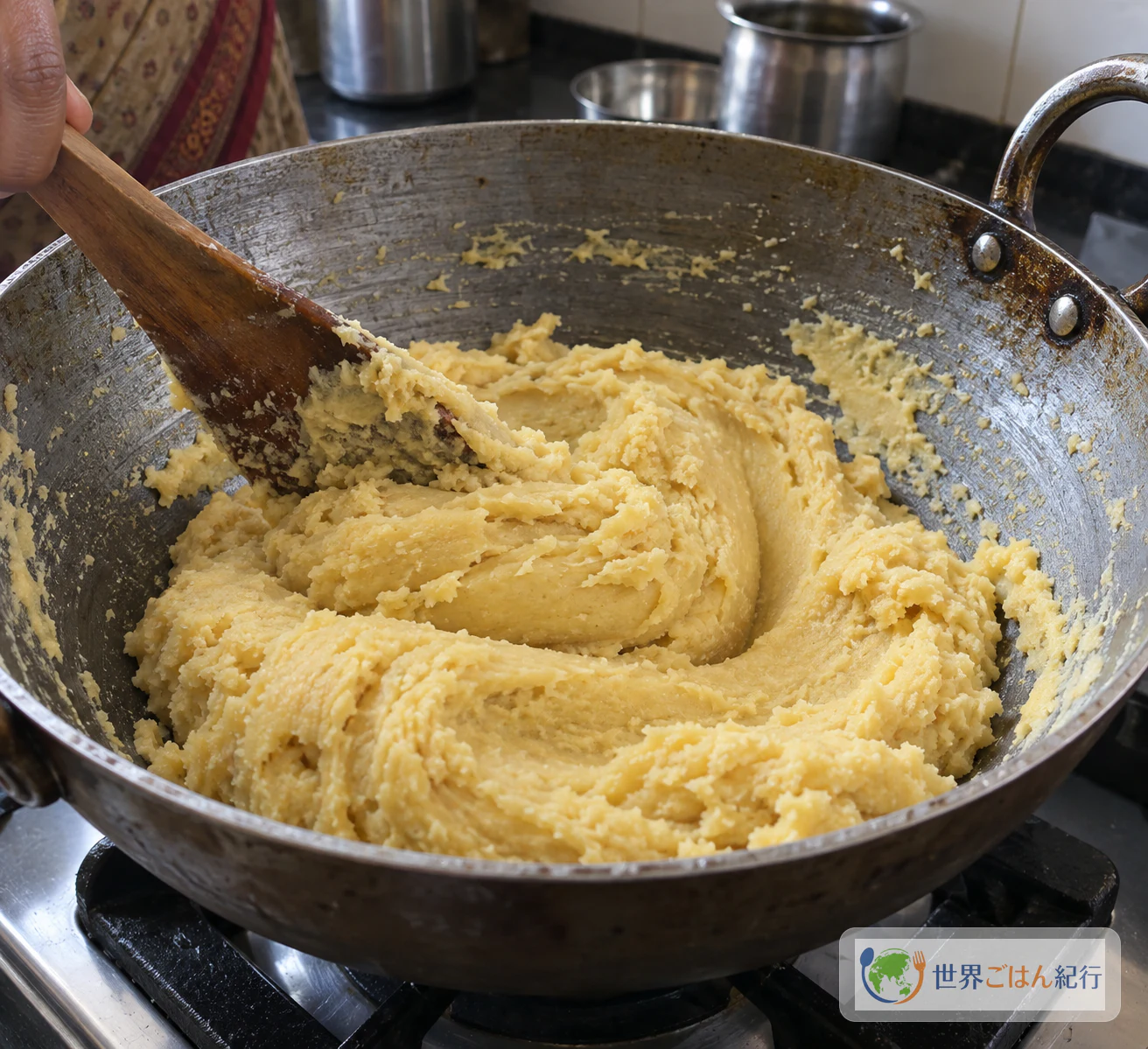
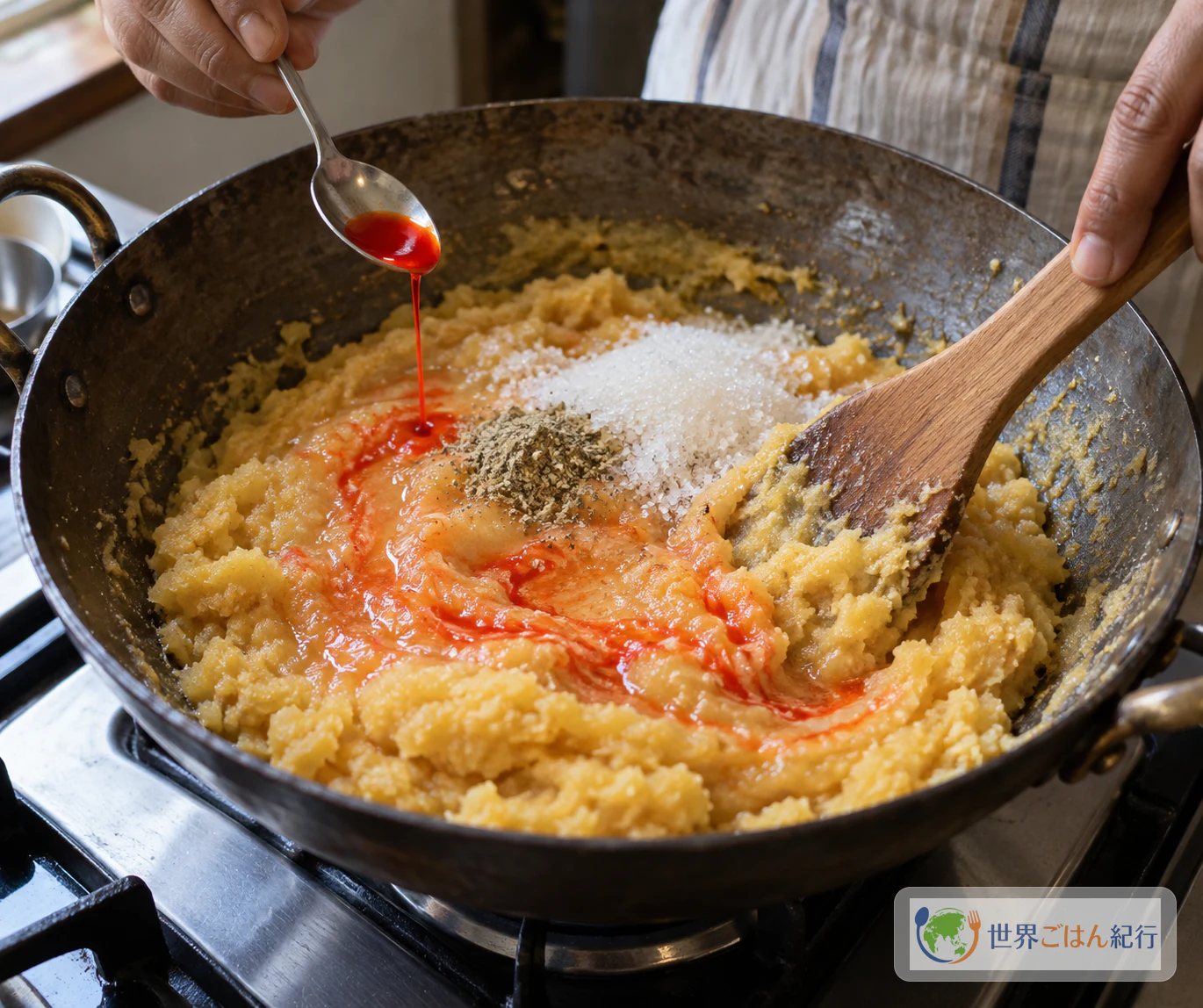
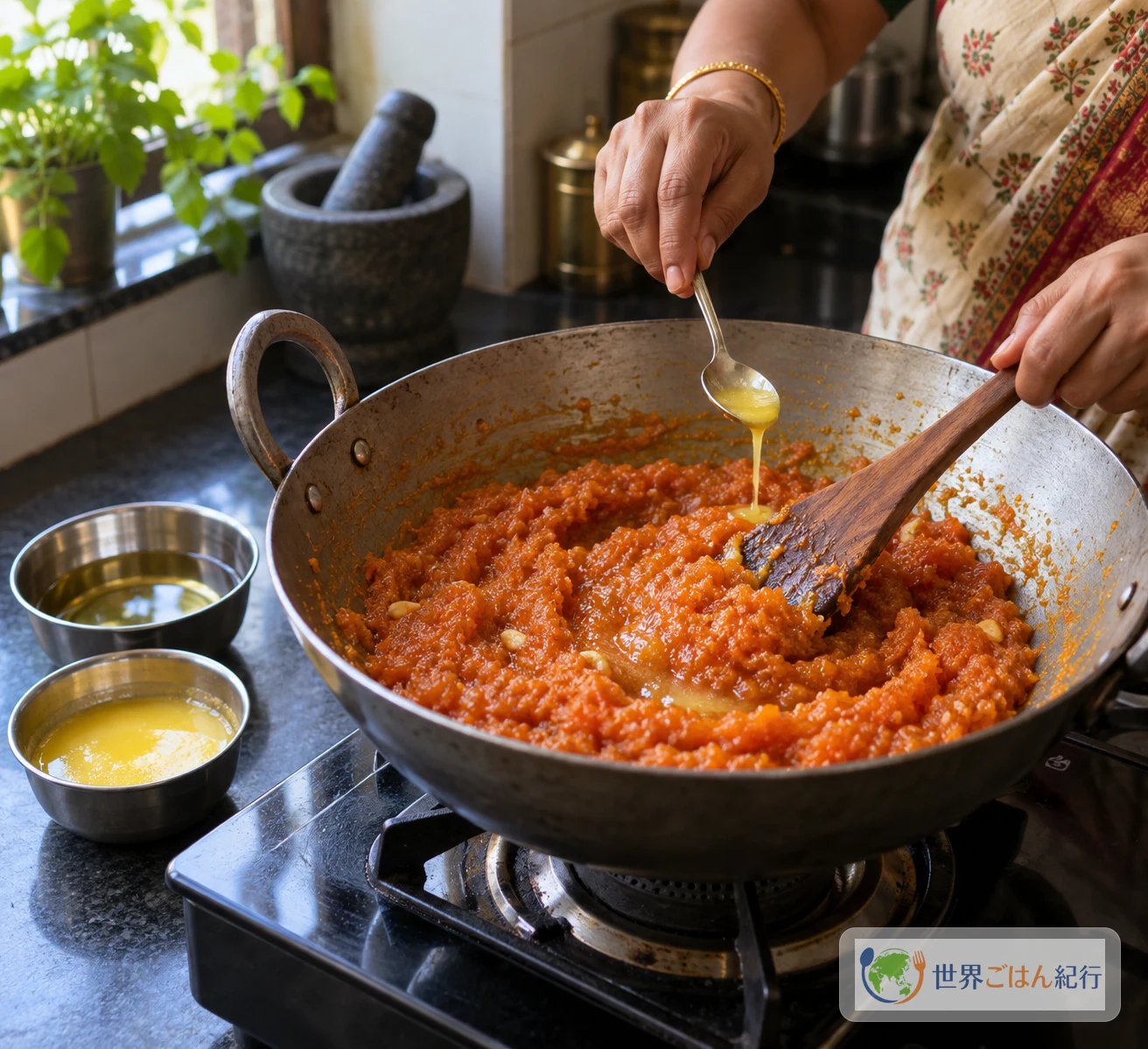
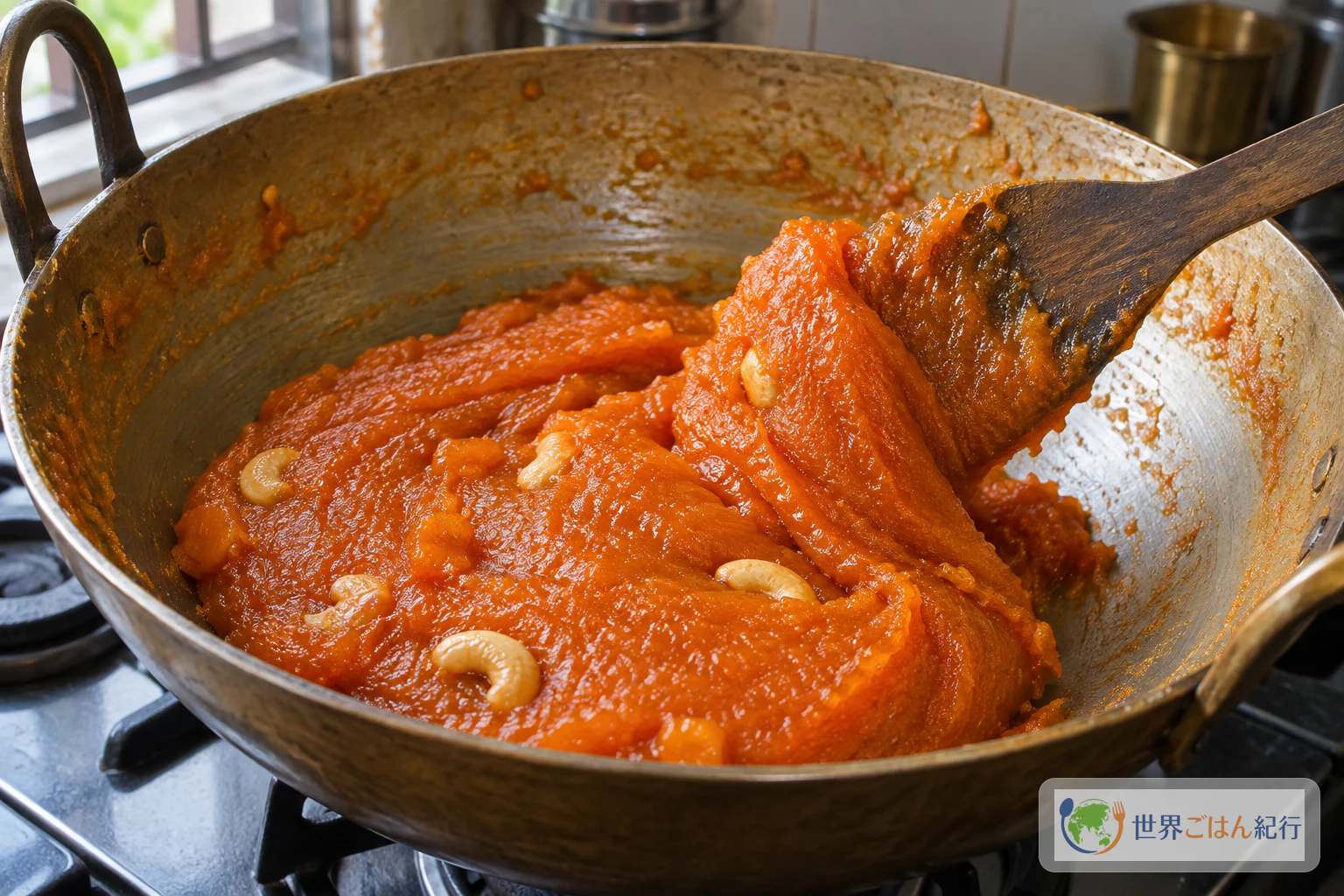
Cook the dal until it crushes easily and mash it smooth. Roast the flour until it smells toasty. After the sugar goes in, keep stirring and work in the oil and ghee a little at a time until the halwa turns glossy and gathers away from the pan.
The sugar goes into a thick, pale paste of mung beans and roasted flour, and within moments the mixture loosens and turns almost runny. This is not a mistake. From here you keep stirring, adding oil and melted ghee a spoonful at a time, letting each addition disappear before the next. Gradually the color deepens, a sheen appears, and the mass starts to slide away from the sides of the pan as one soft piece.
Ashoka halwa, also written Asoka halwa and known as pasi paruppu halwa, is a rich sweet made from yellow split mung beans. Recipe writers and regional news coverage connect it with Thiruvaiyaru, a town in Tamil Nadu in South India. This article follows one home recipe: a version published by the recipe site Chitra's Food Book, whose author adjusted the ingredient ratios of a magazine recipe to suit her own needs. Other published recipes use quite different proportions, so this is one well-documented way to make the dish, not the single "authentic" formula and not a copy of any shop's halwa.
Ashoka Halwa as Told in Thiruvaiyaru
A report in the Tamil news outlet ABP Nadu describes the halwa as Thiruvaiyaru's sweet and takes readers to a local shop, Andavar, where the halwa is served hot on a banana leaf with a portion of spicy mixture, a crunchy savory snack, alongside. That pairing of hot, sweet halwa and a salty, spicy snack is how the article portrays this local shop; it is not presented as something every household does.
The same report ties the shop to the Thyagaraja Aradhana, the music festival in Thiruvaiyaru, describing how musicians and visitors who come for the festival seek out the halwa. In that telling, the sweet belongs to the town's food memory as much as to its kitchens.
Both the news report and Chitra's Food Book credit a man named P.V. Ramaiyer (called Ramu Iyer in the recipe post) with introducing the halwa in Thiruvaiyaru, but the two accounts describe the time span differently, and neither is an independent historical record. This article does not fix a year of origin, and it does not guess at where the name "Ashoka" comes from. The shop in the report also attributes its flavor to local water and firewood; that is the shop's own explanation, and a home kitchen has no way to test it. This article follows the published process: smooth dal, toasted flour and patient additions of fat. This version has not been kitchen-tested by Sekai Gohan, so the result is not guaranteed for every ingredient or kitchen.
Ashoka halwa does not have one fixed definition. Published recipes vary widely in their ratio of dal to flour, sugar and ghee, and in whether they include maida, oil, food coloring or saffron. For more dishes from across the country, see the India country page.
| Recipe | Main proportions as published | Notes |
|---|---|---|
| Chitra's Food Book (used here) | Yellow moong dal 1/2 cup, wheat flour 1/4 cup, maida 1 tbsp, sugar 1 cup, cooking oil 1/2 cup, ghee 1/2 cup | Uses both oil and ghee, red food color and cashews |
| Indian Express Tamil | Pasi paruppu 250 g, ghee 250 ml, sugar 500 g, wheat flour 30 g, cashews 50 g, cardamom 2 g | Red food color with no amount given; no yield or timing listed |
| NDTV Food | Moong dal 2 cups, whole wheat flour 1 cup, ghee 1/4 cup + 1 tbsp, sugar 1/2 cup | Uses saffron; cashews and raisins optional |
These comparisons only show that recipes differ. The method below uses the first recipe alone and does not mix in amounts or steps from the others.
Ingredients for the Chitra's Food Book Version (Makes 2 cups)
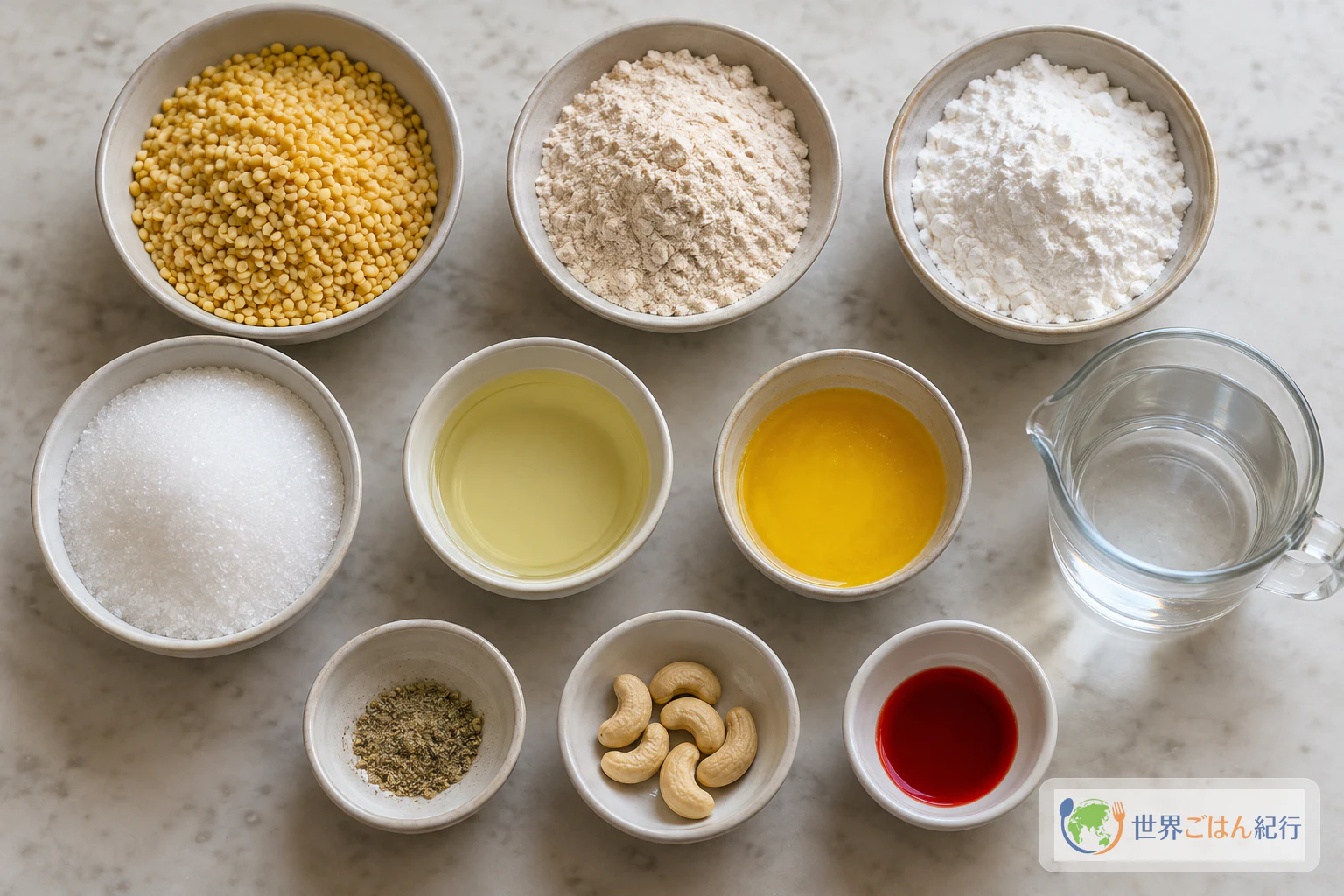
The source measures in cups and spoons, with 1 cup equal to 250 ml. The amounts are kept exactly as written. The oil is used in two parts, and the two quantities of water have different jobs.
This recipe contains wheat (wheat flour and maida), cashew nuts, and ghee, which is made from milk. Check the labels on every package, including the dal, and use food coloring only according to its food-use labeling.
Choosing Ingredients and Substitutions
Yellow moong dal is skinned, split mung beans. Look for it at Indian grocers or online if your supermarket does not carry it; whole green mung beans with skins are not the same ingredient.
Ghee carries much of the aroma here, so don't treat it as interchangeable with butter or ordinary vegetable oil. The cooking oil in this recipe is specified as refined and odorless, so choose a neutral oil rather than one with a strong flavor.
Cashews only need to be ordinary unsalted cashews; there is no need for a special grade. Maida is a refined white wheat flour; all-purpose flour is the common equivalent name.
Red food color is optional. Without it the halwa will be paler than in the photos, but the ingredients and aroma stay the same. This article does not suggest a natural ingredient as a replacement for the color, because the recipe does not test one.
Equipment
- A pressure cooker or a pot for cooking the dal
- A heavy, deep pan or kadai for the halwa (useful for long stirring, but an ordinary pan works)
- A potato masher or a blender
- A sturdy spatula or wooden spoon
- Measuring cups (250 ml) and measuring spoons
- A few small bowls for the oil, ghee and color mixture
Method: From Smooth Dal to a Glossy Halwa
The recipe card in the source lists 15 minutes of preparation and 30 minutes of cooking, while the author's own text says cooking takes 30–45 minutes depending on the quantity. Treat these as a rough guide: the amount you make and your burner will change the time, so judge doneness by how the halwa looks and moves, not by the clock.
Heat levels come from the source: high heat to dry-roast the dal, low heat to roast the flour, and medium to medium-high once the dal and sugar are in. The source gives no temperatures.
Troubleshooting: Grainy, Scorched, Runny or Oily
| Problem | What to do |
|---|---|
| The dal paste still has grains | Mash or blend it again before the sugar goes in; once the sugar is added, the grains are hard to fix |
| The flour looks about to burn | Lower the heat right away and keep stirring |
| The mixture went runny after the sugar | This is expected. Keep cooking and stirring; it comes back together as you add the fat |
| The fat isn't mixing in | Stop adding fat and keep stirring until what is in the pan is absorbed, then continue in smaller amounts |
| The fat has separated or the halwa has scorched | The source gives no reliable way to undo either, so it is best to prevent them with small additions, steady stirring and controlled heat |
Variations, and How They Change the Result
- Without food color: The halwa will be paler. The ingredients and aroma stay the same, making this the simplest change.
- Without cashews: This may help when cooking for someone with a nut allergy, but watch for cross-contact in your kitchen and ingredients. The flavor and texture will change.
- Less ghee, more oil: The author mentions that some cooks use more oil and less ghee, but gives no ratio. Treat any such change as a different recipe that needs its own testing.
- Less fat or less sugar: The author does not recommend reducing these, and the same gloss and texture are not guaranteed. If you adjust them, expect a different finish.
Storage and Reheating
The recipe author writes that the halwa keeps for 10 days in a container, but does not say at what temperature or under what conditions, so that figure should not be read as a safe storage period. The source also does not explain how to store or reheat it. A cautious approach: store the halwa in a clean, airtight container in the refrigerator, eat it soon, and discard it if you notice an off smell or change in color. When reheating after refrigeration, warm a small amount at a time so it heats evenly.
Frequently Asked Questions
Is Ashoka halwa the same as North Indian moong dal halwa?
The names overlap, and the recipe used here is itself titled both Ashoka halwa and moong dal halwa. This article follows the Chitra's Food Book version linked with Thiruvaiyaru. Other recipes published as Ashoka halwa, such as NDTV Food's, use different proportions and ingredients, so there is no single shared definition.
Is the red food color necessary?
No. It is used in this version, but you can leave it out; the halwa will simply be paler. This article does not suggest turmeric or other ingredients as a substitute, because the recipe does not test them.
Do I have to use all the oil and ghee?
The listed amounts are the maximum. The author adjusts how much goes in by watching the halwa, so add the fat a little at a time and stop once it is glossy and leaves the pan.
How many people does it serve?
The source gives only the finished quantity, about 2 cups, and no number of servings.
Can I make it ahead?
The author mentions keeping it for 10 days in a container, but without storage temperatures or conditions, that cannot be treated as a guarantee. Refrigerate it in a clean, airtight container and eat it soon.
Will it taste like the halwa from the Thiruvaiyaru shop?
Not necessarily. The shop described by ABP Nadu attributes its flavor to local water and firewood, which a home kitchen cannot reproduce or test. This is a home version based on one published recipe, not a copy of the shop's halwa.
Sources
- Chitra's Food Book, "Ashoka Halwa Recipe – Thiruvaiyaru Pasi Paruppu Halwa – Moong Dal Halwa." The recipe used in this article: ingredients and amounts, method, yield of 2 cups, the recipe card's timing and the 30–45 minute range in the text, the author's adjustment of a magazine recipe, her note on adjusting the fat, and her 10-day storage remark. Its account of the dish's history is secondhand. https://chitrasfoodbook.com/ashoka-halwa-recipe-thiruvaiyaru-pasi/
- ABP Nadu / ABP Live Tamil, "Ashoka Halwa: Thiruvaiyaru Ashoka Halwa – who invented it?" Regional reporting linking the halwa to Thiruvaiyaru, the Andavar shop and the P.V. Ramaiyer story, visitors to the Thyagaraja Aradhana, and the shop's serving of hot halwa on a banana leaf with mixture. Its explanations of origin and flavor are those given in the report, not independent historical records. https://tamil.abplive.com/news/thanjavur/thanjavur-thiruvaiyaru-ashoka-halwa-know-history-origin-interesting-things-tnn-214573
- Indian Express Tamil, "Ashoka halwa made the traditional way." A different published formula, used only to show how recipes vary. https://tamil.indianexpress.com/food/asohka-halwa-recipe-in-tamil-6805724
- NDTV Food, "Ashoka Halwa Recipe." Another published formula and method, used only for comparison. https://food.ndtv.com/recipe-ashoka-halwa-954769