
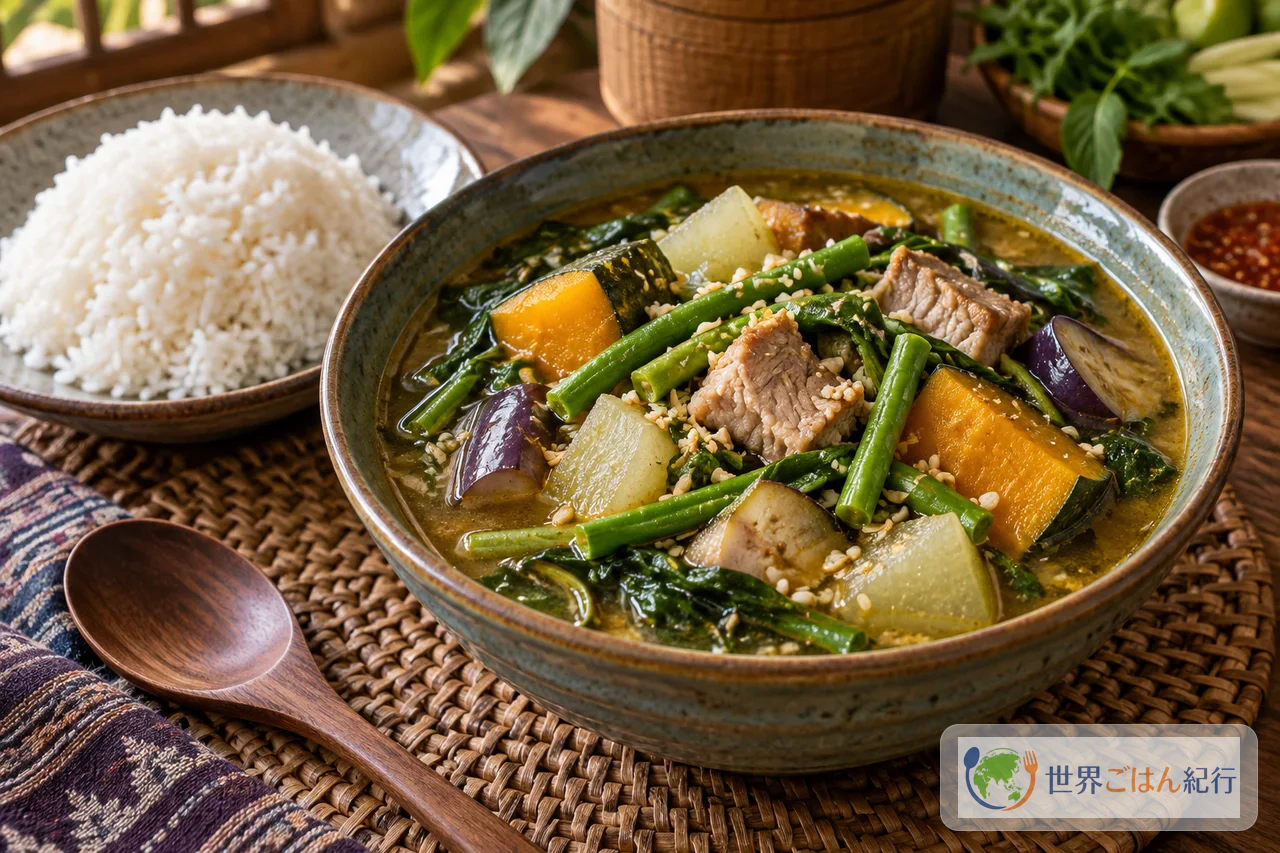
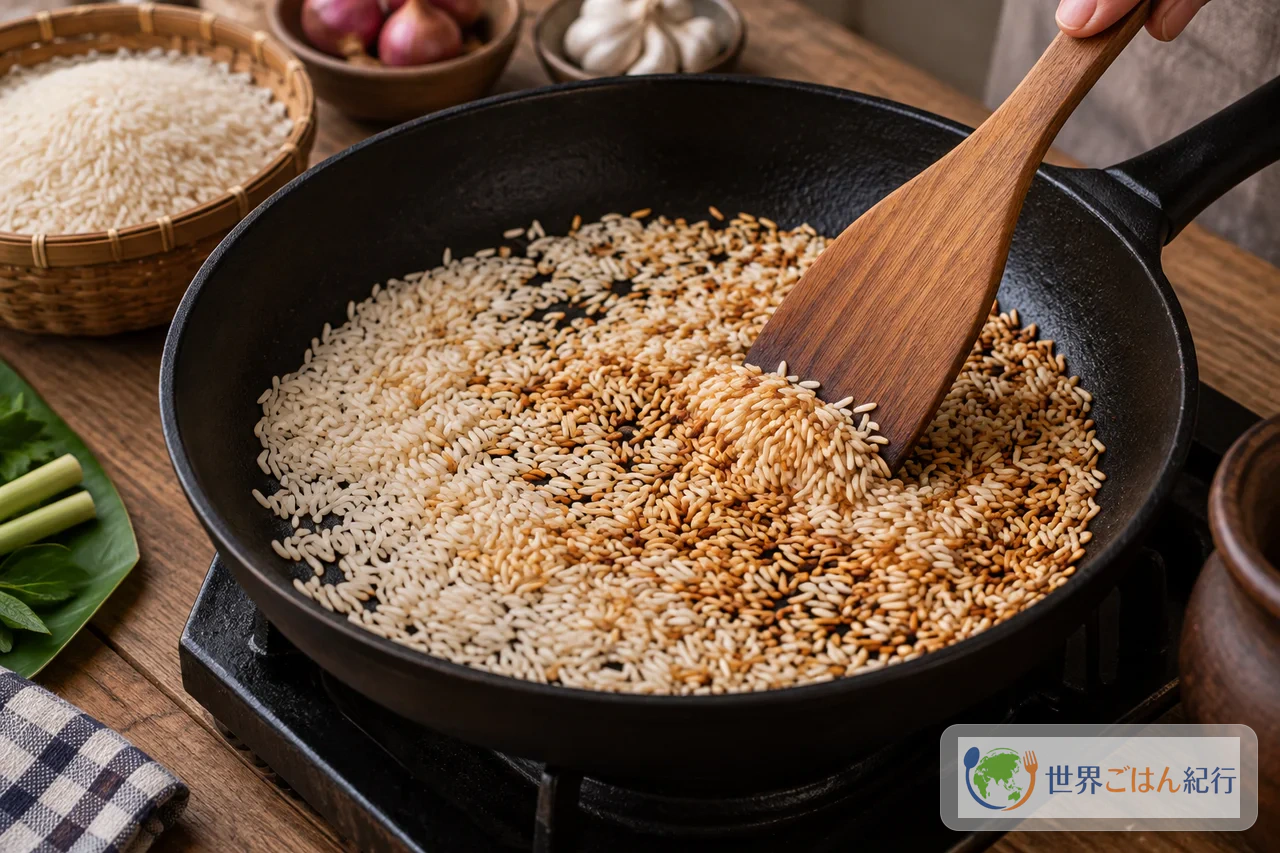
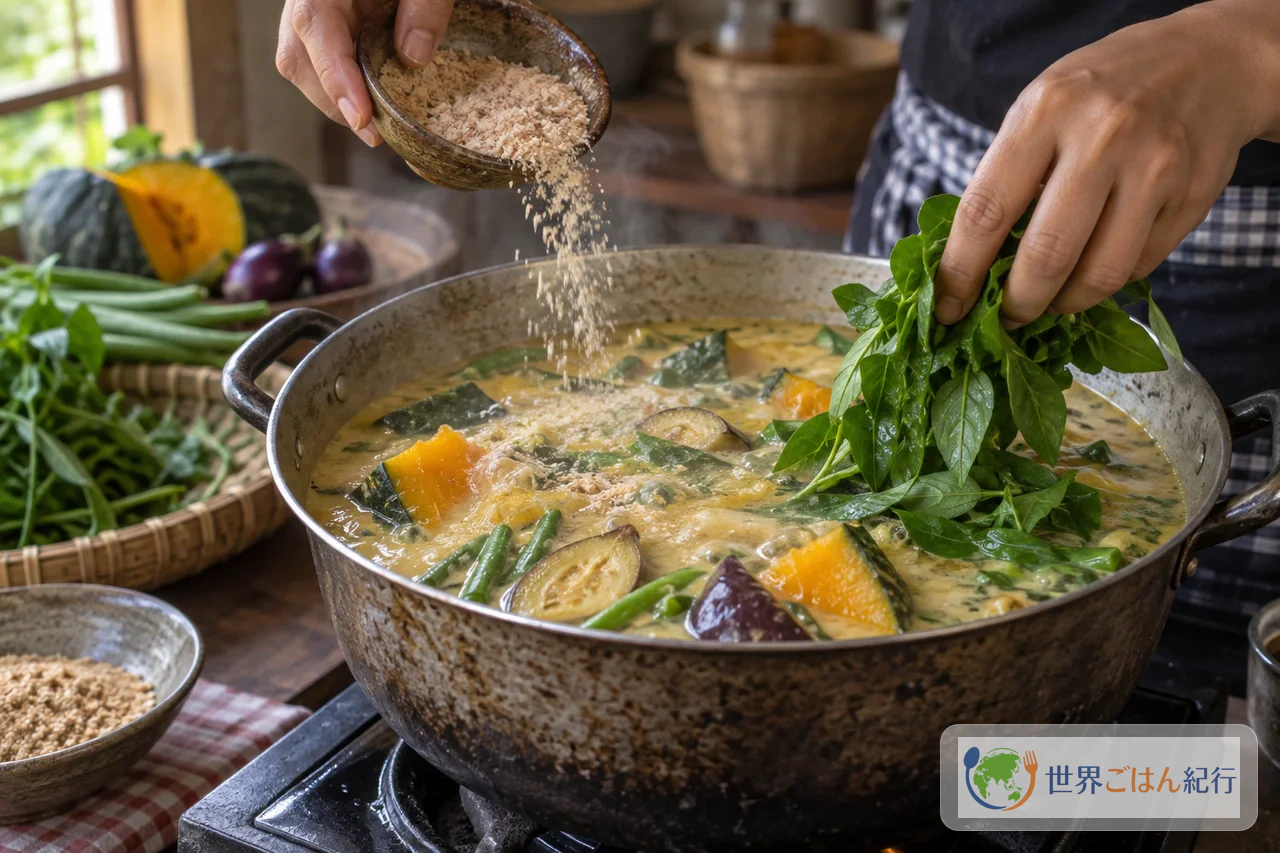
Roll rice around in a dry pan, and the white grains turn light golden bit by bit and give off a scent like popcorn. Add the cooled, coarsely crushed toasted rice to a pot of vegetables, and the broth does not turn heavy with flour but becomes thick enough to cling thinly between the vegetables.
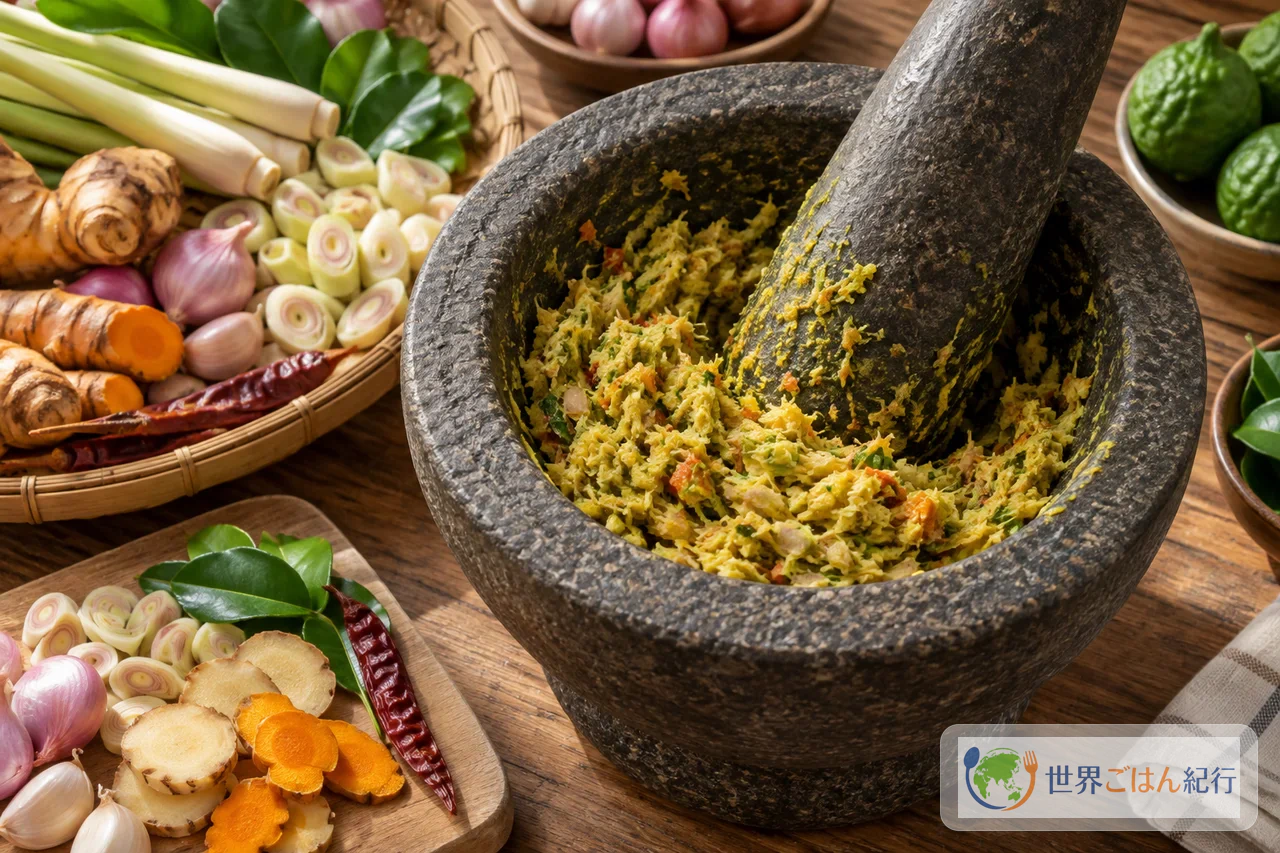
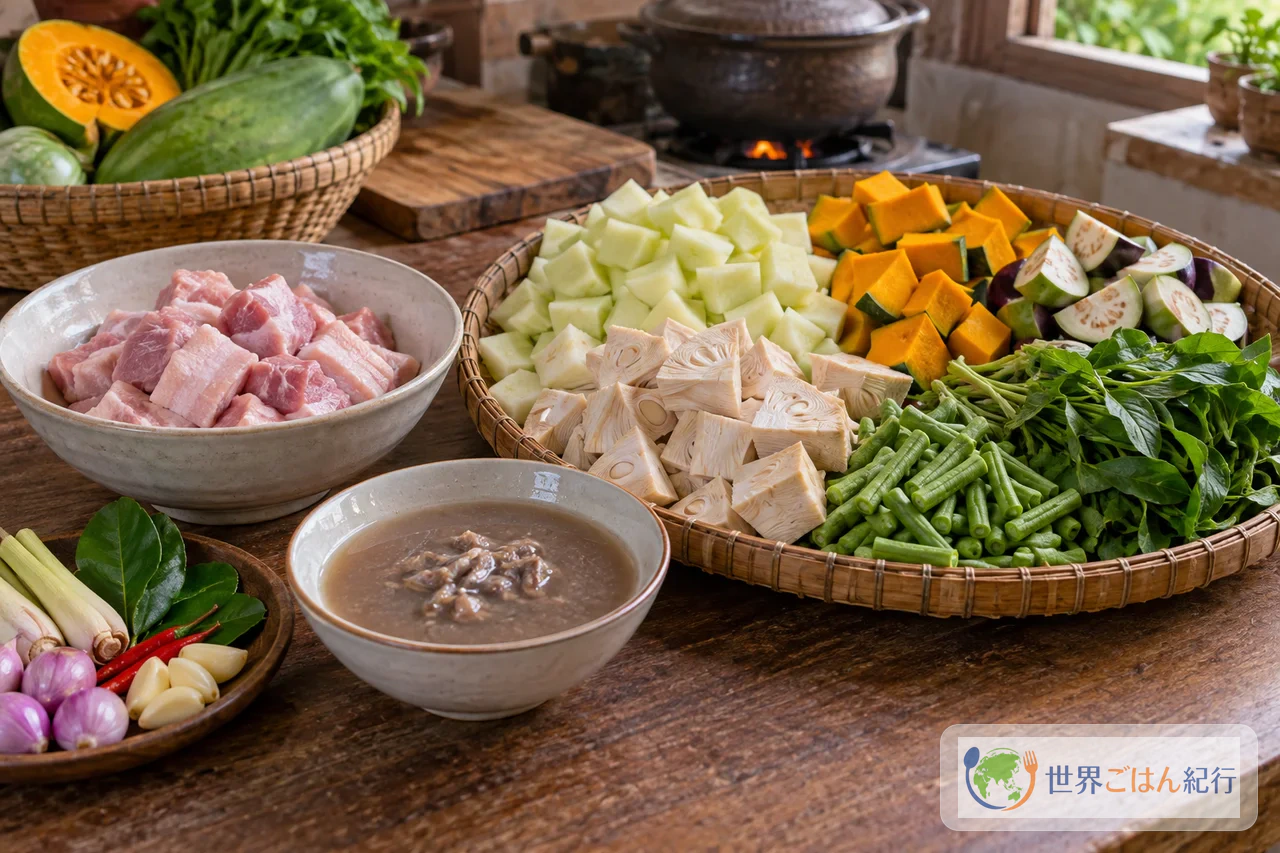
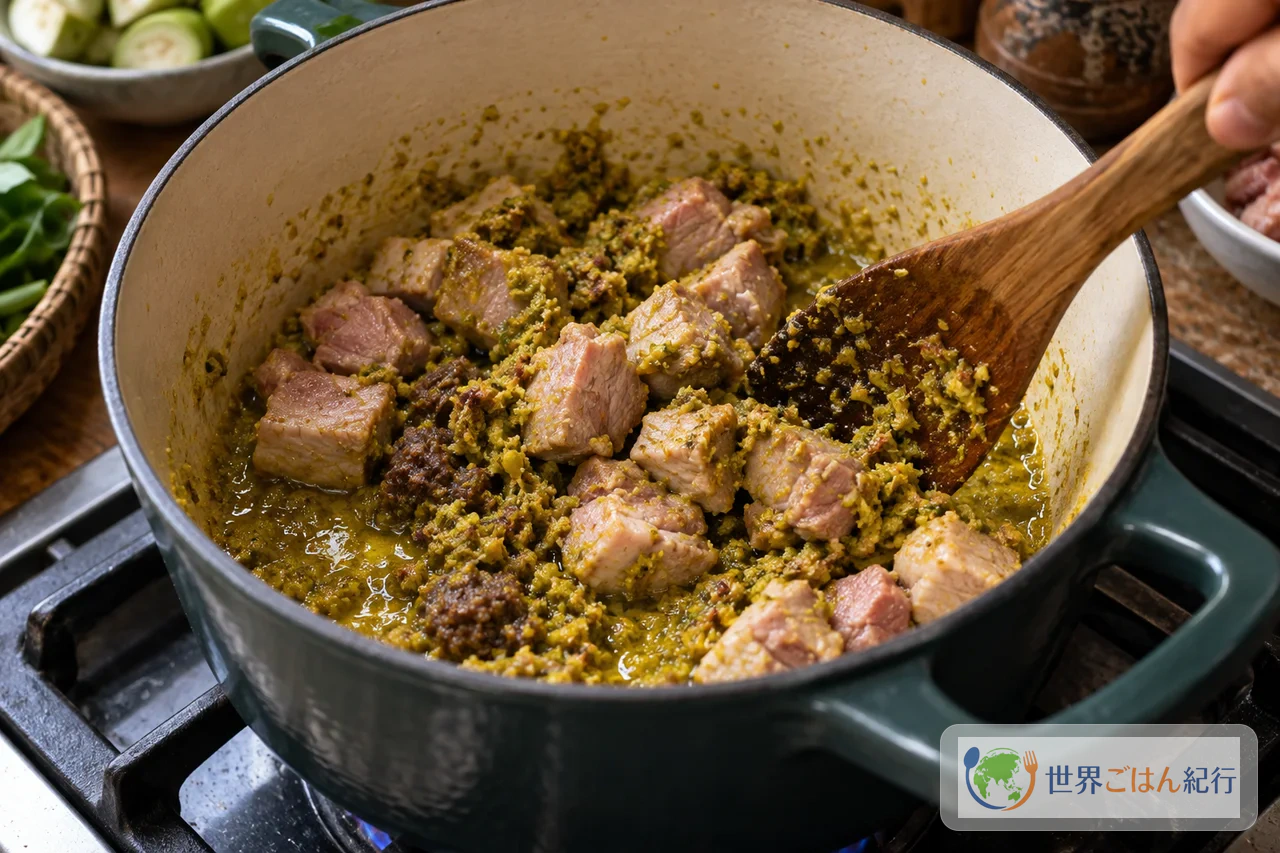
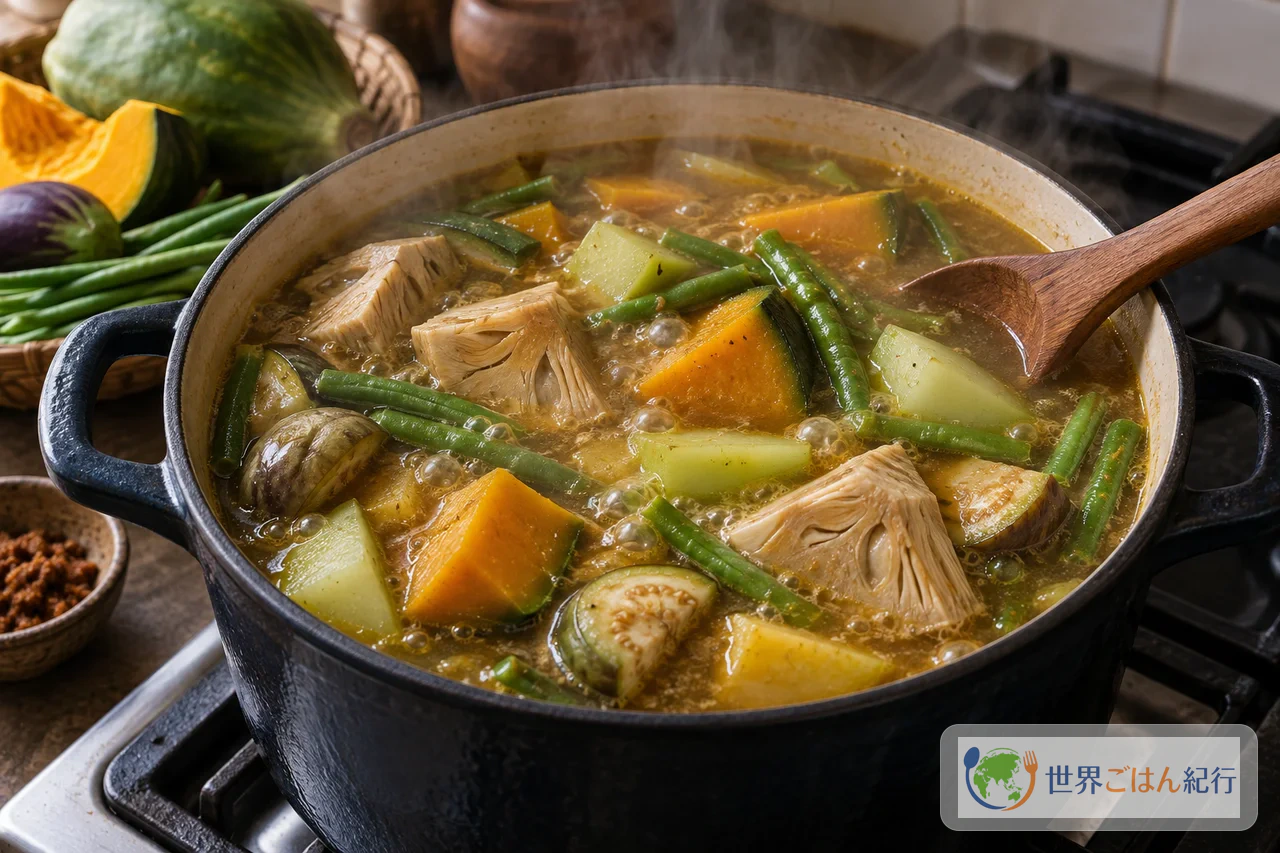
Samlor korko (Samlor Korko / សម្លរកកូរ) supports this toastiness with kroeung, a pounded blend of lemongrass, galangal, and makrut lime leaves, and with prahok, a fermented fish paste. The vegetables are cooked until soft, but put everything in at once and the pumpkin falls apart, the eggplant soaks up water, and the greens lose their green. Divide the hard vegetables, the meat, the toasted rice, and the leafy greens by how they cook, and texture survives in a single pot.
What gives people pause when making Cambodian home cooking abroad is not green papaya or young jackfruit so much as how to handle prahok. Leave it out to tone down the smell and it becomes easier to eat, but the depth of the fermented fish is lost too. This article treats the recipe with prahok as the standard, and also explains separately what changes when you replace it with fish sauce if you cannot get it.
Toasted rice pulls a pot of vegetables together: the background of samlor korko
Samlor is the Khmer name for a type of dish, and in English-language sources you also see the spellings samlaw, samlar, and samla. In sources that explain the name, samlor refers to a soup or stew, and korko is said to relate to the action of stirring the pot. True to the name, it is not a soup where you only drink clear broth; meat, vegetables, and an aromatic paste are mixed together in the pot and eaten with rice.
Official guides to the Cambodian table describe a food culture that combines rice, samlor, and vegetable dishes. Korko is sometimes introduced as a traditional stew using roasted and ground rice, pork, and pumpkin. Rice is not only served alongside; its aroma and light thickness are also put into the pot, which creates an eating experience different from a plain soup of meat and vegetables.
Kroeung, the center of the aromatics, is a paste pounded together from lemongrass, galangal, garlic, shallot, and makrut lime leaf, among others. Chopping the tough fibers and letting them open slowly in oil keeps the brightness of the lemongrass and the cooling quality of the galangal better than adding aroma all at once with curry powder. A small amount of chili adds a layer of fragrance, and at a table that wants to avoid heat, you can leave it out without breaking the backbone of the pot.
The ingredients are not a single fixed list. Depending on the region and household, some versions use more water and lean toward a soup, while others use more toasted rice and lean toward a stew. There are recipes with chicken or fish as well as pork, and the combinations change with the season and what vegetables are available: green papaya, young jackfruit, eggplant, pea eggplant, pumpkin, moringa. Outside Cambodia you can replace green papaya with daikon and young jackfruit with pumpkin or mushrooms, but toasted rice, kroeung, and prahok each have a separate role, so replacing them all with one substitute loses the outline of the flavor.
Dry-roasted rice gives the broth not just a toasty aroma but a fine, slightly grainy thickness. Adding store-bought rice flour gives an even thickening, but not the aroma of roasted grain or the small grains that remain between the ingredients. A few minutes of dry roasting and a coarse grind are steps you should not skip even when you cook this in a home kitchen.
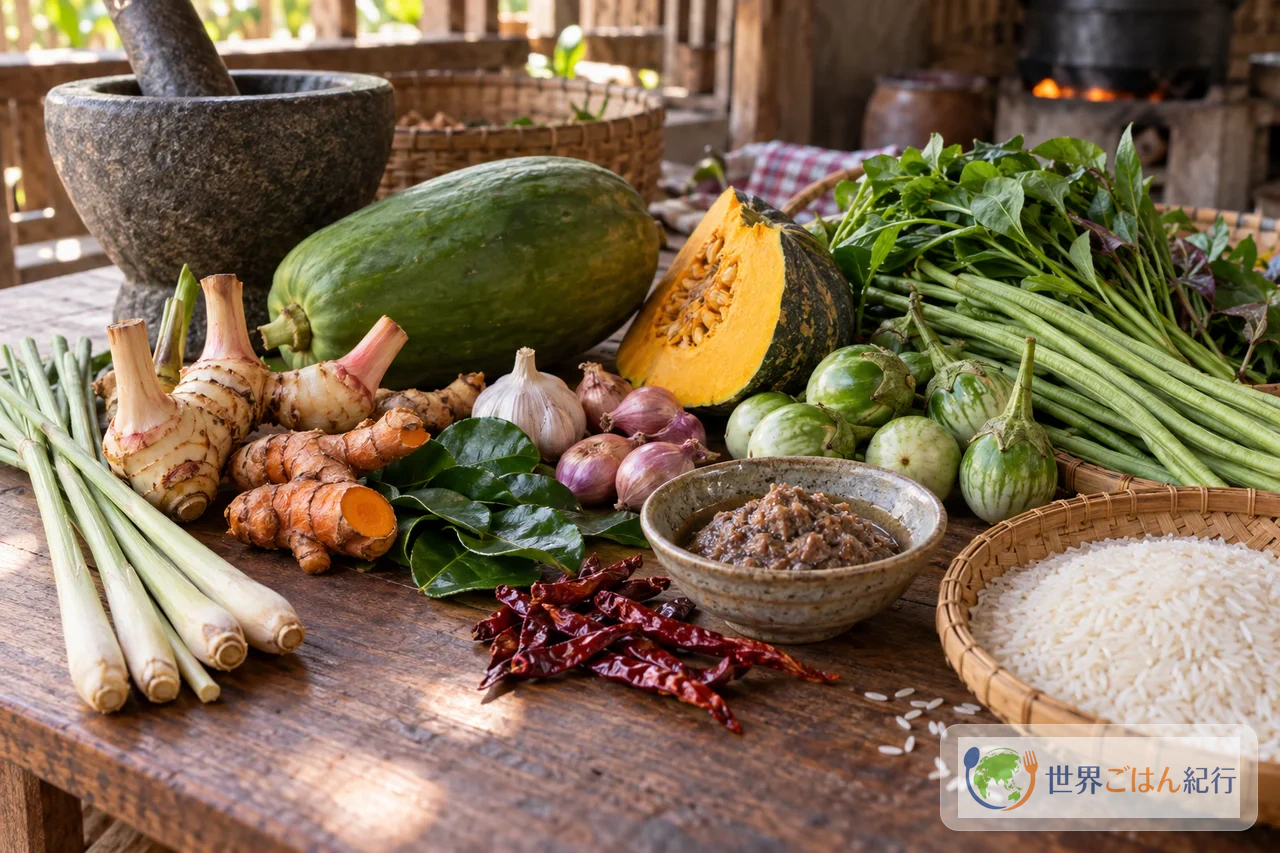
Ingredients (serves 4)
You do not need to gather every vegetable the authentic way. Think separately about the ingredients that form the core of the flavor and those that create texture in the pot. Lemongrass, galangal, and makrut lime leaves overlap in the role of aroma, so do not make up for the absence of two by using a large amount of the third.
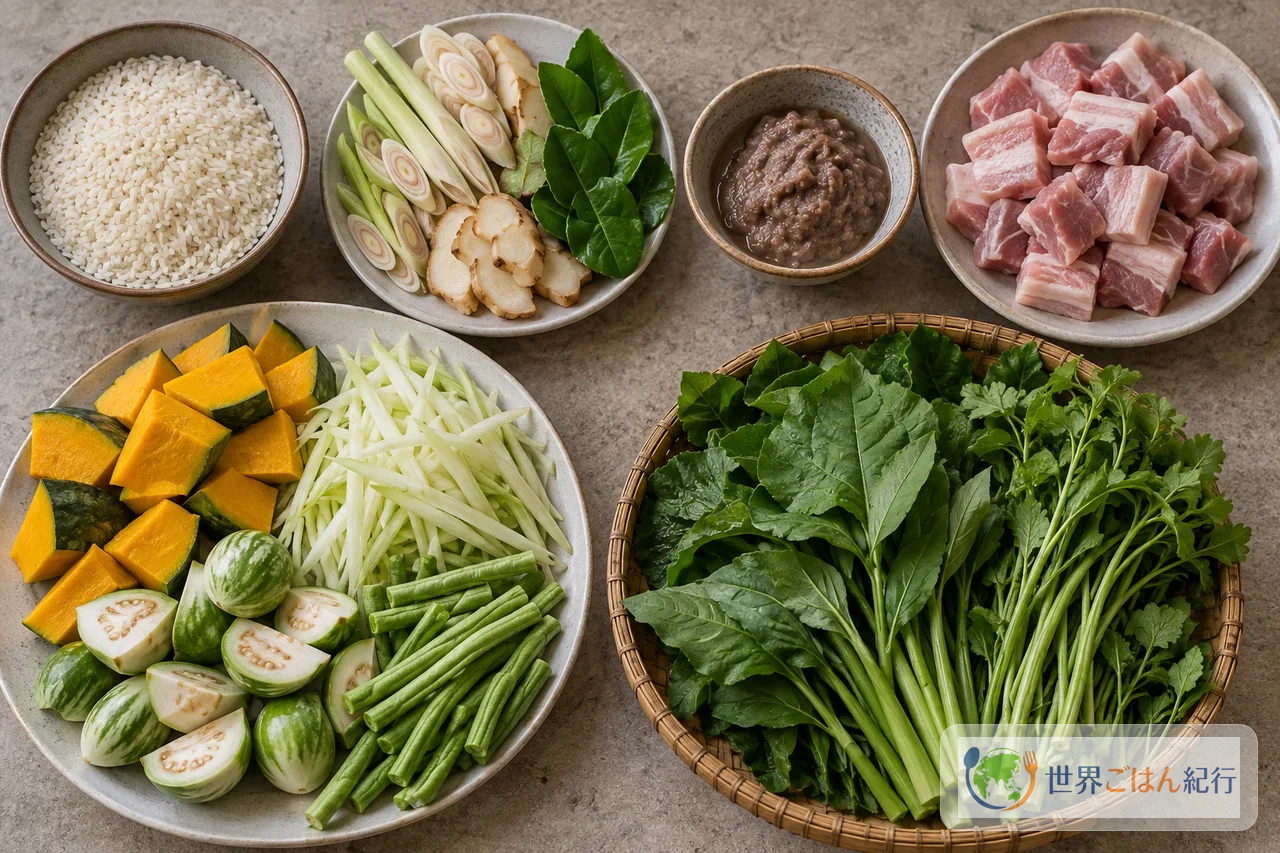
Prahok is a separate ingredient from fish sauce, shrimp paste, and chili paste. The reason to order it online if you cannot find it nearby is that just 15 g of fermented fish changes the base of the pot's savoriness and aroma. On the other hand, someone trying it once, or someone who dislikes the smell of fermented fish, can start with the version swapped to fish sauce. Check the label for a fermented fish paste whose ingredients are fish and salt, the size, and the storage conditions after opening.
If you want to keep the fermented aroma, dissolve 15 g in water and strain it. If you replace it with fish sauce alone, do not put in the full amount from the start; begin with 20 ml and taste. Salt content and solids differ by product, so check the ingredients and storage conditions before the size.
If you choose frozen lemongrass, decide by whether you will use the aroma many times. A product from which you can use the white part for the kroeung and put the green part into the broth makes it harder to waste the rest. Check that it is edible, the net weight, and whether it is frozen or dried.
Method: layer toasted rice, kroeung, and vegetables by how they cook
Do not reuse the cutting board or knife that touched raw meat for the leafy greens or the plated rice. If you finish cutting the vegetables during preparation and cut the pork last, it is easier to judge washing and cooking.
Three judgments that decide the result
Make the toasted rice coarse grains, not powder
Turning toasted rice into a perfect powder thickens the broth faster but loses the small toastiness when you bite into the rice. Conversely, grains that are too large stay hard in the mouth and thicken only part of the broth. Crush it to a mix of 1 to 2 mm grains and fine powder, and after adding it to the broth, wait only 3 to 5 minutes on low heat. Reheated the next day it thickens further, so finishing the first day's pot a little loose makes it easier to eat.
Do not cook the prahok aroma away; open it once in oil
Because the aroma of fermented fish is strong, adding it directly to the broth at the end makes the saltiness and aroma feel separate. After frying the kroeung in oil, add the strained prahok and fry for 1 minute so the pork picks up the aroma. When replacing it with fish sauce, the grainy feel and aged aroma of the fermented fish are gone, so do not put in all 30 ml of fish sauce at once; start with 20 ml and add 5 ml at a time at the end. If you want to know more about the aroma and use of prahok, the dip prahok ktis is also a useful comparison.
Whether to buy a mortar depends on whether you will make kroeung repeatedly
Kroeung made in a mortar releases aroma while crushing the lemongrass fibers. It does not need to be smooth like curry paste, so a food processor can recreate it, but there is more work to gather small amounts of aromatics under the blade. If you make Cambodian or Thai aromatic pastes many times a month, a heavy mortar is a candidate. If you are making this just once, a mortar or food processor you already have is enough.
If you choose a granite mortar set, check the material, inner diameter, whether it comes with a pestle, and how to wash it. It is heavy, so it suits people who can set aside storage space and a place to wash and dry it.
What flavor backbone to keep when you swap ingredients
Swapping green papaya for daikon
Daikon releases more water than green papaya and its time to breaking down is easier to predict. Cut it into 1.5 cm half-moons and add the next ingredient while the center is still a little firm. Cut thin, the flavor leaves it before the toasted rice goes in, and the broth ends up tasting only of daikon.
Leaving out young jackfruit
Young jackfruit goes in not as fruit sweetness but as a fibrous ingredient. If you cannot get it canned, do not force in ripe jackfruit; add 60 g of mushrooms. Mushrooms go in at the same time as the eggplant and absorb broth, so add 50 ml more water in all so the pot does not get tight.
Swapping pork for chicken or fish
With chicken thigh, fry the surface in the kroeung the same way as the pork, add the water, and cook through to the center. When using white fish or catfish-type fish, the flesh breaks easily, so simmer the hard vegetables first instead of the pork and add the fish for the last 10 to 12 minutes. When using fish, there is no need to increase the prahok. The fish broth and the fermented fish aroma overlap, so start the fish sauce low and taste.
Making it without meat or fish
Without prahok or fish sauce, you can build the flavor with 15 g of fermented soybean paste and salt, and it holds up as a vegetable stew. But the fermented fish aroma and the savoriness of the sea do not remain, so this is not a way to recreate samlor korko's flavor as it is. If you have a fish allergy or follow a vegetarian diet, check the ingredients of the seasonings and decide first where to draw the line of enjoying it as a different dish.
Soupier or more stew-like
Leaving the water at 900 ml gives a stew-like version in which the aroma of toasted rice and the ingredients cling to the rice. If you want more broth, add 50 to 100 ml from the start and keep the toasted rice at 45 g. Adding only water later dilutes the flavor, so put back fish sauce a little at a time and adjust to a richness that has aroma, not saltiness.
If you also want to try a kroeung fish dish, comparing it with amok shows how the same lemongrass-based aromatics change with coconut milk and steaming. Samlor korko keeps the shape of the vegetables and the grainy body of toasted rice, while amok gathers the aroma into the smoothness of fish and coconut.
From the Cambodian table to a home kitchen
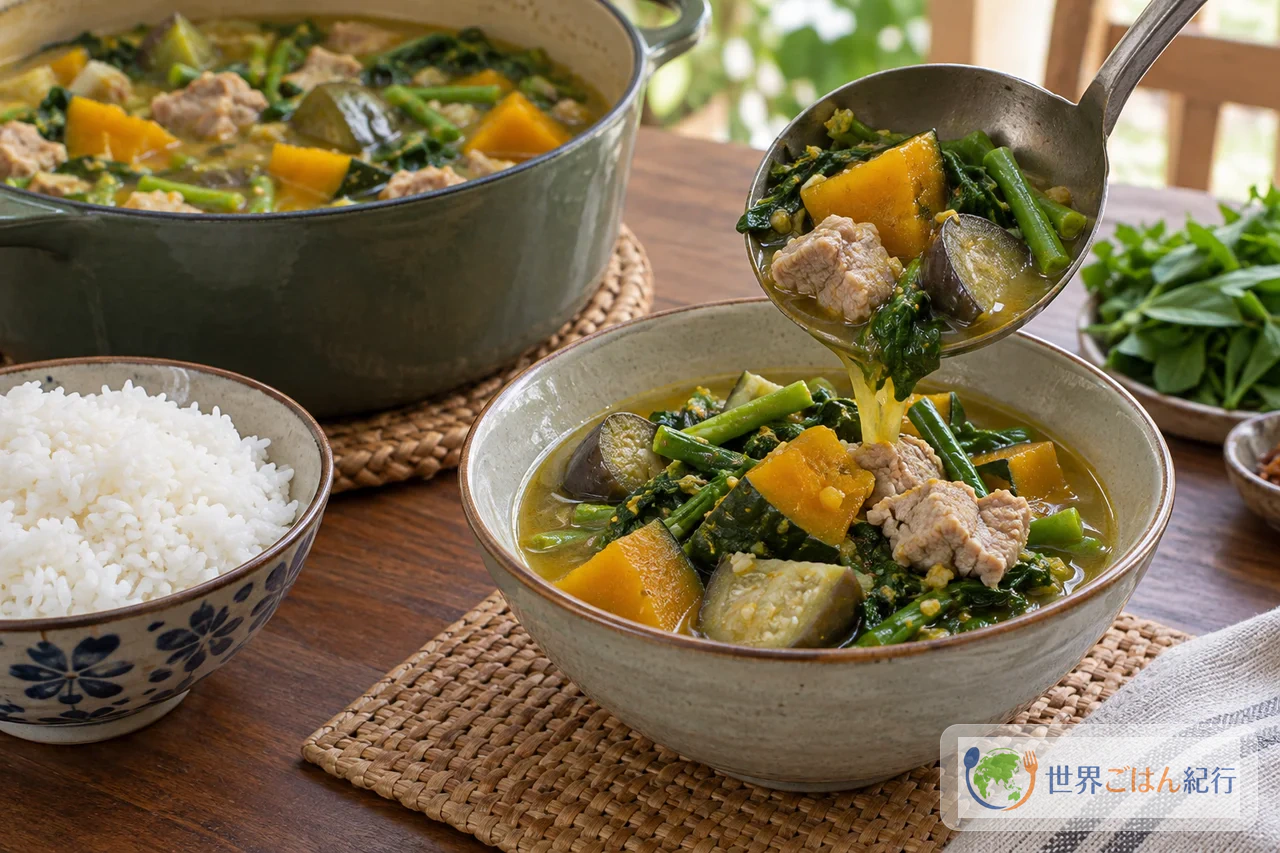
Samlor korko is easier to grasp as a dish when eaten with warm rice, breaking down the broth, vegetables, and meat little by little, rather than served as a rich stew that stands on its own in the pot. Cambodian food guides list rice, samlor, and vegetable dishes together because the table leaves room to recombine flavors and textures, rather than because soup and staple are eaten as separate things.
The order to protect in a home kitchen is clearer than the names of the ingredients. Cut the lemongrass and galangal fine and open the kroeung in oil. Strain the prahok with water and let the meat take it up. Simmer hard vegetables such as green papaya or daikon first, and add eggplant and beans afterward. At the end, give the broth its character with toasted rice and keep the color of the leafy greens. Follow this flow and even without pea eggplant or moringa, you can taste aroma, savoriness, and the layering of vegetables separately.
Conversely, if you replace the kroeung with store-bought curry powder alone, add the prahok only at the end as fish sauce, and turn the rice completely into powder, it moves closer to a spicy vegetable curry. That is not wrong, but you lose all three of samlor korko's individual qualities: the fermented fish, the pounded aromatics, and the toasted rice. When reducing ingredients, do not combine all three into one substitute; decide which aroma you will keep.
Frequently asked questions
Can I make it with fish sauce alone if I have no prahok?
You can, but it will not taste the same. Leave out the 15 g of prahok, start with 20 ml of fish sauce, and add 5 ml at a time at the end. If you want to make up a little of the fermented fish aroma, rather than increasing the fish sauce you could mash in a small amount of anchovy. But anchovy has its own flavor, so check that fish is among the ingredients and use it lightly the first time.
How far can I substitute green papaya, young jackfruit, and pea eggplant?
Green papaya can be replaced with daikon, young jackfruit with mushrooms or pumpkin, and pea eggplant with shimeji mushrooms or bell pepper. Daikon and pumpkin change the water and sweetness, so keep to the cutting size and order of adding. Ripe jackfruit is much sweeter, so do not use it in place of the young fruit.
How do I fix a broth that is too thin or too thick?
If it is thin, before adding more fish sauce, take off the lid and simmer on low for 5 minutes. Taste once the aroma of the toasted rice comes out and the broth leaves a thin coating on the back of a spoon. If it is still thin, add fish sauce 5 ml at a time. If it is too thick, add 30 ml of boiling water at a time, simmer 1 minute, and check. As it cools the toasted rice takes up more broth, so leaving the pot a little loose just before eating is the safe choice.
Can I make the kroeung without a mortar?
You can make it in a food processor. Cut the ingredients to about 2 mm before putting them in, add no water, pulse 10 seconds at a time, and scrape down the sides. It does not need to be perfectly smooth; stop when no long lemongrass fibers remain and it holds together when pressed with a finger. A mortar is handy for people who make aromatic pastes repeatedly, but for this one time no extra purchase is needed.
Can I make it ahead?
Separate the finished pot from the rice, move them to shallow containers, and cool quickly. Japan's Ministry of Health, Labour and Welfare advises, for preventing food poisoning at home, cooling leftovers in shallow containers, reheating thoroughly, and heating the center of a dish to 75°C for at least 1 minute. When reheating, check that the whole pot is bubbling and hot through to the center. The aroma of prahok and the thickness of the toasted rice grow stronger the next day, so eat it the same day if you can, and if you keep it, within the next day. Throw out anything about which you are unsure of the smell, the look, or how it was stored.
This dish uses pork, fish, fish sauce, and prahok. Use separate cutting boards, knives, and tongs so the juices of raw meat and fish do not reach salads or plated rice, and check the ingredient labels of each product.
Move the pot and the rice separately into shallow containers and cool them quickly, and when reheating, make sure they are hot all the way through. Because pork or fish is used, aim for 75°C or above at the center for at least 1 minute, and throw out anything you are unsure about in storage condition or smell.
Sources
- Information For Visitor | Cambodia Francophonie 2026: overview of Cambodian food culture, kroeung, prahok, samlor, and korko. Accessed and checked: 25 September 2026.
- How to Make Karko Vegetable Stew | Cambodianess: ingredients and cooking order based on a cookbook from the Ministry of Foreign Affairs and International Cooperation of Cambodia. Published: 19 February 2021. Accessed and checked: 25 September 2026.
- Samlor Korko Recipe: Cambodian Soup | Grantourismo Travels: explanation of spelling variations, household differences, toasted rice, prahok, ingredients, and how it is eaten. Published: 26 June 2020. Accessed and checked: 25 September 2026.
- Preventing Food Poisoning at Home | Ministry of Health, Labour and Welfare (Japan): handling raw meat and fish, heating the center to 75°C for at least 1 minute, and cooling and reheating leftovers. Accessed and checked: 25 September 2026.



