
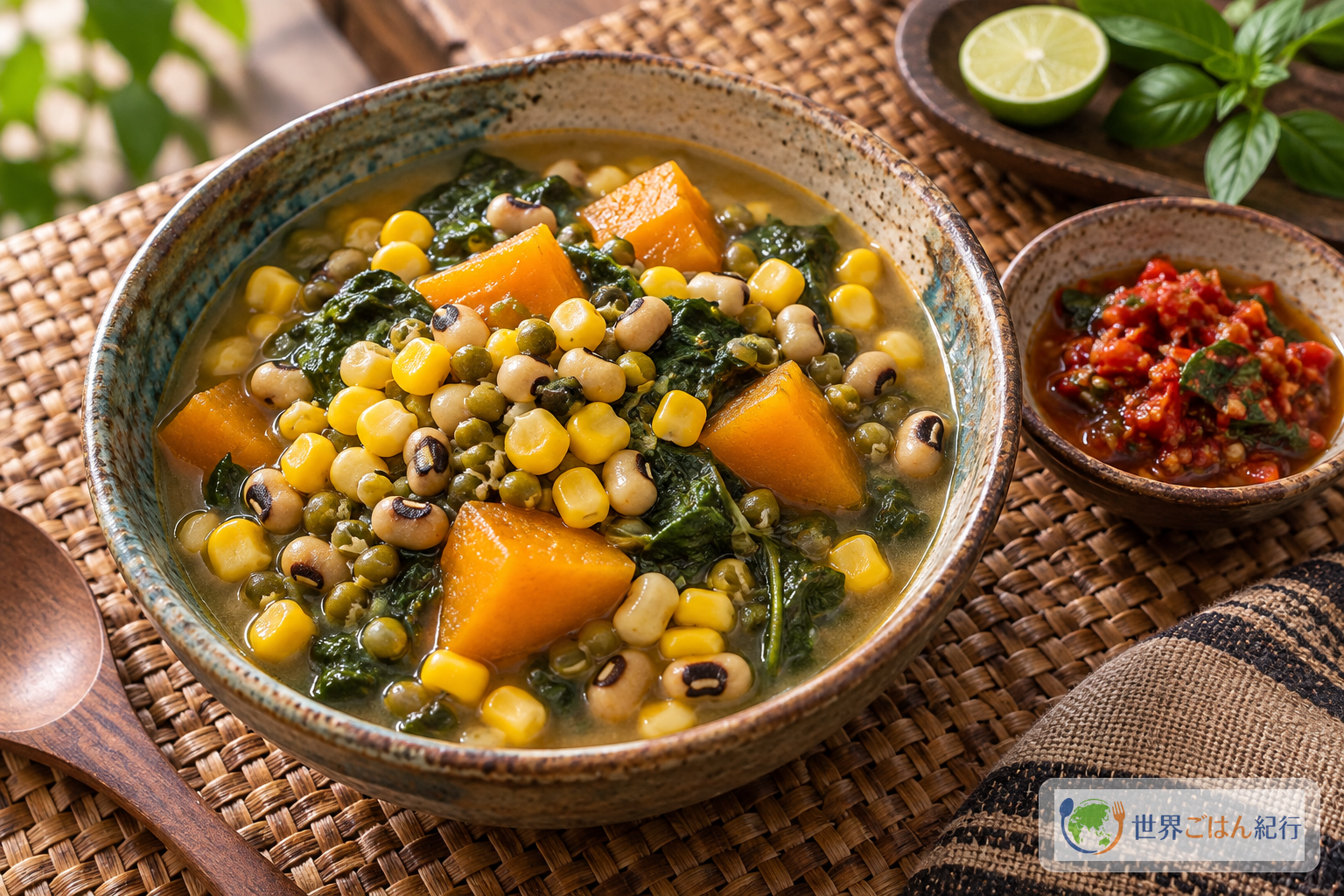
A pot where corn kernels bring beans and pumpkin together
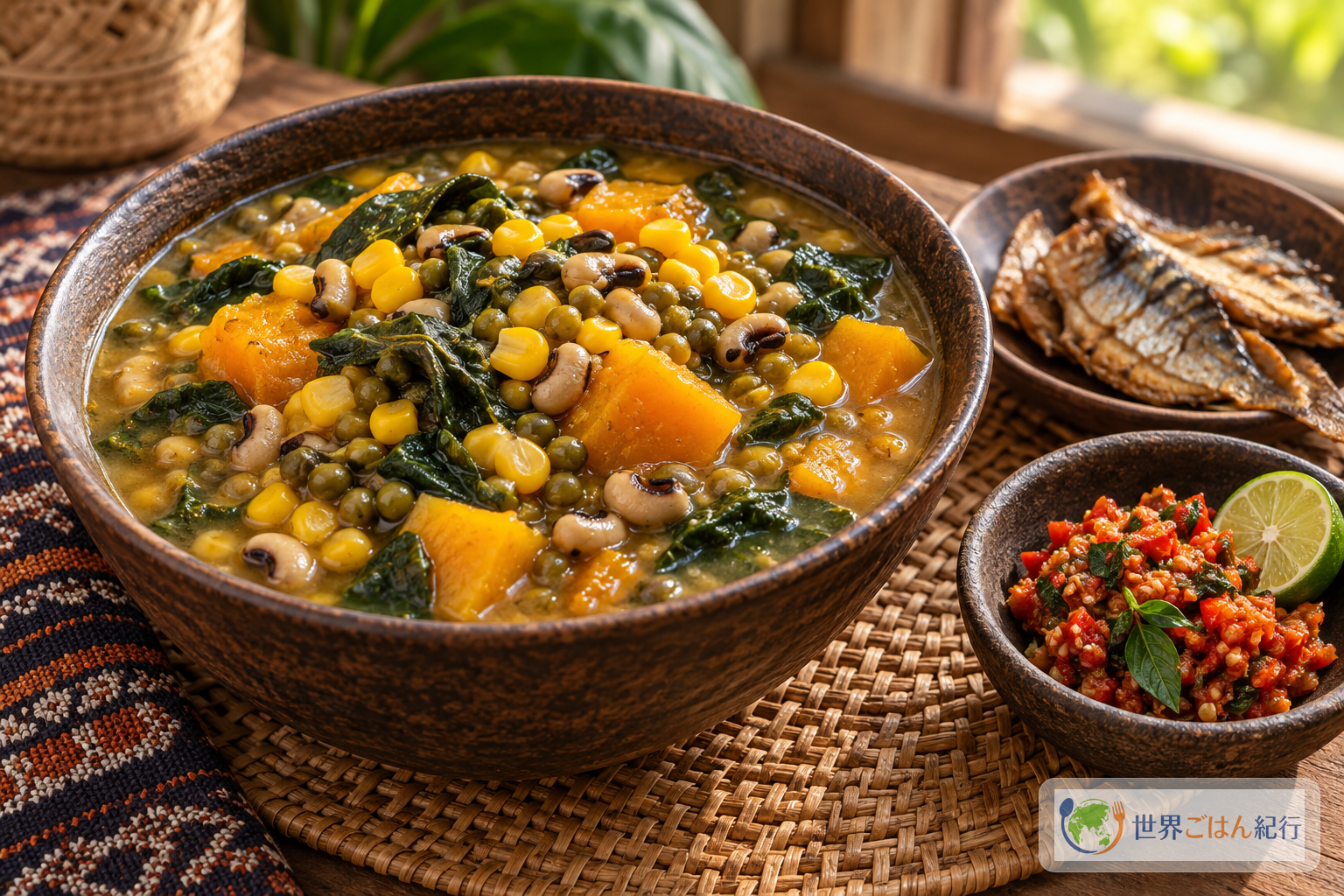
In the pot, dry corn kernels take up water and the skins of the beans soften little by little. Add pumpkin and its sweetness melts into the broth, still with edges to it, and when leafy greens drop in at the end, the boundaries between kernel, bean and vegetable are loosely joined. Katemak is not a stew that pushes flavor by layering spices. The taste of one pot is built from the time it takes to soften the ingredients and from a fiery sambal served on the side.
Katemak (Jagung Katemak) is a dish of corn, beans, pumpkin and leafy greens handed down in East Nusa Tenggara, including Indonesian West Timor. Local food-culture sources describe a distinction in cooking: hard corn is boiled first, while young kernels are cooked together with pumpkin and beans. When using dried kernels, following this order lets the corn cook through before the pumpkin falls apart. The names given for the beans in a food-culture source on East Nusa Tenggara (NTT), Bahan Pangan Masyarakat Nusa Tenggara Timur, vary by region, so mung beans and black-eyed peas are used here to recreate it.
When you can't find dried corn, using hominy that keeps the thickness of the kernel, rather than canned sweet corn, makes it harder to miss the direction of the texture. Pre-treatment is shorter, but the toasty aroma of dried kernels and how the core is left are not the same.
Hominy is for people who can't set aside the time to soak dried corn overnight or can't find hard edible kernels nearby. When buying, check the can contents, use only the amount in the ingredient table above drained, and handle the rest as the can label directs. If all you have is sweet corn, rather than forcing this substitute, make it as a different dish, a stew of beans and pumpkin, and the core of the flavor will remain.
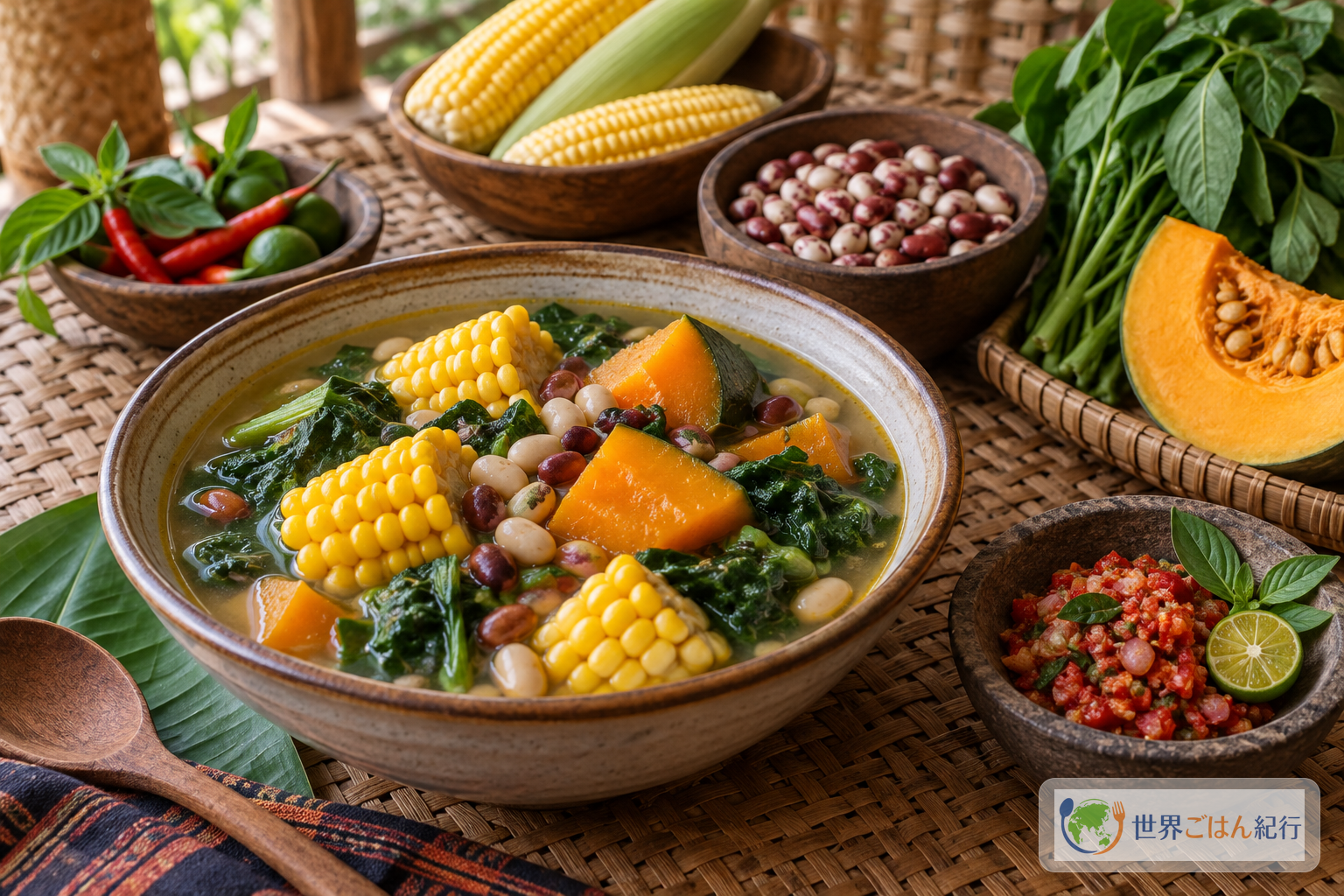
At the West Timor table, kernels and beans are stars together
On the dry land of East Nusa Tenggara, corn is not a flour or a garnish but a grain that supports the volume of the table. The five main ingredients of katemak recorded in the source are corn, pumpkin, kacang nasi, kacang polong and pumpkin leaves. Other vegetables, chile, meat and salted fish may be added. The black-eyed peas chosen in this recipe are not meant to assert the kind of bean, but are treated as a substitute that doesn't break down easily and keeps the presence of the grains.
A dish quite similar to katemak, across the border in East Timor, is batar da'an. English-language local guides and recipe sources also introduce it as a dish of corn, mung beans, pumpkin and leafy greens simmered together. But batar da'an is the name of an East Timorese dish, while katemak here is the name of a dish from Indonesian West Timor. It is more accurate not to merge them just because the ingredients are close, and to see it as similar pot dishes in the same climate zone of the island. The Air University Timor-Leste field guide also lists batar da'an as an East Timorese meal.
Even among West Timor's corn dishes, jagung bose shows a different face. Its pre-treatment removes the husk of the corn, and it is simmered with beans and brought toward a porridge with coconut milk. Katemak leaves the kernels and vegetables and sets the sambal separately. That difference is a clue to tell apart the corn dishes of the same land as you eat them.
Ingredients (serves 4)
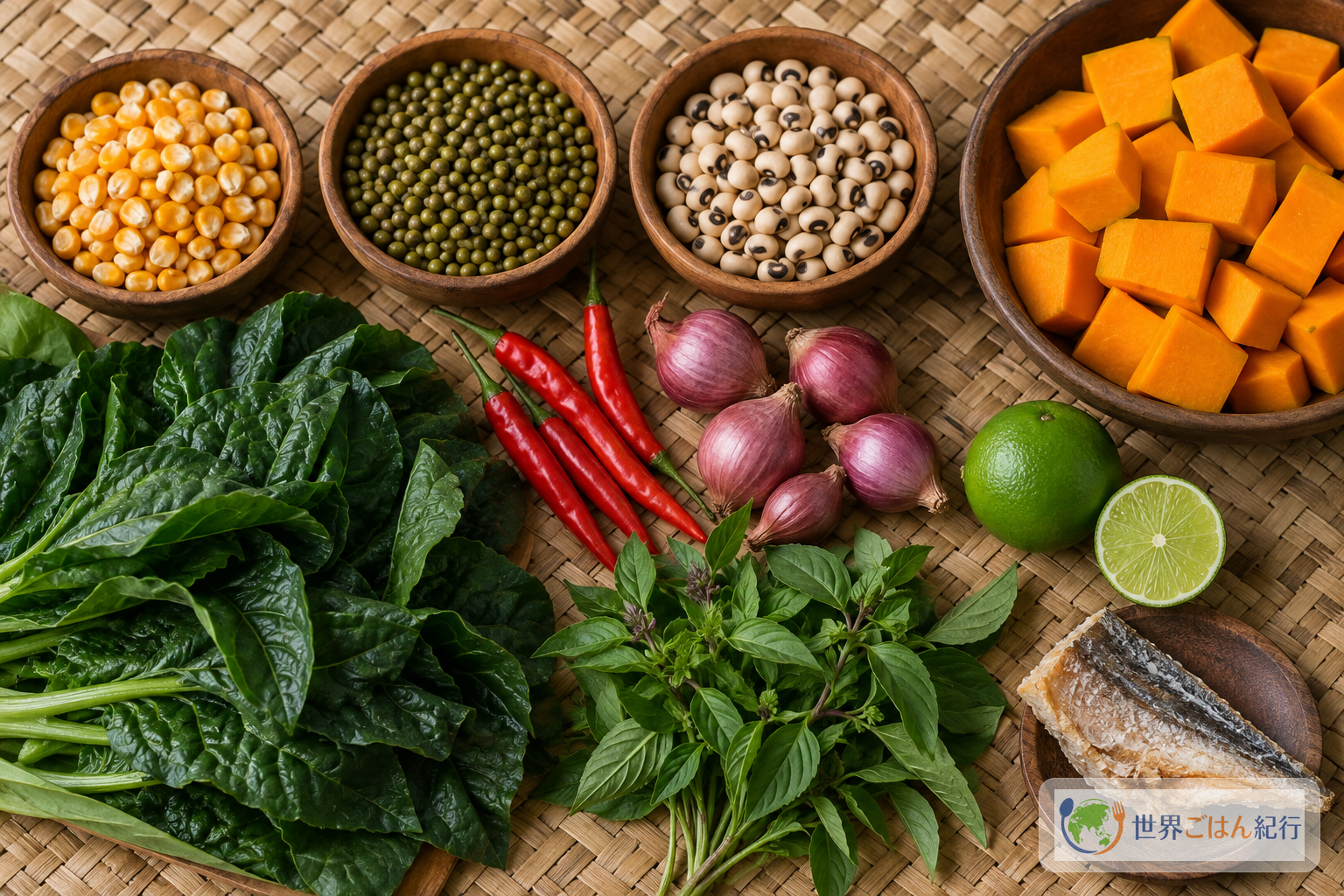
The nutrition figures for the ingredients are rough per-serving estimates using dried beans and dried corn, not including the sambal or optional coconut milk. They change with the kind of beans, corn and pumpkin, so if you need exact nutritional calculation, go by the labels of what you bought.
Method
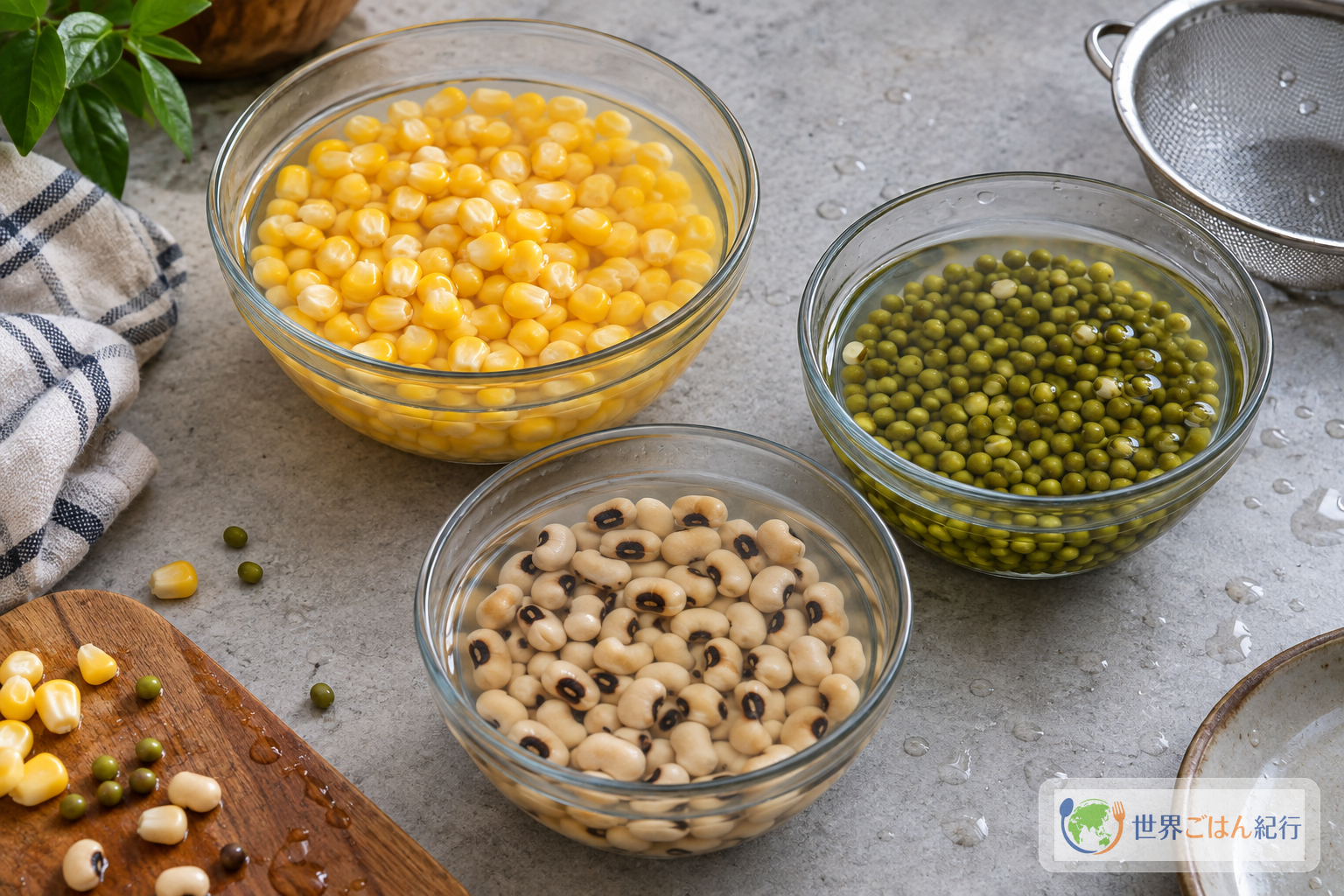
1. Soak the dried beans and corn separately
Wash the dried corn, mung beans and black-eyed peas separately and soak each in plenty of water for 8 hours or more. Don't cut the corn and beans; let them soften with their shape intact. Putting corn and beans in the same bowl makes it harder to see the difference in how they soften by grain size, so keep them apart. After soaking, discard the water and drain well in a strainer.
If using hominy, skip soaking the corn and soak only the beans. Drain the hominy and keep it in the refrigerator until the stage when pumpkin is added.
2. Cook the corn first
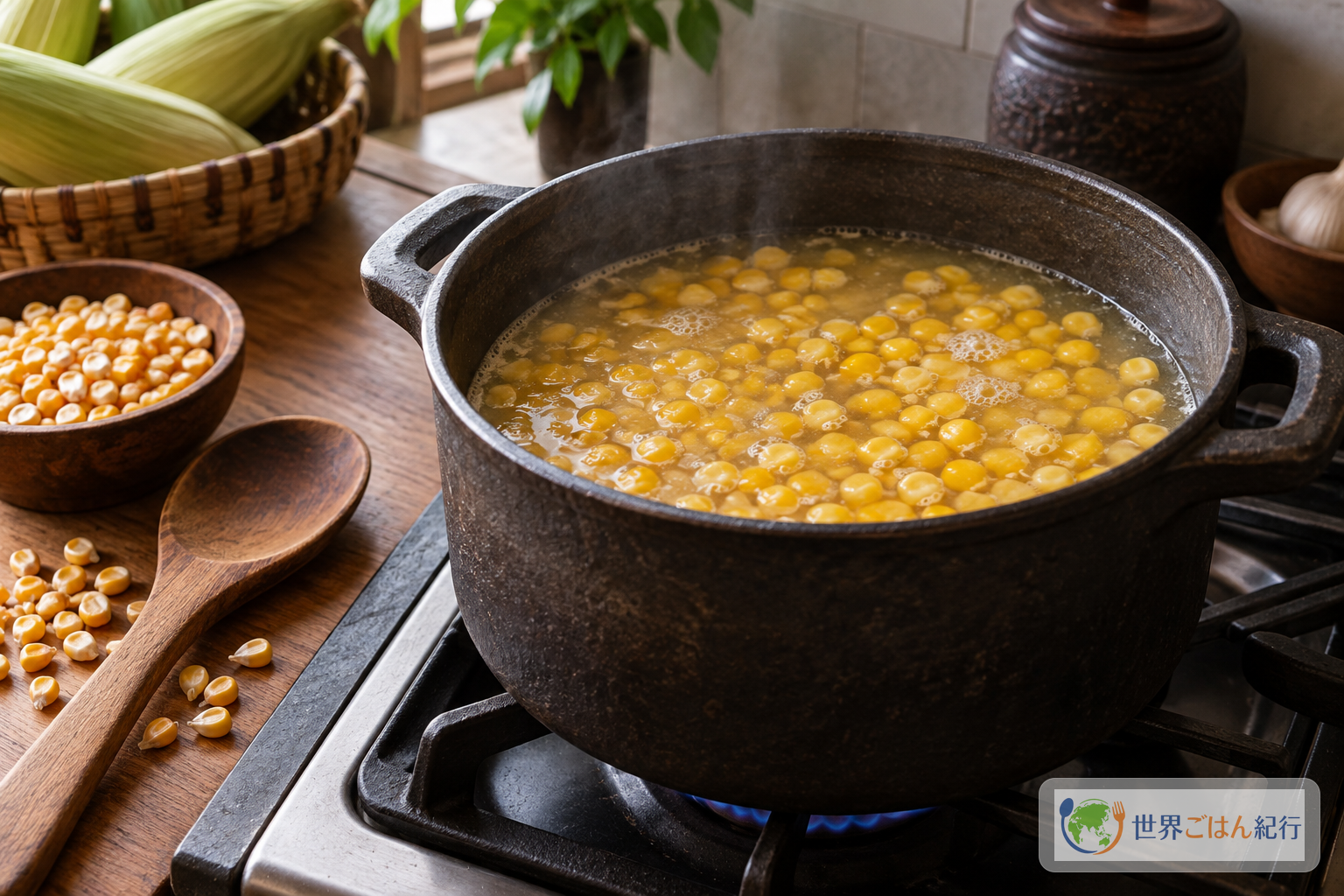
Put the dried corn and 1.5 L water in a heavy pot and bring to medium heat. When it boils, skim the foam from the surface, drop to medium-low and simmer 35 to 45 minutes. Set the lid slightly ajar to prevent boiling over.
You don't need to make it fully soft here. Take out one kernel and press it with a finger: if the surface dents but a floury core remains in the center, that is the signal to add the beans. If the water drops too low, add boiling water and take care not to scorch the bottom of the pot. The hominy version skips this step.
3. Add the beans and cook through
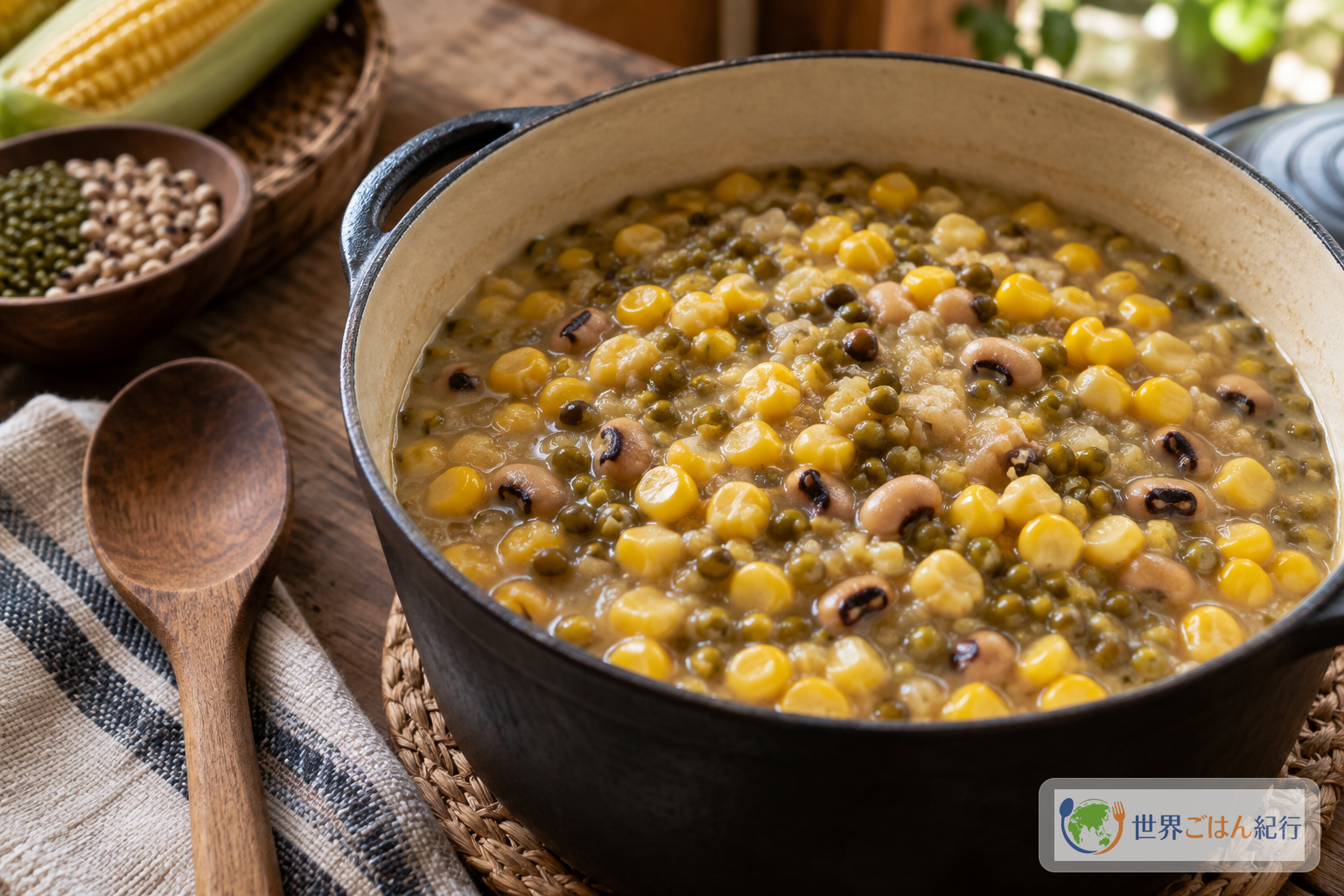
Add the soaked mung beans and black-eyed peas and, when it returns to a boil, lower to low heat. Simmer 20 to 30 minutes until no firmness remains in the center of the beans. Keep the heat so the broth on the surface moves quietly, so the beans alone don't suddenly fall apart.
Move on when the mung bean skins have split and a black-eyed pea can be lightly crushed with a finger. The broth flows thinly when the spoon is tilted, and the centers of the beans are smooth with no floury taste. If a floury core remains, extend by 5 minutes at a time without adding the pumpkin. Pumpkin softens before the beans, so waiting here is what separates the results.
4. Add the pumpkin and give the broth body
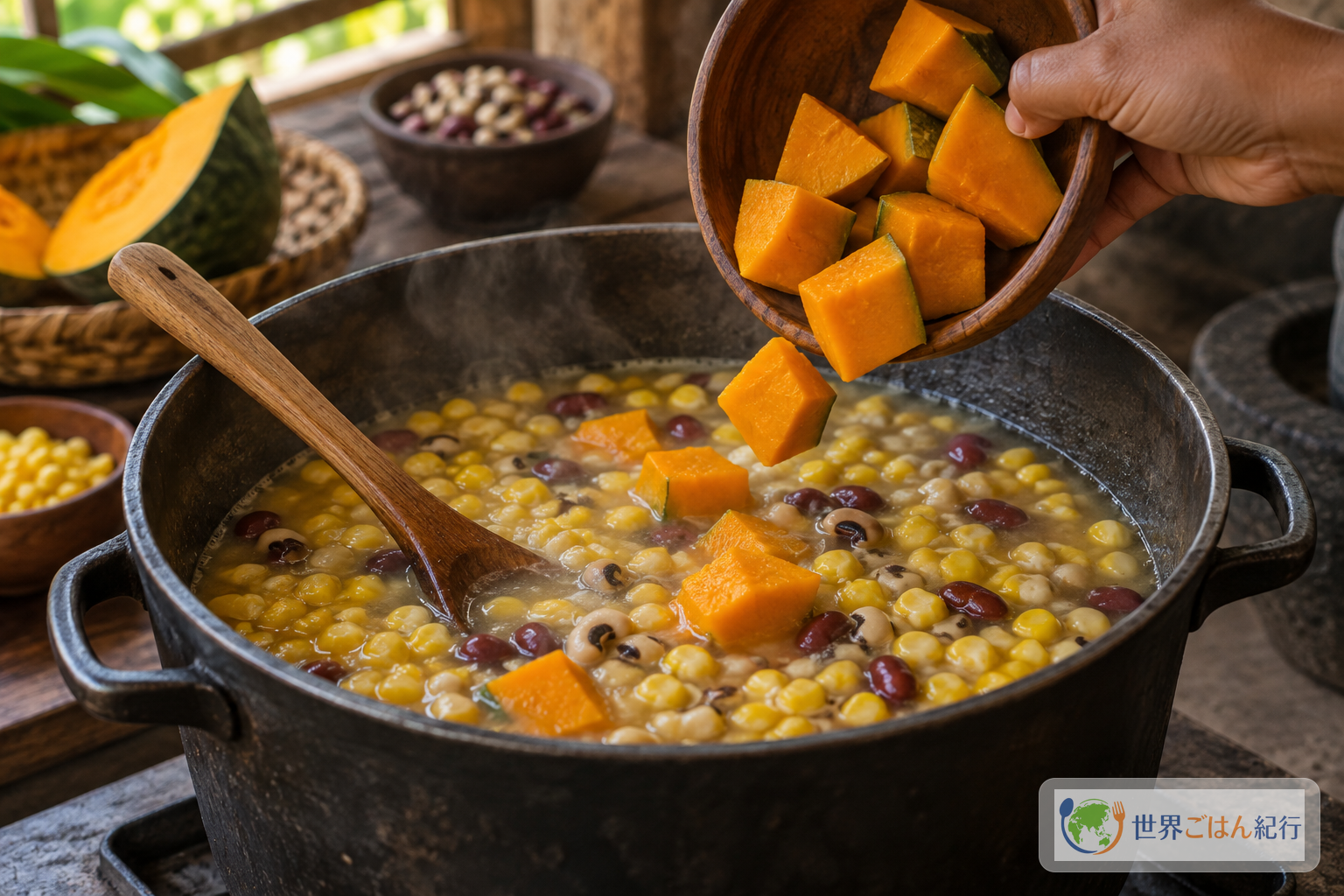
Add the 3 cm cubes of pumpkin and simmer 12 to 15 minutes over low heat. Stop when the corners of the pumpkin remain and a bamboo skewer goes in without resistance. If using hominy, add the drained kernels here and simmer 10 to 12 minutes including the time to warm them.
If you want the broth a bit thicker, crush just 1 or 2 pieces of pumpkin with a wooden spoon at the edge of the pot. Crushing all of it makes it like a potage and weakens the katemak character of eating the kernels. Stop when the broth has a light viscosity, can be scooped by spoon but still flows. If liquid runs low, add boiling water 100 ml at a time to restore it.
5. Add the greens and salt last
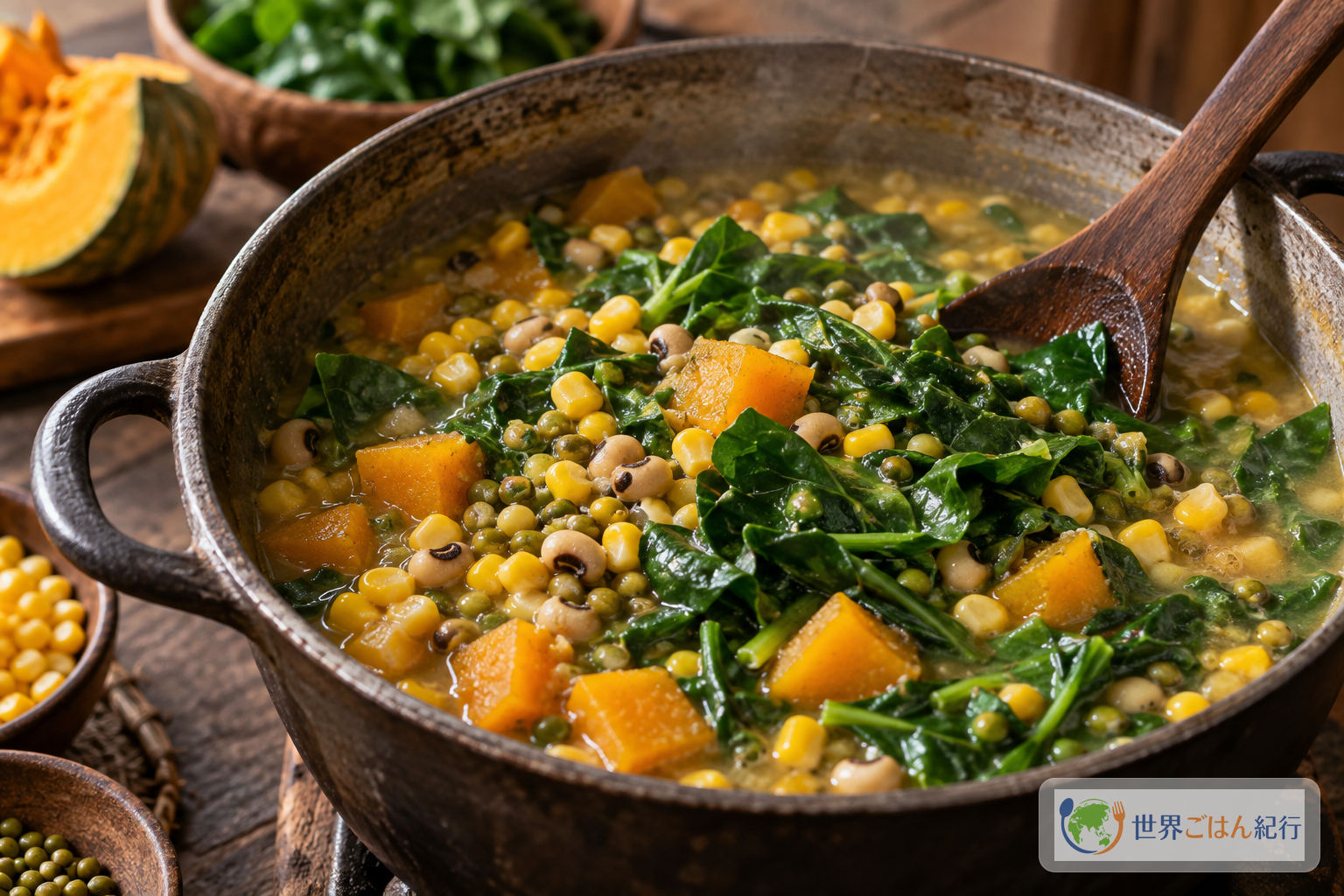
Cut komatsuna or spinach 3 cm wide and put it in the pot with the salt. Simmer only 2 to 3 minutes until the leaves wilt, then turn off the heat. When using pumpkin leaves, too, put in the hard stems first and the leaves later.
Taste, and it is done when these three are in place: the corn kernels can be chewed, the beans are smooth and the pumpkin holds its shape. The saltiness is set here because the dish is meant to be paired with the separate sambal and salted fish.
6. Make the sambal separately
Finely chop the red chile, red onion, basil and salted fish or anchovy, and dress with lime juice and salt. It takes about 8 minutes. You can grind it in a mortar, but a coarse chop that leaves grains gives a bite that stands against the softness of the stew.
Don't stir the sambal into the pot; serve it in a small dish. Put out a small amount at first, so each person can adjust the heat, acidity and fish saltiness in their own bowl. Leaving out the fish makes it a plant-based stew, though the flavor of the salted fish mentioned in the source is lost.
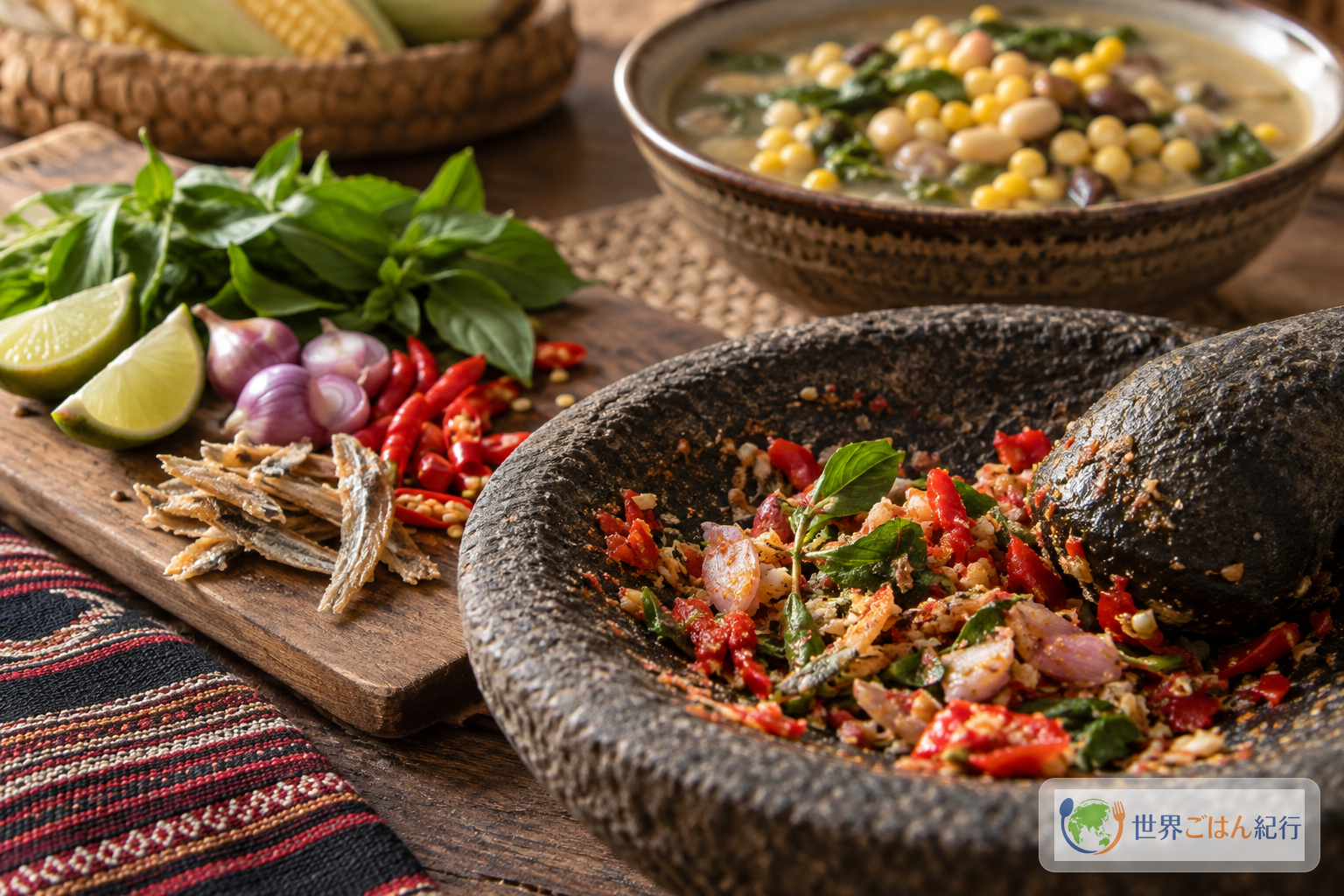
A tool for a coarse sambal
A tool for coarsely crushing the sambal lets you finish quickly while keeping the aroma of chile, onion and basil.
A granite mortar and pestle is worth considering if you will make sambal several times and want grains of even size rather than chopping with a knife. If you already have a mortar or a knife, there is no need to buy more. Crush a small amount of chile coarsely. Turning it into a complete paste makes the aroma and texture heavy, so it is fine to make it with a knife the first time and decide afterward whether you need one.
Tips for adjusting the firmness of the kernels and the broth
When only the core of the corn is hard
If the heat is high with too little liquid, only the surface of the kernels splits and the bottom of the pot scorches. Add boiling water, set the lid slightly ajar and extend by 10 minutes at a time over low heat. If the beans and pumpkin are already soft, scoop out the contents, cook only the corn further and return them, which prevents breaking down too far.
If the core is hard even with hominy, the can may be a type with a strong bite, or the cooking was not enough. Adding canned sweet corn in place of the corn mainly gives only sweetness to the broth, so first add water and warm the whole pot again.
When the pumpkin falls apart first
Pumpkin that has collapsed is not a failure. The broth thickens naturally and the flavor moves toward wrapping the kernels. But if the pumpkin melted while the beans were still hard, don't add more pumpkin; add boiling water and cook the beans through. Next time, lengthen the gap before adding pumpkin until the centers of the beans are soft.
When it is watery or too heavy
If watery, take off the lid and reduce over low heat for 5 to 10 minutes, and crush a single piece of pumpkin. If too heavy, add boiling water a little at a time. Adding thickness with flour or potato starch gives the mouthfeel of a different soup rather than the broth of corn and beans, so it is not used.
Storage
Keep the sambal and stew separate, and don't leave the stew in a large pot while warm; divide it into shallow containers. When it has cooled slightly, refrigerate it; the guide is 3 to 4 days refrigerated and 2 to 3 months frozen. FoodSafety.gov's Cold Food Storage Chart also gives soups and stews with vegetables or meat as 3 to 4 days refrigerated and 2 to 3 months frozen. Reheat until hot through the center, and warm only the amount you will eat at once from frozen.
Regional difference with coconut milk, and whether to buy it
The standard katemak extends the stock of corn and beans with water and leaves the sweetness of pumpkin and the aroma of leaves. Adding coconut milk rounds out the mouthfeel even with the same ingredients and moves toward a porridge-like direction such as jagung bose. This is not a requirement common to all katemak and is safest treated as a variation by household or region.
If using a 400 ml can of coconut milk, reduce the water for simmering by 200 ml and add 200 ml of coconut milk at the stage when the pumpkin goes in. It is worth buying if you will use it in curry and laksa too and use up the rest of the opened can over several dishes. To carry the leftover toward another aroma, it can also go to a coconut dish such as nasi uduk. If you want a light broth just this once, don't substitute milk or soy milk; skip it and keep it water-based. The sweet aroma of dairy becomes a different flavor from this dish's regional variation.
Serving at the table
Into a deep bowl, scoop the corn and beans first and put the pumpkin and greens on top. Pouring in only plenty of broth makes it look like soup, so the guide for plating is to leave several kernels in each mouthful. Put the sambal in a small dish, and if salted fish was used, serve it on the side.
Because katemak already contains grain and beans, white rice need not be served. In a lighter finish with more broth, it can go with a little rice, but then it easily mixes with the way of eating in neighboring regions such as batar da'an. Deciding which dish you are eating before adjusting the liquid keeps both the explanation at the table and the flavor from wavering.
Frequently asked questions about katemak
Where is katemak from?
It is a dish of East Nusa Tenggara, including Indonesian West Timor. The source explains it as linked to Indonesian-side regions such as Kupang, South Central Timor, North Central Timor, Belu and Malaka. Writing only "Timor cooking" without the country makes it hard to distinguish from East Timor's batar da'an, so this article says West Timor.
Is it the same dish as batar da'an?
It is not the same dish. The composition of corn, beans, pumpkin and greens simmered together is close, but batar da'an is the name of an East Timorese dish. Comparing The Southeast Asian Table's English-language source and the CRS Rice Bowl recipe shows that similar ingredients are used in the island's same climate zone, but the explanation of country and dish name should be kept apart.
Can I make it without soaking the dried corn overnight?
With hominy you can skip soaking. Keep to the water amount in the ingredient table and the order of addition in step 4, and soak the beans. Fresh corn and canned sweet corn differ in how they cook and in sweetness, and they cannot be boiled for the same time as a substitute for the dried-kernel version.
Can I add meat or fish?
The source says meat and salted fish are sometimes added. For the first pot, to confirm the relationship among corn, beans, pumpkin and leaves, it is designed so that fish is used only in a small amount in the sambal. If adding meat, cook it separately and combine it just before finishing so you don't lose track of how the dried beans are cooking.
Is katemak a vegan dish?
The stew itself can be plant-based if made with vegetable stock or water and no salted fish. The basil and chile sambal can also be made without fish. But check the ingredient labels of canned hominy, store-bought stock and seasonings.
Sources
West Timor and East Nusa Tenggara food culture
- Jasman, Dorthea M.W. Nai, Arvinda C. Lalang, Ni Wayan O.A.C. Dewi. Bahan Pangan Masyarakat Nusa Tenggara Timur. Tangguh Denara Jaya Publisher, 2025. https://www.researchgate.net/publication/403317036_BAHAN_PANGAN_MASYARAKAT_NUSA_TENGGARA_TIMUR (accessed 23 September 2026)
English-language sources and comparison with a neighboring region
- Air University, Air Force Culture and Language Center. Expeditionary Culture Field Guide: Timor-Leste. https://www.airuniversity.af.edu/Portals/10/AFCLC/04.%20Ready%20Airman/INDOPACOM/ECFG%20Timor-Leste%202025r.pdf?ver=V5LundiNbBe_OArQQoRtNg%3D%3D (accessed 23 September 2026)
- The Southeast Asian Table. "Batar Da'an (Corn & Pumpkin Stew) — Timor-Leste." https://thesoutheastasiantables.com/recipes/timor-leste/batar-da-an-corn-pumpkin-stew (accessed 23 September 2026)
- Catholic Relief Services Rice Bowl. "Batar Da'An — Timor-Leste." https://www.crsricebowl.org/recipes/batar-daan-timor-leste (accessed 23 September 2026)
Storage
- FoodSafety.gov. Cold Food Storage Chart. https://www.foodsafety.gov/print/pdf/node/15?id=cold-storage-table (accessed 23 September 2026)



