A Cold Manado Coconut Sweet Where the Spoon Breaks the Surface
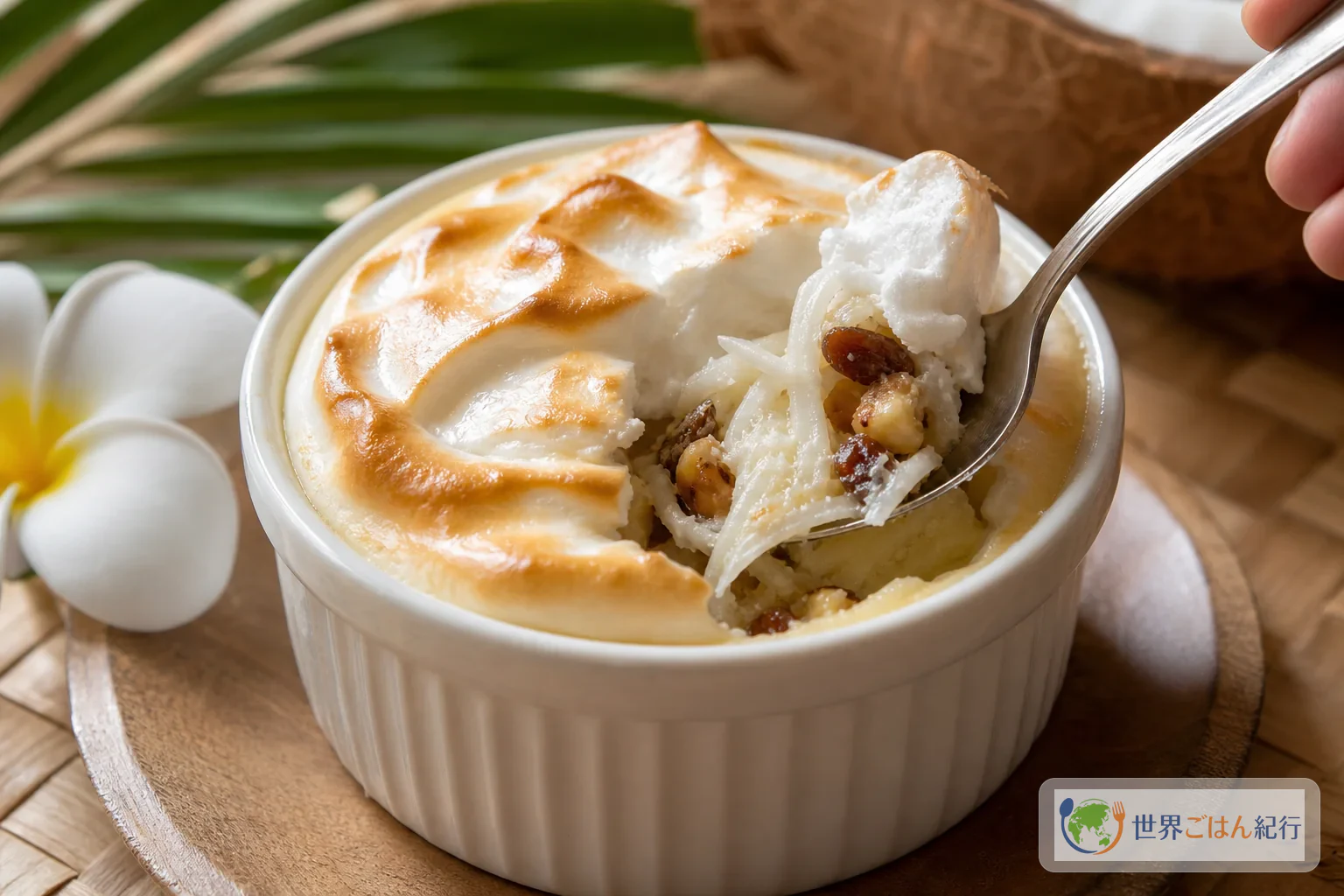
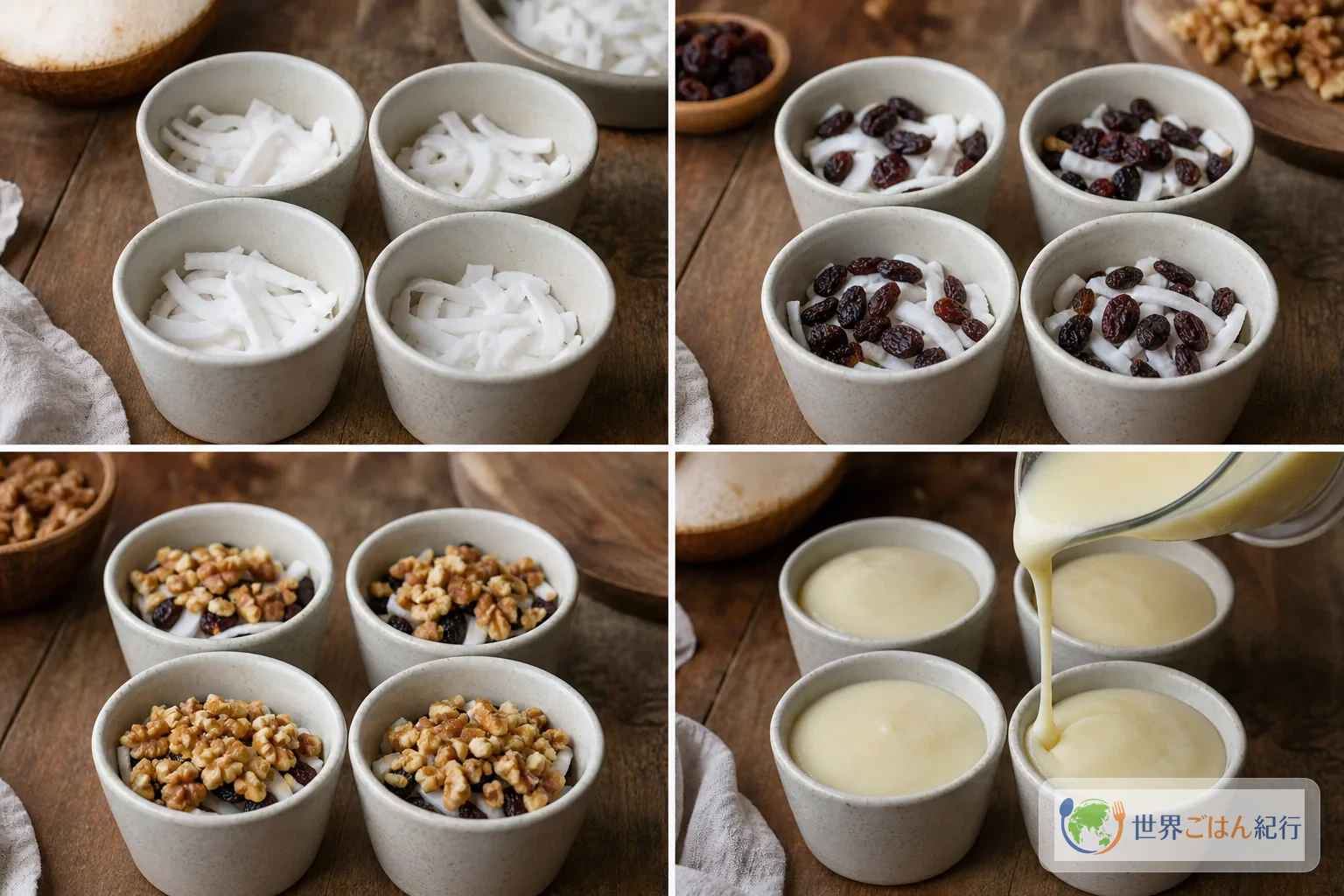
Put a spoon into chilled klappertaart and first you meet the light resistance of the meringue, and under it the egg custard slowly appears. Inside the white custard are hidden long strips of young coconut, sweet-and-sour raisins and the small crunch of walnuts.
Klappertaart is a sweet tied to Manado in North Sulawesi, Indonesia. It is introduced as a sweet with Dutch influence, with young coconut as the star, layered with egg, milk, nuts and raisins. It is not a sweet that is carried by the heat of just-baked alone; its outline comes together including the time to let the heat out and then chill it.
What gives pause when making it at home is not finding local young coconut but where to stop the moisture of the custard. Adding more canned coconut milk makes the aroma stronger, but too much leaves the center loose even after baking. So I divide it into 4 small baking dishes and, keeping the coconut aroma, aim for a firmness you can scoop with a spoon once chilled.
Even within Indonesia, unlike nasi uduk, which carries the aroma into rice, in klappertaart the judgment of how much coconut moisture and how much to set with egg is the star. If you want to widen to flour sweets of eastern Indonesia, try bagea next, and to compare the texture of sweet snacks, serabi.
If you want a fuller aroma, use 200 ml unsweetened coconut milk and add young coconut flesh that has been drained.
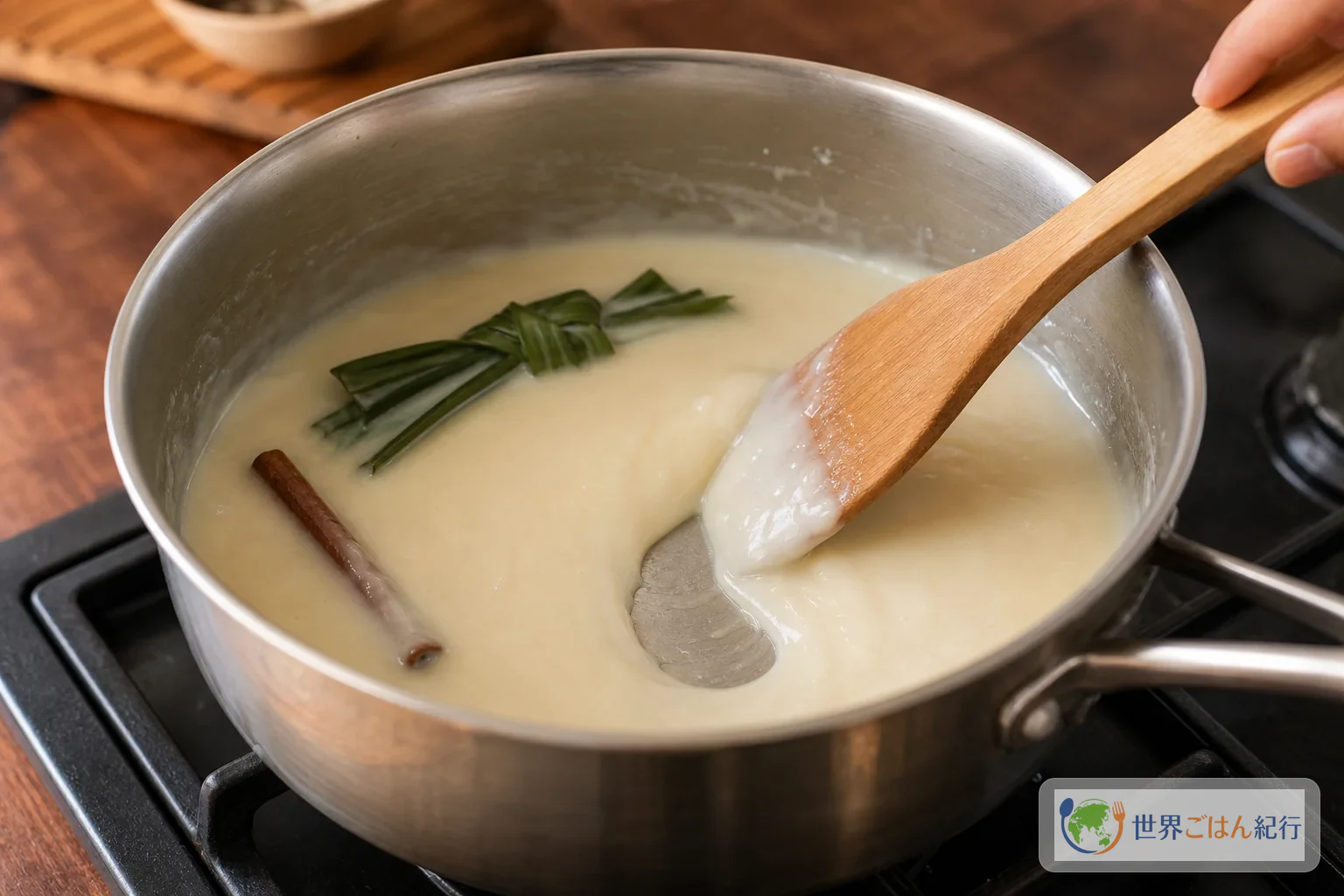
Do not boil the custard; turn off the heat where the trail of the spatula stays for about 2 seconds.
On a day you cannot spare the chilling time, you can leave out the meringue and serve it warm, but do not change the cooking of the egg or the storage conditions.
Ingredients: Makes 4 Small Baking Dishes
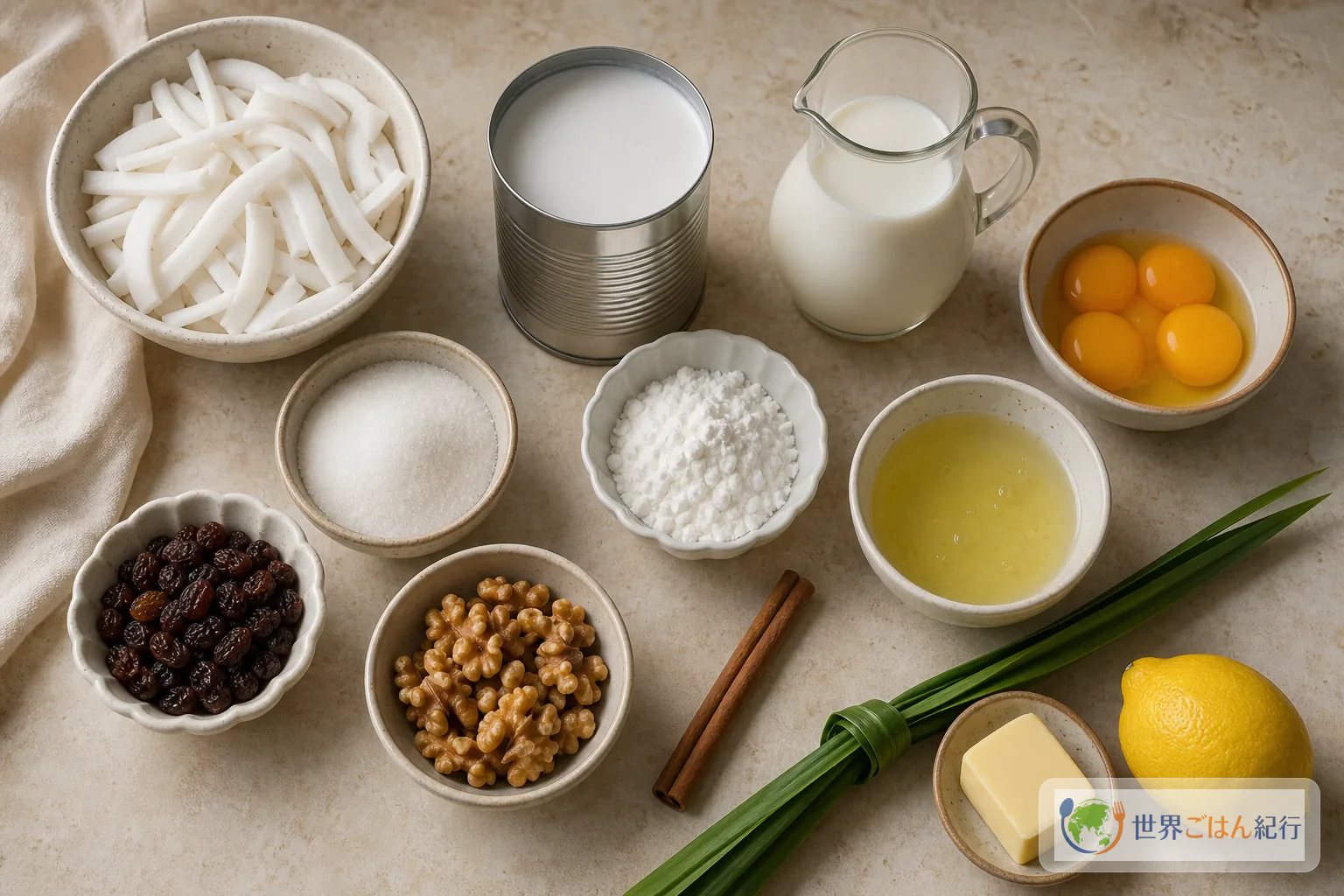
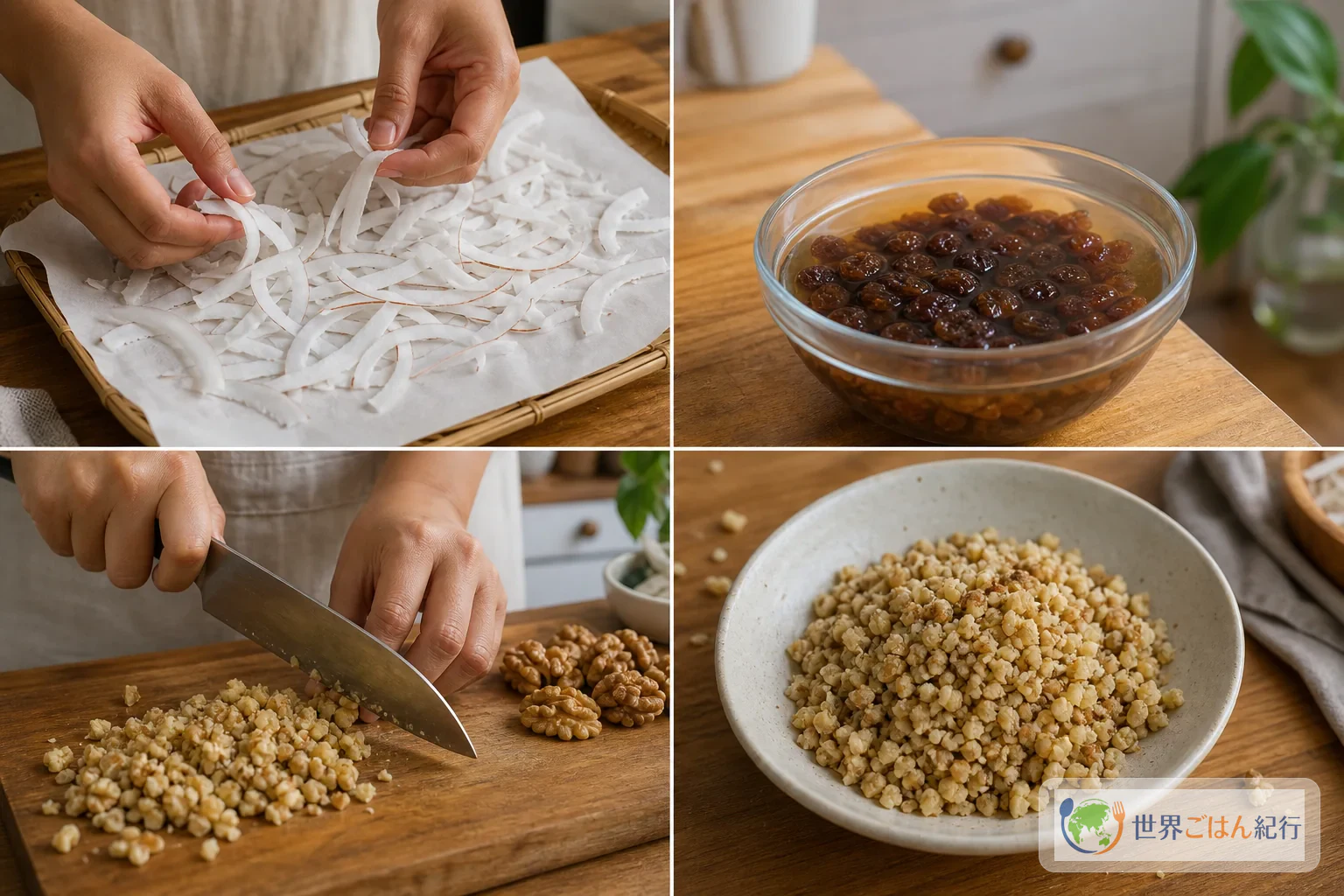
Use four 180–200 ml baking dishes. If you have no fresh young coconut, thaw unsweetened frozen coconut in the refrigerator and press off the surface moisture with paper towels. Sweetened candied coconut changes the sweetness and moisture, so it is not suited to this formula.
It contains egg, dairy and walnuts. Processed coconut milk and nut products may carry labeling for soy, wheat and so on, depending on the product, so if you have an allergy check the ingredients and the same-facility labeling when buying.
Shopping: A Can for the Aroma Base, Flesh for the Texture
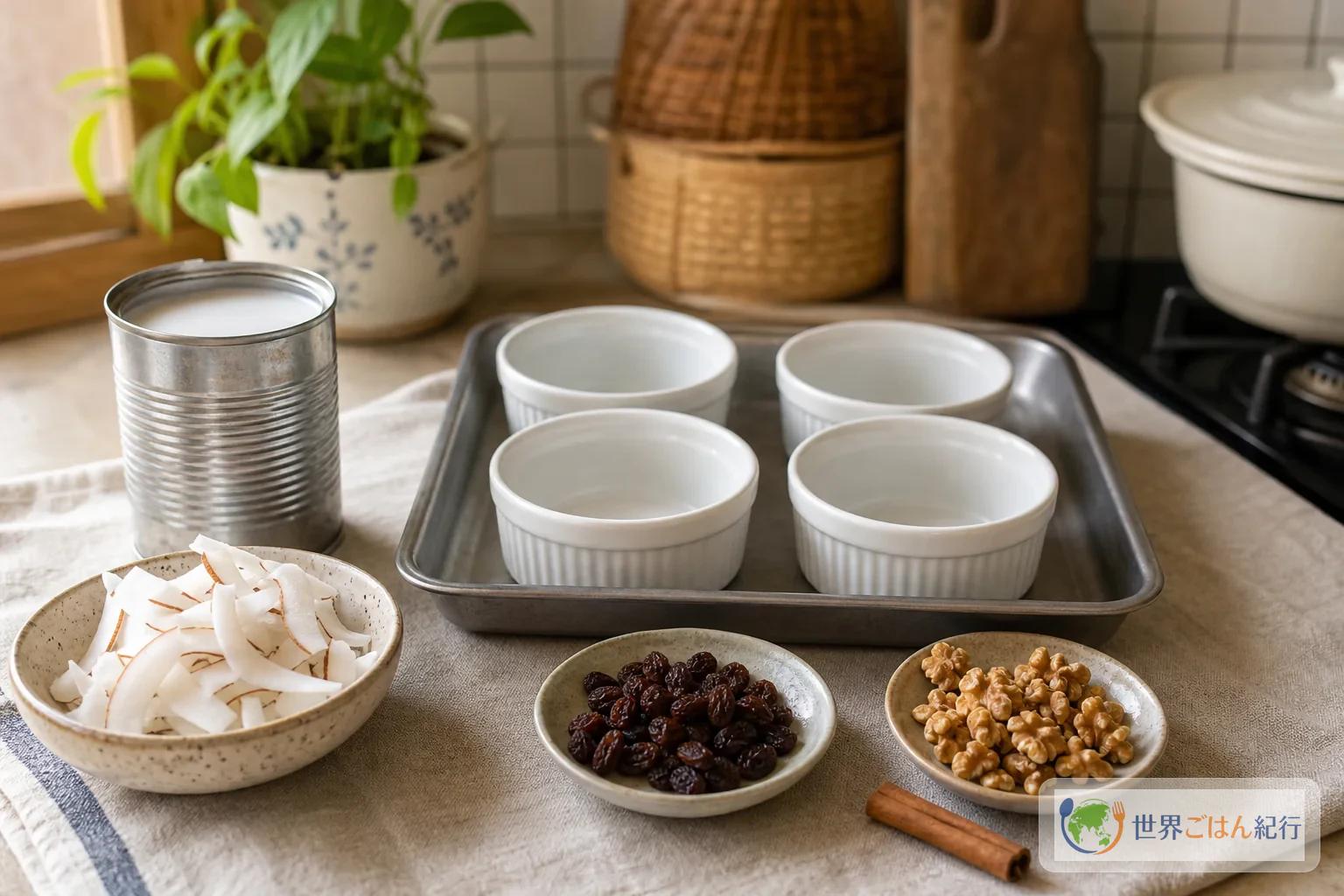
Fresh young coconut flesh cannot always be bought. Without fresh flesh, unsweetened frozen is fine, but if you leave out even the coconut milk, the flavor of milk and egg comes forward and it becomes a different custard. What is worth buying here is that even if you use half of a 400 ml can, the rest can go to curries and rice dishes, and that you can check "unsweetened" and the ingredient label before buying. If you already have thick coconut milk in the refrigerator and are making a small batch just this once, you do not need to buy new.
When you choose, check for a content of 400 ml, whether it is unsweetened, and whether the ingredients include any sweetener other than coconut.
Move the rest of the opened can to another clean container and refrigerate it following the can's label. Handling after opening differs by product, so rather than fixing the number of days of storage here, put the label, the smell and the condition first.
Method: Cook the Custard, Then Bake the Meringue
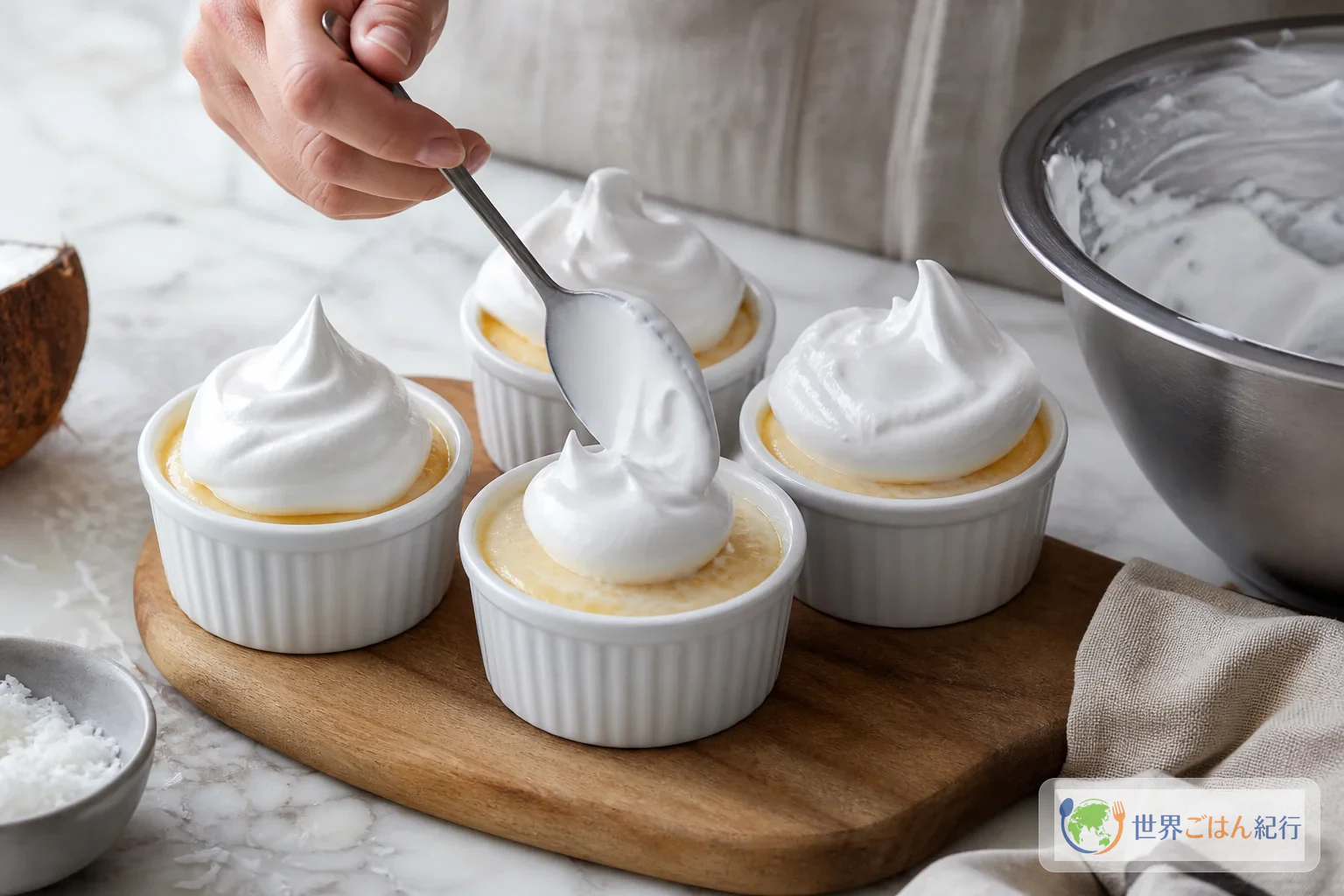
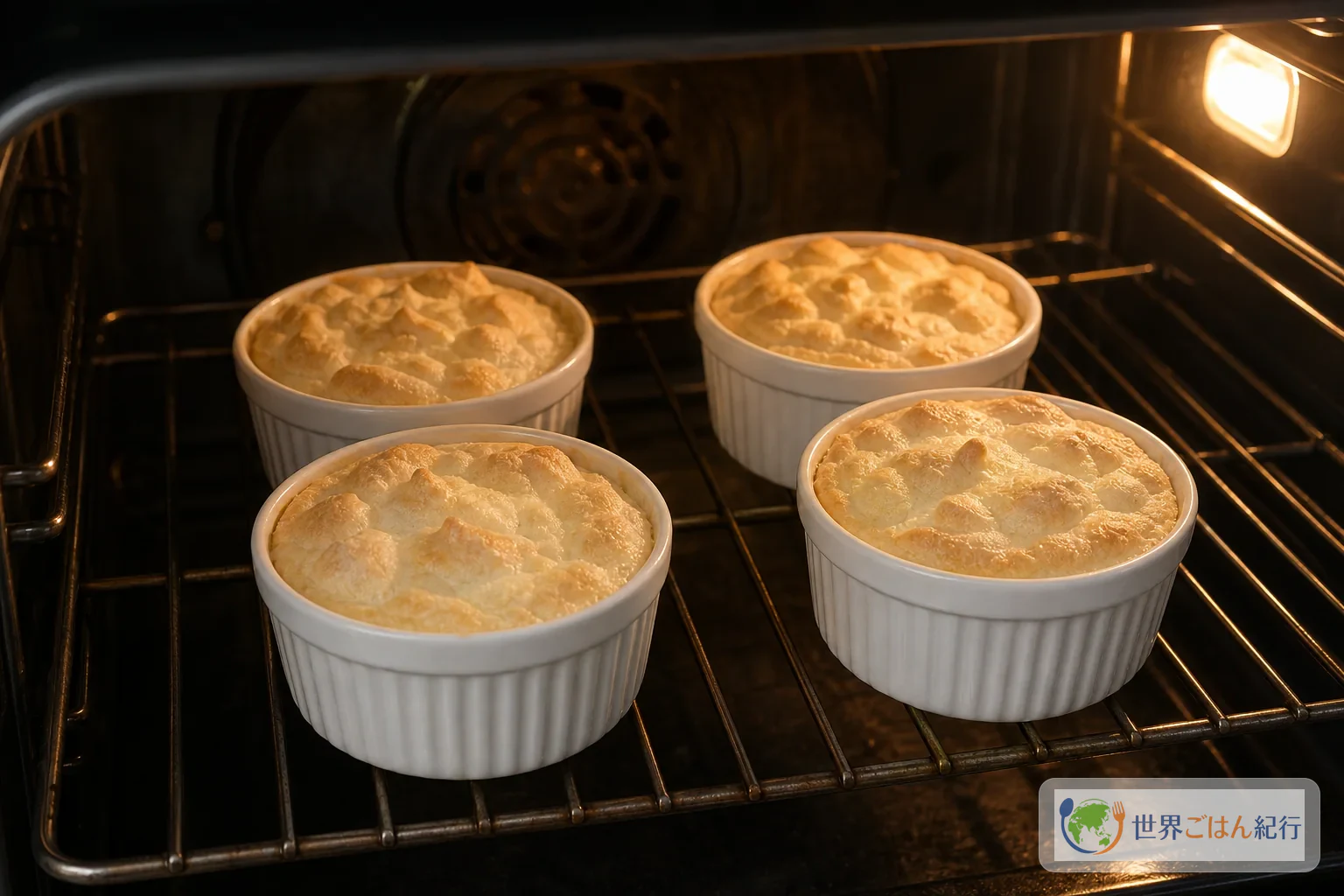
Rather than putting it in the oven from the start to set, klappertaart is easier to adjust if you build the thickness of the custard in a pot and then bake. Preheat the oven to 160°C (325°F) and grease the inside of the baking dishes with a little butter.
Just baked, the custard is soft and the shape easily falls apart when scooped with a spoon. If serving it warm, confirm that the heat has gone to the center and the meringue has set, then rest it for 15 minutes. If you choose a cold finish, not skipping the 2 hours in the refrigerator is what separates the fine fibers of the flesh from the smoothness of the custard.
Cooking Tips: Do Not Add Moisture, and Keep One Line of Aroma
Cans of coconut milk may have the thick part settled at the bottom. Shaking well before opening and mixing with the milk before it goes into the pot keeps the fat from being rich at first and watery in the latter half.
Rather than scattering cinnamon powder through the whole, simmering a stick briefly and removing it does not hide the coconut aroma. Choose the stick when you will reuse it for chai and baked goods and want to be able to stop the strength of the aroma partway. If you have powder that still carries aroma and are making this just once, skip it.
| What happened | Main cause | Quick fix |
|---|---|---|
| The custard runs even when chilled | The flesh has too much moisture, or it was undercooked | Dissolve 5 g cornstarch in 15 ml cold milk, return to the pot and stir 2–3 minutes over low heat |
| The custard is heavy and breaks | It was boiled, or too much starch | Turn off the heat, add 10 ml warm milk and slowly thin with a whisk |
| The meringue weeps water | Oil in the bowl, or sugar added too early | Whip the whites in an oil-free bowl and add sugar in 3 additions. Bake right after topping |
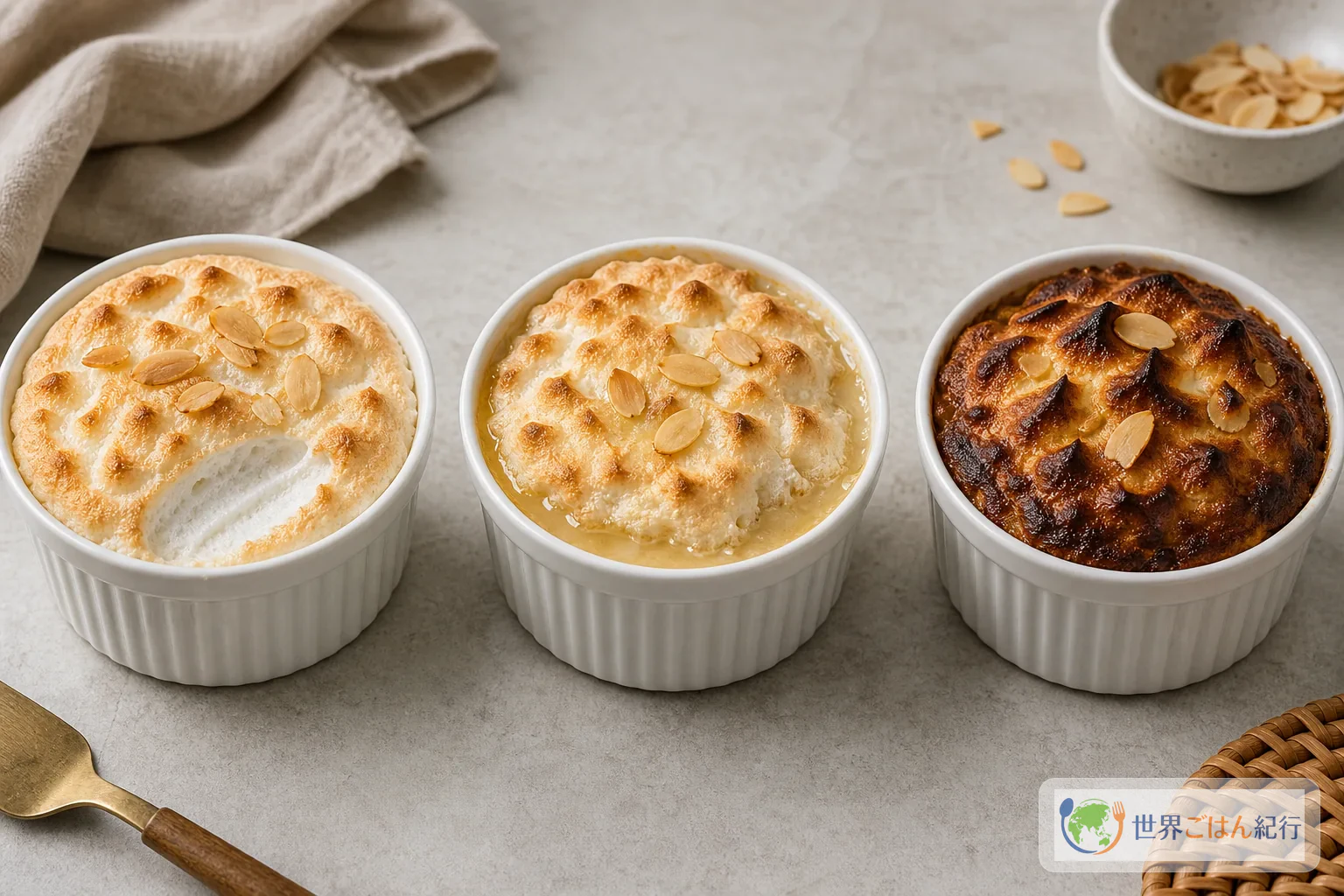
| Only the surface gets dark | Strong top heat, or the dish is on the upper rack | Move to the middle rack, cover the surface loosely with foil and bake to the center at 160°C (325°F) |
| The flesh feels hard | Not young coconut, or cut too thick | Cut to 4 mm wide, and use frozen only after completely thawing |
Even if the taste seems weak, you do not necessarily add sugar first. Check in the order of: salt missing, cinnamon simmered too long, or the coconut milk having separated, and you can bring the aroma back without increasing sweetness.
Changes at the Table: Chilled or Served Warm
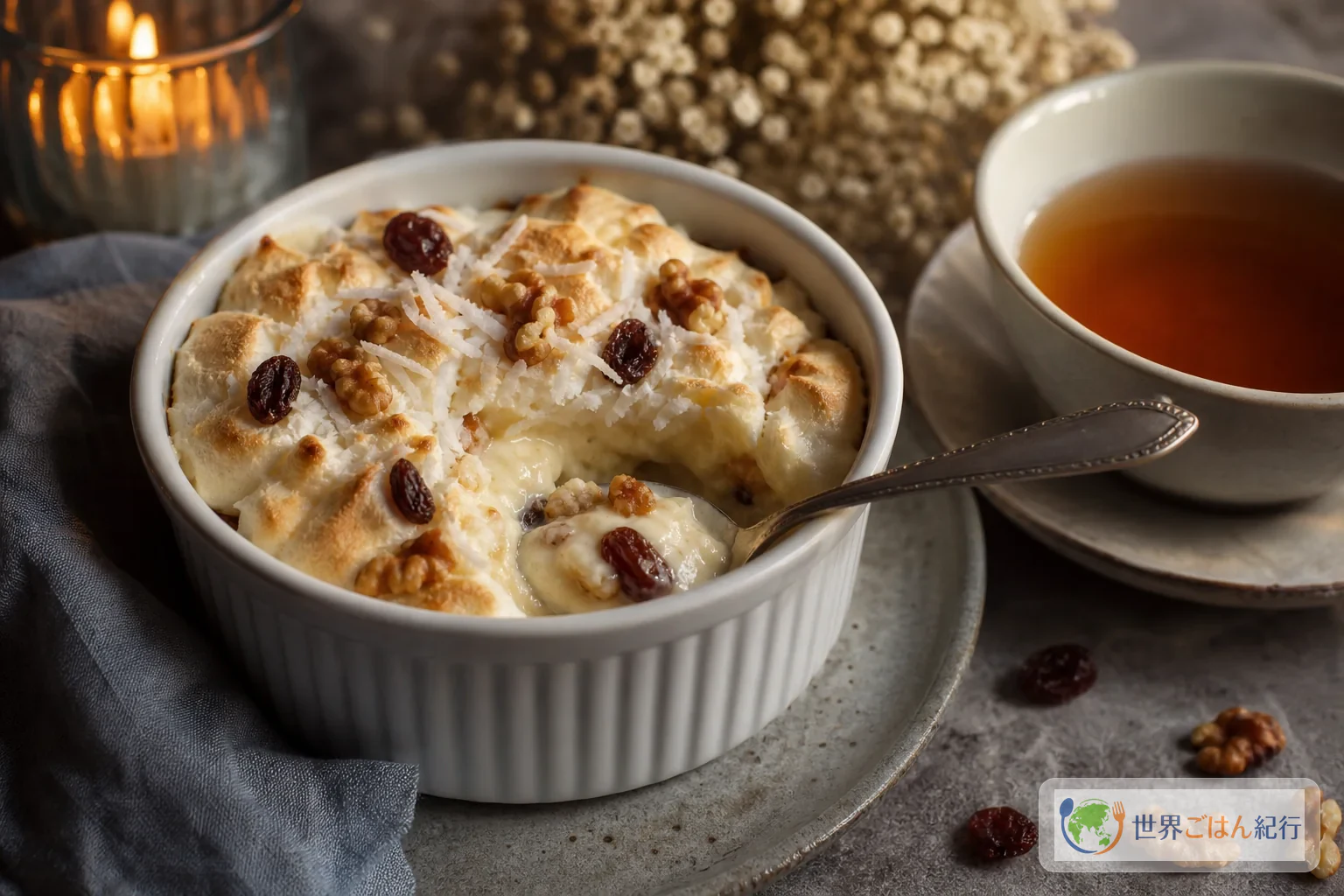
With klappertaart, changing just the serving temperature, rather than the ingredients, changes the impression. Cold, the boundary between custard and flesh is clear; slightly warm, the aroma of butter and coconut spreads. It is not a question of which is right; choose by whether you serve a small portion after a meal or gather around it just baked.
| Variation | Amount and steps | Result |
|---|---|---|
| Replace fresh flesh with frozen | Thaw 200 g unsweetened frozen flesh in the refrigerator and press off moisture | A little milder in aroma, but the texture is easy to keep |
| Use pandan | Tie 15 cm, add when simmering the custard and remove at the end | A greener, sweeter aroma than vanilla |
| Omit the rum | Soak the raisins in hot water for 10 minutes | Easier to eat with children, with fruit sweetness coming forward |
| Replace walnuts with almonds | The same 30 g chopped to 2–4 mm | Lighter savoriness and a brighter crunch |
| Omit the meringue and chill | Bake the custard, scatter nuts after it cools and chill 2 hours | The surface does not become light, and egg and coconut are the stars |
| Bake in a large dish | Move to an 18 cm baking dish and bake at 160°C (325°F) for about 30–35 minutes | The center takes time to cook through, so check 71°C (160°F) and the condition |
| Less sweet | 60 g sugar in the base and 30 g for the meringue | The coconut aroma comes forward, but the sweetness feels weaker when chilled |
To put leftover coconut milk toward a meal, nasi uduk, which infuses the aroma into rice, is an easy choice. To lean toward a flourless sweet of eastern Indonesia go to bagea, and to enjoy a thin batter and coconut go to serabi, and even with the same sweet coconut the design of texture changes.
A Dutch Name Born at a Manado Table
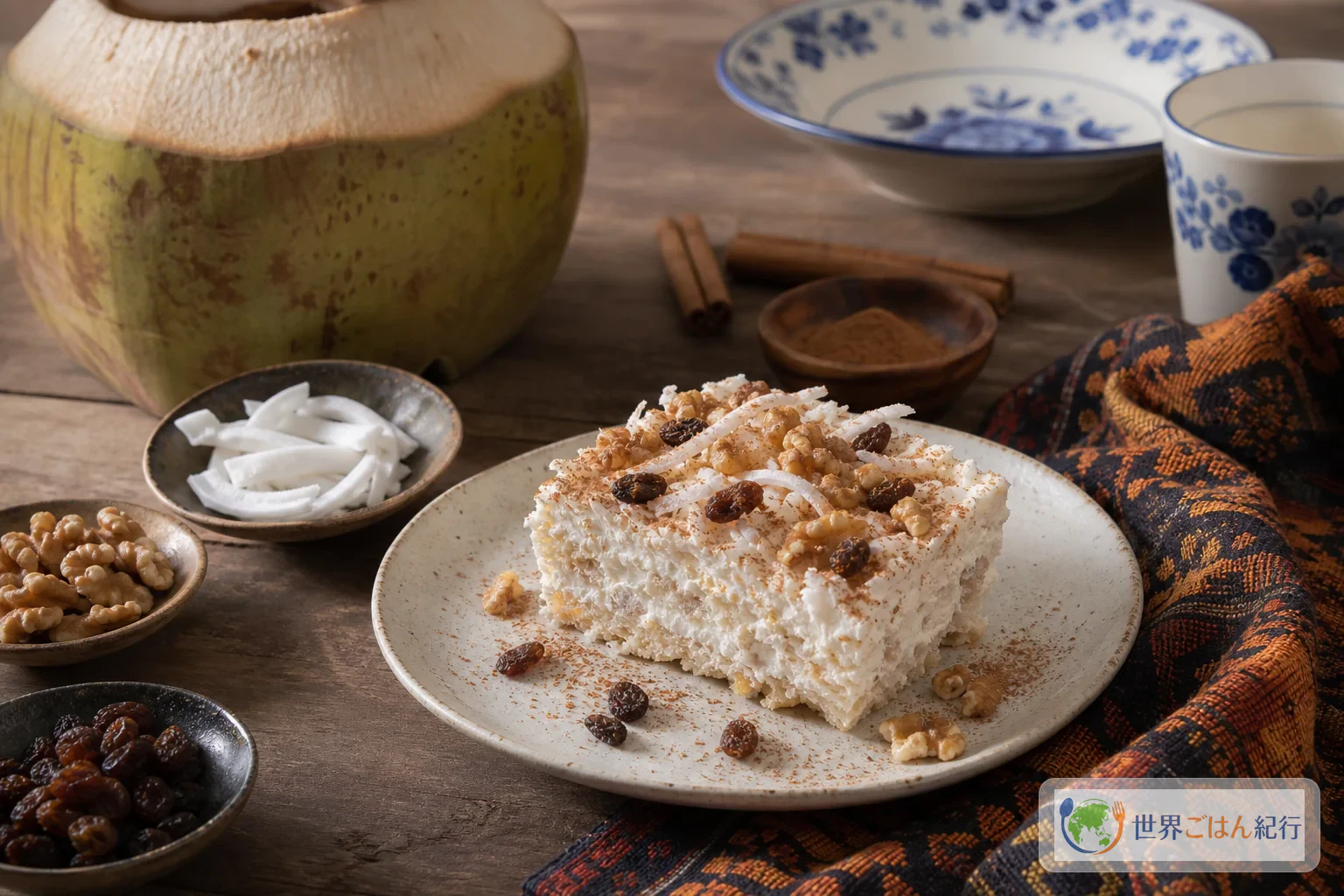
If you call klappertaart only an "Indonesian-style tart," a little of the dish's history spills out. A paper in an academic journal organizes it as follows: through contact in the period of Dutch rule, a recipe that came to Manado overlapped with Indonesian ingredients, and klappertaart became a sweet tied to Manado. This is not simply a story of one country's dish moving to another; it means the outline of the dish changed depending on who made it, what was available and on what occasions it was eaten.
Local introductions describe it as a sweet custard dessert pairing long strips of young coconut with walnuts and raisins, with the aroma of rum. There are also records of it studied as a sweet served on special occasions, and explanations that it is served chilled after a meal.
Substitutes in a home kitchen are not a compromise to dilute the culture. They are a task of thinking separately about the tenderness of young coconut, the fat and aroma of coconut milk, and egg and starch holding up the liquid. Even if fresh flesh is replaced by frozen, if you keep the thinness of the flesh and the draining, the feeling of custard and fibers parting at the tip of the spoon remains.
Frequently Asked Questions
What if I cannot find young coconut flesh?
Use 200 g unsweetened frozen young coconut, thaw it in the refrigerator and press off surface moisture. Sweetened coconut or coconut in syrup increases sugar and moisture at once, so it is not used in this formula. If you really have no flesh, there is the alternative of adding 80 g unsweetened coconut flakes and 20 ml milk, but the soft bite of young flesh cannot be reproduced.
Is pandan leaf essential?
It is not essential. When using pandan, tie 15 cm and put it in the custard, and take it out when you turn off the heat. If you cannot get it, building the aroma with 5 ml vanilla and 1/2 cinnamon stick does not hide the star coconut.
How do I fix it if the custard is watery?
Return it to the pot, add 5 g cornstarch dissolved in 15 ml cold milk, and stir 2–3 minutes over low heat. Putting flour straight into hot custard makes lumps, so always disperse it in a cold liquid first. Next time, drain the flesh and heat until the spatula's trail stays for 2 seconds before moving to the dishes.
How many days can baked klappertaart be stored?
Let it release heat, cover, and finish it in 2–3 days in the refrigerator as a guide. Do not leave an egg dish at room temperature more than 2 hours, and in an environment above 32°C (90°F) refrigerate within 1 hour. Take out only what you will eat, and discard it regardless of days if there is an off smell, surface moisture or mold.
What if there is an egg or nut allergy?
Egg is used in both the custard and the meringue, and walnuts carry the nut texture. Removing the egg means redesigning it as a cornstarch-only sweet, and when you remove the nuts, making it without increasing the fillings is easier to read for moisture than adding the same amount of coconut. Check the labeling of products containing dairy, egg, walnuts and coconut, and if someone in the family has a severe allergy, do not use shared utensils.
FoodSafety.gov gives a guide to cook egg-containing dishes to a center temperature of 71°C (160°F) and to refrigerate within 2 hours of cooking. When it is hard to judge by appearance, put the center temperature and the time first.
Sources
- Indonesia Travel, "Deliciously Hot Manado Foods" — accessed and checked 2026-08-04 https://www.indonesia.travel/gb/en/travel-ideas/gastronomy/deliciously-hot-manado-foods
- Handoyo, C. C. et al., "Klappertaart: an Indonesian–Dutch influenced traditional food", Journal of Ethnic Foods, 5(2), 147–152 — accessed and checked 2026-08-04 https://doaj.org/article/108359cae52d4c60943d53bc47528fec
- Soputan, D. D. et al., "Organoleptic Test and Chemical Characteristics of Klappertaart Products of Manado During Storage", Jurnal Ilmu dan Teknologi Pangan — accessed and checked 2026-08-04 https://ejournal.unsrat.ac.id/v3/index.php/itp/article/view/15298
- What To Cook Today, "Klappertart Panggang (Baked Coconut Custard)" — accessed and checked 2026-08-04 https://whattocooktoday.com/klappertart.html
- FoodSafety.gov, "Cook to a Safe Minimum Internal Temperature" — accessed and checked 2026-08-04 https://www.foodsafety.gov/food-safety-charts/safe-minimum-internal-temperatures
- FoodSafety.gov, "Salmonella and Eggs" — accessed and checked 2026-08-04 https://www.foodsafety.gov/blog/salmonella-and-eggs