Pancit Bihon: Filipino Celebration Rice Noodles with Shrimp and Chicken
A 4-serving pancit bihon guisado made with thin dried rice vermicelli. Learn the order for letting the noodles absorb broth, what patis and calamansi do, heat control that keeps the noodles from breaking, substitutes, storage, and why long noodles appear at Filipino birthdays.
This recipe was translated from the Japanese original by the Sekai Gohan editorial team. Read the original (Japanese)
Prep25 min
Cook20 min
Total45 min
Serves4 servings
LevelEasy
Until the thin noodles soak up the broth
White rice noodles go into the brown broth left in the bottom of the pan. At first they look almost flimsy, but every time you lift them with chopsticks or tongs they change color a little more, binding together the shrimp, chicken and cabbage. Squeeze a small calamansi over at the end, and the soy sauce suddenly tastes lighter. Pancit bihon guisado is a dish you eat for that transformation.
Pancit comes in many forms: canton made with wheat noodles, sotanghon with glass noodles, palabok topped with a shrimp sauce, and more. Bihon is the one made with thin rice noodles. Filipino food sites often describe it as a dish served at birthdays, its long noodles a wish for long life. But it is also an easygoing everyday dish that shows up on a big platter at a weekday lunch or a family gathering. As Kawaling Pinoy points out, the mix of meat, shrimp and vegetables differs from household to household.
The first stumbling block isn't unfamiliar ingredients but moisture. Try to stir-fry it dry over high heat like Taiwanese-style fried rice noodles, and the surface dries out while the core stays hard. Boil it to doneness in a big pot of water instead, and it can't take in the broth you add later; the noodles break into short pieces as soon as you dig in. The flavor backbone here is the body of chicken broth, the faint fermented note of fish sauce, and the citrus at the end. Think of it less as rehydrating the noodles and more as letting them absorb the broth little by little, and things stay under control.
For a first try, ordinary thin dried rice vermicelli from the supermarket and a lemon are plenty. If you can get to a Filipino or Asian grocer, or shop online, patis and annatto seeds are the ones to look for. The first adds a fermented aroma along with saltiness; the second adds a soft orange color more than flavor. You won't be stuck without either. Don't overbuy; decide by how close to the original you want to get.
Decide this first
These amounts assume dried rice vermicelli about 1 mm thick. Wide pho noodles, mung bean glass noodles and steamed yakisoba noodles won't turn out right with the same amounts and times. Look for thin dried noodles labeled rice, bihon or rice vermicelli.
Ingredients
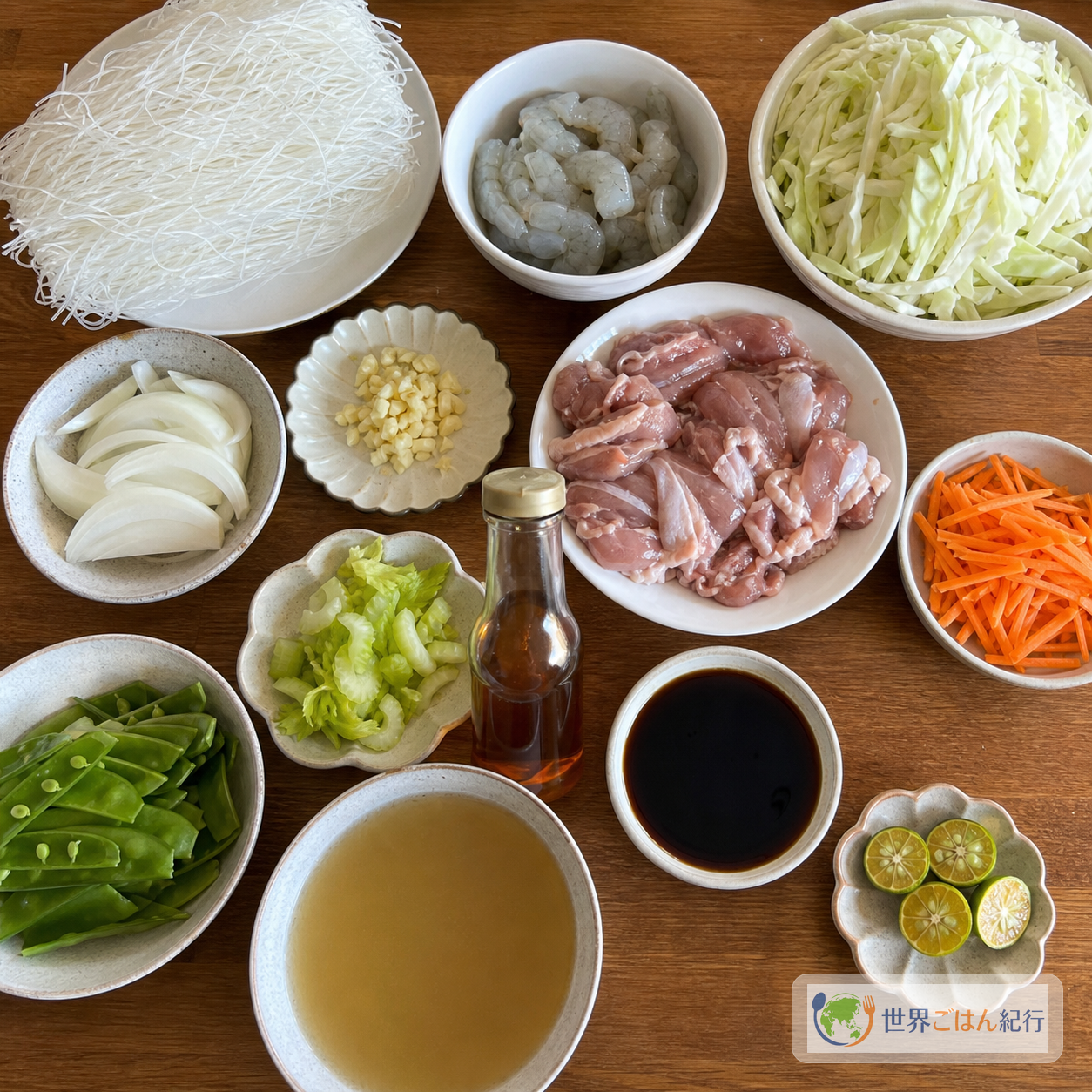
Separating the thin dried noodles, shrimp, chicken and vegetables ahead of time keeps the stir-fry order straight
This serves 4. It's just right as a main dish; for a birthday or potluck, set it beside fried chicken or lumpiang shanghai (in Japanese) and it will stretch to about 6 people. Check the package: if the stated cooking time for your noodles is very short, cut the time they spend in the broth in step 1 by 30 seconds.
Ingredient
Amount
Substitutes & notes
Thin dried rice vermicelli (bihon)
200 g
100% rice or mostly rice. Thick pho noodles give a different dish
Chicken thighs
250 g
1.5 cm cubes. If using breast, coat with 1 tsp potato starch or cornstarch
Peeled shrimp
180 g
Halve large ones. To skip shrimp, add 100 g more chicken
Cabbage
180 g
3 cm squares. If using napa cabbage, use 150 g and drain well
Carrot
80 g
Julienned, 4 cm long
Snow peas or sugar snap peas
80 g
Halved on the diagonal. Green beans also work
Onion
1/2 (about 100 g)
Sliced 5 mm thick
Celery
1/2 stalk (about 50 g)
If you don't like it, use the white parts of 2 green onions
Garlic
3 cloves
Minced
Green onions
2
Thinly sliced, for finishing
Chicken broth
500 ml
About 2 cups. Or 2 tsp chicken bouillon granules dissolved in hot water
Soy sauce
1 1/2 tbsp
Regular soy sauce
Patis or Thai fish sauce
2 tsp
Without fish sauce, add 1 more tsp soy sauce
Sugar
1 tsp
Just enough to round off the broth, not to make it sweet
Black pepper
1/3 tsp
Coarsely ground is best
Vegetable oil
1 1/2 tbsp
Rice bran oil also works
Calamansi
4
Or 1/2 lemon, 4 sudachi or 1 lime
Annatto seeds
1 tsp
Optional; for tinting the oil. 1/8 tsp turmeric can stand in for color only
Allergies and prep
This dish contains shrimp, chicken, soy and fish. Store-bought fish sauce, chicken broth and rice noodles vary in ingredients from product to product, so check the labels if you have allergies. Pat thawed frozen shrimp dry; if they smell strong, toss with 1 tsp sake, leave for 5 minutes, and pat dry again. Leftover moisture steams the pan before anything gets a chance to sear.
What you can swap locally, and what to look for if you want to go further
Rice noodles, chicken, vegetables, soy sauce and lemons are easy to find. Not forcing in more specialty ingredients is what makes the first batch go well. The only reasons to visit an international grocer or shop online are wanting to try Filipino fish sauce, or wanting the soft orange color annatto brings.
You don't need patis just to add salt. Make the dish once with Thai fish sauce or soy sauce, and pick up patis if you find yourself wanting to cook more Filipino food. When buying, make sure it really is fish sauce and not a soy-based seasoning.
Annatto seeds tint food without asserting themselves the way paprika does. Warm 1 tsp seeds in 1 tbsp oil over low heat for 1 minute; once the oil turns reddish brown, remove the seeds and sauté the garlic in that oil. The dish works without it. There's no need to buy a big bag just for pancit; it makes sense if you also plan to make arroz caldo or kutsinta. If you only want the color once, use turmeric instead.
Method: don't boil the noodles through; let them take in the broth
Loosen the noodles in broth
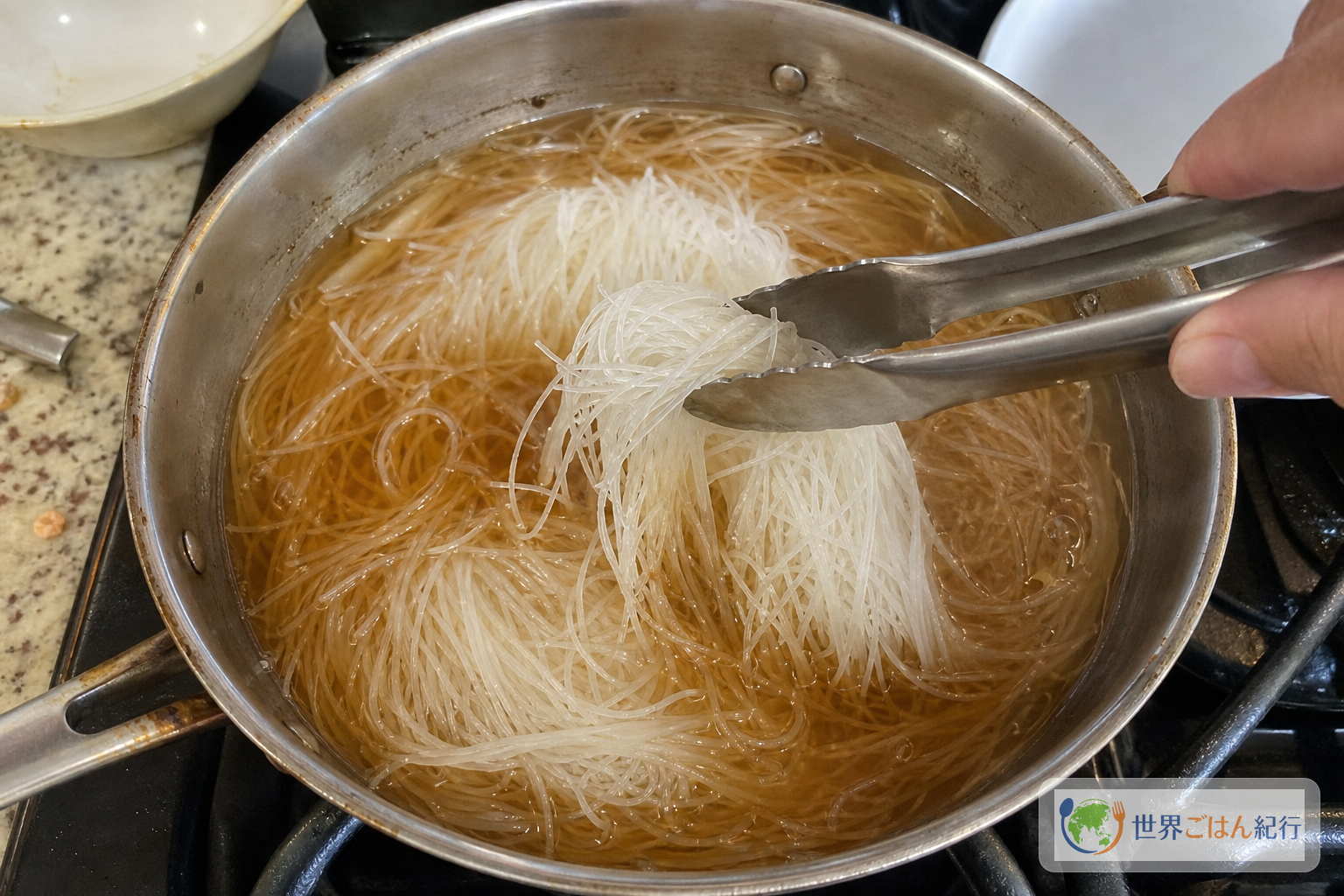
Bring 500 ml chicken broth, 1 1/2 tbsp soy sauce and 1 tsp sugar to a boil in a wide pot. Once it boils, spread 200 g rice noodles into the center and push them under, loosening them with chopsticks or tongs for just 1 minute 30 seconds. Drain while a little white core remains and the bundle doesn't snap when lifted, and reserve 300 ml of the broth. If they get too soft here, the noodles will break in the next steps.
Soften the noodles in the broth for just a minute and a half, leaving a little white core
Sear the shrimp first
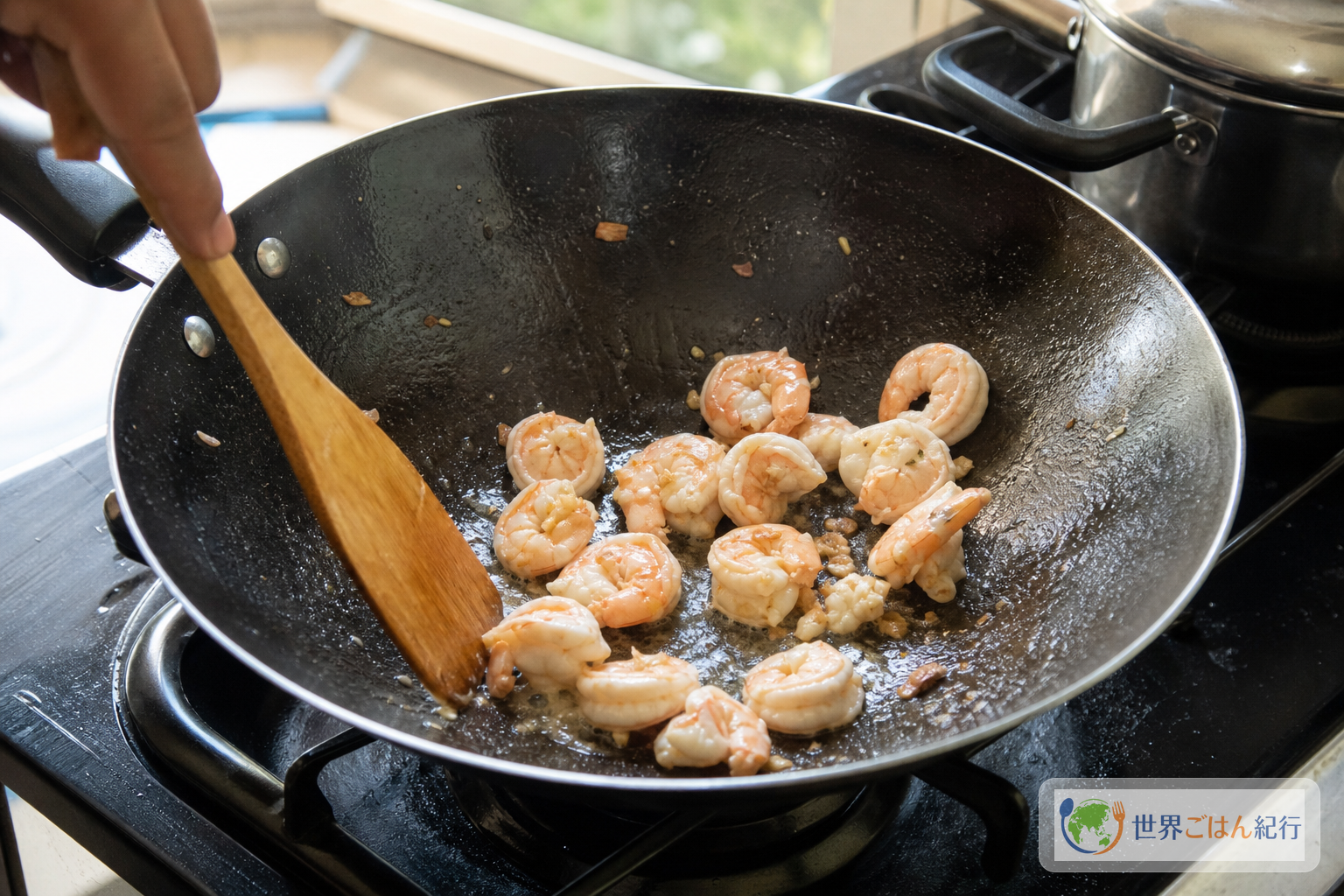
Heat a large frying pan or wok over medium-high for 1 minute and spread 2 tsp oil in it. Add 180 g shrimp, patted dry, in a single layer and sear 40 seconds on one side, then 30 seconds after turning. When the edges turn pink and the center begins to change from translucent to white, move them to a plate. Taking them out while they are still loosely curved keeps them from toughening at the end.
Take the shrimp out as soon as the edges turn pink; they go back in at the end
Cook the chicken and vegetables
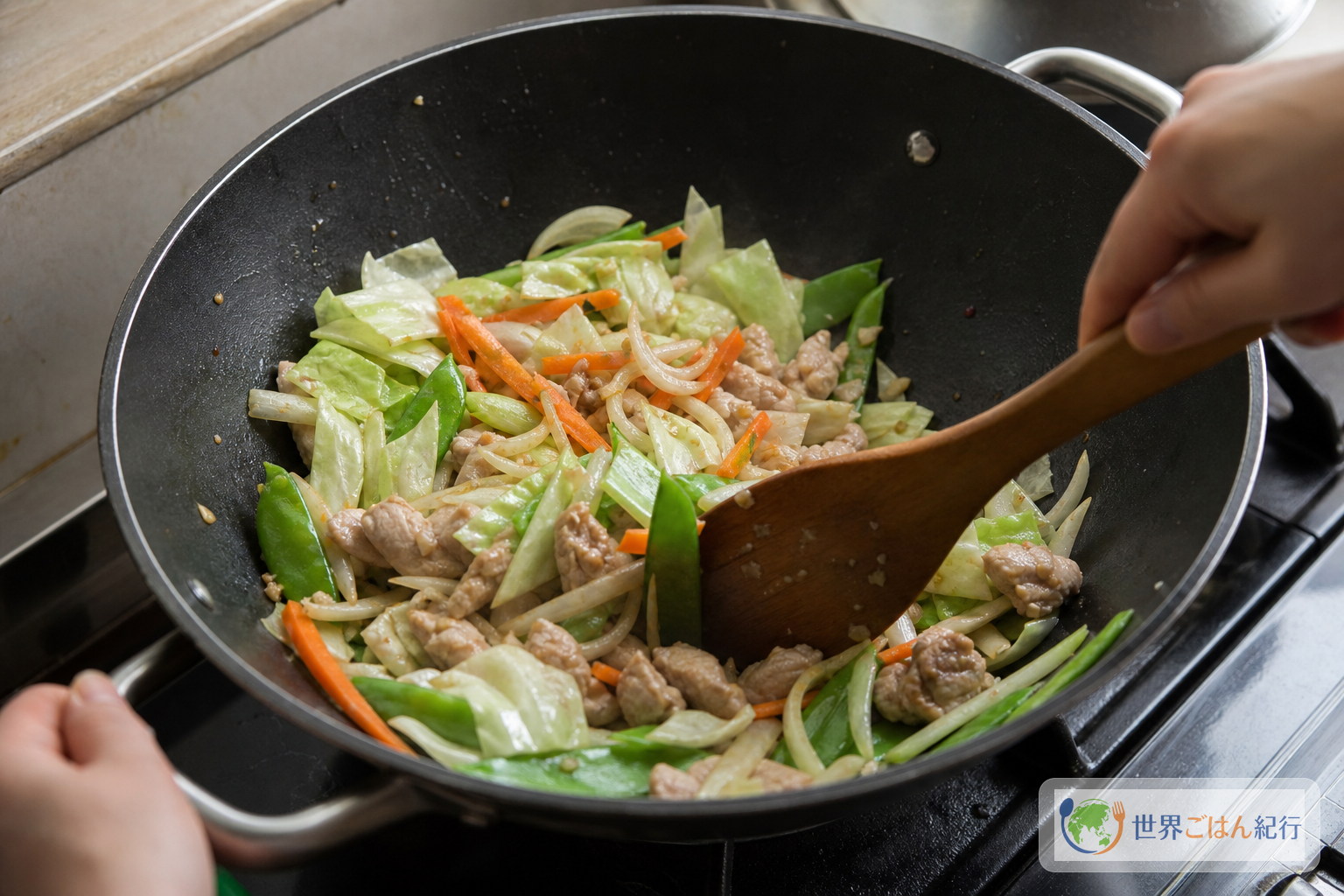
Add 1 tbsp oil to the same pan and stir-fry the garlic, onion and 1.5 cm cubes of chicken thigh over medium-high for 3 minutes. When the surface of the chicken turns white, add the 4 cm carrot strips, celery, snow peas and 3 cm squares of cabbage in that order, and cook 2 minutes more. Stop while the cabbage edges are translucent but the centers are still firm. If you cut the chicken larger, check that the thickest piece reaches 74°C (165°F).
Move on while the cabbage cores are still firm
Let the noodles absorb the rest of the broth
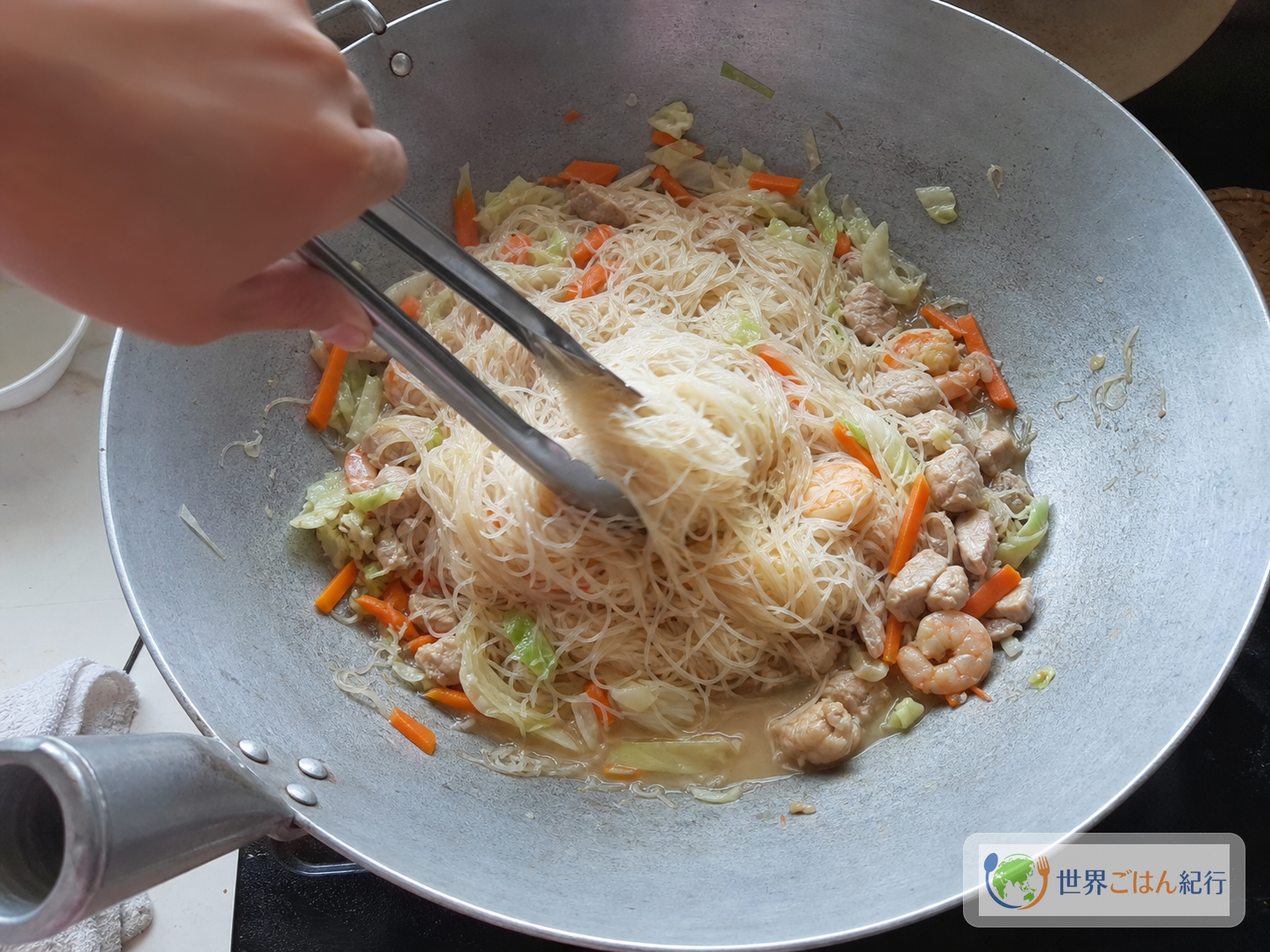
Pour 200 ml of the reserved broth and 2 tsp patis into the pan and add the noodles right away. Keep lifting them from the bottom and turning them with tongs for 2 minutes; once the broth is no longer visible, add the remaining 100 ml. It's a success when the liquid at the bottom is almost gone and the noodles have turned light brown but still come apart strand by strand. If liquid remains, turn the heat up to medium-high for just 30 seconds; if it gets too dry, add 1 tbsp hot water.
Don't add the broth all at once; add more little by little once the bottom of the pan starts to dry
Return the shrimp and finish with citrus
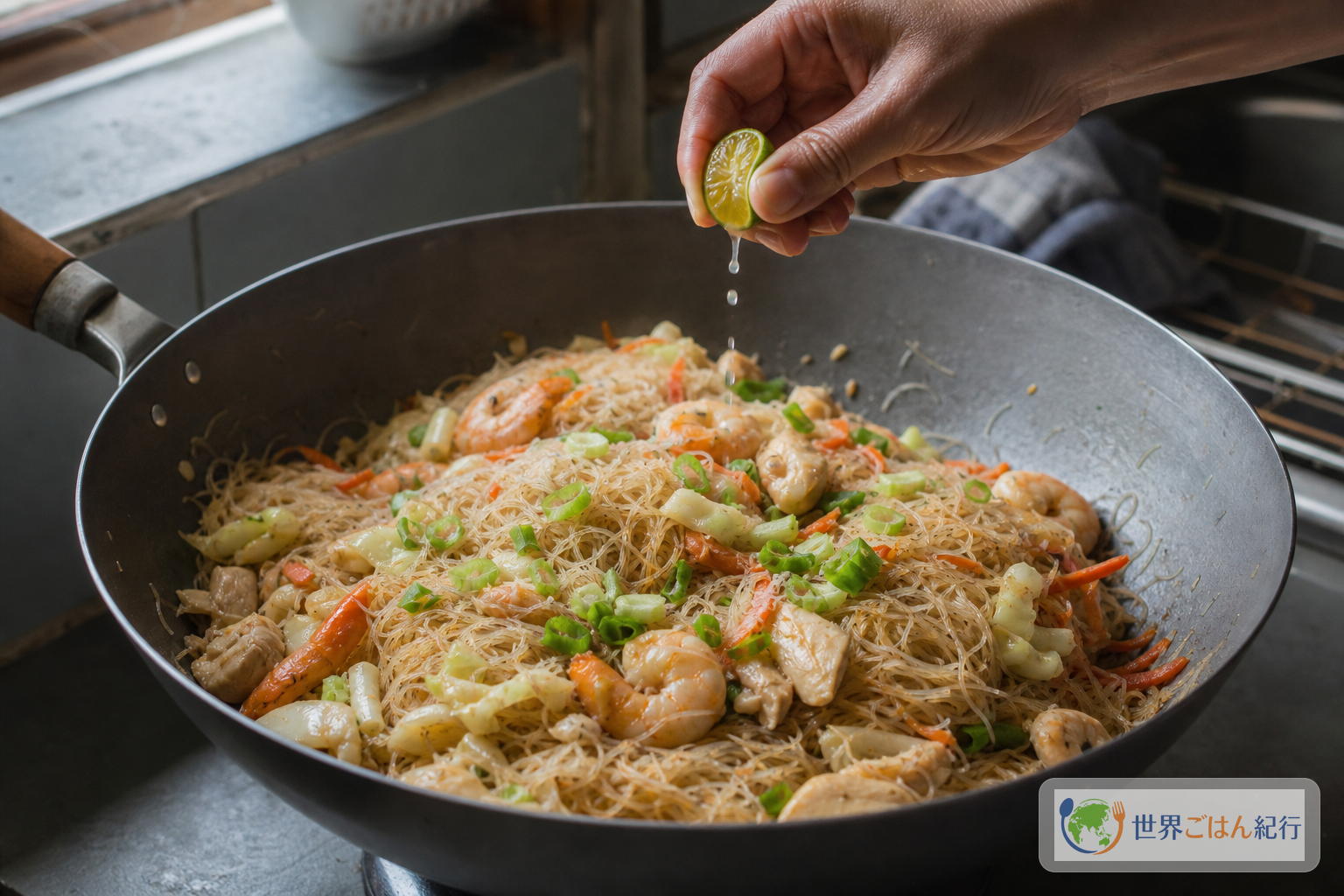
Add the shrimp back along with the green onions and black pepper, turn off the heat, and turn everything twice with tongs. When no liquid is left at the bottom, the noodles separate strand by strand and the shrimp are warmed through, pile it high on a platter. Squeeze calamansi, lemon or sudachi over just before eating. Start with about 1 tsp per person and add more at the table if needed. Simmering the acid in the pan drives off its aroma and leaves only the heaviness of the soy sauce.
Squeeze the citrus after turning off the heat, and the fish sauce and soy sauce taste lighter
You can tell it worked by the noodles on your chopsticks, not their color
Pancit bihon isn't a dish you brown. Lift about 10 strands: if the bundle slowly separates and has a slight springiness, it passes. A puddle in the bottom of the pan means the flavor hasn't gone in yet; noodles stuck in one clump mean they've absorbed too much liquid. The latter isn't a failure you need to throw out. Add 2 tbsp hot water and 1 tsp lemon juice around the edge of the pan and loosen over low heat for about 30 seconds, and it becomes easy to eat again.
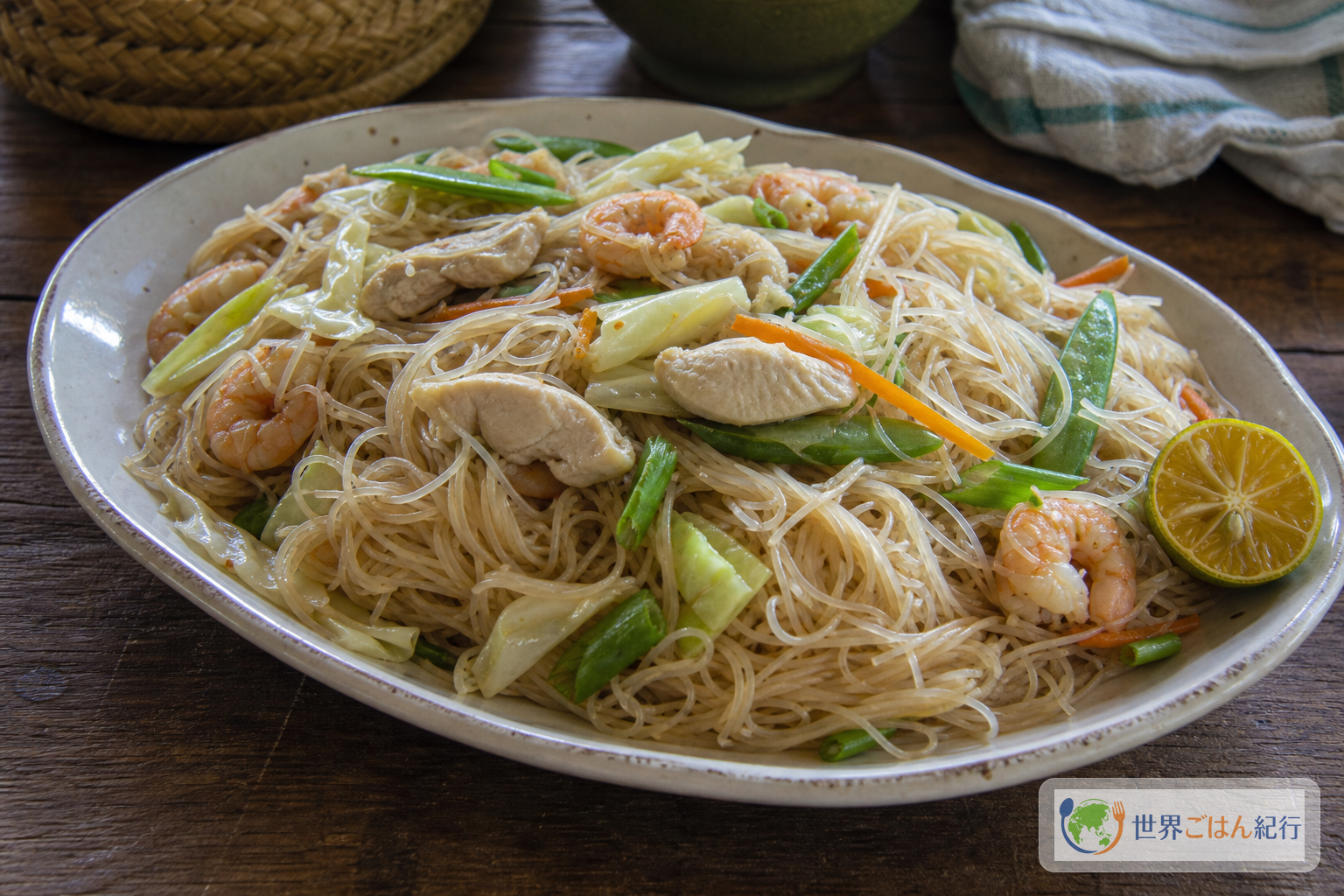
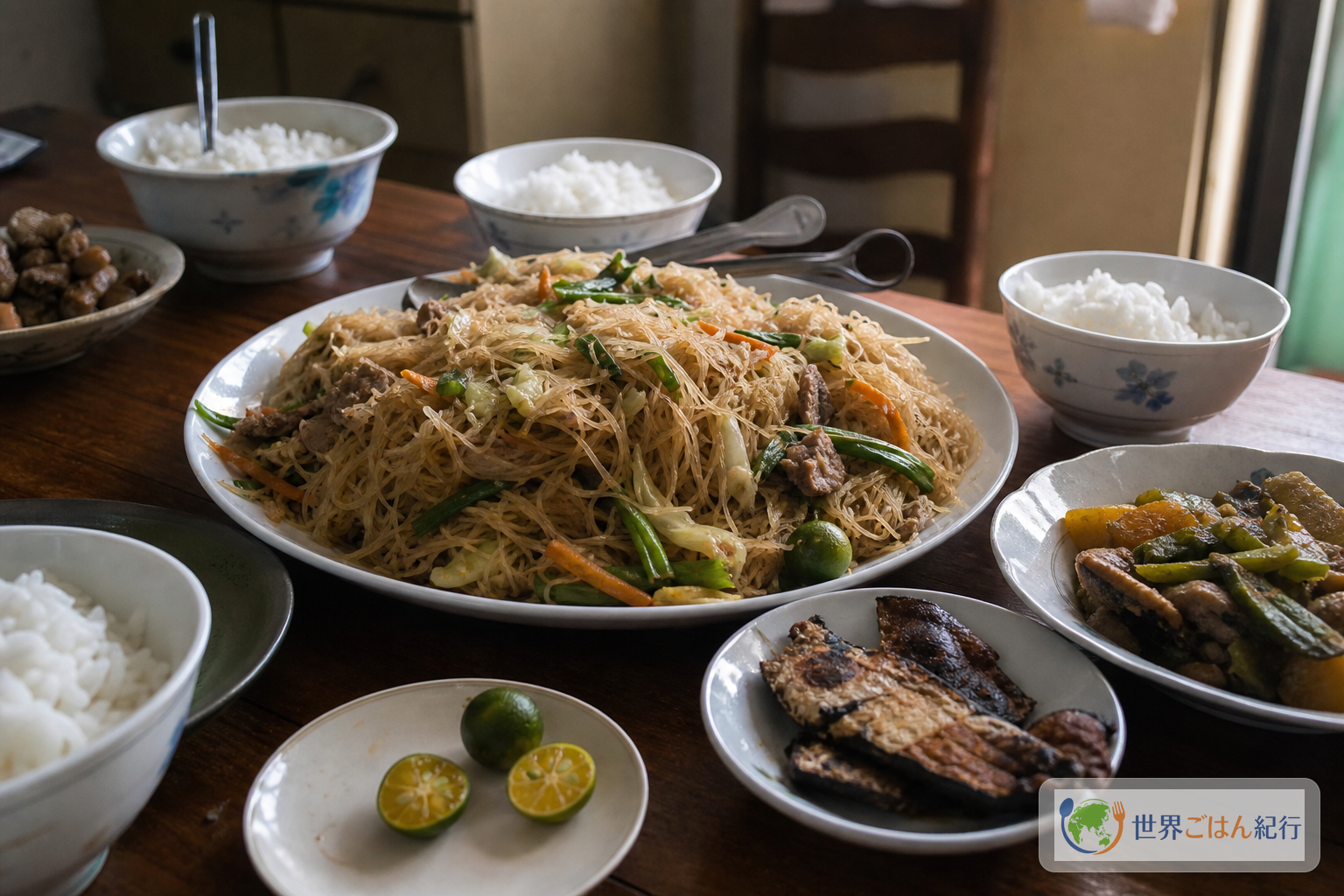
Pancit bihon works as a shared platter alongside rice and other dishes, or as a main dish on its own
If it tastes too strong, adding only water dilutes the chicken broth and fish sauce along with it. It's easier to fix by softening 30 g more noodles separately and mixing them in. If it's too sour, add 1/4 tsp sugar and a handful more cabbage and stir-fry for 30 seconds. If it needs salt, add patis 1/4 tsp at a time. A single last drop of fish sauce changes the impression, so the trick is not to get carried away and use a tablespoon.
If you don't have a large pan
Stir-fry just the toppings in a frying pan about 30 cm across, let the noodles absorb the broth in a pot, then combine them half at a time at the end. Compared with cramming everything into a small pan, the noodles won't break and the vegetables won't steam.
Variations: what you can change and what to keep
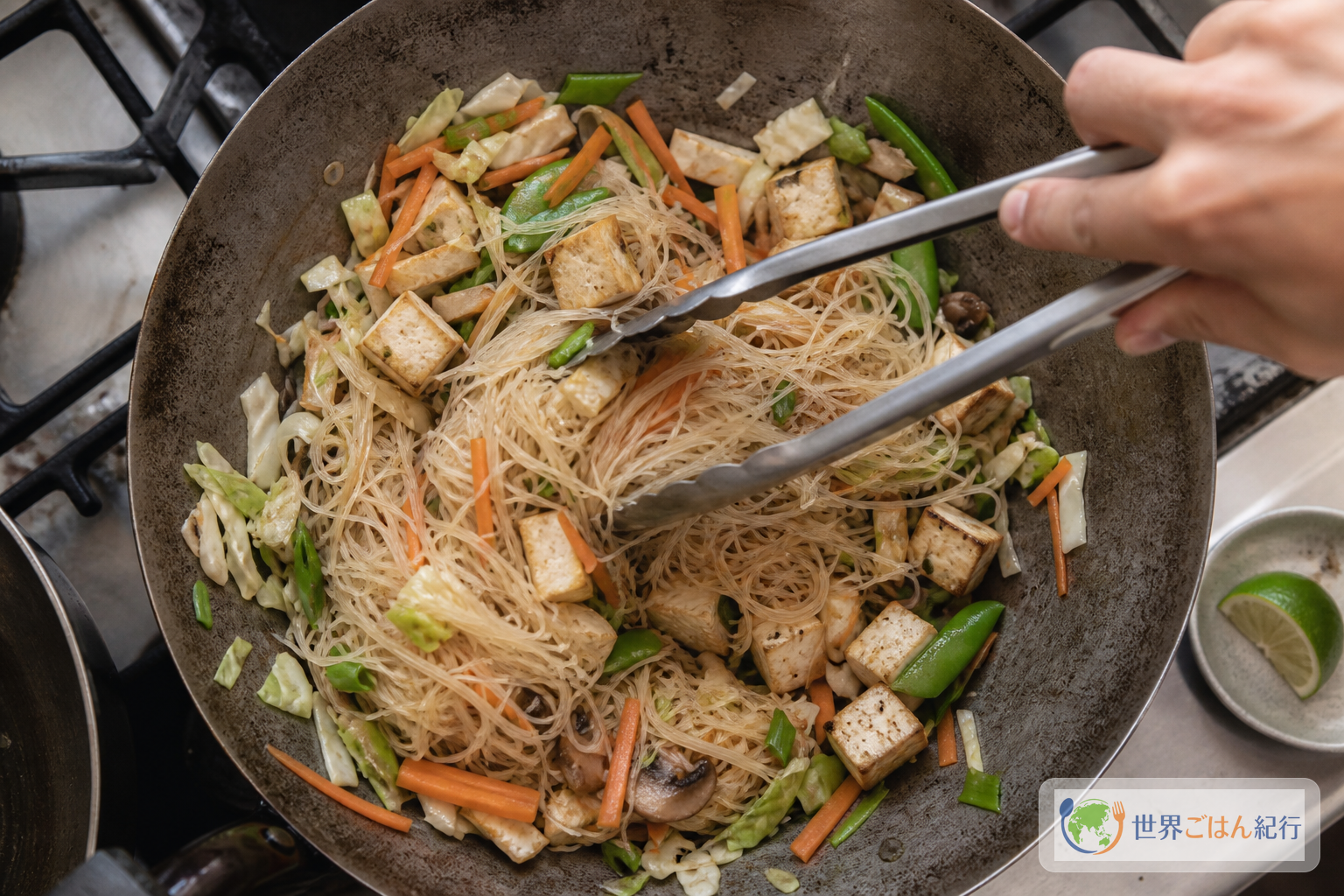
A pancit bihon variation with firm tofu and mushrooms in place of shrimp and chicken
Chicken only
On a day without shrimp, increase the chicken thighs to 350 g. You lose the shrimp aroma, but since the noodles go into the pan where the chicken cooked, the broth keeps its direction. On a weeknight, this is more practical than buying frozen shrimp.
A tofu and mushroom version
Use 300 g drained firm tofu and 150 g shimeji mushrooms in place of the shrimp and chicken. Cut the tofu into 2 cm cubes, sear the surfaces first and set aside. If you're not using fish sauce, add 1 more tsp soy sauce and replace 100 ml of the chicken broth with dried shiitake soaking liquid so the flavor doesn't fall flat.
Lighten it with bean sprouts
Reduce the cabbage to 100 g and add 150 g bean sprouts in step 5. Mixing them for only 30 seconds after turning off the heat keeps them from releasing much water. If you plan to keep leftovers for the next day, the texture holds up better without sprouts.
Serve the heat on the side
If people at the table like different levels of heat, don't put chile in the pan. Set out sliced red chiles or sambal in a small dish so everyone can add their own. Making the whole platter spicy makes the calamansi aroma harder to notice.
Enjoy the contrast with canton
With wheat noodles, pancit canton (in Japanese) is all about chew and that fried-noodle character. Bihon, by contrast, is about the lightness of thin noodles that have soaked up broth. Some households mix both, but sticking to one kind the first time makes it easier to learn how to judge the moisture.
Nutrition estimate
Per serving, roughly 510 kcal, 27 g protein, 14 g fat and 66 g carbohydrates. These change if you add more shrimp, remove the chicken skin or cut the oil to 1 tbsp. Because the dish uses fish sauce, soy sauce and chicken broth, on days when you're watching sodium, cut the fish sauce to 1 tsp and use a bit more lemon.
How a noodle of Chinese origin became a Filipino platter
The word pancit is linked to a Hokkien term for something conveniently or quickly cooked. Panlasang Pinoy describes how noodle dishes of Chinese origin grew to suit Filipino tastes and branched into many kinds, including bihon, canton and sotanghon. Still, today's pancit bihon is not a copy of a Chinese noodle dish.
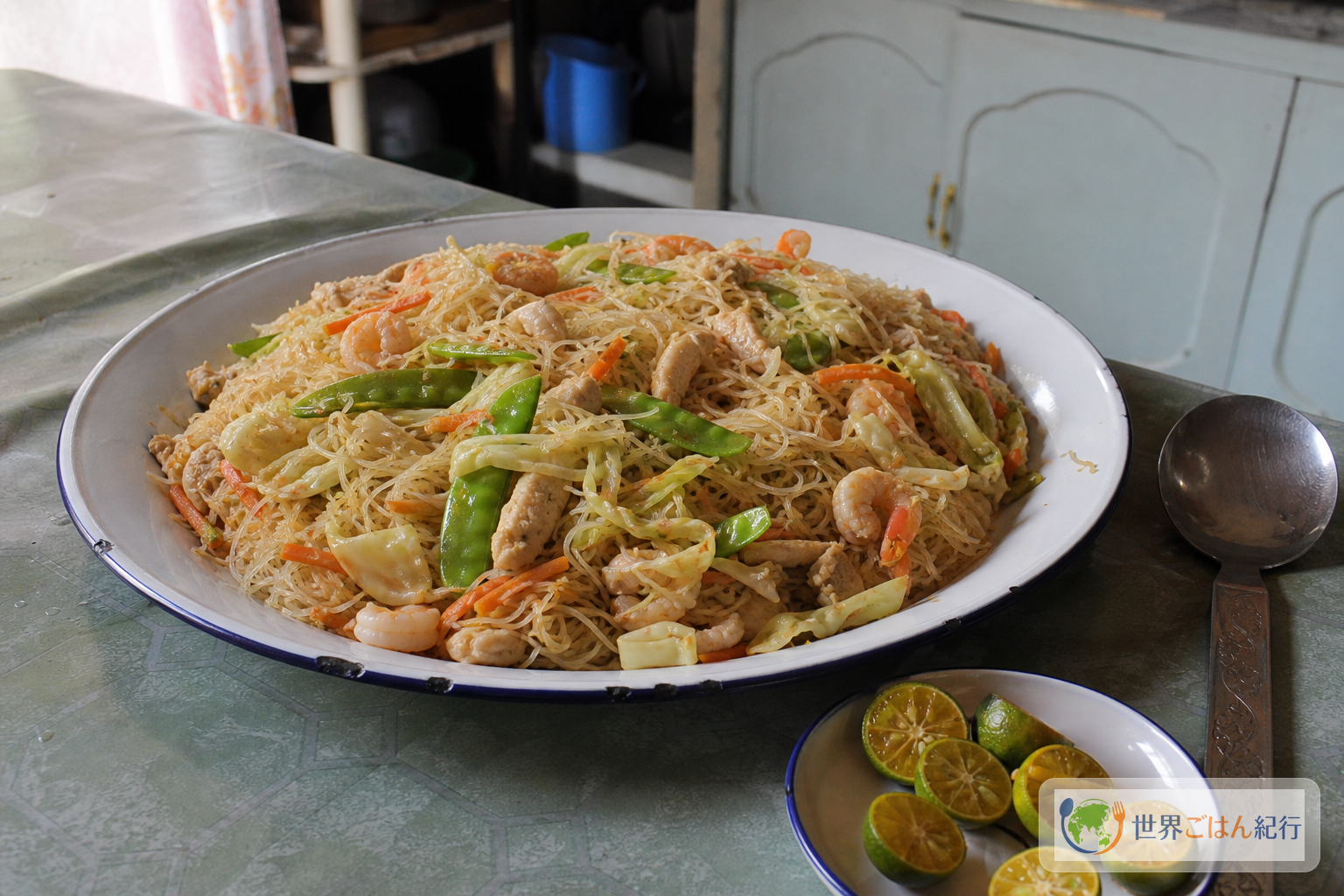
Pancit bihon is served on a big platter for sharing, with the citrus on the side
Layer fish sauce, soy sauce, calamansi, cabbage and shrimp onto thin rice noodles, and the result has a lightness quite unlike Chinese-style fried noodles. Because the meat and vegetables change from home to home, it never feels stiff, even as a celebration dish. The Philippine Information Agency describes Filipino cuisine as something shaped by outside influences layered with local ingredients and the life of households and regions. Piling noodles on a big platter, everyone serving themselves, squeezing citrus over: that mix shows in the way it's eaten, too.
Knowing why long noodles are favored at birthdays makes it a little easier to understand why they're served without being cut. That said, if there are small children at the table, it's fine to cut them so they're easier to eat. Put the table's comfort ahead of the symbolism, keep the citrus on the side, and everyone can season their own plate to taste.
FAQ: storage, substitutes and rescues
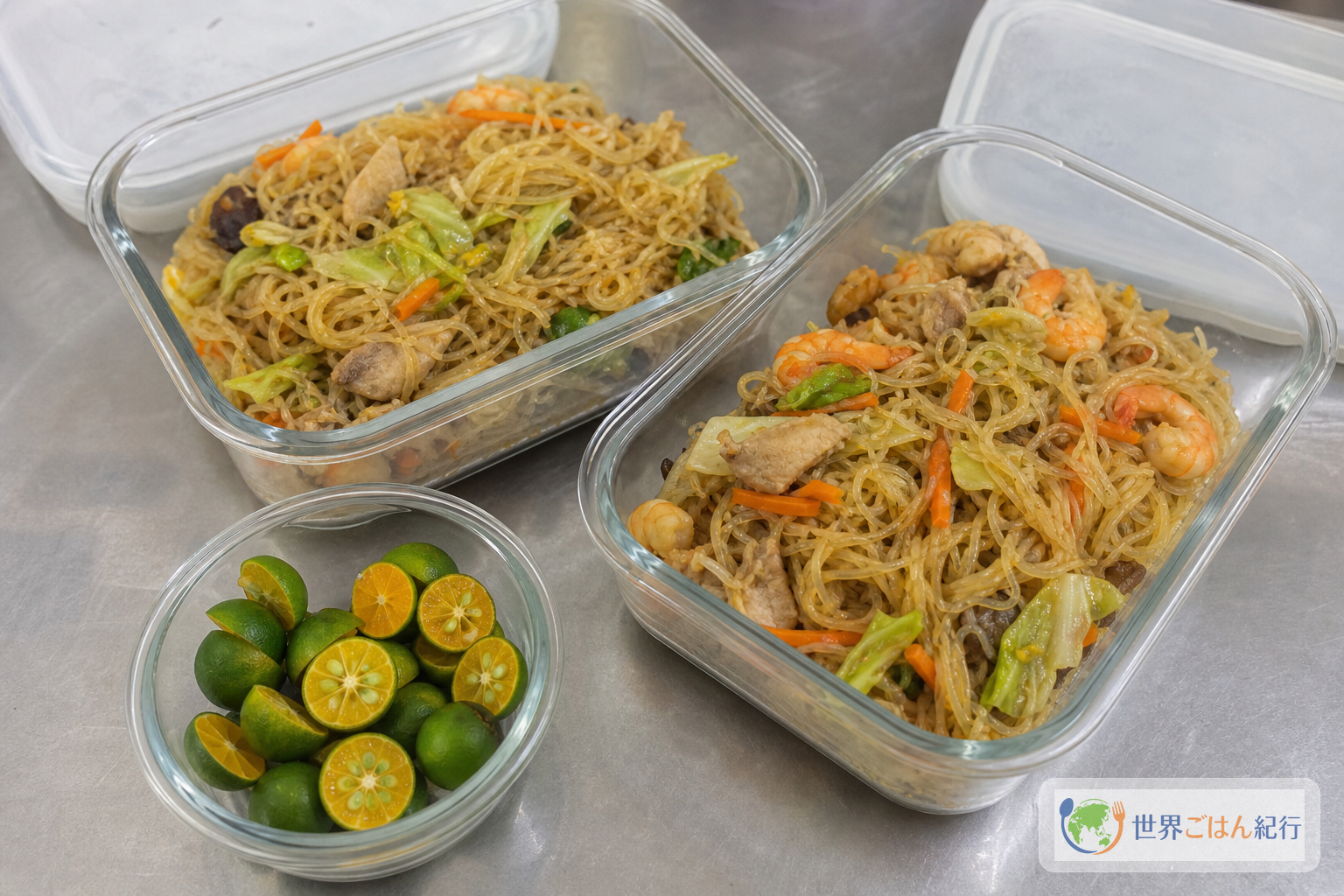
Divide pancit bihon into shallow containers and store the citrus separately
Can I soak the noodles in water first?
Yes. But noodles softened in water should not go into the broth in step 1. Soak them in lukewarm water for 5 minutes, drain while the centers are still firm, and start step 4 with 200 ml broth. If they've gone completely soft, halve the broth you add to the pan.
What's closest if I can't find calamansi?
Sudachi for aroma, lemon for easy-to-handle acidity, and lime if you want a greener scent. None of them taste the same. As long as you don't simmer the lemon in the pan and squeeze it just before eating, the lightness that makes it pancit stays.
Can I use patis and Thai fish sauce interchangeably?
At the 2 tsp used here, yes. Patis leans the dish more Filipino; Thai fish sauce gives a slightly different aroma. Both are very salty, so rather than adding more soy sauce first, taste and add 1/4 tsp at a time.
How do I fix sticky noodles?
Before turning up the heat and stir-frying harder, spread the noodles out. Add 2 tbsp hot water around the edge of the pan, loosen with tongs for 30 seconds, then add 1/2 tsp lemon juice. If clumps remain, adding a few more vegetables to give the moisture somewhere to go holds it together better than thinning with water alone.
How long does it keep?
Let it cool, divide it into shallow containers and refrigerate within about 2 hours of cooking, then finish it by the next day. To reheat, sprinkle with 1 tbsp water, cover loosely and microwave, stirring partway, until it's hot all the way through. Don't leave dishes containing meat, shrimp and cooked noodles at room temperature for long. FoodSafety.gov advises discarding cooked leftovers containing meat or seafood that have been above 4°C (40°F) for more than 2 hours.
To compare Filipino noodles, pancit canton (in Japanese), stir-fried with wheat noodles, is also a celebration noodle but with a distinctly different texture. On days when you put a meat main beside the platter, adobo (in Japanese), braised in soy sauce and vinegar, or the sour soup sinigang lets you carry the fish sauce and citrus notes into other dishes.