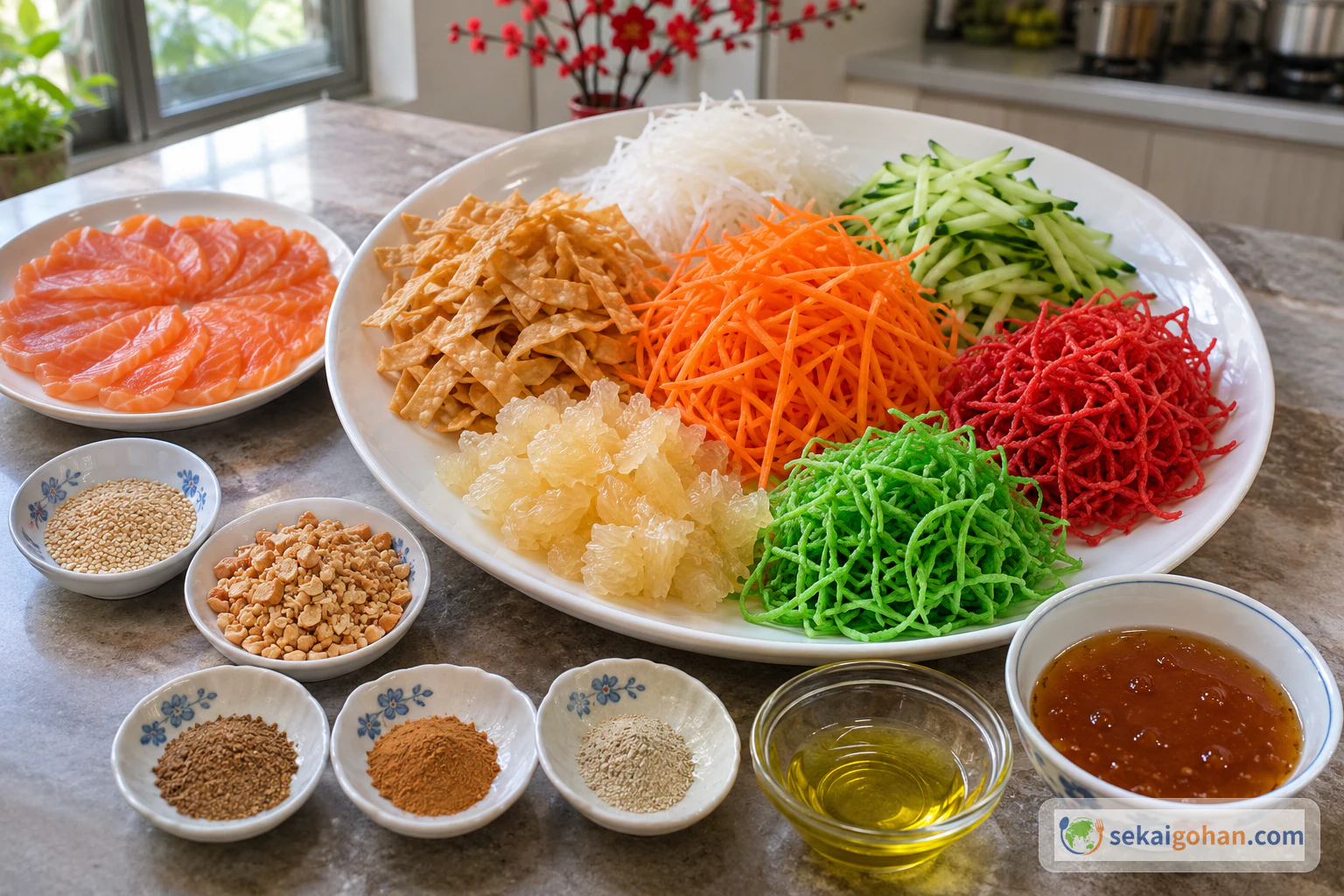
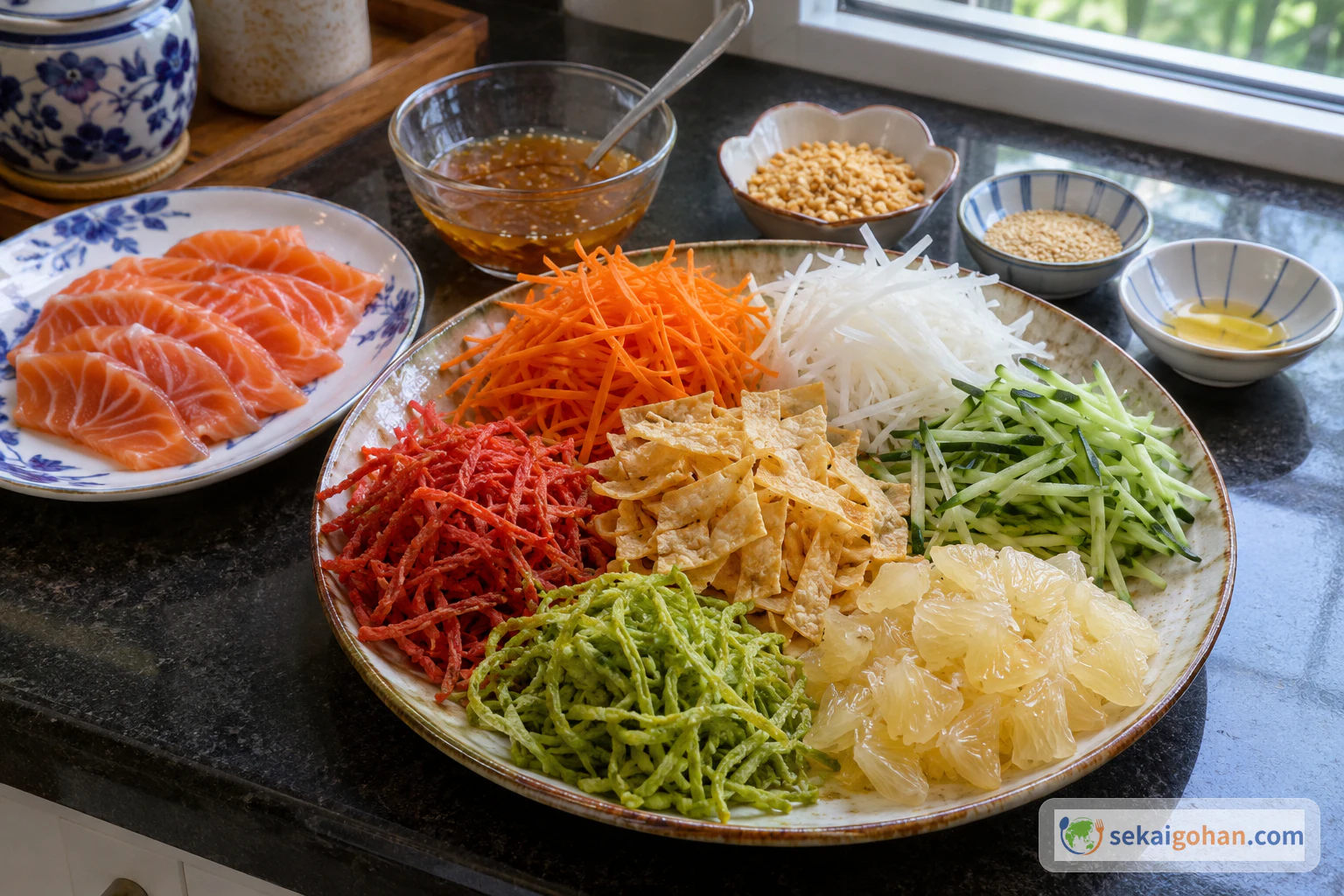
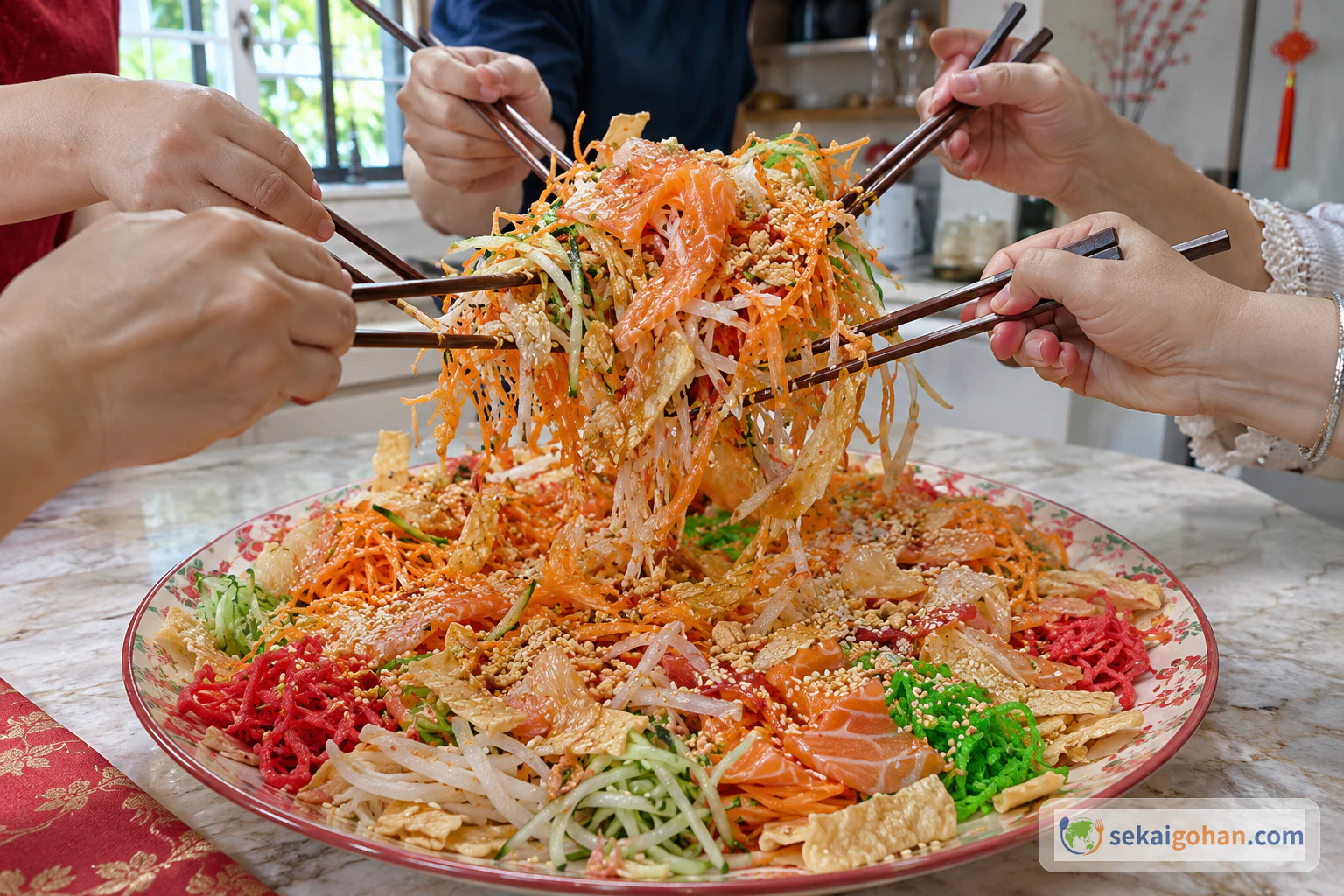
Everyone gets up from their chairs. A round platter sits in the middle of the table, covered in mounds of orange carrot, white radish, pale green cucumber, pink and green taro strands and slices of salmon. Each person holds a pair of chopsticks, and as the last sauce goes on, they all plunge in, lift the strands as high as they can and call out wishes for the year ahead. That is yusheng, the raw fish salad of the Lunar New Year in Singapore and Malaysia. It tastes sweet and tangy from plum sauce and pomelo, with warm notes of cinnamon and five-spice, the crunch of peanuts and crackers, and cool, soft salmon running through it.
Seven Colors and a Shouted Wish: Where Yusheng Comes From
The name is written 魚生, yúshēng, which means "raw fish." Said aloud, it also sounds like abundance rising, and that pun drives the whole dish. Every ingredient carries a wish, and you say that wish as it goes onto the platter. The toss itself is called lo hei (捞起), Cantonese for "tossing up." The salad also goes by lo sang, yee sang and Prosperity Toss. The modern seven-color version is called qicai yusheng (七彩魚生), and you will also hear facai yusheng (發財魚生) and xinnian yusheng (新年魚生).
At lo hei, everyone at the table stands and lifts the ingredients high with chopsticks. The higher the toss, the greater the luck. Strands land on the tablecloth, people laugh, and nobody minds the mess.
From fishermen's custom to a Singapore table
Eating raw fish on Renri (人日), the seventh day of the lunar new year and "everybody's birthday," is usually traced to fishing communities on the Guangdong coast. Cantonese and Teochew immigrants brought the raw fish habit to Singapore in the 19th century. Early sellers from Jiangmen are remembered for raw fish served with ginger, lime, shredded spring onion and sesame. In the 1930s, Loong Yik Kee is credited with adding pickled vegetables, sugar and vinegar. Today the salad is no longer tied to the seventh day and is eaten across the fifteen days of the New Year.
The colorful dish people toss today spread through Singapore in the 1960s. Four chefs are linked to it: Lau Yoke Pui, Tham Yui Kai, Sin Leong and Hooi Kok Wai. The people connected to them said in 2012 that they never claimed to have invented it. Lai Wah Restaurant opened in 1963 with Tham Yui Kai and Lau Yoke Pui among its founders. The restaurant's owners tell how diners asked the waiters for the right greeting for each ingredient, and lo hei became a fixed part of the meal from there. In the 1970s, Lai Wah in Bendemeer began serving a premixed sauce of plum sauce, rice vinegar, kumquat paste and sesame oil. A Malaysian restaurant, Yow Kee, opened in Singapore in 1978 and is credited with bringing plum sauce to the dish. Malaysia has its own claim: in Seremban, the dish is credited to Loke Ching Fatt, and his family has pressed that claim. Where the modern platter began is not settled, but the form took shape in Southeast Asia, not in mainland China.
Regional styles and today's tables
The Cantonese style, eaten by merchants on Renri, is the line that leads to the modern qicai yusheng. The Teochew style, called husay or huay yu, belongs to a different family. The fish is air-dried and dressed with a sweet-sour sauce and vegetables, and it is eaten on any day of the New Year. Lo hei is widely practiced in Malaysia too. In November 2020, yusheng and lo hei joined Singapore's inventory of intangible cultural heritage. For more of the island's food, see our Singapore country page.
Three kinds of platter sit side by side during the festival: ready-made packs from the supermarket, elaborate restaurant versions and platters made at home. Restaurants pile on lobster and abalone or give the salad a Thai, Sichuan, Italian or masala twist. There are halal and vegetarian versions as well. The home platter below keeps to the essentials: fine-cut vegetables, fried taro, pomelo, spices, crunch and plum sauce.
What each handful means
Households and restaurants add the ingredients in different orders. This is one common sequence, matched to the ingredients in this recipe.
| Added to the platter | Phrase | Wish |
|---|---|---|
| Salmon | 年年有余 (nian nian you yu) | Abundance year after year |
| Abalone, if using | 年年包有余 (nian nian bao you yu) | Abundance wrapped up every year |
| Pomelo | 大吉大利 (da ji da li) | Great luck and great profit |
| Cinnamon and white pepper | 招財進寶 (zhao cai jin bao) | Wealth and treasure come in |
| Five-spice powder | 五福臨門 (wu fu lin men) | Five blessings at the door |
| Oil | 一本萬利 (yi ben wan li) or 多多油水 (duo duo you shui) | Great returns, plenty of profit |
| Carrot and red taro | 紅運當頭 (hong yun dang tou) | Good fortune ahead |
| Cucumber and green taro | 青春常駐 (qing chun chang zhu) | Lasting youth |
| Daikon | 步步高升 (bu bu gao sheng) | Rising step by step |
| Peanuts | 金銀滿屋 (jin yin man wu) | A house full of gold and silver |
| Sesame seeds | 生意興隆 (sheng yi xing long) | Thriving business |
| Crackers | 滿地黃金 (man di huang jin) | Gold covering the floor |
| Plum sauce | 甜甜蜜蜜 (tian tian mi mi) | A sweet life |
| The toss | 萬事如意 (wan shi ru yi) | May everything go as you wish |
Ingredients (serves 2)
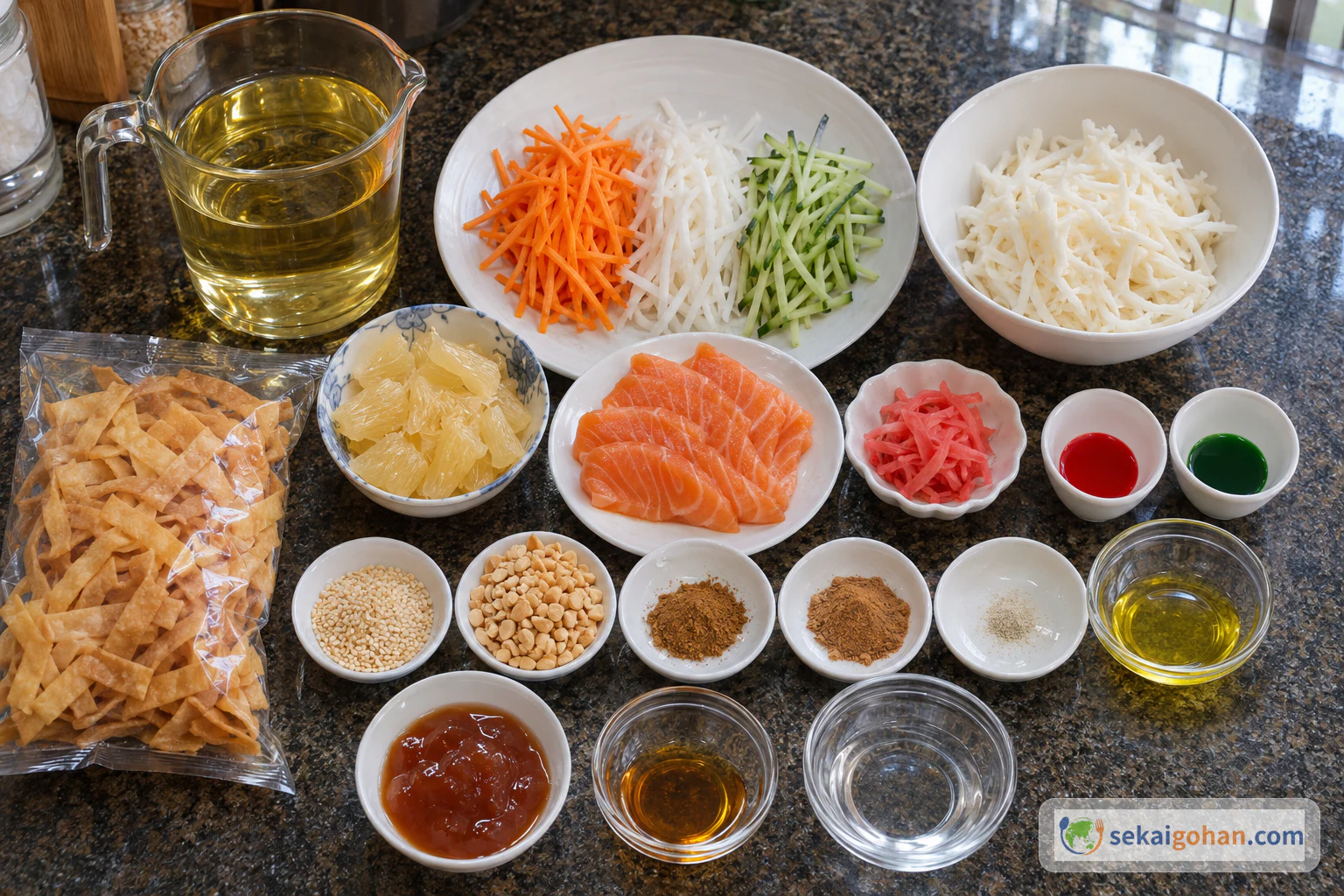
Double everything for 4 people and triple it for 6. The salad is served on one round platter. The circle stands for completeness and plenty.
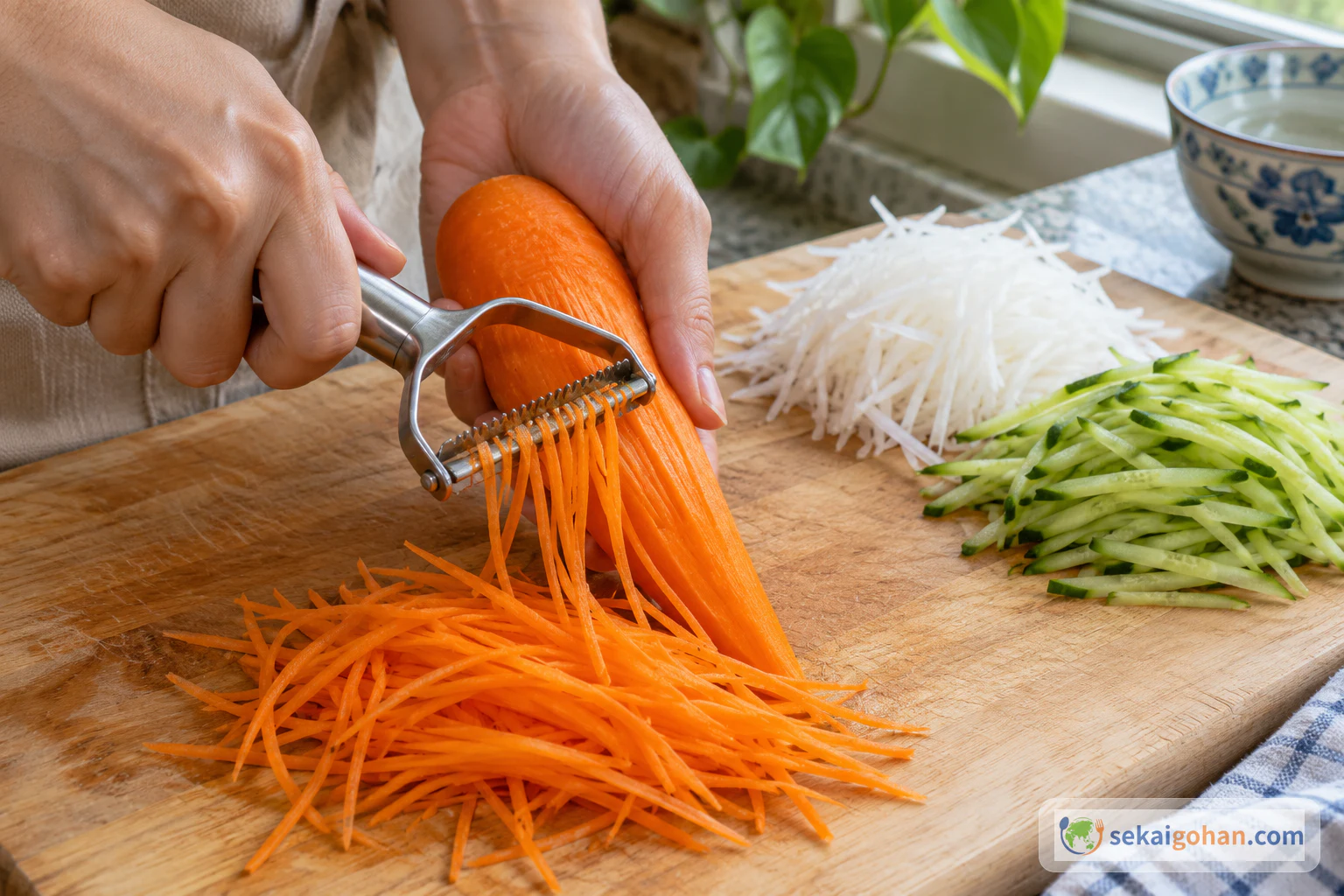
Thin, long strands of carrot, daikon and cucumber wrap around the salmon and catch the sauce during the toss. Short, thick sticks fall off the chopsticks and leave the fish bare.
This salad contains fish, peanuts and sesame. Pok chui crackers and fried wonton skins contain wheat. Check the labels on the plum sauce, the crackers and the pickled ginger for allergens before you buy.
Equipment
A julienne tool and a separate board for the fish do most of the work here.
- Toothed julienne peeler, julienne slicer or mandoline
- Cutting board and knife for the vegetables
- A separate cutting board and knife for the raw fish
- Disposable food-safe gloves
- Wok or deep pan for frying, with a slotted spoon
- Plate for draining the fried taro
- Dry frying pan for toasting sesame
- Small bowls and dishes for the sauce and toppings
- A large round platter
- Chopsticks for everyone at the table
Buying the Fish, the Sauce and the Crunch
Buy salmon labeled for raw eating (sashimi grade), and slice it on its own board with its own knife, away from anything you will cook. Raw mackerel was the traditional fish. Salmon sashimi is now what most platters use, and abalone slices can stand in or sit alongside. Use only saltwater fish. Since December 5, 2015, Singapore has banned freshwater fish in all ready-to-eat raw fish dishes. In testing, freshwater fish showed significantly higher bacterial contamination than saltwater fish, and food outlets there now serve only saltwater fish meant for raw eating.
Infants and young children, pregnant people, older adults and people with a long-term illness should avoid raw fish. A 2015 outbreak of Group B Streptococcus infection in Singapore was reported to be linked to raw fish dishes, but the outbreak strain, GBS ST283, was not found in retail sashimi. Keep the raw fish apart from fish for cooking, at the store, in the fridge and on the board.
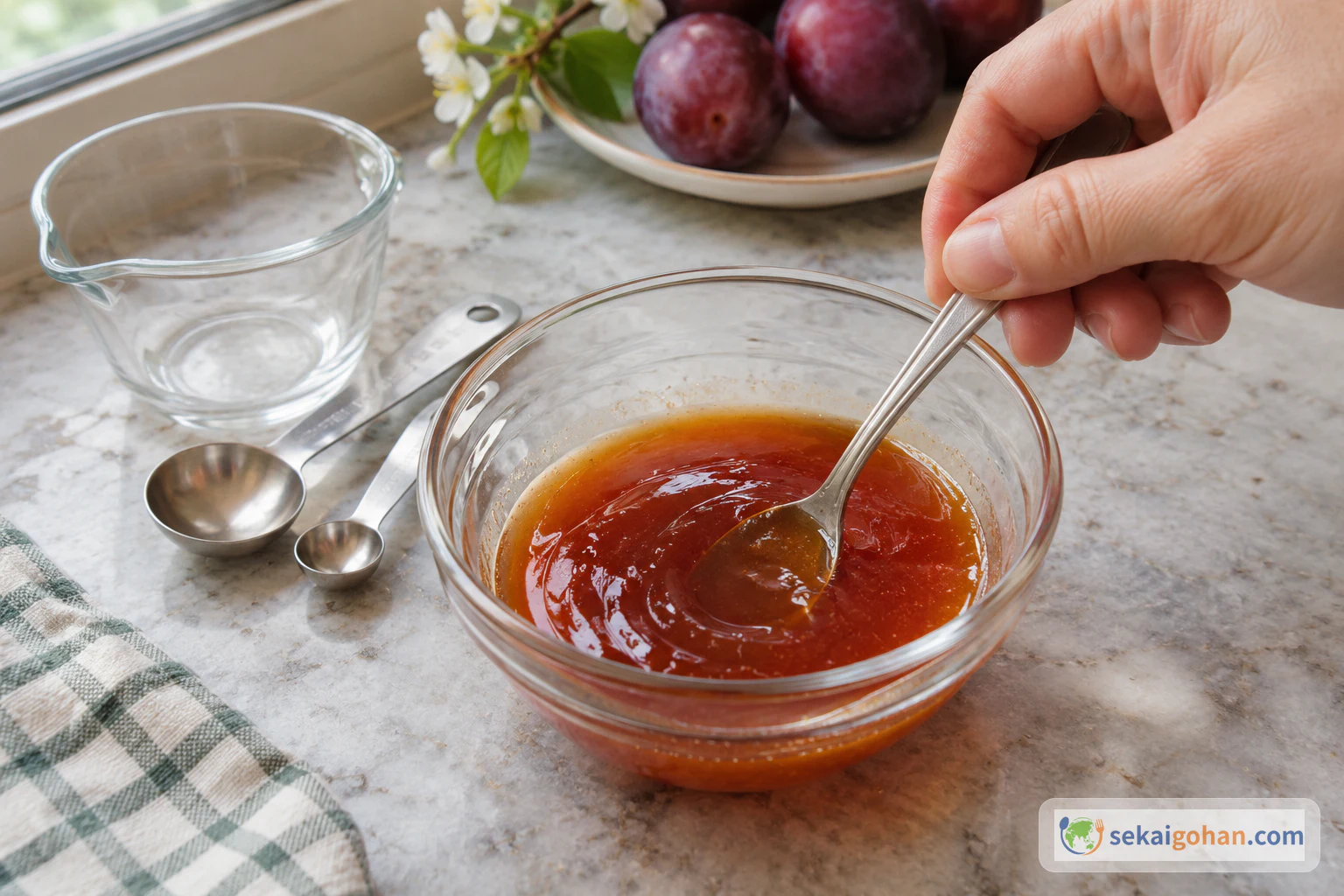
Chinese plum sauce is sold in jars at Chinese and Southeast Asian grocers and online. It sets the flavor of the whole platter, so it is worth tracking down. Pok chui crackers come in packs at the same shops. Fried wonton skins are the swap, and they give a slightly heavier, crisper crunch. If you cannot find pomelo, use grapefruit segments. They are juicier and a little more bitter, so drain them well before plating. Taro is sometimes labeled yam. Roasted peanuts from the snack aisle work, but taste one first and use less if they are heavily salted.
Method: Cut, Fry, Then Toss at the Table
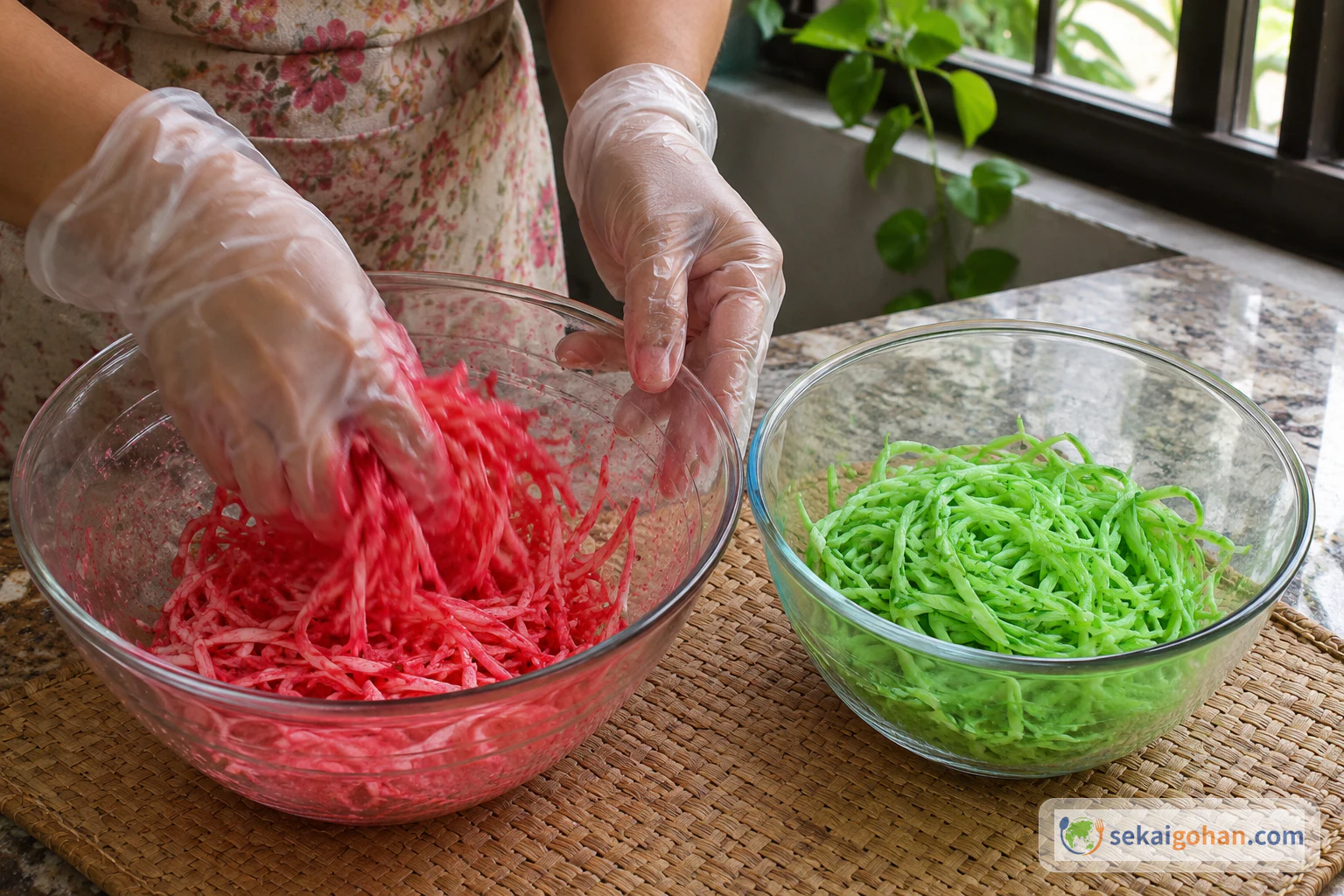
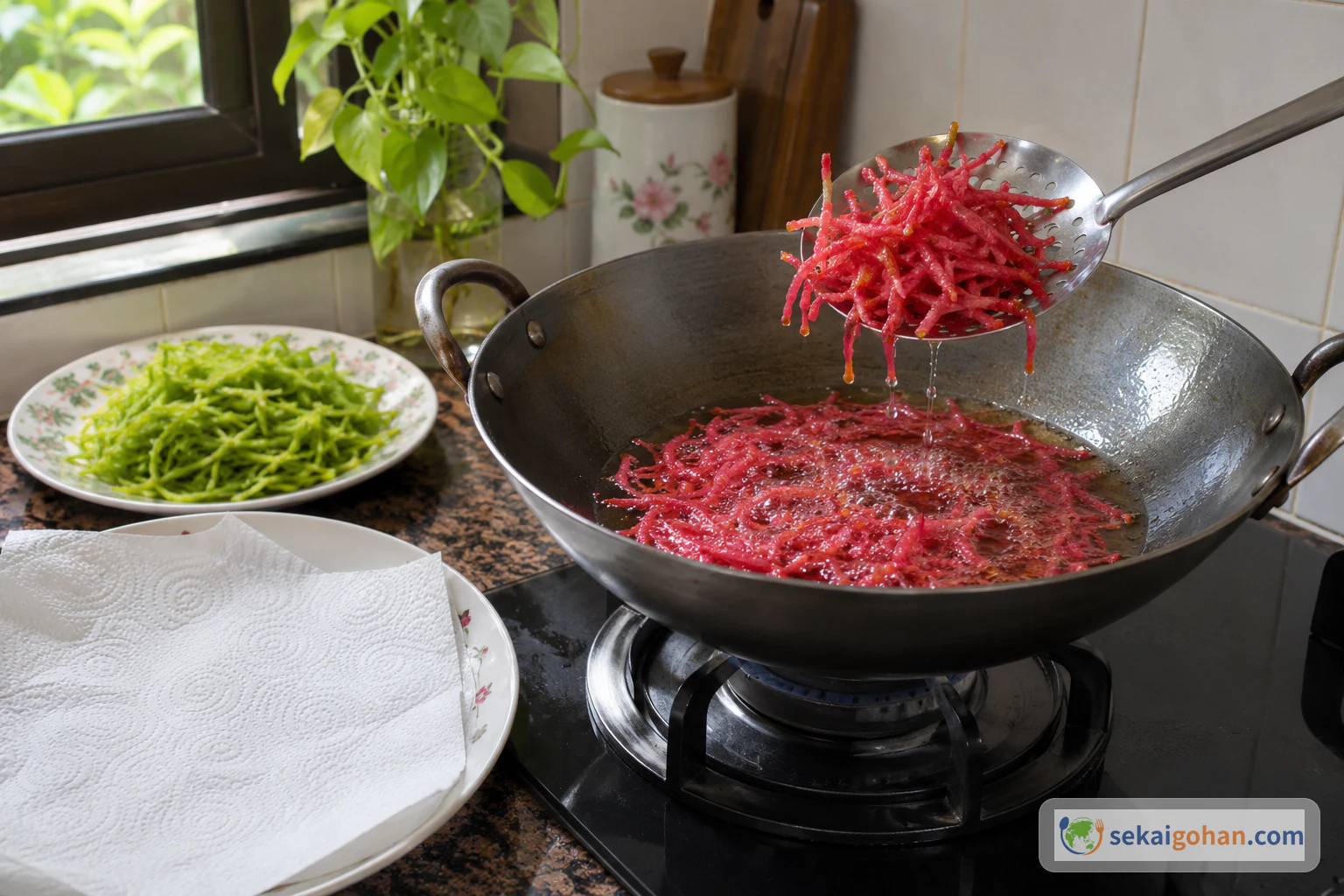
All the work happens before anyone sits down. Cut the vegetables first, then color the taro so it has time to dry while you mix the sauce and portion the toppings. Frying takes only minutes. Plate everything just before serving, and keep the salmon on its own plate until the toss.
The fried taro should come out puffed and tender-crisp, still showing its pink and green. If it browns and turns hard like potato chips, the oil was too hot or the strands stayed in too long.
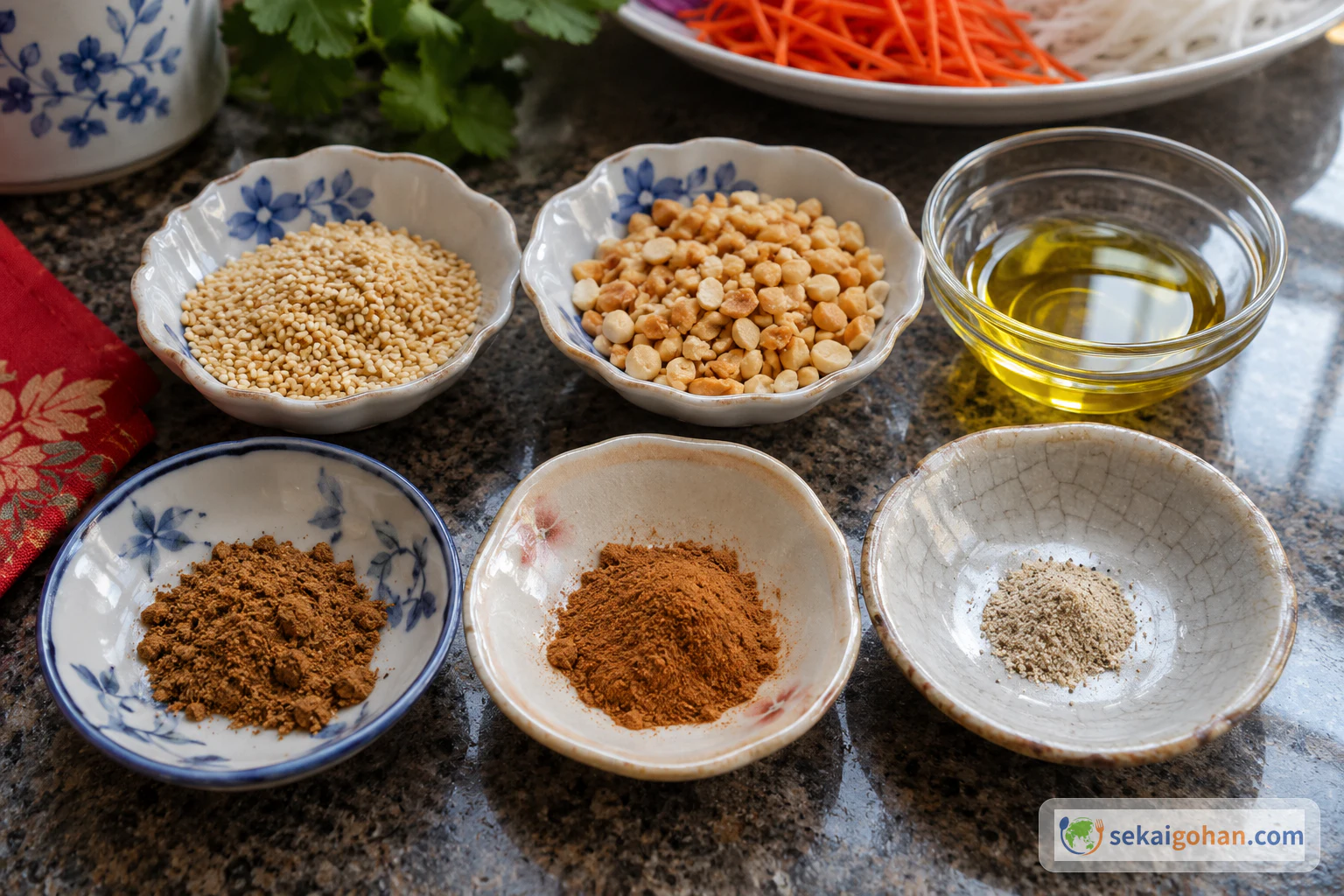
Toast the sesame in a dry pan only until it turns light tan. It goes from golden to burnt very quickly, so stay at the stove and tip the seeds onto a dish the moment they color.
When It Goes Wrong
Most problems show up at the taro or the sauce, and each one has a quick fix.
| What you see | Why | What to do |
|---|---|---|
| Hands itch after handling taro | Raw taro irritates bare skin | Wear gloves for shredding and coloring, and wash your hands well afterward |
| Taro comes out brown and hard like chips | Oil too hot, or fried too long | Turn the heat down to medium and lift the strands out after about 3 minutes, while still pale |
| Dressing clings in thick blobs | Plum sauce too dense | Stir in more hot water a little at a time until it drips in a ribbon |
| Vegetables clump and drop off the chopsticks | Strands cut too thick or short | Use a julienne peeler or mandoline and cut along the full length of the vegetable |
| Puddle of water under the cucumber | Watery seed core | Julienne around the seeds and leave the core out |
| Sesame tastes bitter | Toasted too dark | Toast a fresh batch only until light tan and take it off the heat at once |
Serving, Variations and Making Ahead
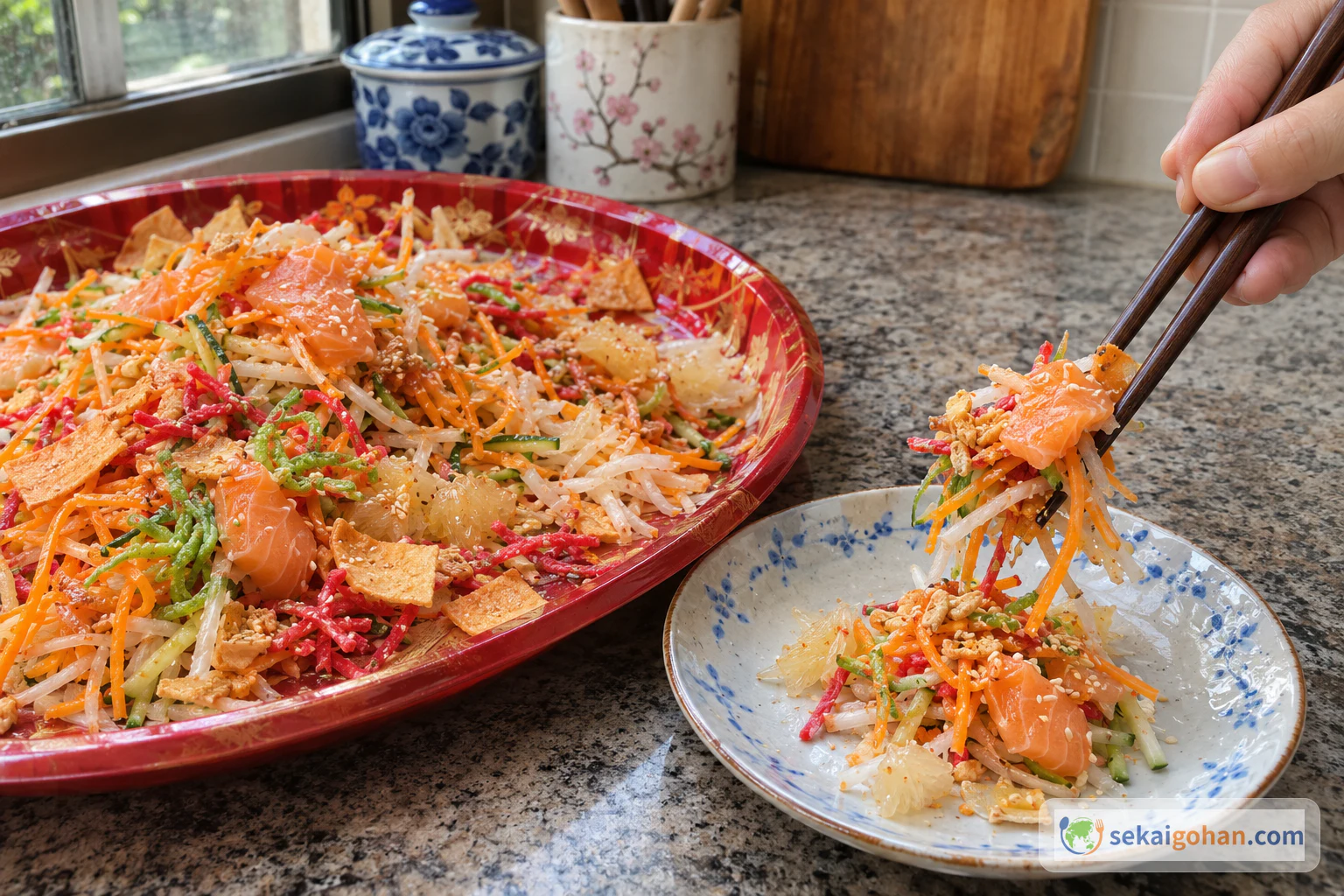
Yusheng belongs to New Year gatherings, at home, at work and in restaurants, all through the fifteen days of the festival. The toss is the moment the table comes together. After it, everyone picks from the shared platter onto small plates. One platter for two scales up by doubling or tripling, and a bigger group simply crowds closer around a larger plate.
Variations
- Smoked salmon or abalone instead of sashimi. This suits tables that would rather not eat raw salmon. Lay smoked salmon slices slightly overlapping and roll them into a rose for the center of the platter.
- Creamy plum mayo dressing. Mix 1 tbsp hot water, 1 tbsp granulated sugar, 2 tbsp plum sauce, 2 tbsp Kewpie mayonnaise, 1 tbsp Thousand Island dressing and 1 tbsp sesame seeds. It coats the strands more thickly and turns the salad richer and rounder.
- No food coloring. Use strips of red and green bell pepper in place of the colored taro, or wakame salad in place of the green taro. The platter stays bright and gets a fresher, juicier bite.
- Fruit or vegetarian platter. Build the colors from fruit such as mandarin orange, grapefruit, jackfruit and mango, and leave out the fish. The toss and the wishes stay the same.
- A bed of fried rice vermicelli. Some cooks spread fried rice vermicelli under the salad and dress it with mirin, Shaoxing wine, light soy, rapeseed oil, a pinch of five-spice and a little sesame oil. It is less sweet than the plum version.
Making ahead
You can prepare most of the platter the day before. Refrigerate the plum dressing in a covered container for up to a week. Keep the julienned vegetables covered in the refrigerator. Let fried wonton skins cool completely, then store them in an airtight container at room temperature. You can spread the colored taro on a baking sheet to dry and fry it the next day.
Frequently asked questions
Is salmon the right fish for yusheng?
Yes. Salmon sashimi is the usual fish on today's platters, at home and in restaurants. Raw mackerel was the traditional choice. Whichever you use, buy saltwater fish sold for raw eating.
Can children and pregnant guests join the lo hei?
They can stand and toss with everyone, but infants, young children, pregnant people and older adults should not eat raw fish. Make a second platter with fruit, or with all the vegetables and crunch and no fish. That way everyone at the table has something to toss and eat.
Where can I find plum sauce and pok chui crackers outside Asia?
Look in Chinese or Southeast Asian grocery stores and online. They sell both, and around the New Year they often carry ready-made yusheng packs too. If the crackers are missing, fried wonton skins do the same job on the platter.
Do I have to say the phrases in Chinese?
The phrases carry the wishes, so most tables say them in Chinese, often in Cantonese. Saying a wish as each ingredient goes on is what matters. A table that speaks another language can call out the meaning in its own words.