
Behind the yellow steam, a southern Thai eatery
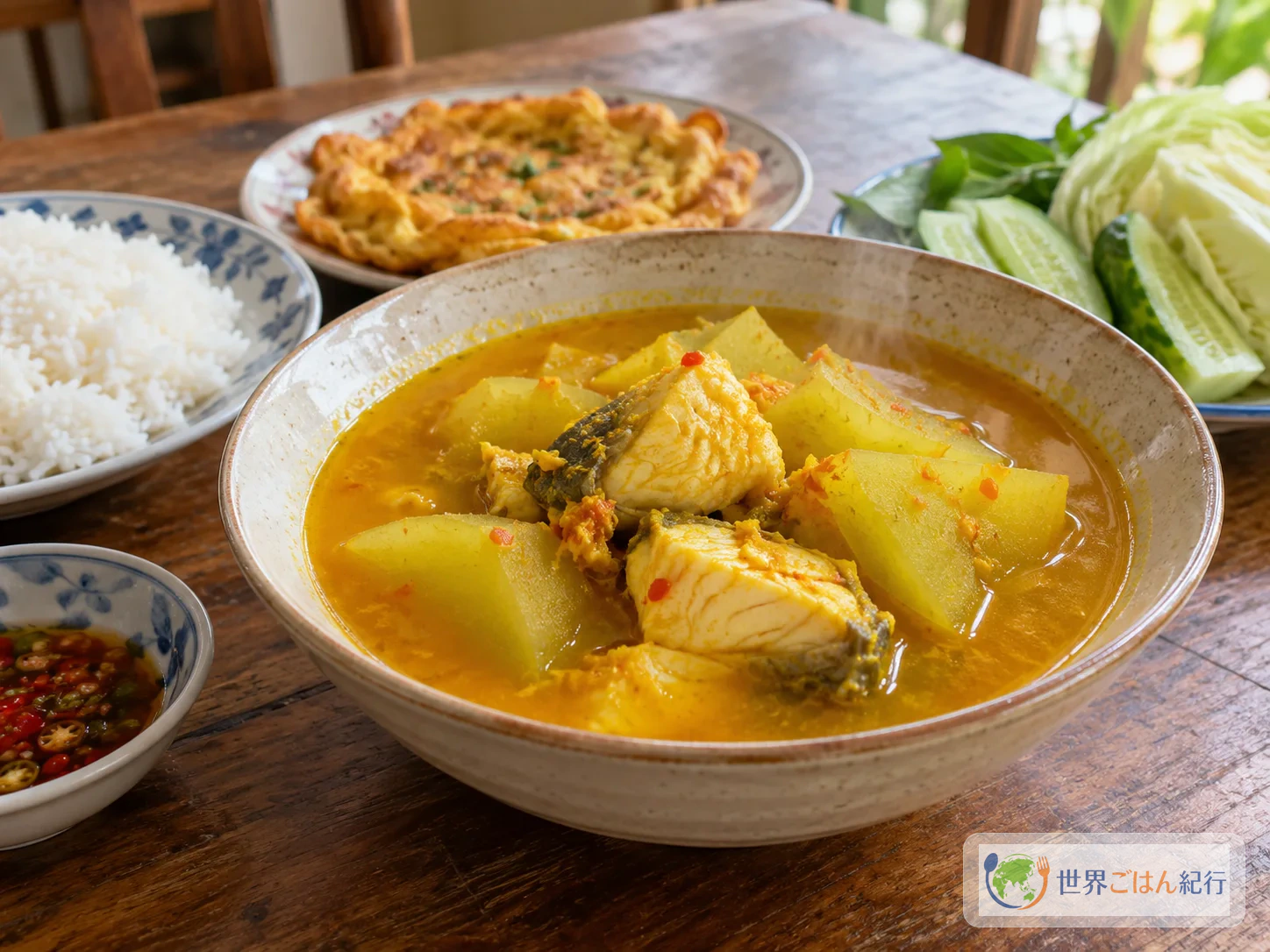
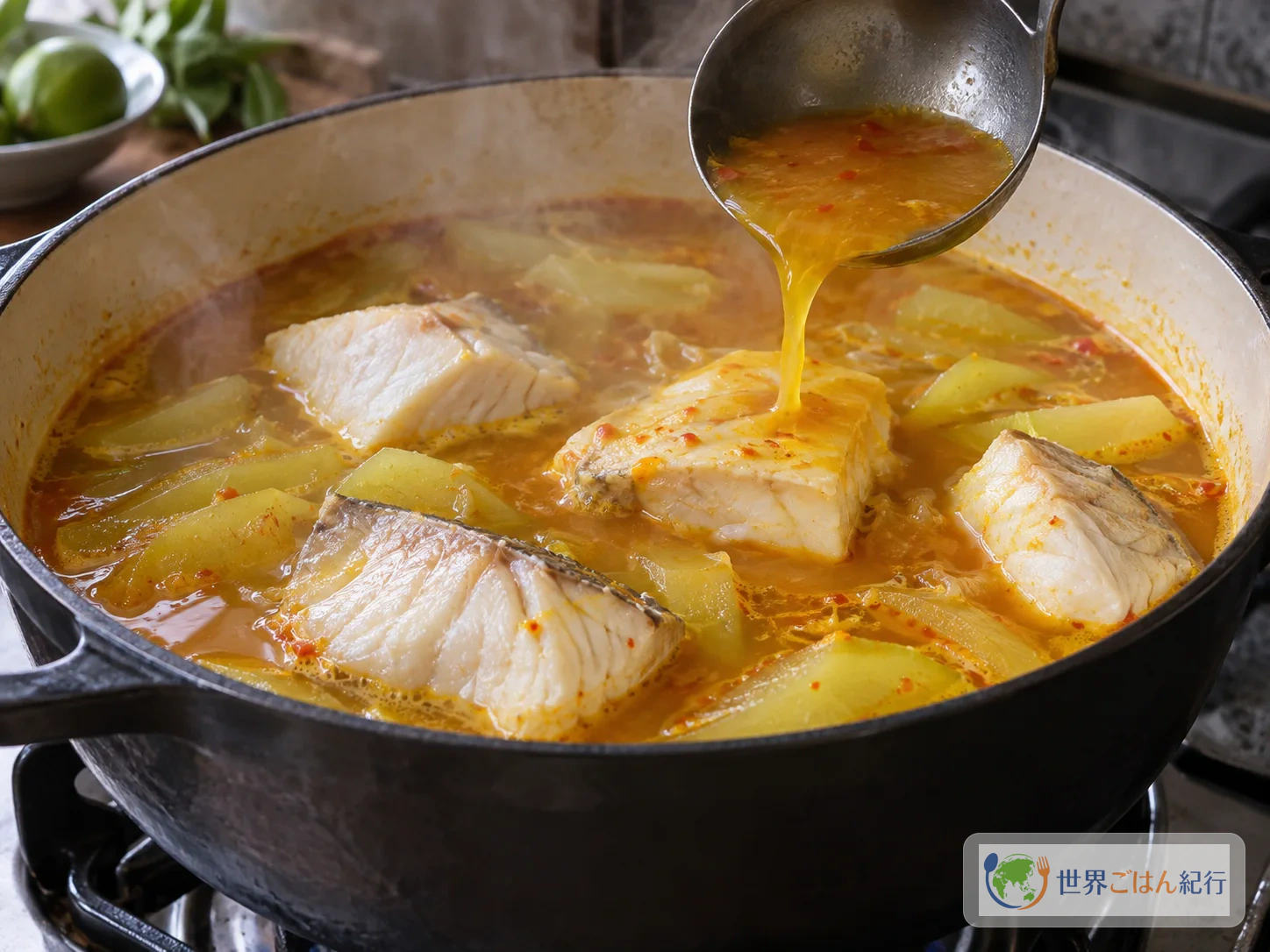
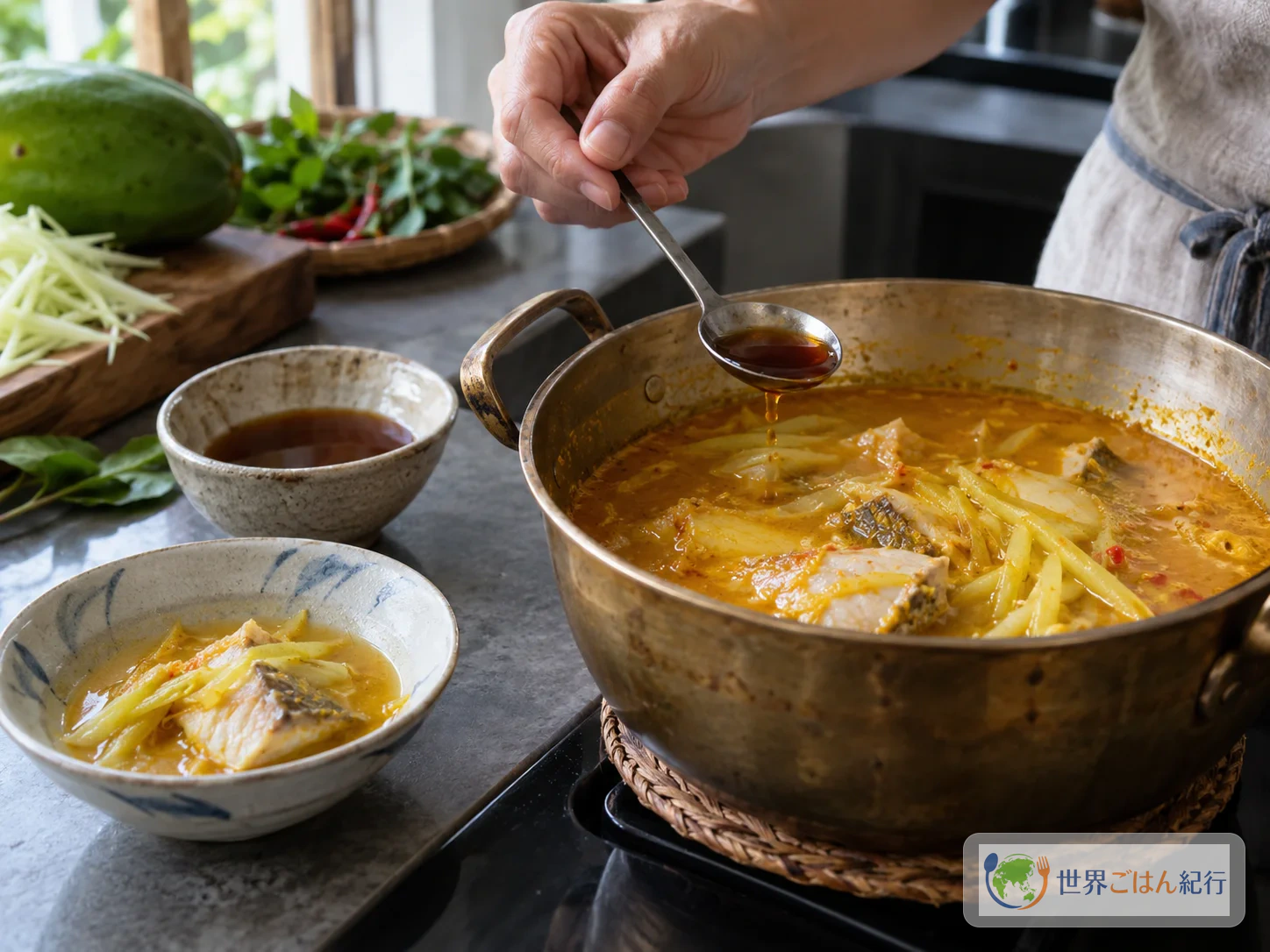
Picture the moment the lid comes off a big pot in a southern Thai eatery or at a family table. The steam rising from the pot carries turmeric, mixed with the sharp scent of chilies and sourness. Yellow broth is ladled out with fish and vegetables and set beside white rice. The color of the broth comes from turmeric, and the center of the flavor is sourness and chili heat. The things you eat are fish and vegetables.
This dish is gaeng som (แกงส้ม, gaeng som). It is made as an everyday dish in southern Thailand and served in eateries too, a sour and spicy curry closer to a soup. It is not rounded out with coconut milk. The flavor is built in layers from fish broth, shrimp paste, chilies and sourness. In a home kitchen, green papaya is the slightly tricky part. It is an unripe, hard fruit, which is a different thing from the sweet fragrance of ripe papaya. Treat it as a mild-textured vegetable close to winter melon. And this curry is a dish in which sourness takes the lead.
Four servings are built from 500 g firm white fish, 400 g green papaya, a southern-style aromatic paste and the sourness of tamarind. The name changes by region. In the south it is gaeng som, but in central Thailand, including Bangkok, this southern version is sometimes called gaeng leuang (yellow curry). There is also a reddish gaeng som in the central region, so to avoid confusion this article sticks to the southern version, yellow with turmeric and not putting sweetness in front. What matters at the finish is finishing without breaking the fish.
A sour and spicy pot that the south has kept changing, fish and vegetables alike
The Thai แกงส้ม (gaeng som) is a name for a curry, or a soup, with sourness. "Som" refers to sourness, not to the color of the dish, so it does not mean an orange dish. Because the southern version has turmeric and chilies, the broth runs from yellow to orange. Fish and vegetables are simmered together in that one pot. In short, if you remember แกงส้ม as "sour curry", you can predict the taste.
Southern Thailand is a land lying between the Indian Ocean and the Gulf of Thailand. It is also a region where seafood is easy to get. The Department of Cultural Promotion's explanation of southern cooking points to maritime trade with India, China and Java, the influence of South Indian spice culture, and closeness to Malaysian cooking. This is not, however, a story about the origin of gaeng som alone. It is better taken as background to the flavor of southern cooking as a whole. This pot sits in the kitchens of a land where sea fish and spices traveled back and forth.
The difference from central-region gaeng som is easiest to see in the order of color, taste and ingredients. Eating Thai Food treats central gaeng som as a separate line, reddish and sweeter, and distinguishes the southern version as a yellow, spicy and sour dish. In Bangkok and the central region, the southern version is sometimes called gaeng leuang (แกงเหลือง). According to public explanations of southern cooking, spicy, salty and sour tastes are preferred and sweetness is not put forward. Turmeric and shrimp paste are also used often. It is yellow, yet there is no coconut. That said, this is not the only authentic formula. It is a dish that changes form by region, by household and by the combination of fish and vegetables.
In the south, the dish is called แกงส้ม (gaeng som). When ordering the southern version in the central region, it may be called แกงเหลือง (gaeng leuang, yellow curry). The terms "gaeng som", "gaeng leuang" and "southern Thai yellow curry" can refer to the same southern dish depending on context, but do not treat the red gaeng som of the central region as the same thing.
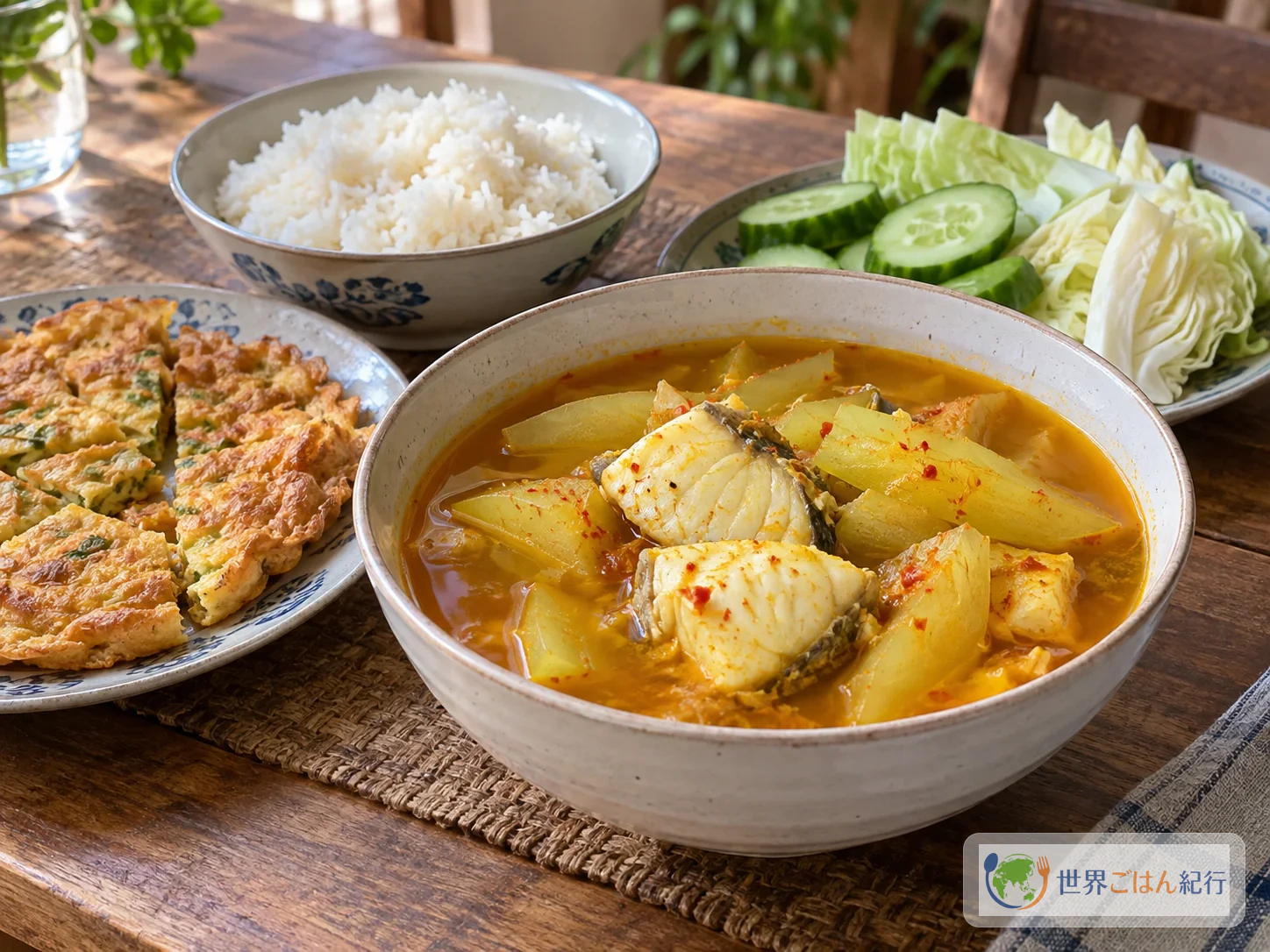
Southern gaeng som is described as a standard dish kept ready in southern eateries and also cooked at home. The Thai table has the idea of pairing rice with side dishes, kap khao / samrap. Within that, gaeng som plays the role of a main dish that lets the rice soak up the broth. Local Thai recipe sources describe eating it with white rice, a Thai omelet and other southern curries.
The ingredients are not fixed. Green papaya, taro stems, palm shoots, bamboo shoots, pineapple, water spinach and the flowers of Cochlospermum are among the candidates. It is often made with one kind of vegetable, but there are examples that combine several. With pineapple the broth turns sweeter, and with green papaya the heat and sourness come forward. For the souring ingredient, some households use lime while other methods use tamarind. This article centers on tamarind, which is easy to find. If you think of the fish and vegetables as changing with season and market, you grasp the freedom of this pot.
Ingredients (serves 4)
This quantity is designed as a main dish for four to eat with rice, with plenty of broth. The sourness comes from diluted tamarind paste, and you adjust the amount at the end, depending on the concentration of the product and whether it is sweetened. The center of gravity you aim for is not sweetness. It is the aroma of turmeric, the heat of chili, the saltiness of shrimp paste and the sourness of tamarind. Do not round it out with sweetness; draw the outline with sourness, and you get a pot that feels southern.
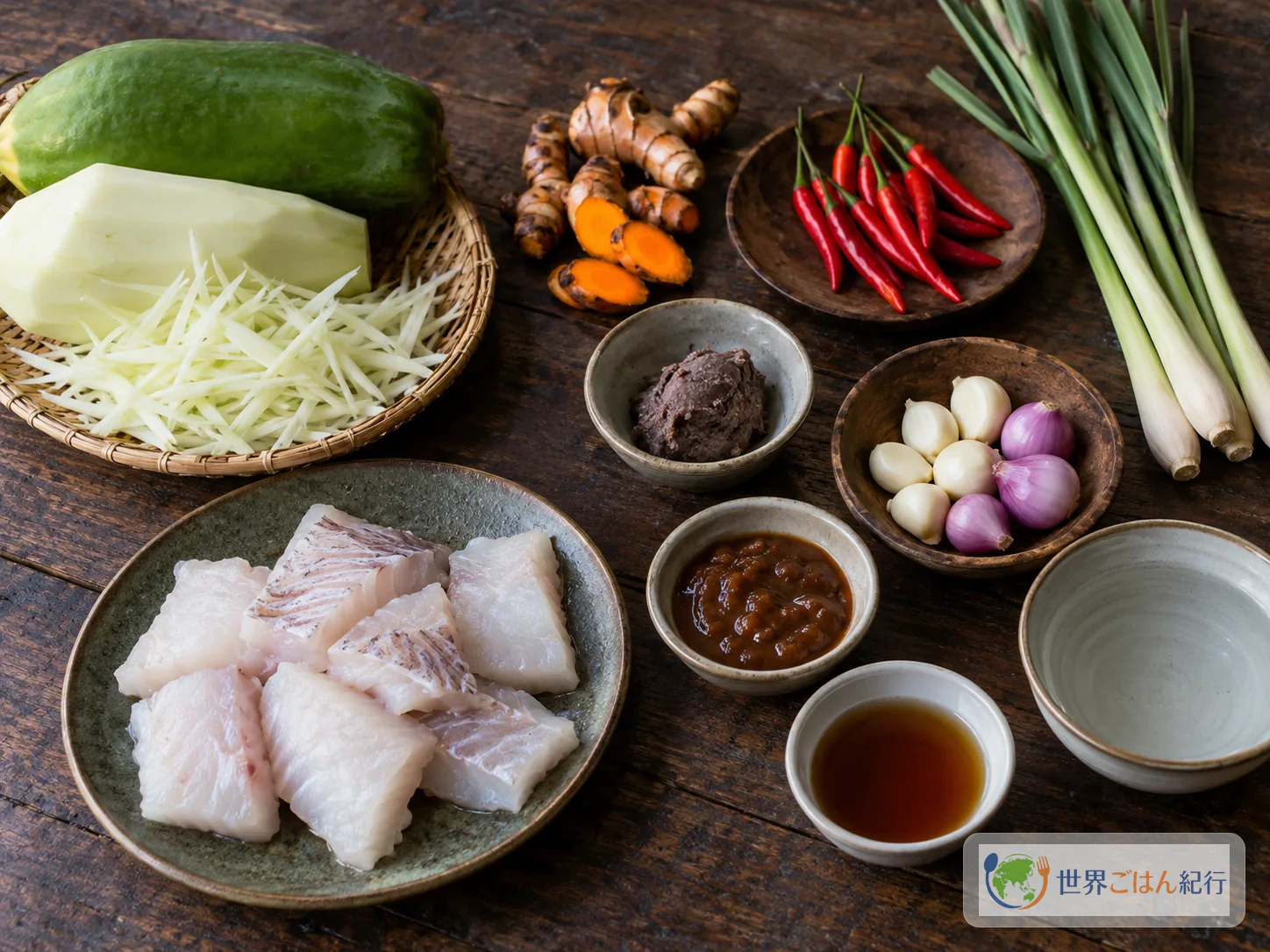
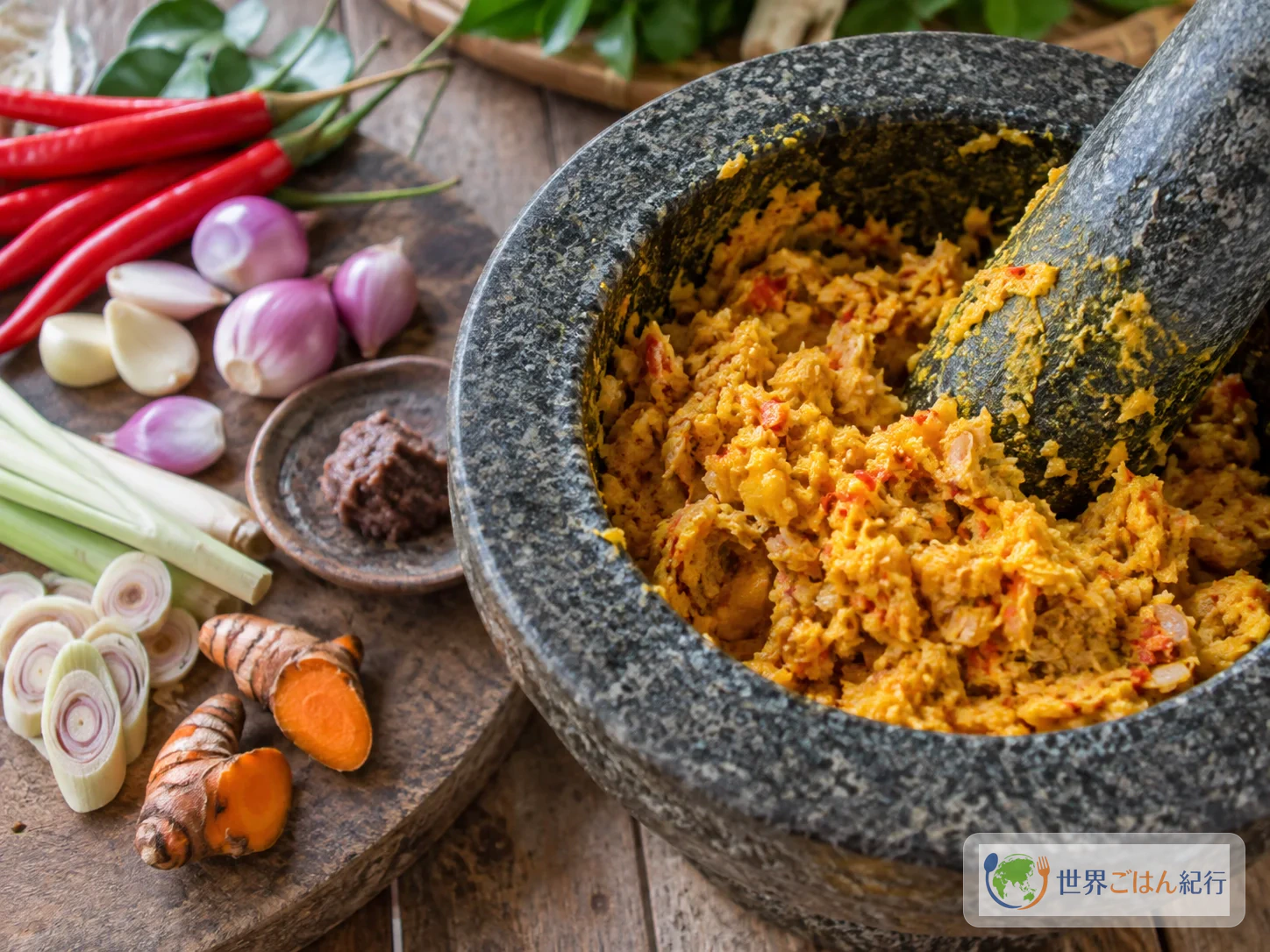
Tamarind paste differs by product in concentration, in whether it is sweetened and in saltiness. Do not put the whole amount in the pot from the start; dilute it and taste a little at a time. Using unsweetened tamarind a little at a time is the basic rule that runs from shopping through finishing. Fresh turmeric brings not only yellow but a scent reminiscent of mustard. Powder is a way in to the recipe, but it does not give the same aroma.
Shrimp paste contains crustaceans. Check the ingredient label, and do not use it for anyone who needs to avoid crustaceans. Just as you check the shrimp paste label, check the fish sauce as well, since it is a fish-derived seasoning. Turmeric can stain blenders, cutting boards and cloth yellow to orange. Do not use tools in which the color would be a problem. Do not leave raw fish at room temperature after buying it, keep its juices away from other foods eaten raw, and cook it through to the center.
How far to move toward the original in your own kitchen
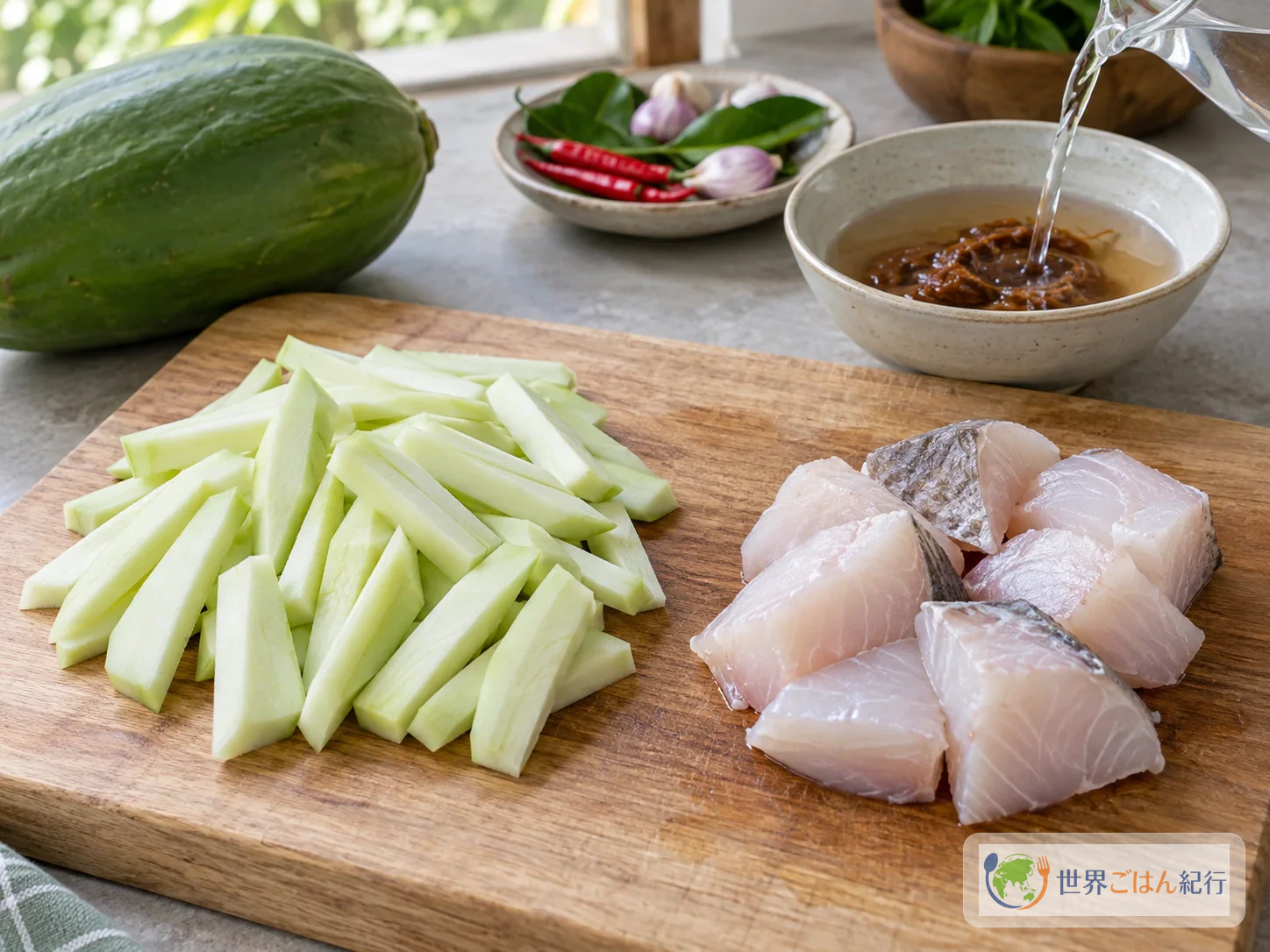
Fresh turmeric, green papaya and small Thai chilies are the ingredients that bring you closer to the original flavor. Outside Southeast Asia, though, shelf space for them is limited in an ordinary supermarket. For the fish, keep the idea of the sea fish used in southern recipes and replace it with firm white fish such as sea bass, cod or sea bream. Do not use ripe papaya in place of green papaya. Daikon moves toward bite and a peppery note, and winter melon toward a mild texture, but both differ from the faint sweetness and hardness of green papaya. Even when you substitute, do not turn to ripe papaya. Do not give way on this one point.
| Ingredient closer to the original | Choice elsewhere | Difference in the result |
|---|---|---|
| Fresh turmeric | Fresh rhizome; if none, turmeric powder | The yellow is kept, but the green, earthy aroma and pungency of the fresh rhizome weaken |
| Green papaya | Daikon or winter melon | Daikon gives crispness and a peppery bite, winter melon a soft, broth-soaking quality. Ripe papaya is much sweeter and makes a different dish |
| Small chilies of the prik kee nu type | Red chilies, adjusted by quantity | The way the heat stands up and the green aroma change. Start with less and keep it open to additions |
| Sea fish fillets | Sea bass, cod, sea bream | Fat content and firmness differ. Thin fillets break up easily when simmered, so cut them thick |
| Tamarind | Lime juice | Tamarind gives a rounded fruity note, lime a sharp aroma. Both are used in the south, each in its place |
The three points to hold first are thinning the aromatic paste with water so it coats the fish and vegetables, not adding coconut milk, and adjusting the sourness last. The fish and green papaya can be replaced with what you can get. But if you add ripe papaya, coconut milk or sugar, the outline of the yellow southern version changes. If you switch to lime, do not convert it to the same quantity as tamarind; add it a little at a time after turning off the heat. What you protect is the order and the center of flavor.
Method
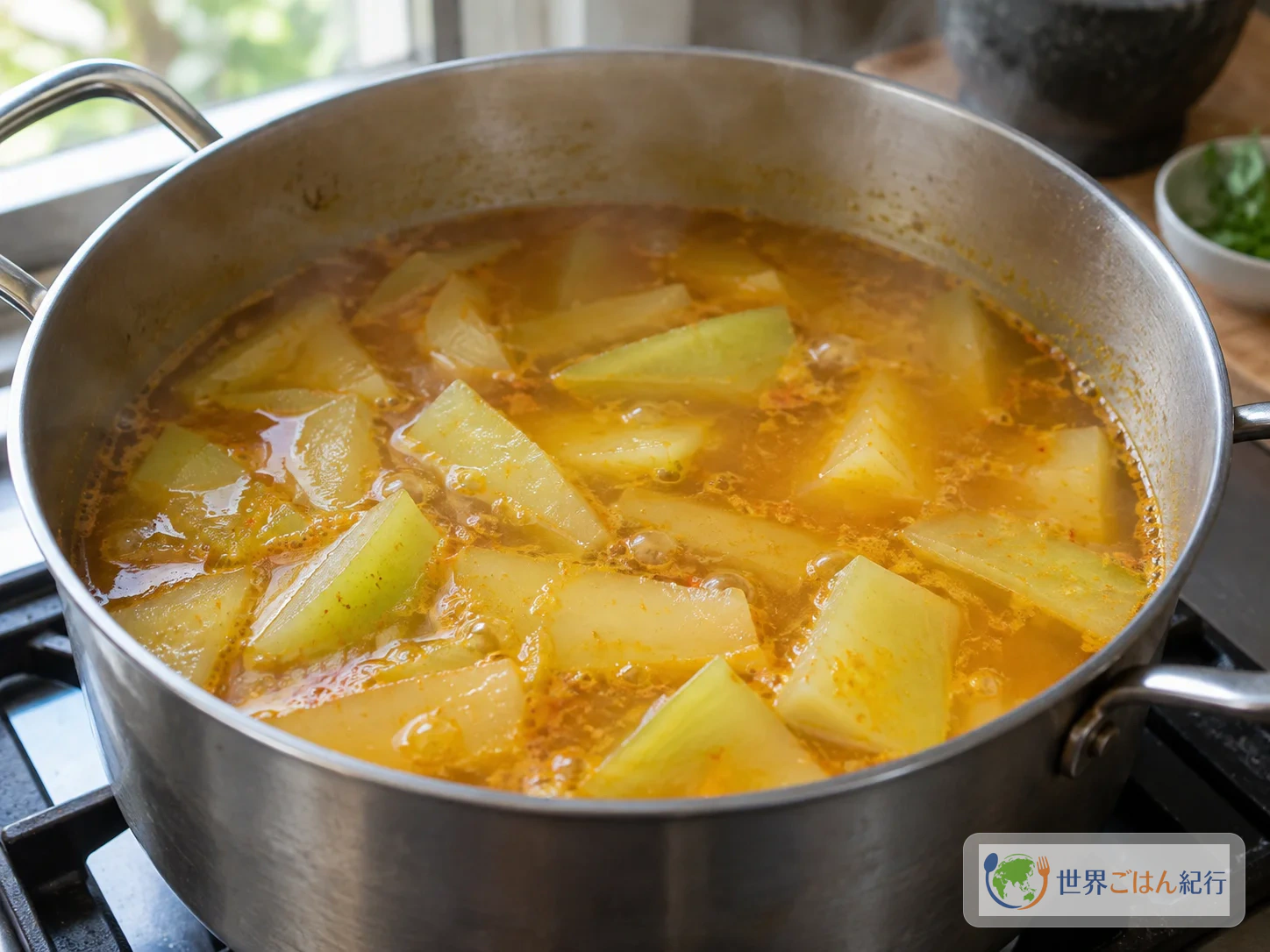
As a guide, prep takes 35 minutes and cooking 25. Times shift with the thickness of the fish and the hardness of the green papaya. Make the aromatic paste uniform first, simmer the vegetables first, and cook the fish briefly at the end. Adjust the sourness in two stages, partway through simmering and after turning off the heat, because boiling it continuously drives off the aroma. Remember: fish last, sourness in two stages.
What to watch in the pot is the green papaya. It turns translucent and a bamboo skewer slides lightly to the center, yet it has not fallen apart. That state is the signal to add the fish. Aim for translucent, with corners still there. The broth can stay a light, soupy liquid. Do not reduce it to a curry-like thickness.
Do not reuse the knife and cutting board that handled fish for the green papaya or the raw side vegetables without washing them first. The point is keeping fish juices off raw vegetables. Even if you leave out the shrimp paste, fish sauce is fish-derived, so check the ingredient label. Anyone who needs to avoid crustaceans should not use shrimp paste. Even with a substitute, the flavor will not match the southern version. Do not touch your eyes or mucous membranes with hands that have handled chilies. If a pot has turned too hot, thin it with water and adjust toward eating it with rice, eggs and raw vegetables.
Gathering the southern Thai aroma by shopping
Fish, rice, garlic, onion, daikon and eggs are covered by a neighborhood supermarket. What is worth looking for at an Asian grocery or online are the ingredients that form the axis of flavor: tamarind, shrimp paste, turmeric and lemongrass. Look for only the flavor axis. When you search, use the plain names "tamarind", "shrimp paste", "turmeric" and "lemongrass". You do not need to be particular about brand, size or model number. On the label, check whether the tamarind is unsweetened, whether the shrimp paste contains seafood ingredients, and whether the fresh turmeric is refrigerated or frozen.
In the pot, each has a clear role. Tamarind adjusts sourness, shrimp paste gives saltiness and umami, turmeric gives color and aroma, and lemongrass carries the green aroma of the aromatic paste. Fish sauce makes up, at the end, for saltiness that shrimp paste alone does not supply. Differences in saltiness between products are absorbed by tasting. You do not need to buy extra ordinary pots, pans, a general-purpose blender or common fresh produce for this. Just add aroma and sourness to your shopping, and you get closer to a southern Thai kitchen.
Leftover specialty ingredients can go to other dishes on this site. Tamarind works in pad Thai and in northern Thailand's gaeng hung lay, and lemongrass in tom yum goong. Keep shrimp paste sealed and refrigerated to prevent the smell from spreading. Fresh turmeric can be frozen in thin slices, but follow the product's label. Carrying one shopping trip into the next pot wastes nothing.
Placed on a southern Thai table, the heat of the pot changes
At a southern Thai table, there is a way of eating in which spicy, salty dishes come with raw and seasonal vegetables. They are there to rest the palate from the heat with each bite. The Department of Cultural Promotion explains the southern side vegetables as phak nao / phak kret. It lists both ordinary vegetables such as cucumber, long beans and eggplant and vegetables typical of the south. Side vegetables are an escape from the heat. Gaeng som can be ladled over white rice or taken into a small bowl. It is also served with egg dishes and other southern side dishes.
Thai samrap / kap khao is the idea of a table that combines rice with several dishes. Gaeng som is placed as one dish among them. Thailand Foundation explains the idea of pairing a strongly flavored dish with dishes of another taste to balance the whole table. If you make one pot your main dish, try adding a Thai-style omelet, raw vegetables and chilled cucumber. It makes it easier to reproduce the role the side dishes play in the southern way of eating. Loosen the strength of one pot across the whole table.
For southern sourness there are several options: tamarind, lime, sourness from sugar palm, and sour fruits. Because the fish, vegetables and souring ingredient change, the color and aroma of the pot are not fixed to one thing even within gaeng som. This article chose tamarind, which is easy to get, and that does not conflict with lime-centered home versions.
Change the fish and vegetables and you get a different gaeng som
The variations shown here are not for making it more luxurious by adding ingredients. They read the same sour and spicy broth differently through combinations of fish, vegetables and sourness. Try them with the aim of reading the outline of flavor through a single vegetable.
| Variation | Main ingredients | Difference in result and process |
|---|---|---|
| Green papaya and white fish | The base recipe | Centered on the mild crispness of green papaya and the sourness of tamarind |
| Pickled bamboo shoots and fish | About 500 g pickled bamboo shoots | Strong in salt and sourness, so rinse well and parboil, and adjust tamarind and salt from small amounts |
| Pineapple and fish | Fresh or unsweetened pineapple | Sweetness comes out, so make the tamarind a little stronger and do not add sugar |
| Taro stems and fish | Taro stems | Keep the fibrous texture. Use prepared ones and simmer longer than green papaya |
| Palm shoots and fish | Palm shoots, boiled and packed | Make use of their mild crispness, and add at the same time as the fish or after to avoid breaking up |
| Shrimp and firm vegetables | Shrimp, green beans, cauliflower, cabbage | Shrimp cook quickly, so simmer the firm vegetables first and add the shrimp at the end |
Green papaya has little sweetness, so heat and sourness stand out. Pineapple is an ingredient that adds sweetness, and since the sweetness moves into the broth, the impression of flavor changes even at the same quantity. Putting in several ingredients adds texture, but it can drift away from the outline common in southern homes and eateries, where one vegetable takes the lead. If you switch to shrimp, the cooking time is shorter, so do not mechanically apply the same 7–8 minutes as for fish.
Add coconut milk, heavy sugar or a red store-bought curry roux, and the dish moves toward a different curry, not southern gaeng som. Even when you change the ingredients, keep four things: the aromatic paste, the sourness, the umami of seafood and a thin, light broth. Keeping the light broth holds the outline of the southern version.
Rescuing a pot that went wrong
Once fish has broken up, it cannot be put back in shape. Treat it as a soup to spoon over rice together with the broth, and do not stir it again. Many flavor problems, on the other hand, can be recovered. Separate the flavors you can restore from the textures you cannot, and you see where the pot stands. Too sour, too salty, too spicy, aromatics coarse, broth thin. These five states are sorted in the table.
| State | What to do first | How to restore it at the finish |
|---|---|---|
| The sourness is too sharp | Take a little broth aside with the heat off | Dilute by adding 50 ml of water at a time, then recheck the saltiness. Hiding it with sweetness is a last resort |
| Too salty | Without moving the fish, check only the broth | Add a little water or unsalted broth and combine with green papaya and rice. Do not add more fish sauce |
| Too spicy | Remove the chilies only if you can take them out | Serve with rice, eggs and cucumber, and ladle less broth. Do not erase the flavor by adding a lot of plain water to the pot |
| Aromatics coarse and raw-tasting | Suspect that grains of paste remain and cooking was too short | If the fish is not in yet, simmer 3–5 minutes over medium-low heat. After the fish is in, keep extra cooking short so the flesh does not break |
| Broth is thin | Check whether too much water was added, and whether sourness and salt are there | Dissolve a little paste in some of the broth taken aside, return it to the pot and simmer briefly. Adding only powdered spices is unlikely to give body |
Taste in the order of sourness, heat, saltiness. Right after adding sourness, take care not to add too much salt. If the green papaya has become too soft, do not stir the pot; gently scoop out the broth and fish. Serve any ingredient whose texture has held on the side. The habit of tasting only the broth before adding anything can save the pot.
Storage and reheating
As a rule, finish it the day you make it. If you keep leftovers, store the rice and gaeng som separately. Japan's Ministry of Agriculture, Forestry and Fisheries advises not leaving stews in the pot, cooling them quickly, dividing them into shallow containers, and refrigerating or freezing them promptly. It also asks that refrigerated food be eaten as soon as possible. Do not leave a pot containing fish at room temperature in one large mass. Do not let it cool in the pot; divide it and chill it quickly. When eating, stir gently from the bottom only the portion you will eat, and reheat it thoroughly to the center. Long reheating breaks up the fish and green papaya, so reheat only the amount you need.
The Ministry of Agriculture, Forestry and Fisheries cautions that the quantity of food-poisoning bacteria cannot be judged by smell, color or taste alone. Do not decide safety by smell alone. Discard anything left at room temperature for a long time, anything whose storage state is unknown, and anything that seems off when the container is opened, without tasting to check.
FAQ
Are gaeng som and gaeng leuang the same dish?
In the south it is called แกงส้ม (gaeng som). In the central region and Bangkok, the southern version is sometimes called แกงเหลือง (gaeng leuang). But do not assume the red gaeng som of the central region tastes the same; check the region and the ingredients.
Can I use lime instead of tamarind?
Yes. Southern methods include ones using lime and ones using sour tamarind. Tamarind gives a rounded fruity note and lime a sharp aroma, so do not convert to the same quantity; add it a little at a time after turning off the heat. Do not keep lime juice at a boil.
What can I use if I cannot find green papaya?
Daikon gives crispness and a light peppery bite, and winter melon a mild, broth-soaking softness. Neither is the same as green papaya, but both can fill its role in the pot. Ripe papaya is sweet and strongly aromatic, so it is not used as a substitute in this southern version. Pickled bamboo shoots, taro stems and pineapple can also be chosen as ingredients used by region and household.
What if I dislike or cannot eat shrimp paste?
If you must avoid crustaceans, do not use shrimp paste, and check the ingredient labels as well. Leaving it out weakens the core of saltiness and umami. Adding fish sauce or miso will not give the same taste as the southern version, and fish sauce is fish-derived. Do not take a substitute made to avoid a reaction as a guarantee of safety.
Can I fix it in the pot when it is too spicy?
Diluting with water alone also dilutes the flavor. Serve it with rice, eggs, cucumber and cabbage, and ladle less broth. Next time, start with half the chilies in the paste and leave room to add more when you taste at the end. Fresh chilies do not lose all their heat even with the seeds removed.
Can I make it with frozen fish?
Local recipe sources say it can be made with frozen fish if the flesh is firm. Pat off the water from thawing, cut thick fillet pieces, and add them after the broth has come back to a boil. Check that the flesh has turned white to the center and flakes, and do not simmer it long enough to toughen.
Does the flavor settle if I eat it the next day?
The next day, the sourness and heat may mellow. The texture of the fish and vegetables, however, breaks up more easily than when freshly made. Do not leave the pot at room temperature for making ahead; divide it into shallow containers, chill it quickly, and eat refrigerated food as soon as possible. Reheat only the portion you will eat, thoroughly, and do not judge whether anything is off by smell.
Sources
- Department of Cultural Promotion, Ministry of Culture, Thailand「มรดกวัฒนธรรมภาคใต้ “อาหารพื้นบ้าน”」https://www.culture.go.th/culture_th/ewt_news.php?filename=in&nid=6459 (accessed and checked 2 October 2026)
- Thailand.go.th, Public Relations Department「Featured food of each region」https://thailand.go.th/issue-focus-detail/009-013?hl=en (created 17 January 2023, accessed and checked 2 October 2026)
- Thailand Foundation「Thai Food」https://thailandfoundation.or.th/th/thai-food-opening/ (published 22 May 2025, accessed and checked 2 October 2026)
- Eating Thai Food, Mark Wiens「Southern Thai Gaeng Som Recipe (Sour Spicy Fish Curry)」https://www.eatingthaifood.com/thai-gaeng-som-recipe/ (accessed and checked 2 October 2026)
- Thai SELECT / Office of the Permanent Secretary, Ministry of Commerce, Thailand「Thai SELECT Cookbook」https://www.ops.go.th/en/data-store/archive-documents/download/4/5638/16?method=view (accessed and checked 2 October 2026)
- TrueID Food「สูตรทำ แกงเหลือง ปลากะพงหน่อไม้ดอง แกงส้มใต้ จัดจ้านฉบับคนใต้แท้ !」https://food.trueid.net/detail/lDXwmdRbqy6K (published 1 November 2022, accessed and checked 2 October 2026)
- Ministry of Agriculture, Forestry and Fisheries of Japan「冷蔵庫のかしこい使い方~冷蔵庫を活用した食品の保存~」https://www.maff.go.jp/j/syouan/seisaku/foodpoisoning/frige.html (accessed and checked 2 October 2026)
Related articles
Summary
Gaeng som is a sour and spicy curry of fish and vegetables from southern Thailand. In the central region, the southern version is sometimes called gaeng leuang. Built on turmeric, shrimp paste, chilies and tamarind, it is not rounded out sweetly with coconut milk. Simmer the green papaya first until it is translucent, do not stir once the fish is in, and set the sourness after turning off the heat. Ladle the yellow broth over the rice. That is how this pot is eaten.
Wherever you cook it, if you can get fresh turmeric and green papaya, put aroma and texture first. If not, replace them with turmeric powder and daikon or winter melon. Tamarind and lime lean in different directions of sourness, so choose according to what you can buy and what you like, and adjust the concentration of the product by tasting. If there are leftovers, do not leave them in the pot; divide, chill, and eat as soon as possible. Even when you substitute, keep the outline of sourness and heat. If you manage that, it is a southern Thai pot even in your own kitchen.



